第二曲线

Search documents
液态奶不赚钱,伊利忙着卖奶粉奶酪,蒙牛弄“保健品”?
3 6 Ke· 2025-12-18 11:45
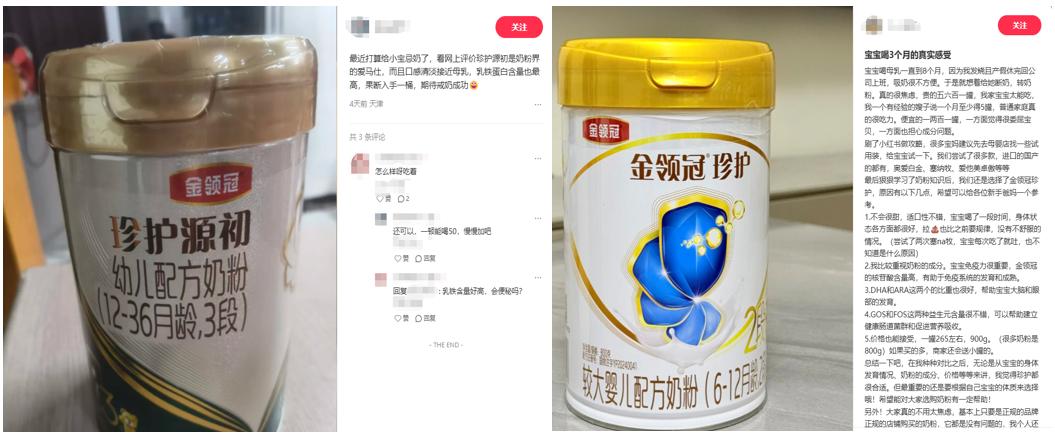
Core Insights - The liquid milk market is facing challenges due to oversupply of traditional products and insufficient supply of specialty products, with leading companies like Yili and Mengniu maintaining dominance through channel and scale advantages [1] - The sales growth of liquid milk is slowing down, with leading companies shifting focus towards higher value-added products such as cheese, milk powder, and ice cream [1][2] - Yili is proactively transitioning to a second growth curve by expanding its product offerings in milk powder and cheese, while Mengniu is focusing on vertical integration in the cheese market and entering the health food sector with its probiotic drink [7][9] Group 1: Market Dynamics - The liquid milk segment, once a major revenue driver, is experiencing a decline in growth, with consumers increasingly favoring low-temperature milk for its freshness [2] - Data shows that the market share of ambient milk products is decreasing, with ambient pure milk's share down by 2.68% and sales down over 18%, while low-temperature products are gaining traction with a 1.18% increase in share and a 19.68% increase in sales [2] - Both Yili and Mengniu are feeling the pressure from the declining liquid milk market, as evidenced by their decreasing revenue proportions from this segment [2][3] Group 2: Yili's Strategy - Yili is effectively responding to market changes by increasing its focus on milk powder and cheese, with its revenue from liquid milk decreasing from 67.79% at the end of 2023 to 60.66% by Q3 2025 [4] - The company has established a comprehensive product matrix in the milk powder sector, including organic infant formula and goat milk powder, leveraging its brand influence and distribution channels [6] - Yili's proactive strategy has allowed it to maintain a relatively stable performance in a declining market, with a year-on-year revenue decrease of only 1.63% [4] Group 3: Mengniu's Approach - Mengniu has successfully established a foothold in the cheese market with its brand Miaokelando, which achieved a revenue of 1.39 billion yuan, growing by 14.22% [7] - The company is also venturing into the health food sector with its probiotic drink YouyiC, which has received health product certification, marking a significant step towards functional foods [9][12] - Mengniu's strategy involves a more vertical approach, focusing on niche markets and health-oriented products, although it faces challenges in adapting to the regulatory environment of the health food industry [12][13]



浙江省国资委:要坚持优化布局,进一步聚焦产业体系,加快开启增长“第二曲线”
Zheng Quan Shi Bao Wang· 2025-12-11 11:39
Core Viewpoint - The Zhejiang Provincial State-owned Assets Supervision and Administration Commission emphasizes the importance of focusing on the "14th Five-Year Plan" and its key requirements to enhance the core functions and competitiveness of state-owned enterprises [1] Group 1: Strategic Focus - The meeting highlights the need to implement the "4+1" important requirements and the "132" overall deployment for the upcoming year [1] - There is a call to optimize the layout and further focus on the industrial system to accelerate the initiation of the "second curve" of growth [1] Group 2: Structural Adjustment and Innovation - The significance of the "second curve" during the "14th Five-Year Plan" period is emphasized, with a focus on participating in and utilizing the capital market for structural adjustments and industrial upgrades [1] - The approach includes "adding and reducing," "horizontal and vertical progress," and "classified policies" to continuously promote the optimization and adjustment of the industrial structure of provincial enterprises [1] Group 3: Reform and Governance - The meeting stresses the importance of innovation-driven development and enhancing open cooperation to accelerate the construction of innovative state-owned enterprises [1] - There is a focus on stimulating vitality through classified governance and ensuring the implementation of key reform tasks [1] - The need for deepening supervision and enhancing effectiveness through continuous strengthening of investor supervision and penetrating regulation is also highlighted [1]
碧桂园服务单列孵化业务,执行总裁黄鹏挂帅上阵
2 1 Shi Ji Jing Ji Bao Dao· 2025-12-09 23:09
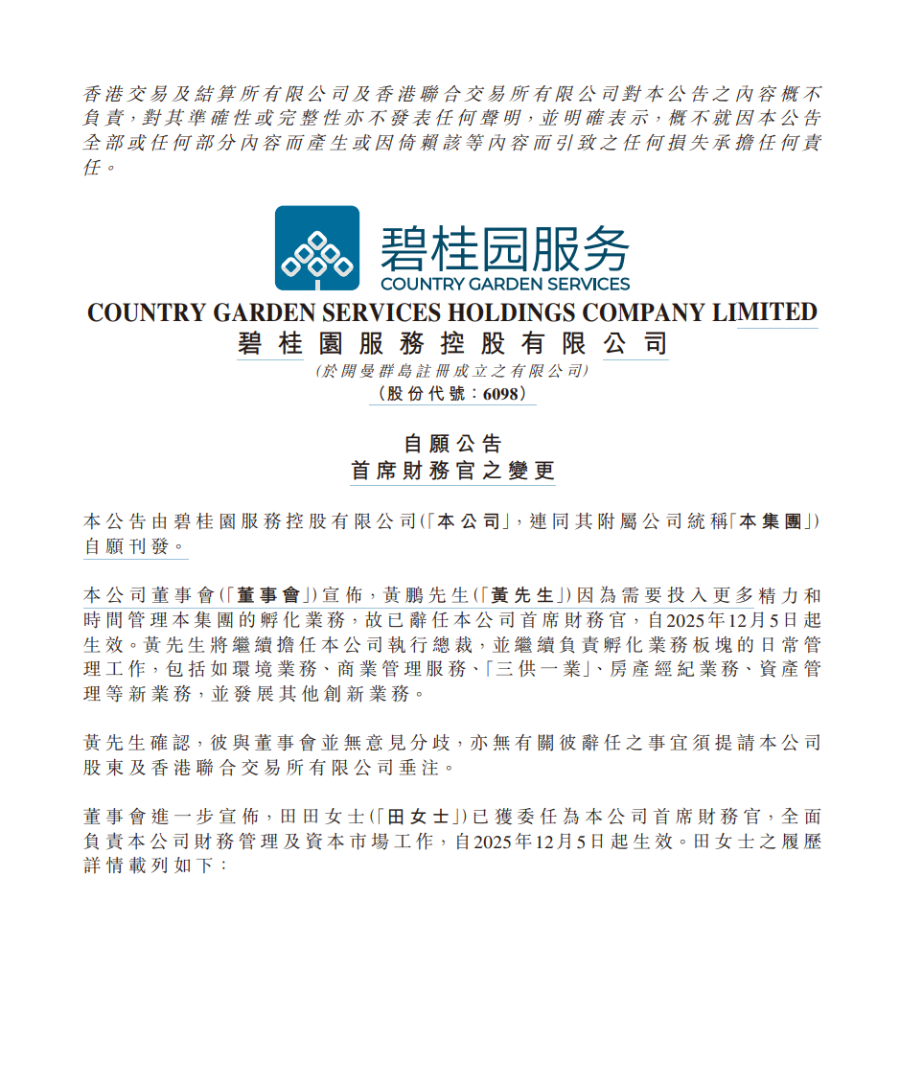
Core Viewpoint - The recent personnel changes at Country Garden Services reveal a new strategic direction, with a focus on optimizing governance and enhancing business innovation and transformation [1][3]. Group 1: Personnel Changes - Huang Peng has resigned as Chief Financial Officer (CFO) to focus on managing the group's incubation business, while Tian Tian has been appointed as the new CFO [1][2]. - Huang Peng, a veteran with the company since September 2016, will continue as Executive President and manage the incubation business [1][2]. Group 2: Organizational Restructuring - The company has reorganized its business structure into three main segments: the "Large Property Management" segment, the "Incubation Business" segment, and the "Functional Services" segment [3]. - The "Large Property Management" segment aims to enhance value creation, focus on deepening core services, and improve operational efficiency through systematic construction [3]. - The "Incubation Business" segment will focus on diverse growth opportunities, including existing independent businesses and the development of innovative services [3][5]. Group 3: Financial Performance - In the first half of the year, the core property management service revenue reached 13.61 billion yuan, a year-on-year increase of 6.7% [4]. - The total number of managed property projects reached 8,108, with a managed area of 1.06 billion square meters, of which approximately 40.2% is located in first- and second-tier cities [4]. - Community value-added service revenue was 2.1 billion yuan, reflecting a year-on-year growth of 5.3% [4]. Group 4: Business Development and Market Expansion - The "Incubation Business" segment includes environmental services, commercial management, and asset management, which are expected to have growth potential but require strong leadership to overcome current growth bottlenecks [5][6]. - In the first half of the year, the "Three Supplies and One Industry" segment signed 315 new contracts, with a total contract value of approximately 1.787 billion yuan [6]. - The company is focusing on urban service areas such as environmental management and smart operations, although revenue from urban services decreased by approximately 18% year-on-year [6]. Group 5: Market Outlook and Analyst Insights - Analysts from Dongfang Securities believe that Country Garden Services has potential in value-added services and is actively expanding community services, including partnerships in the electric vehicle charging sector [7]. - The organizational restructuring is seen as a practical response to industry challenges, aiming to solidify service foundations while allowing space for high-value innovative business incubation [7].

碧桂园服务,高管变动
21世纪经济报道· 2025-12-09 06:46
Core Viewpoint - The recent personnel changes at Country Garden Services reveal a new strategic direction for the company, focusing on optimizing its organizational structure and enhancing its business innovation and transformation capabilities [1][3]. Organizational Changes - Huang Peng has resigned as Chief Financial Officer (CFO) to focus on managing the group's incubation business, while Tian Tian has been appointed as the new CFO, responsible for financial management and capital market operations [3][6]. - The organizational restructuring includes consolidating the basic property management, new business growth, and functional service sectors into a "large property sector," while the strategic incubation business will remain distinct [6][8]. Business Performance - The core property management service revenue for the first half of the year reached 13.61 billion yuan, a year-on-year increase of 6.7%. The total number of managed properties reached 8,108, covering 31 provinces and cities in mainland China, with a managed area of 1.06 billion square meters [7]. - Community value-added service revenue was 2.1 billion yuan, reflecting a 5.3% year-on-year growth [7]. Incubation Business Focus - The incubation business, overseen by Huang Peng, includes environmental services, commercial management, and asset management, among others. This segment aims to break through growth bottlenecks and explore new business opportunities [8][9]. - The "Three Supplies and One Industry" property management service area has seen significant growth, with a revenue increase of approximately 68.5%, contributing about 17.9% to total revenue [8]. Market Expansion and Challenges - In the first half of the year, the company signed 315 new contracts in the "Three Supplies and One Industry" sector, with a total contract value of approximately 1.787 billion yuan [9]. - The urban services segment reported a revenue of approximately 1.779 billion yuan, a decline of about 18.0%, while commercial management services also experienced a drop in revenue [9]. Strategic Outlook - The restructuring aims to strengthen core capabilities and enhance organizational vitality, laying a solid foundation for long-term stable development and improved market competitiveness [10]. - Analysts believe that the adjustments will allow Country Garden Services to address common challenges in the property industry while creating space for high-value innovative business incubation [10].

碧桂园服务单列孵化业务,行政总裁黄鹏挂帅上阵
2 1 Shi Ji Jing Ji Bao Dao· 2025-12-09 00:36
Core Viewpoint - The recent personnel changes at Country Garden Services reveal a new strategic direction for the company, focusing on optimizing its organizational structure and enhancing its business innovation and transformation capabilities [3][6]. Organizational Changes - Huang Peng has resigned as Chief Financial Officer (CFO) to focus on managing the group's incubation business, while Tian Tian has been appointed as the new CFO [3][5]. - The organizational restructuring aims to unify the basic property management, new business growth, and functional service sectors into a "large property sector," while the strategic incubation business will be maintained as a separate entity [6][8]. Business Performance - The core property management service revenue for Country Garden Services reached 13.61 billion yuan, a year-on-year increase of 6.7% [7]. - The total number of managed property projects reached 8,108, covering 31 provinces and cities in mainland China, with a managed area of 1.06 billion square meters [7]. - Community value-added service revenue was 2.1 billion yuan, reflecting a year-on-year growth of 5.3% [7]. New Business Initiatives - The incubation business segment includes environmental services, commercial management, and asset management, among others, and aims to explore new growth avenues [8][9]. - The "Three Supplies and One Industry" initiative has shown significant growth, with property service management area reaching approximately 90.1 million square meters and revenue of about 4.156 billion yuan, marking a year-on-year increase of approximately 68.5% [9]. Market Expansion - In the first half of the year, Country Garden Services signed 315 new contracts under the "Three Supplies and One Industry" initiative, with a total contract value of approximately 1.787 billion yuan [10]. - The company is focusing on urban services, including environmental management and smart operations, although revenue from urban services decreased by about 18% to approximately 1.779 billion yuan [10]. Future Outlook - Analysts believe that the organizational adjustments will strengthen the company's core capabilities and stimulate organizational vitality, laying a solid foundation for long-term stable development and enhanced market competitiveness [11].
时报观察丨人形机器人站上车展C位的冷思考
Zheng Quan Shi Bao· 2025-11-24 23:18
Group 1 - Major automotive companies are increasingly venturing into the humanoid robot sector, showcasing a shift in focus from traditional automotive innovations to robotics at the 2025 Guangzhou International Auto Show [1] - Companies like GAC Group and XPeng Motors presented their humanoid robots, indicating a trend where humanoid robots are becoming a key selling point amidst a temporary lull in smart automotive technology advancements [1] - The underlying technology for smart cars and humanoid robots shares commonalities, allowing automotive companies to leverage their expertise in intelligent manufacturing and user engagement to explore new revenue streams in robotics [1] Group 2 - The commercial logic and developmental stage of humanoid robots differ significantly from that of automobiles, requiring substantial investment and a long return cycle, which could strain cash flow if pursued blindly by automotive companies [2] - The Chinese automotive industry is currently facing challenges, with an overall profit margin of only 4.5% in the first nine months, which is below the average for downstream industrial enterprises [2] - A strategic approach to humanoid robot development should be based on technological applicability and genuine market demand rather than merely chasing trends, emphasizing the need for a balance between innovation investment and financial health [2]



时报观察 人形机器人站上车展C位的冷思考
Zheng Quan Shi Bao· 2025-11-24 19:31
Core Viewpoint - The 2025 Guangzhou International Auto Show has shifted focus from automotive innovations to humanoid robots, with major automakers showcasing their advancements in robotics instead of groundbreaking automotive technologies [1] Group 1: Industry Trends - Major automakers, including GAC Group and Xpeng Motors, are entering the humanoid robot market, indicating a cross-industry trend where companies like SAIC, BYD, Changan, and Chery are also exploring this space [1] - Tesla views robotics as a key part of its future strategy, highlighting the industry's pivot towards humanoid robots [1] Group 2: Technological Synergy - The underlying technologies of robotics and smart vehicles share commonalities, such as intelligent perception, autonomous movement, route planning, and human-machine interaction, allowing automakers to leverage their existing expertise in these areas [1] - Automakers are applying their manufacturing and control capabilities from vehicle production to the development of robots, aiming to create a new revenue stream and enhance their market valuation [1] Group 3: Cautionary Insights - The business logic and developmental stage of humanoid robots differ significantly from that of automobiles, requiring substantial investment and a long return period, which could strain cash flow if not managed carefully [2] - The automotive industry is still grappling with challenges like price wars, with an overall profit margin of only 4.5% in the first nine months of the year, which is below the average for downstream industrial enterprises [2] - A strategic approach to humanoid robotics should be based on technological feasibility and genuine market demand rather than merely chasing trends, emphasizing the need for a balance between innovation investment and financial health [2]
金富科技拟跨界收购蓝原科技,业绩承压豪赌“第二曲线”破局
2 1 Shi Ji Jing Ji Bao Dao· 2025-11-24 14:32
Core Viewpoint - Company Jinfu Technology is planning to acquire at least 51% of Guangdong Lanyuan Technology Co., Ltd. to seek new growth opportunities amid declining performance in its core food and beverage packaging business [2][3][4] Financial Performance - For the first three quarters of 2025, Jinfu Technology reported revenue of 662 million yuan, a year-on-year decrease of 9.12%, and a net profit of approximately 93.44 million yuan, down 19.45% year-on-year [2] - In Q3, the company achieved revenue of 257 million yuan, a decline of 2.69% year-on-year, and a net profit of 43.83 million yuan, down 16.88% year-on-year [7] Strategic Acquisition - The acquisition of Lanyuan Technology, which specializes in cable manufacturing and new materials, represents Jinfu Technology's attempt to diversify its business and create a "second curve" for growth [2][4][9] - The acquisition is seen as a strategic move to enhance the company's profitability, risk resistance, and overall competitiveness [4][6] Industry Context - Jinfu Technology operates in a competitive food and beverage packaging industry, facing growth limitations as the beverage sector matures [6] - The company aims to expand its product offerings in the packaging sector while also exploring mergers and acquisitions to achieve external growth [4][6] Operational Challenges - The company is experiencing transitional pains due to large-scale capacity expansions, which have impacted profitability [7][8] - Environmental regulations, fluctuating raw material prices, and intensified competition are additional challenges facing the packaging industry [6][9]


做AI时代的弄潮儿|混沌创新院第10期招生开启!
混沌学园· 2025-11-21 04:07
Core Insights - The article emphasizes the transformative impact of AI across all industries and roles, highlighting the necessity for continuous evolution to find certainty in a rapidly changing environment [3][6][10]. Group 1: AI and Innovation - The article discusses the integration of AI with innovative methodologies to empower business practices, focusing on the importance of understanding innovation and its foundational principles [10][11]. - It outlines a curriculum designed to help participants navigate the AI-driven landscape, emphasizing strategic insights and practical applications for business innovation and organizational upgrades [11][12]. Group 2: Community and Collaboration - The article highlights the unique "three-teacher system" at the Chaos Innovation Institute, which fosters deep connections and collaborative learning among participants, enhancing their entrepreneurial journeys [14][18]. - It mentions the establishment of a high-quality alumni network, comprising over 2,500 entrepreneurs from various sectors, facilitating cross-industry collaboration and knowledge sharing [30][31]. Group 3: Practical Application and Results - Participants are encouraged to define their "winning battles" at the beginning of their journey, engaging in collaborative exercises to develop actionable solutions throughout their learning experience [21][22]. - Success stories are shared, illustrating how alumni have effectively applied the Chaos methodology to achieve significant business results, such as the rapid growth of AI-driven products [23][25]. Group 4: Enrollment and Opportunities - The article announces the opening of enrollment for the 10th cohort of the Chaos Innovation Institute, inviting entrepreneurs and business leaders to join and enhance their strategic capabilities in the AI era [7][36]. - It emphasizes the benefits of team participation, suggesting that collective learning accelerates organizational evolution and reduces communication costs [34][33].

月产20部,短剧能否成为华策影视“第二曲线”
Bei Jing Shang Bao· 2025-11-18 08:11
Core Viewpoint - Zhejiang Huace Film & TV Co., Ltd. is accelerating its layout in the short drama sector, aiming to transform new businesses from "trial" to "pillar" and become a new growth engine through a strategy of "scale + quality" [1][9]. Group 1: Short Drama Production and Performance - In 2023, Huace Film & TV entered a normalized production phase for short dramas, launching three series, with "My Return Has Wind" achieving over 200 million views [4]. - By 2025, the company premiered 20 short dramas, including "In the Name of Love" and "Dear Enemy," each surpassing 200 million views, with "In the Name of Love" reaching over 540 million views [4][5]. - The rapid increase in short drama production capacity has been noted, with a monthly output now at 20 dramas [1]. Group 2: Market Trends and Consumer Behavior - The user base for micro-short dramas reached 662 million by December 2024, with a usage rate of 59.7%, reflecting a 7.3 percentage point increase from the previous half-year [8]. - The shift in consumer viewing habits towards "fragmented" content consumption has made short dramas, typically under 10 minutes, well-suited for mobile platforms [8][9]. - The demand for short dramas is driven by their quick production cycle and high viewer engagement, contrasting with the longer investment and uncertain returns of traditional dramas [8][9]. Group 3: Financial Performance and Strategic Response - Huace Film & TV reported a revenue of 1.939 billion yuan in 2024, a year-on-year decrease of 14.48%, and a net profit of 243 million yuan, down 36.41% [8]. - In the third quarter of 2025, the company’s revenue fell to 251 million yuan, a 52.21% decrease, with a net profit of 57.6 million yuan, down 39.38% [8]. - The company’s strategic pivot towards short dramas is seen as a necessary response to external pressures and internal performance challenges [9][11]. Group 4: Competitive Landscape and Industry Dynamics - Other traditional film companies, such as Huayi Brothers and Shanghai Ningmeng Media, are also entering the short drama market, indicating a broader industry trend towards this format [10]. - The competition in the short drama sector is intensifying, with companies leveraging AI technology and innovative production methods to enhance content quality [10][11]. - The ability to quickly adapt to consumer preferences and deliver innovative content will be crucial for Huace Film & TV to establish short dramas as a significant revenue stream [11].