美元贬值交易

Search documents
特朗普提名沃什执掌美联储,美元回吐涨幅、美债跌幅收窄
Xin Lang Cai Jing· 2026-01-30 12:56
Core Viewpoint - President Donald Trump has officially nominated Kevin Warsh as the next Federal Reserve Chairman, a choice perceived as relatively hawkish by the market, leading to a narrowing of the dollar's gains and a steepening of the U.S. Treasury yield curve [1][4]. Group 1: Market Reactions - Following Trump's confirmation of Warsh's nomination, the Bloomberg Dollar Index's gain was reduced to 0.2%, while U.S. Treasury yields showed mixed movements, with the 2-year yield slightly declining and the 30-year yield increasing by 3 basis points [1][4]. - The probability of Warsh becoming the Federal Reserve Chairman has surpassed 90%, as indicated by betting markets, particularly after the decline in support for BlackRock executive Rick Rieder [2][5]. Group 2: Warsh's Policy Stance - Warsh is viewed as a long-time inflation hawk, having previously emphasized the risks of rising prices during the financial crisis, but he has recently advocated for lower borrowing costs, aligning with Trump's stance, which raises questions about his future policy direction [1][4]. - Analysts suggest that despite Warsh's hawkish reputation, he may seek to justify a more dovish policy stance, with futures markets still pricing in two rate cuts of 25 basis points this year [2][5]. Group 3: Federal Reserve's Balance Sheet Management - Warsh has consistently opposed maintaining a large Federal Reserve balance sheet, which is currently at $6.6 trillion, raising concerns about how he would manage this asset size and whether the Fed should continue purchasing short-term Treasuries or withdraw more market liquidity [6][8]. - The market is particularly focused on how Warsh's nomination might influence the Fed's approach to its balance sheet and overall monetary policy, especially in light of the current fiscal challenges and political pressures on the central bank [8]. Group 4: Broader Economic Context - The market is experiencing anxiety over the unpredictability of U.S. policy-making, significant fiscal deficits, and political interference in central bank policies, making Warsh's traditionalist approach a timely signal for investors [7][8]. - The recent trend of dollar depreciation, driven by bets on long-term declines in purchasing power, has led to the Bloomberg Dollar Index hitting a near four-year low, with Warsh's nomination potentially serving as a catalyst for a rebound in the dollar [8][9].
每日机构分析:1月30日
Sou Hu Cai Jing· 2026-01-30 11:42
Group 1: U.S. Economic Outlook - If Kevin Warsh is nominated as the next Federal Reserve Chair, the U.S. Treasury yield curve is expected to steepen, driven by short-term yields declining faster than long-term yields [1] - Conversely, if Rick Rieder from BlackRock is nominated, the yield curve may flatten as long-term yields decrease more rapidly than short-term yields [1] - Regardless of the nomination outcome, market reactions are anticipated to be temporary as the new chair will need to persuade other committee members [1] Group 2: Emerging Markets Performance - Developed economies are facing fiscal and policy risks, while emerging markets are experiencing strong capital inflows, continuing the trend from late 2025 [2] - Emerging market equities are projected to achieve their best monthly performance since November 2022, with UBS Global Wealth Management forecasting further gains [2] - In January, 15 out of 22 emerging market currencies in the MSCI index appreciated, and the Bloomberg Emerging Market Local Currency Government Bond Index has returned approximately 2% this year [2] Group 3: Euro and ECB Concerns - Analysts from Deutsche Bank express concerns about the European Central Bank's apprehension regarding the appreciation of the euro, which could further lower inflation [2] - ECB officials are wary of the negative effects of a strong euro and are reluctant to allow significant appreciation [2] Group 4: Gold and Precious Metals Market - Analysts indicate that gold prices surged in January, with a peak increase of nearly $1,300 per ounce, but signs of a market top are emerging [3] - As the market anticipates the appointment of a new Federal Reserve Chair, gold prices are under pressure, with a potential further decline expected [3] - The recent sharp drop in precious metals is speculated to trigger deeper corrections, as the market lacks clear catalysts for such a rapid decline [3] Group 5: Japan's Economic Forecast - Analysts from ING predict a moderate economic recovery in Japan by Q4 2025, with a projected GDP growth of 0.2% quarter-on-quarter, reversing a previous contraction [4] - Economic activity in Japan has shown signs of slowing, with retail sales in December falling more than expected and manufacturing activity likely remaining subdued [4]

估值洼地引爆买盘!土耳其股市迎1997年以来最强1月
Jin Shi Shu Ju· 2026-01-29 09:49
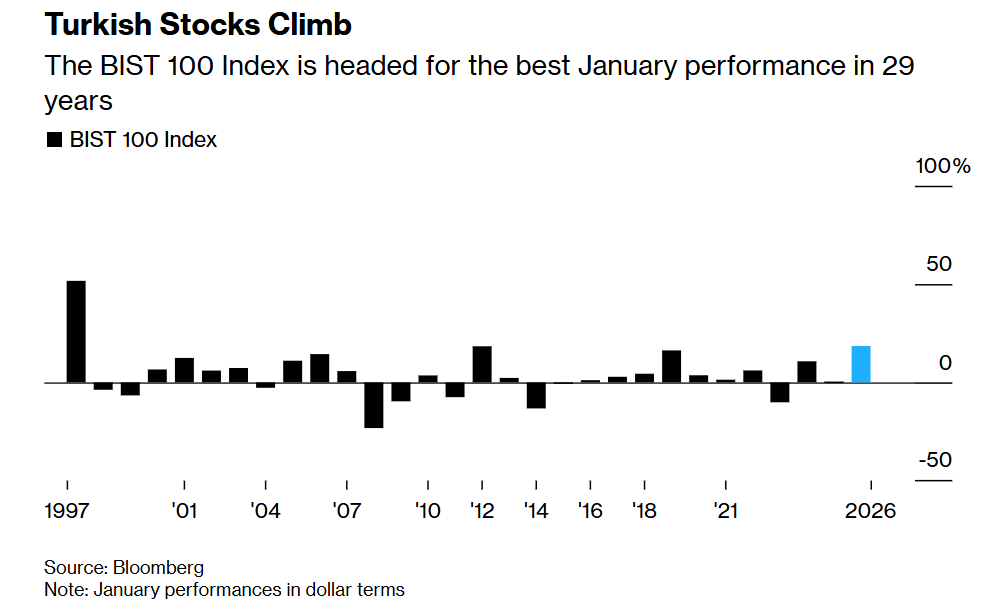
AI播客:换个方式听新闻 下载mp3 伊斯坦布尔100指数有望创下29年来最佳的1月表现 音频由扣子空间生成 受益于新兴市场乐观情绪蔓延及自身估值优势,外国投资者重新涌入土耳其股市,推动该国股市有望创下1997年以来的最佳1月表现。 以美元计价,伊斯坦布尔100指数1月至今已上涨19%,为1997年以来同期最佳表现。即便经历本轮上涨,以预期市盈率衡量,土耳其股市相较于其他 新兴市场股票仍存在显著估值折让。 土耳其股市的交易价格较新兴市场同类股票低约70% 去年,土耳其总统雷杰普・塔伊普・埃尔多安(Recep Tayyip Erdogan)对政治对手的打压令投资者恐慌,导致土耳其资产在新兴市场期待已久的反 弹行情中错失良机。如今,在美元走弱以及投资者寻求分散美国资产配置的推动下,土耳其股市正逐步缩小与其他新兴市场的差距。 阿塔投资管理公司首席执行官巴图汉・奥兹沙欣(Batuhan Ozsahin)表示:"在新兴市场需求旺盛的背景下,土耳其股市正迎头赶上,美元贬值交易 仍在强劲持续。" 土耳其央行数据显示,自去年12月初至今年1月16日,该国股市已吸引13.6亿美元的外资流入。贝莱德前沿市场投资信托基金目前将土耳 ...

2026年极简政经史(2):达沃斯论坛:美国盟友对美国重新“估值”
Orient Securities· 2026-01-26 06:03
Group 1: Market Dynamics - The Davos Forum highlighted tensions among U.S. allies, with notable figures like Canadian Prime Minister Carney calling for a reassessment of relationships with the U.S.[7] - The market's short-term focus is on Trump's negotiations with NATO regarding Greenland, with the VIX index peaking around 20, indicating limited market volatility[7]. - The forum's discussions suggest a potential shift towards "de-dollarization," benefiting precious metals and commodities in the medium term[7]. Group 2: U.S. Allies' Strategies - U.S. allies are considering reducing reliance on the U.S. dollar, which may lead to a depreciation of the dollar due to increased political risk associated with U.S. assets[7]. - The ongoing U.S. fiscal deficits and declining fiscal discipline contribute to a market perception of "dollar debasement," favoring investments in physical assets[7]. - A long-term transformation in U.S. allies' relationships could lead to increased investments in Chinese assets, promoting the internationalization of the Renminbi[7]. Group 3: Implications for Chinese Enterprises - A reassessment of U.S.-China relations by U.S. allies may open new markets for Chinese enterprises, enhancing their profit margins abroad[7]. - The potential for reduced political risks in overseas markets could facilitate greater access for Chinese companies, previously hindered by U.S. influence[7].
“TACO”交易再现!格陵兰危机缓和搅动汇市 美元暂稳风险货币反弹
智通财经网· 2026-01-22 13:27
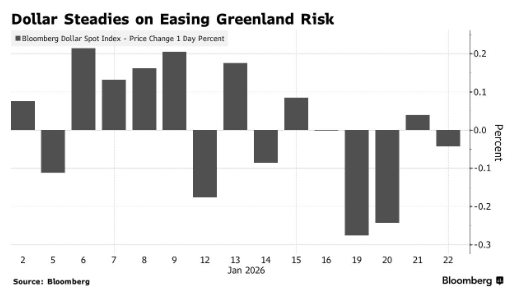
Group 1 - The easing of tensions regarding the U.S. acquisition of Greenland has alleviated global market anxiety, leading to a stabilization of the dollar and a strong performance of high-risk currencies [1] - The Norwegian krone and Australian dollar, which typically fluctuate with risk appetite, both rose over 0.6% against the dollar, leading the gains among major currencies [1] - Market volatility indicators have decreased, and U.S. Treasury bonds are gradually stabilizing after a period of significant sell-off [1] Group 2 - Despite the stabilization of the dollar index, the dollar faced a notable decline of approximately 0.5% this week [3] - The long-term volatility indicators suggest that traders expect the current state of market calm to persist, although the upcoming Federal Reserve monetary policy decision is likely to influence short-term volatility [3] - The recovery in the U.S. Treasury market aligns with the easing of market volatility, with the range of U.S. Treasury bond fluctuations expected to reach the second-lowest level since 2021 [3] Group 3 - Investors are focusing on a series of U.S. economic data, including the upcoming core inflation indicator, the Personal Consumption Expenditures (PCE) price index, which could support the Federal Reserve's stance on maintaining current interest rates [6] - Some forex analysts caution that the rebound of the dollar may be relatively mild following President Trump's change in tone, suggesting a potential trend of "dollar depreciation trades" as geopolitical tensions prompt market participants to withdraw from dollar assets [6] - The current global geopolitical landscape appears to have entered a new phase, with recurring geopolitical tensions likely to instill a sense of caution among market participants [6]
FOF和资产配置月报:风险逐级探明,布局春季行情-20251224
Huaxin Securities· 2025-12-24 08:09
- The report does not contain any specific quantitative models or factors for analysis. It primarily focuses on macroeconomic trends, asset allocation strategies, and market observations[1][2][4]. - The report discusses the performance of various asset classes, including equities, bonds, commodities, and currencies, but does not provide detailed quantitative factor construction or modeling processes[10][11][12]. - It highlights the seasonal effects and market trends, such as the spring rally in Hong Kong and A-shares markets, but does not delve into quantitative factor testing or modeling[38][39][63]. - The report mentions a rotation timing model for high-growth and dividend strategies, which uses indicators like term spreads, social financing growth, CPI, PPI, U.S. bond rates, and fund flows. However, it does not provide detailed formulas or construction processes for these indicators[59]. - The rotation strategy achieved an annualized return of +17.54%, outperforming the benchmark by +11.77%, with a current allocation recommendation of 60% dividend and 40% growth[59]. - Seasonal effects are noted, such as small-cap stocks outperforming in February and March, while large-cap stocks dominate in April and December[63]. - The report provides market sentiment analysis, including institutional buying intentions and external capital flows, but does not include quantitative factor testing or modeling[51][54]. - Industry performance is discussed, with a focus on sectors like TMT, AI, and industrial metals, but no quantitative models or factors are detailed[64][67]. - The report includes valuation metrics for indices like the S&P 500, Nasdaq, and Shanghai Composite, but does not provide quantitative factor construction or testing[26][47][48]. - The report does not contain specific quantitative models or factors for analysis, nor does it provide formulas or detailed construction processes for any mentioned strategies or observations[1][2][4].
金价明年破5000美元?分析:前提是“美元贬值交易”重新流行
Hua Er Jie Jian Wen· 2025-11-07 13:58
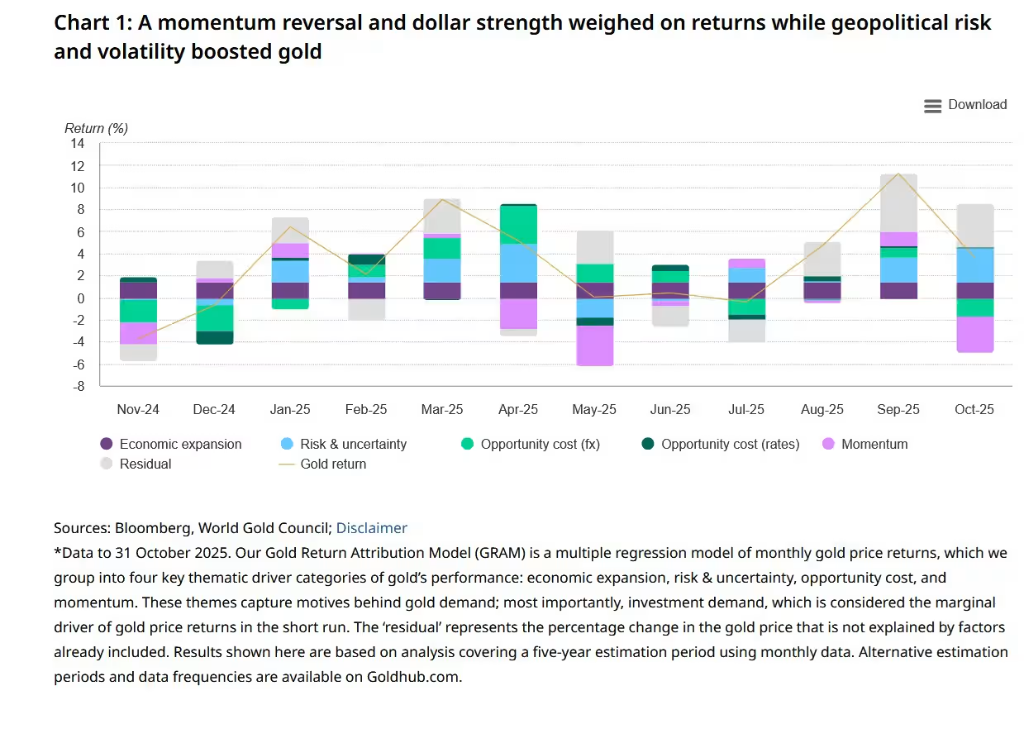
Core Viewpoint - Despite recent declines in gold prices, the fundamental logic driving the rise in precious metals this year—"dollar devaluation trade"—remains intact, with expectations of gold potentially surpassing $5000 next year [1] Group 1: Market Dynamics - Gold prices have recently dropped significantly, retreating 8.5% from the record high in October, leading to discussions about whether the upward trend has paused or peaked [1] - Analysts suggest that the current pullback is not a warning signal but rather an investment opportunity, supported by strong fundamentals such as central bank purchases, Asian demand, and under-allocation by Western investors [1][11] - The Federal Reserve's October meeting led to a decrease in expectations for a rate cut in December, temporarily weakening the appeal of holding gold [1][10] Group 2: Technical Analysis - Current price adjustments are viewed as healthy consolidations rather than a reversal of the upward trend, with no long-term sell signals identified [2][4] - The recent price weakness is seen as a necessary pause that could support the core long-term upward trend [4][7] Group 3: Central Bank Activity - Central banks are expected to increase global gold reserves by over 1000 tons for the fourth consecutive year, indicating defensive measures rather than speculative actions [9][11] - The speed of central bank gold purchases is unprecedented compared to a decade ago, reinforcing the bullish outlook for gold [8] Group 4: Future Outlook - The potential for gold to reach $5000 hinges on the re-emergence of the dollar devaluation trade, which is driven by concerns over fiscal imbalances, rising debt, and government debt monetization [12] - Analysts predict that gold may experience a pullback of several hundred dollars during the consolidation phase, but strong fundamentals will likely push prices to new records once this phase concludes [11][12]
香港第一金PPLI:黄金价格冲高与市场博弈下的资产配置逻辑
Sou Hu Cai Jing· 2025-10-21 07:12
Group 1 - The core viewpoint of the articles highlights the recent surge in international gold prices, which have surpassed $4,300, amid a weakening U.S. dollar and increasing discussions around "dollar devaluation trades" [1][2] - The relationship between gold and the U.S. dollar is characterized by a strong inverse correlation, where a weaker dollar typically leads to increased demand for gold as an alternative asset [2][3] - The driving forces behind the rise in gold prices include heightened geopolitical risks, expectations of U.S. Federal Reserve interest rate cuts, and increased gold purchases by central banks as part of their foreign reserve strategies [5][6] Group 2 - The U.S. Treasury market has shown relative calm despite the rising gold prices, with 10-year Treasury yields fluctuating between 4.05% and 4.15%, indicating strong investor confidence in the Fed's ability to control inflation [6] - The future trajectory of the dollar and Treasury yields hinges on economic signals that will influence the Fed's policy decisions, particularly regarding potential interest rate cuts or tightening due to inflationary pressures [7] - Investors are advised to recognize the unique advantages of gold in combating inflation and geopolitical risks, while also closely monitoring the dynamics of the Treasury market for insights into Fed policy direction [8]

黄金、比特币双双创历史新高,美国政府关门刺激“美元贬值交易”
华尔街见闻· 2025-10-06 12:13
Core Viewpoint - The article discusses the rising popularity of a "devaluation trade" strategy among investors, driven by concerns over the U.S. fiscal outlook and the value of the dollar, leading to record highs in gold and Bitcoin prices [1][4][6]. Group 1: Market Reactions - Gold prices surpassed $3,900 per ounce, reaching a new historical high, just days after breaking the $3,800 mark [1]. - Bitcoin hit a peak of $125,689 on October 5, exceeding its previous record of $124,514 set on August 14 [4]. - The ICE U.S. Dollar Index (DXY) fell by 0.1% last Friday, marking a year-to-date decline of approximately 10% [4]. Group 2: Underlying Factors - The "devaluation trade" is fueled by long-term factors such as uncertainty regarding long-term inflation, U.S. fiscal policy, concerns over the independence of the Federal Reserve, and the persistent high deficits of major economies [6][10]. - Analysts suggest that the current government shutdown is a reflection of deeper structural issues within the political system, contributing to the ongoing high federal deficits [10][11]. Group 3: Analyst Predictions - Analysts are optimistic about the future of gold and Bitcoin, with Citibank's Alex Saunders predicting Bitcoin could reach $181,000 within 12 months, viewing it as "digital gold" [12]. - Fund manager Jeff Muhlenkamp anticipates gold prices will clearly exceed $4,000 by the end of the year, citing significant concerns over the U.S. deficit, which is currently around 6% to 6.5% of GDP [13].