
美联储扩表

Search documents
热点思考 | 美联储扩表与QE时代的终结——“流动性笔记”系列之七(申万宏观·赵伟团队)
申万宏源研究· 2025-12-30 01:29
Core Viewpoint - The Federal Reserve's initiation of the Reserve Management Purchase (RMP) after the December 2025 FOMC meeting signals the end of the QE era rather than a restart, despite both leading to an expansion of the Fed's balance sheet. The RMP and QE have fundamental differences in policy and market implications [2][7]. Group 1: Federal Reserve's Balance Sheet Expansion - The Federal Reserve announced a restart of balance sheet expansion at the December FOMC meeting, with the pace slightly exceeding expectations, aligning with liquidity management needs. By the end of 2025, reserves may have fallen to ample levels, necessitating early expansion to accommodate economic growth and seasonal demand fluctuations [3][8][14]. - The RMP is a new phase of "normalization" in balance sheet expansion, with two methods of providing reserves: RMP and reinvestment of agency securities. The RMP will start at a scale of $40 billion per month, expected to remain high until April 2026, then slow to an average of $20-25 billion per month [3][18][69]. Group 2: Nature of RMP - The RMP is a technical operation aimed at assisting the effective implementation of monetary policy without altering the Fed's policy stance. It primarily refers to interest rate policy, allowing market rates to fluctuate narrowly around the policy rate without frequent open market operations [4][41][69]. - RMP and QE both lead to balance sheet expansion but differ fundamentally. While they have similar quantitative impacts on the Fed's and commercial banks' balance sheets, they differ qualitatively. RMP is a conventional liquidity management operation, while QE is a broad "yield curve management" tool [4][65][69]. Group 3: Conclusion on QE - QE is not likely to restart until interest rates are lowered to near zero, as this is the inherent order of monetary easing. Not all balance sheet expansions are classified as QE; the precondition for QE is that monetary policy faces a zero lower bound constraint [5][71]. - Historical instances of QE-style expansions by the Fed occurred only after interest rates were lowered to zero or near zero, including during the Great Depression, post-World War II, after the 2008 financial crisis, and following the 2020 pandemic [5][47][71].


下方支撑较强 沪铜延续强势【盘中快讯】
Wen Hua Cai Jing· 2025-12-29 01:16
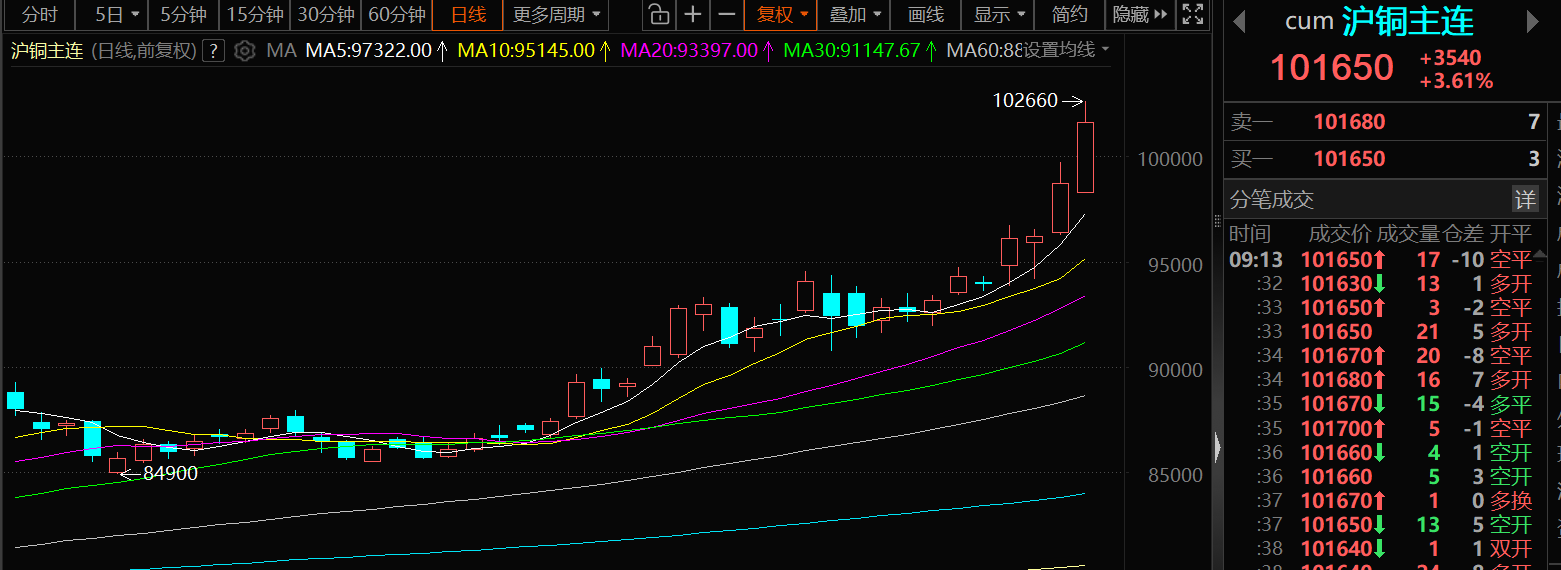
Core Viewpoint - The copper market is experiencing significant price increases due to the Federal Reserve's continued interest rate cuts and the resumption of balance sheet expansion, alongside ongoing supply tightness in the copper market [2] Group 1: Market Dynamics - On Friday night, the Shanghai copper market saw a surge, with the main contract rising over 3% [2] - The U.S. continues to exert a siphoning effect on the copper market, leading to low inventory levels in non-U.S. regions despite some accumulation [2] Group 2: Demand and Risks - High copper prices are suppressing domestic demand, while increasing anxiety in the precious metals market raises concerns about potential risks at elevated price levels [2]
申万宏源:美联储开启“常态化”扩表新阶段 重启QE或需等待下一次危机
Zhi Tong Cai Jing· 2025-12-27 23:29
Core Viewpoint - The report from Shenwan Hongyuan indicates that the Federal Reserve's initiation of Reserve Management Purchases (RMP) after the December 2025 FOMC meeting has sparked optimism for a "QE-style" liquidity easing, but in reality, it marks the end of the QE era rather than a restart [1] Group 1: RMP and Normalization of Balance Sheet - The Federal Reserve has entered a new phase of "normalization" in balance sheet expansion with the announcement of RMP, which slightly exceeded expectations but aligns with liquidity management needs [2] - By the end of 2025, reserves are expected to have declined to an ample level, necessitating early balance sheet expansion to accommodate economic growth and seasonal demand fluctuations [2] - RMP will be implemented starting December 12, with an initial scale of $40 billion, expected to remain high until April 2026, after which it may slow to an average of $20-25 billion per month [2] Group 2: Nature of RMP vs. QE - RMP is fundamentally a technical operation aimed at assisting effective monetary policy implementation without altering the Fed's policy stance, primarily focusing on interest rate policy [3] - While both RMP and QE lead to balance sheet expansion, they differ fundamentally; RMP is a routine liquidity management operation, whereas QE is a broader "yield curve management" strategy [3] - RMP is not a new tool, having been implemented after the end of balance sheet reduction in October 2019, and its pace of normalization may align with nominal GDP growth rates [3] Group 3: Conclusion on QE - The report concludes that the Fed is unlikely to restart QE before returning to a zero or near-zero interest rate environment, as the internal order of monetary easing dictates that rate cuts are more effective in stimulating demand prior to hitting the zero lower bound [4] - Historical instances of QE-like balance sheet expansions occurred only after reaching zero interest rates, indicating that the Fed may need to wait for the next crisis to consider restarting QE [4] - In conventional monetary policy ranges, interest rates serve as the primary indicator of policy stance, making it unnecessary to focus excessively on the Fed's balance sheet operations [4]

热点思考 | 美联储扩表与QE时代的终结——“流动性笔记”系列之七(申万宏观·赵伟团队)
申万宏源宏观· 2025-12-27 16:42
Core Viewpoint - The Federal Reserve's initiation of the Reserve Management Purchase (RMP) after the December 2025 FOMC meeting signals the end of the QE era rather than a restart, despite both leading to an expansion of the Fed's balance sheet. RMP and QE have fundamental differences in policy and market implications [2][7]. Group 1: Federal Reserve's Balance Sheet Expansion - The Federal Reserve announced a restart of balance sheet expansion at the December FOMC meeting, with the pace slightly exceeding expectations, aligning with liquidity management needs. By the end of 2025, reserves may have fallen to ample levels, necessitating early expansion to accommodate economic growth and seasonal demand fluctuations [3][8][14]. - The RMP, starting on December 12, 2025, has an initial scale of $40 billion, expected to remain high until April 2026, after which it may slow to an average of $20-25 billion per month [3][18][69]. Group 2: Nature of RMP - RMP is a technical operation aimed at assisting the effective implementation of monetary policy without altering the Fed's policy stance. It primarily refers to interest rate policy, allowing market rates to fluctuate narrowly around the policy rate without frequent open market operations [4][41][69]. - RMP and QE both lead to balance sheet expansion but differ fundamentally in quality. RMP is a conventional liquidity management operation, while QE is a broad "yield curve management" tool. RMP is market-neutral, whereas QE is market-non-neutral [4][65][69]. Group 3: Conclusion on QE - QE is only likely to be considered after interest rates are lowered to near zero, as this is the inherent order of monetary easing. Not all balance sheet expansions are classified as QE, which requires a zero lower bound constraint on monetary policy. Prior to reaching this limit, rate cuts are a more effective means of stimulating aggregate demand [5][71][60]. - Historical instances of QE-style expansions by the Fed occurred only after interest rates were lowered to zero or near-zero levels, indicating that a return to QE may require a future crisis [5][47][71].

“流动性笔记”系列之七:美联储扩表与QE时代的终结
Shenwan Hongyuan Securities· 2025-12-27 14:00
Group 1: Federal Reserve's Actions - The Federal Reserve initiated the Reserve Management Purchase (RMP) after the December 2025 FOMC meeting, marking the end of the QE era rather than a restart[1] - The RMP is set at a scale of $40 billion for the first month, expected to remain high until April 2026, then potentially slow to an average of $20-25 billion per month[2] - RMP is a technical operation aimed at managing liquidity without altering the Fed's policy stance, primarily focusing on interest rate policy[3] Group 2: Differences Between RMP and QE - RMP and QE both lead to an expansion of the Fed's balance sheet but differ fundamentally in their nature; RMP is for liquidity management while QE is for yield curve management[4] - RMP is market-neutral, whereas QE is market-non-neutral, affecting asset prices differently[5] - The Fed is unlikely to restart QE until interest rates approach zero, as lowering rates is a more effective demand stimulus before reaching that threshold[6] Group 3: Economic Indicators - As of December 24, 2025, the U.S. Treasury General Account (TGA) balance decreased to $801.5 billion, with net issuance of U.S. debt declining[7] - The U.S. fiscal deficit for the calendar year 2025 is projected at $1.77 trillion, lower than the $1.95 trillion from the previous year[8] - The U.S. GDP growth rate for Q3 2025 was 4.3% (annualized), exceeding market expectations of 3.3%, driven by strong consumer spending[9]
机构看金市:12月25日
Xin Hua Cai Jing· 2025-12-25 06:19
Core Viewpoint - The Federal Reserve's interest rate cut probability has decreased, leading to a significant drop in precious metals prices, particularly silver, while the long-term outlook for precious metals remains positive due to various supportive factors [1][3][4]. Group 1: Market Reactions - Precious metals experienced a divergence in performance, with a notable drop influenced by better-than-expected initial jobless claims data, which fell to 214,000, below expectations and previous values [1][3]. - Silver prices have recently seen volatility, touching $72 before retreating, driven by macro liquidity easing and rising interest in platinum and palladium [2]. - The recent U.S. employment data exceeded expectations, putting short-term pressure on gold and silver prices, with initial jobless claims at 214,000, lower than the anticipated 224,000 [3]. Group 2: Economic Indicators - The U.S. GDP for Q3 showed an annualized quarter-on-quarter growth of 4.3%, surpassing expectations of 3.3%, influenced by healthcare prices [3]. - The GDP price index for Q3 was reported at 3.8%, above the expected 2.7%, indicating resilience in price levels despite economic uncertainties [3]. - The PCE price index year-on-year for Q3 was 2.7%, higher than the previous 2.4%, reflecting ongoing inflationary pressures [3]. Group 3: Future Outlook - Despite potential short-term consolidation in gold prices due to profit-taking and lack of new market catalysts, the overall upward trend remains solid, with expectations for continued strength into 2026 [4]. - UBS analysts suggest that while the recent surge in precious metals is notable, the lack of clear driving factors makes short-term predictions challenging, advocating for a cautious approach [4]. - The combination of the Federal Reserve's dovish stance, central bank gold purchases, ETF inflows, and a weaker dollar is expected to support precious metals prices in the medium to long term [1][3].
期货市场交易指引2025年12月19日-20251219
Chang Jiang Qi Huo· 2025-12-19 02:34
Report Industry Investment Ratings - Macro-finance: Bullish on stock indices in the medium to long term, with a strategy of buying on dips; expect government bonds to trade in a range [1][5] - Black building materials: Short-term trading for coking coal; range trading for rebar; sell on rallies for glass [1][8][9] - Non-ferrous metals: Reduce positions on rallies for copper and replenish on low-level stabilization; strengthen observation for aluminum; observe or sell on rallies for nickel; range trading for tin, gold; hold long positions for silver and be cautious about new positions; expect lithium carbonate to trade with a strong bias [1][11][12][18][19] - Energy and chemicals: Range trading for PVC, styrene, rubber, urea, methanol; expect polyolefins to trade with a weak bias; temporarily observe caustic soda and soda ash [1][21][22][23][25][26][28] - Cotton textile industry chain: Bullish with a bias for cotton and cotton yarn; expect PTA to rise in a range; bearish with a bias for apples and jujubes [1][30][31][32] - Agricultural and livestock products: Short-term short-selling on rallies for near-term contracts of live pigs and cautious bullishness for far-term contracts; expect eggs to trade in a range; be cautious about chasing highs in the short term for corn and hedge on rallies for grain holders; range trading for soybean meal, with a bullish bias for near-term contracts and a bearish bias for far-term contracts; be cautious about short-selling for oils and fats [1][34][35][36][37] Core Views - The report provides trading strategies for various futures products in different industries, considering factors such as supply and demand, macroeconomic conditions, and policy impacts. It emphasizes the importance of risk management and the need for investors to make decisions based on their own investment goals and risk tolerance [1][5][8][9][11][12][18][19][21][22][23][25][26][28][30][31][32][34][35][36][37] Summary by Industry Macro-finance - Stock indices are expected to trade in a range in the short term but are bullish in the medium to long term, with a strategy of buying on dips, as US inflation has slowed more than expected [5] - Government bonds are expected to trade in a range, with short - term rates potentially stabilizing if long - term yields do not reach new highs and funding rates remain stable [5] Black building materials - Coking coal market is in a tug - of - war between strong bearish factors and weak bullish factors, with short - term trading recommended [8] - Rebar is expected to trade in a range, with low valuation and weak driving forces, and a weak downward trend [9] - Glass is expected to trade weakly, with a strategy of selling on rallies due to high inventory, weak demand, and potential supply increases [9][10] Non-ferrous metals - Copper is expected to trade in a high - level range, with a strategy of reducing positions on rallies and replenishing on low - level stabilization, due to short - term overheating and potential technical adjustments [11] - Aluminum is expected to rebound, but investors are advised to strengthen observation due to factors such as changes in ore prices, production capacity, and demand [12] - Nickel is expected to trade in a range, with a strategy of observing or selling on rallies, as the medium - to - long - term supply is expected to be in surplus [16] - Tin is expected to trade in a range, with a strategy of range trading, considering factors such as supply tightness and potential demand recovery [17][18] - Silver and gold are expected to trade in a range, with a strategy of holding long positions for silver and range trading for gold, as the medium - term price centers are expected to rise [18] - Lithium carbonate is expected to trade with a strong bias, with attention paid to supply disruptions and demand trends [19] Energy and chemicals - PVC is expected to trade in a low - level range, with weak fundamentals but potential support from low valuation and policy or cost changes [19][21] - Caustic soda is expected to trade in a low - level range, with investors advised to temporarily observe due to high inventory and potential impacts from alumina production [21] - Styrene is expected to trade in a range, with a focus on changes in pure benzene prices and crude oil pricing [22][23] - Rubber is expected to trade in a wide - range, with support from supply disruptions but limited upside due to high inventory and weak demand [23][24] - Urea is expected to trade in a range, with a relatively stable supply - demand pattern [24][25] - Methanol is expected to trade in a range, with supply recovery, high - level but slightly declining downstream demand, and inventory reduction [26] - Polyolefins are expected to trade with a weak bias, with a supply - strong and demand - weak situation [26][27] - Soda ash investors are advised to temporarily observe, as the supply - demand contradiction may be alleviated after supply contraction and there is cost support [28] Cotton textile industry chain - Cotton and cotton yarn are expected to trade with a strong bias, as recent domestic cotton sales are fast and yarn prices are firm [30] - PTA is expected to rise in a range, driven by rising crude oil prices and supply - demand inventory reduction [30][31] - Apples and jujubes are expected to trade with a weak bias, with slow inventory sales [31][32] Agricultural and livestock products - Live pigs are expected to form a bottom in a range, with short - term supply pressure and long - term potential for price recovery after capacity reduction [32][34] - Eggs are expected to trade in a range, with short - term stability, medium - term improvement in supply - demand balance, and long - term supply pressure [34][35][36] - Corn is expected to trade with a weak bias, with short - term selling pressure and long - term support from demand recovery but limited upside [36] - Soybean meal is expected to trade in a range, with a bullish bias for near - term contracts and a bearish bias for far - term contracts [37] - Oils and fats are expected to have intensified corrections, and investors are advised to be cautious about short - selling [37][38][39][40][41][42]
集体大跌
中国基金报· 2025-12-12 23:59
【导读】美股集体收跌,科技股普跌,甲骨文显著下跌,中概股微跌; 30 年期美债收益率升 至 9 月以来最高水平 中国基金报记者 张舟综合整理 大家好,今天是周六,一起聚焦海外市场最新收盘表现与本周整体走势。 美东时间 12 月 12 日周五收盘,美国股市集体收跌。热门科技股普跌,中概股微跌。 来看具体市场情况 —— 美国三大股指全线收跌 昨夜今晨,美股三大股指全线收跌。截至收盘,道琼斯工业平均指数跌 0.51% ,报 48458.05 点;标普 500 指数跌 1.07% ,报 6827.41 点;纳斯达克综合指数跌 1.69% , 报 23195.17 点,纳斯达克 100 指数跌近 2% 。 从周度表现表现看,三大指数震荡调整幅度较大且涨跌不一。其中,纳斯达克综合指累跌 1.62% ,道指累涨 1.05% ,标普 500 指数累跌 0.63% 。 板块方面,昨夜今晨科技股普跌,博通跌超 11% ,美光科技跌逾 6% ,英伟达跌超 3% 。 | 半导体-半导体材料与设备 | | -5.30% | | --- | --- | --- | | 名称 两日图 | 涨跌幅 | 市值 ▼ | | 英伟达(NVIDI ...

百利好晚盘分析:押注明年降息 黄金强势上涨
Sou Hu Cai Jing· 2025-12-12 09:24
Group 1: Gold - The last interest rate cut by the Federal Reserve has concluded, with Chairman Powell not providing hints for future cuts, perceived as a "hawkish cut," but the overall tone is less aggressive than expected. The dot plot indicates only one rate cut (25 basis points) is anticipated next year, consistent with September's expectations [1] - Wall Street investment banks predict two rate cuts next year totaling 50 basis points, with Citigroup forecasting cuts in January and March, while Morgan Stanley suggests January and April. Goldman Sachs, Wells Fargo, and Barclays expect cuts in March and June [1] - Analyst Owen from Baillie Gifford believes that with the conclusion of the last rate cut, investors are betting on future cuts by the Fed, which is favorable for gold prices [1] - Technically, gold broke through the previous two-week trading range (4180-4260 USD) and is expected to target 4320 USD. Short-term outlook indicates a continuation of upward momentum after recent fluctuations [1] Group 2: Oil - Peace negotiations between Russia and Ukraine are at a standstill, with conflicting demands and "red lines." The main disagreement centers on Russia's demand for the Donbas region and security guarantees for Ukraine, with Putin stating he "will not compromise" [2] - The International Energy Agency (IEA) reports that despite declines in oil production from Russia and Venezuela, global supply still exceeds demand. It forecasts a modest increase in global oil demand of 830,000 barrels per day in 2025 and 860,000 barrels per day in 2026, significantly lower than previous years [2] - Technically, oil faced resistance at 60.47 USD last week and has since retreated, with a recent bounce back to around 57 USD. The downward trend remains intact, with resistance at 58.10 USD and support at 57 USD, with a potential drop to 56.20 USD if support is broken [2] Group 3: US Dollar Index - The FOMC statement indicates that reserve balances have fallen to adequate levels, and the Fed plans to purchase 40 billion USD in short-term US Treasury bonds over the next month to maintain sufficient reserves, marking a shift from balance sheet reduction to expansion [3] - Notable short-seller Michael Burry expressed concerns about the Fed's actions, suggesting that without over 3 trillion USD in reserves, the US banking system would be unable to function, indicating fragility. He also noted that each crisis leads the Fed to permanently expand its balance sheet, which poses risks [3] - Technically, the dollar faced resistance at 100.40, indicating a broad range of fluctuations over the past six months. A break below 99 increases the likelihood of further declines, with potential support at 96.60 [3] Group 4: Nikkei 225 - The Nikkei 225 index has maintained a trading range of 50200 to 51000 over the past week, with unclear short-term direction. A breakout above 51100 could lead to a target of 51700 [4] Group 5: Copper - Copper prices recently broke through previous highs, showing a strong upward trend in the hourly chart and a broad upward movement in the daily chart, with further increases likely towards 5.38 USD. Short-term focus is on a key level at 5.35 USD, with potential upward movement towards 5.49 USD [5]

白银新高后如何研判
2025-12-12 02:19
Summary of Silver Market Analysis Industry Overview - The silver market has experienced a significant annual increase of 105%, surpassing gold's performance, driven by factors such as a small market size, naked long positions, increased transportation costs due to U.S. tariff policies, and difficulties in short covering [1][2][4]. Key Points and Arguments - **Market Dynamics**: The silver market's small size has led to a situation where many naked long positions cannot be fulfilled during delivery months, resulting in a squeeze [2][4]. - **High Delivery Month Positions**: The high level of open interest in delivery month contracts indicates rising fulfillment costs [1]. - **Industrial Demand Growth**: The World Silver Association forecasts a compound annual growth rate of 3.4% for industrial silver demand from 2025 to 2031, driven by advancements in photovoltaic technology, autonomous vehicles, and electric vehicles [1][4][6]. - **Decoupling from Gold**: Silver's price movements have become increasingly independent from gold, attributed to tight supply-demand balance and optimistic industrial demand outlook [1][5]. - **Supply Shortage**: Despite a projected narrowing of the supply gap in 2025, a shortfall of 2,000 to 3,000 tons is still expected, supporting price levels [1][5]. - **Macroeconomic Factors**: The U.S. economy is showing signs of divergence, with manufacturing affected by tariffs while the service sector benefits from AI developments. Soft employment data and moderate inflation expectations may provide the Federal Reserve with room for interest rate cuts, albeit at a reduced magnitude [1][7]. Additional Important Insights - **Liquidity Issues**: Current silver price increases are primarily driven by liquidity constraints in the New York market, with a need to monitor COMEX warehouse inventories and domestic stock rebounds to gauge future trends [1][9]. - **Future Price Projections**: Wall Street investment banks predict a strong outlook for precious metals in 2026, with gold target prices between $4,800 and $5,000. If the gold-silver ratio remains around 60, silver prices could exceed $80 [3][11]. - **Technical Analysis**: The current upward trend in silver prices has surpassed initial resistance levels, with potential targets around $62. However, caution is advised due to unfavorable risk-reward ratios [12]. Conclusion - The silver market is characterized by a unique set of dynamics that differentiate it from gold, with strong industrial demand and macroeconomic factors influencing its trajectory. Investors should remain vigilant regarding liquidity conditions and macroeconomic developments while considering potential price movements and technical indicators.