
能源通胀

Search documents
【中国银河宏观】能源通胀下的鹰派发布会——3月FOMC会议
Sou Hu Cai Jing· 2026-03-19 03:06
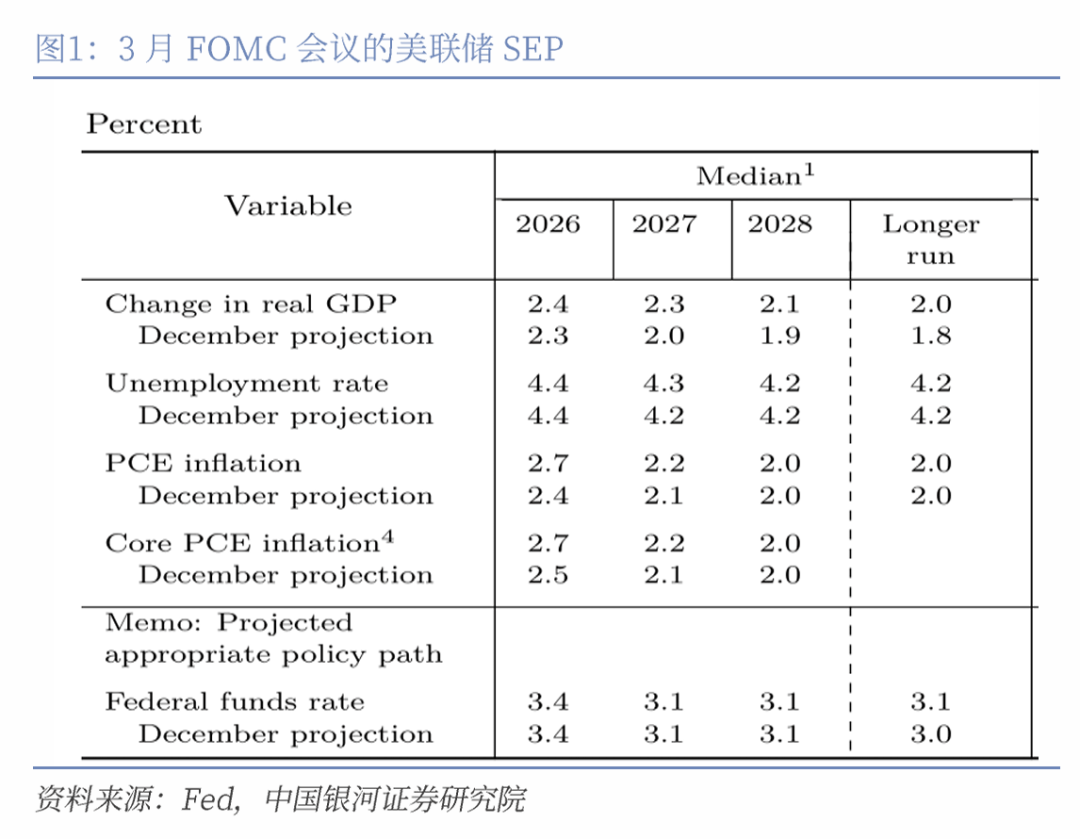
Core Viewpoint - The Federal Reserve remains cautious, maintaining interest rates in the 3.75%-3.50% range, with a slight upward adjustment in inflation expectations, while signaling a potential rate cut later in the year due to economic uncertainties stemming from geopolitical tensions and domestic labor market conditions [1][2][3]. Group 1: Federal Reserve's Actions and Statements - The FOMC statement showed limited changes, with the only dissenting vote against a rate cut coming from Miran, while Waller shifted to support maintaining rates [1][3]. - The SEP (Summary of Economic Projections) indicates a mild increase in inflation expectations for 2026, with PCE inflation rising from 2.4% to 2.7%, and GDP growth slightly adjusted from 2.3% to 2.4% [3][11]. - Powell's comments during the press conference conveyed a hawkish tone, emphasizing the need to balance inflation and employment goals, while downplaying immediate risks to the labor market [4][5]. Group 2: Economic Context and Risks - The economic backdrop presents challenges, with short-term stagflation risks and long-term recession concerns, as March CPI is expected to approach 3% amid rising energy prices [2][4]. - The geopolitical situation in the Middle East, particularly tensions involving Iran, adds uncertainty to energy prices and economic forecasts [2][6]. - The labor market shows signs of stagnation, with new job growth averaging near zero in March, raising concerns about future employment trends [2][4]. Group 3: Market Reactions and Projections - Following the FOMC meeting, risk assets experienced a decline due to heightened geopolitical tensions and hawkish signals from the Fed, with major U.S. stock indices falling significantly [9]. - The CME FedWatch Tool indicates that market participants are currently pricing in no rate cuts for 2026, reflecting a shift in expectations following the Fed's recent communications [9][31]. - The potential for high oil prices to impact economic growth and corporate profits is acknowledged, with a warning that sustained high inflation could lead to recession risks and necessitate rate cuts in the future [7][8].


《黑色》日报-20260313
Guang Fa Qi Huo· 2026-03-13 01:49
1. Report Industry Investment Ratings - No information provided regarding industry investment ratings in the reports. 2. Core Views Steel Industry - Geopolitical conflicts and supply - demand dynamics support steel prices. Steel prices are expected to rise, with the 5 - month contract of rebar and hot - rolled coil facing resistance around 3150 and 3300 respectively [1]. Iron Ore Industry - Iron ore prices are likely to be volatile and bullish in the short term, with a reference range of 780 - 850, due to geopolitical impacts and supply - demand changes [4]. Coke and Coking Coal Industry - For coke, prices are expected to stabilize. It is recommended to go long on the coke 2605 contract in the range of 1650 - 1850 and consider an arbitrage strategy of long coking coal and short coke. For coking coal, it is recommended to go long on the coking coal 2605 contract in the range of 1100 - 1250 [6]. Ferrosilicon and Ferromanganese Industry - Ferrosilicon prices are expected to fluctuate widely in the range of 5700 - 6200. Ferromanganese prices are expected to fluctuate widely in the range of 5800 - 6400 [7]. 3. Summary by Directory Steel Industry Steel Prices and Spreads - Rebar and hot - rolled coil prices in different regions and contracts showed various changes. For example, rebar spot prices in East China increased by 10, and hot - rolled coil spot prices in North China increased by 20 [1]. Cost and Profit - Steel billet prices increased by 20, while some cost and profit indicators such as East China hot - rolled coil profit decreased by 24 [1]. Production and Inventory - Daily average pig iron production decreased by 6.3 to 221.2, a 2.8% decline. Five - major - variety steel production increased by 23.7 to 821.0, a 3.0% increase. Five - major - variety steel inventory increased by 22.9 to 1974.9, a 1.2% increase [1]. Transaction and Demand - Building material trading volume decreased by 0.9 to 8.8, a 9.4% decline. Five - major - variety apparent demand increased by 106.7 to 798.1, a 15.4% increase [1]. Iron Ore Industry Iron Ore - related Prices and Spreads - Warehouse receipt costs of various iron ore types increased, and 05 - contract basis of some ores also increased. For example, the warehouse receipt cost of lower - grade powder increased by 21.8 to 902.4, a 2.5% increase [4]. Supply - 45 - port arrival volume increased by 463.0 to 2609.9, a 21.6% increase, while global shipping volume decreased by 442.9 to 2897.8, a 13.3% decrease [4]. Demand - 247 - steel - mill daily average pig iron production decreased by 5.7 to 227.6, a 2.4% decrease, and 45 - port daily average port clearance volume increased by 12.6 to 311.1, a 4.2% increase [4]. Inventory - 45 - port inventory increased by 25.9 to 17117.86, a 0.2% increase, and 247 - steel - mill imported ore inventory decreased by 73.5 to 9011.6, a 0.8% decrease [4]. Coke and Coking Coal Industry Price and Spread - Coke and coking coal prices and spreads showed different changes. For example, the coke 05 contract increased by 9 to 1727, a 0.5% increase [6]. Supply and Demand - Coke production remained stable, and pig iron production decreased by 6.4 to 221.2, a 2.8% decrease. Coking coal production increased, with raw coal production increasing by 165.0 to 861.3, a 23.74% increase [6]. Inventory - Coke total inventory decreased slightly, and coking coal inventory in some sectors changed. For example, the whole - sample coking plant's coking coal inventory increased by 20.0 to 969.4, a 2.14% increase [6]. Ferrosilicon and Ferromanganese Industry Futures and Spot - Ferrosilicon and ferromanganese futures and spot prices changed. For example, the ferrosilicon main - contract closing price increased by 38 to 5922, a 0.64% increase [7]. Cost and Profit - Ferrosilicon production cost in Inner Mongolia increased slightly, and production profit in Inner Mongolia decreased by 20.5% [7]. Supply and Demand - Ferrosilicon production remained stable at 9.7, and ferrosilicon demand increased by 0.1 to 1.9, a 5.94% increase. Ferromanganese demand increased by 0.5 to 11.7, a 4.94% increase [7]. Inventory - Ferrosilicon inventory of 60 - sample enterprises decreased by 0.5 to 37.6, a 6.6% decrease, and ferromanganese inventory of 63 - sample enterprises decreased by 1.2 to 38.7, a 3.0% decrease [7].
广发早知道:汇总版-20260312
Guang Fa Qi Huo· 2026-03-12 02:28
Report Industry Investment Rating - Not provided in the content Core Views of the Report - The report analyzes various sectors including financial derivatives, commodities, and agricultural products. Geopolitical conflicts, especially the US - Iran conflict, have significant impacts on the markets, causing price fluctuations in energy, metals, and agricultural products. The supply - demand relationship, cost factors, and inventory levels also play crucial roles in determining the price trends of different commodities [2][3][4] Summary by Relevant Catalogs Daily Selections - **Nickel**: Macro changes and raw material contradictions support prices, but high inventory remains a constraint. The price is expected to oscillate strongly in the range of 136,000 - 145,000 [2][37] - **PX**: Short - term prices are dominated by oil prices with increased volatility. It is recommended to wait and see and go long at low prices after the market stabilizes [3][101] - **Silicon Iron**: The market sentiment is volatile, with both supply and demand increasing. The price may oscillate widely in the range of 5,700 - 6,200 [4][68] - **Soybean Meal**: The USDA March supply - demand report has limited impact. The market is expected to maintain a high - level oscillation with a strengthening basis [5][74] Macro - finance Stock Index Futures - The A - share market showed a mixed trend on Wednesday. The four major stock index futures contracts rose and fell differently. It is recommended to construct a bullish spread of far - month put options with a low position, with a neutral - oscillatory view [6][7][9] Precious Metals - Gold prices are expected to oscillate for a long time in the range of 5,000 - 5,250 dollars. Silver prices may still have downward pressure, and platinum and palladium prices have certain support [10][13][14] Non - ferrous Metals Copper - The spot copper supply is tight, and the spot premium is strengthening. In the short term, the price oscillates around 100,000 yuan/ton, and in the long term, the price center is expected to rise [15][18] Alumina - The inventory is slightly decreasing, and the spot price is rising. The price is expected to oscillate widely, and it is recommended to go short at high prices [19][20] Aluminum - Due to geopolitical conflicts, the price oscillates at a high level. In the short term, the main contract is expected to operate in the range of 24,000 - 26,000 yuan/ton [22][24] Aluminum Alloy - The social inventory and warehouse receipts are decreasing. The price oscillates strongly in the range of 23,000 - 24,500 yuan/ton [24][26] Zinc - The price oscillates narrowly. The supply and demand are relatively stable, and it is recommended to go long at low prices in the long term [27][30] Tin - The price is greatly affected by short - term market sentiment. In the long term, it is still optimistic, and it is recommended to wait and see in the short term [31][35] Nickel - The situation is similar to that in the daily selection, with high inventory constraining the upward movement, and the price is expected to oscillate strongly [36][38] Stainless Steel - The price oscillates due to geopolitical disturbances. The cost provides support, and the price is expected to oscillate and adjust in the range of 14,000 - 14,500 [38][40] Lithium Carbonate - The futures price falls. The fundamentals are resilient but lack strong driving forces. The price is expected to oscillate widely in the range of 150,000 - 165,000 [41][44] Polysilicon - The spot market is weak, and the futures price oscillates weakly. The long - term photovoltaic demand may be favorable, and it is recommended to wait and see [45][47] Industrial Silicon - The spot price stabilizes, and the futures price oscillates. The supply and demand are expected to be strong in March, and it is necessary to pay attention to the cost and market situation [48][50] Ferrous Metals Steel - The steel price center rises, and it is expected to oscillate in a range. It is necessary to pay attention to the marginal changes in steel exports and the price pressure levels [50][53] Iron Ore - The price may oscillate strongly in the range of 750 - 820 due to geopolitical impacts and supply - demand changes [55][56] Coking Coal - The spot price stabilizes, and the futures price rebounds. It is recommended to go long at low prices for the 2605 contract and conduct arbitrage by going long on coking coal and short on coke [57][61] Coke - The futures price rebounds. The supply and demand are basically balanced in the short term. It is recommended to go long at low prices for the 2605 contract and conduct arbitrage by going long on coking coal and short on coke [62][66] Silicon Iron - Similar to the daily selection, the price may oscillate widely in the range of 5,700 - 6,200 [67][68] Manganese Silicon - The price may oscillate widely in the range of 5,800 - 6,400 due to cost - pushing and supply - demand changes [69][71] Agricultural Products Meal - The USDA March report has limited impact, and the market is expected to maintain a high - level oscillation with a strengthening basis [72][74] Live Pigs - The slaughter pressure is high, and the price is expected to continue to bottom out, with the possibility of further decline in the near - month [75][76] Corn - The price oscillates at a high level, with support and pressure coexisting. It is necessary to pay attention to the specific supply and policy release [77][79] Sugar - The international and domestic sugar markets have different trends. The domestic market is expected to oscillate at a high level, and it is recommended to wait and see [80] Cotton - The cotton price shows a strong trend. The domestic and international markets have different situations, and it is necessary to pay attention to downstream demand and planting policies [82] Eggs - The supply is sufficient, and the demand is moderate. The price is expected to oscillate at a low level [86][87] Oils and Fats - Palm oil is expected to oscillate strongly in the short term, soybean oil is affected by the Middle East situation and supply rumors, and rapeseed oil oscillates in a range [88][91] Red Dates - The spot market improves, and the futures price oscillates strongly. It is recommended to operate in a short - term band with strict risk control [92][93] Apples - The spot trading is weak, and the futures price oscillates and falls. It is necessary to pay attention to the Tomb - Sweeping Festival replenishment, ordinary fruit de - stocking, and weather changes [94][96] Energy and Chemicals Crude Oil - The short - term price decline space is limited. It is necessary to pay attention to the progress of the US - Iran conflict and the passage of the Strait of Hormuz [97][98] PX - Short - term prices are dominated by oil prices with increased volatility. It is recommended to wait and see and go long at low prices after the market stabilizes [100][101] PTA - The supply - demand drive is limited, and the price follows the raw materials. It is recommended to wait and see and pay attention to oil prices [102][103] Short - fiber - The supply - demand pattern is weak, and the price follows the raw materials. It is necessary to pay attention to the downstream cost transmission [104][105] Bottle Chips - The supply - demand is expected to be tight. It is recommended to operate similarly to PTA and pay attention to the processing fee pressure [106][107] Ethylene Glycol - The supply - demand is expected to improve in March, and the price may oscillate at a high level. It is recommended to wait and see [108][109] Pure Benzene - The short - term price follows the oil price. It is recommended to wait and see and shrink the spread between pure benzene and styrene at high prices [110] Styrene - The short - term price follows the oil price. It is recommended to operate similarly to pure benzene and pay attention to the downstream recovery and the Strait of Hormuz passage [111][112] LLDPE - The price is expected to be strong in the short term due to supply contraction and demand recovery expectations. It is necessary to track the cost and demand [114] PP - The supply - demand balance improves, and the price is strong. It is recommended to gradually stop profiting from the 5 - 9 positive spread [115] Methanol - The price oscillates widely due to geopolitical conflicts. It is recommended to gradually stop profiting from long positions [115] Caustic Soda - The price rises due to geopolitical disturbances. The supply - demand is weak, and it is necessary to be vigilant against price drops after the situation eases [116][117] PVC - The price fluctuates emotionally due to cost concerns. It may be passively pushed up in the short term [118][119] Urea - The cost drives the price, and the fundamentals change little. The price is strong in the short term but may decline later. It is recommended to follow the crude oil series with a long - at - low strategy [120][121] Soda Ash - The supply and inventory are high, and the demand is average. The price is expected to oscillate, and it is recommended to wait and see [122][125] Glass - The cost provides support, and the demand improves. It is necessary to pay attention to de - stocking. The price is expected to oscillate, and it is recommended to wait and see [122][126] Natural Rubber - The price oscillates widely due to the impact of oil prices. It is expected to oscillate in the range of 16,500 - 17,500, and it is recommended to wait and see [126][129] Synthetic Rubber - The price of BR rebounds due to expected raw material shortages. It is recommended to lightly go long on the spread between RU2605 and BR2605 at low prices [129][132] Container Shipping to Europe - The price is pushed up by the fuel surcharge. It is expected to oscillate widely in the range of 1,700 - 2,100. It is recommended to pay attention to the 6 - 10 positive spread entry opportunity [133][134]
美国2月CPI点评:美国通胀的考验或尚未到来
KAIYUAN SECURITIES· 2026-03-12 01:16
Group 1: Inflation Data Overview - The U.S. CPI increased by 2.4% year-on-year in February, while core CPI rose by 2.5%, both meeting market expectations[12] - Overall inflation and core inflation remained stable, with energy inflation showing an upward trend[2] - Core inflation showed a slight decrease, driven by a high base effect and a decline in core goods and services[3] Group 2: Energy and Food Inflation - Energy prices rose by 0.5% year-on-year in February, a 0.6 percentage point increase from January[3] - Food prices increased by 3.1% year-on-year, rebounding by 0.2 percentage points from January[3] - Core goods inflation decreased by 0.12 percentage points to around 1.0%, while core services inflation remained stable at approximately 2.93%[3] Group 3: Future Inflation Risks - There is a potential for inflation to rebound due to the high base effect disappearing and rising energy prices[4] - The geopolitical situation in the Middle East may lead to unexpected inflation increases, particularly with oil prices rising significantly[5] - A 10 USD increase in oil prices is estimated to raise U.S. inflation by 0.2%[5] Group 4: Federal Reserve Implications - The Federal Reserve's decisions may not be immediately affected by current inflation trends, but prolonged high oil prices could lead to a longer wait-and-see approach[6] - The Fed is expected to consider 1-2 rate cuts in 2026, primarily after the new chair takes office in the second half of the year[6]
广发早知道:汇总版-20260310
Guang Fa Qi Huo· 2026-03-10 02:03
Report Industry Investment Rating No information provided in the text. Core Viewpoints of the Report - The market is significantly affected by the geopolitical conflict between the US, Israel, and Iran, leading to sharp fluctuations in prices of various commodities and financial products. The market sentiment is highly volatile, and the future trend depends on the development of the conflict and the intervention of relevant policies [2][3][87] - For most commodities, the short - term price trends are strongly influenced by geopolitical factors, while the medium - to long - term trends are related to their own supply - demand fundamentals. For example, for metals like copper and tin, there is a long - term bullish outlook, but short - term adjustments may occur [16][33] - In the energy and chemical sectors, the supply and demand of products are affected by factors such as the blockade of the Strait of Hormuz and the reduction of oil production in the Middle East. The price trends are closely related to the price of crude oil and the development of the geopolitical situation [87][88][90] Summary by Directory Daily Selections - **Tin**: Trump's hint that the war is "basically completed" has dissipated market panic, and tin prices have risen. In the medium - to long - term, there is a bullish logic, and short - term adjustments may provide opportunities for long - term long positions [2][33] - **Methanol**: Geopolitical risks remain, and methanol prices are in a high - level wide - range shock. The current price is mainly driven by geopolitical sentiment, and attention should be paid to the actual progress of the conflict and the inventory reduction rhythm at ports [3] - **Silicon Iron**: Market sentiment is changeable, and the cost of silicon iron has a boosting effect. In the short term, it is recommended to wait and see due to the influence of international geopolitical conflicts [3][58] - **Oils and Fats**: The futures of oils and fats opened the daily limit and then closed. There is still a risk of subsequent fluctuations. Different types of oils have different trends, and it is necessary to pay attention to the price trends of crude oil and the supply - demand situation [4][5][78][79][80] Macro - finance - **Stock Index Futures**: The stock index bottomed out and rebounded. The energy risk may be alleviated. It is recommended to wait and see unilaterally and try to construct a bullish spread of out - of - the - money put options on far - month contracts [6][7][8] - **Precious Metals**: Trump hinted at easing the conflict between the US and Iran. Industrial products generally rose, the US dollar declined, and precious metals opened low and rebounded. In the future, it is necessary to pay attention to the impact of the Middle East situation on the global economy and inflation, as well as the demand and capital trends of precious metals [9][10] Non - ferrous Metals - **Copper**: Concerned about the change in the situation between the US and Iran, copper prices bottomed out and stabilized. In the medium - to long - term, the copper price is expected to rise, and short - term adjustments may provide opportunities for long - term long positions [12][16] - **Alumina**: The chemical property linkage has strengthened, and the price has risen and then fallen. It is expected to maintain a wide - range shock, and it is recommended to short on rallies [17][18] - **Aluminum**: The supply crisis in the Middle East has spread, and the price volatility has increased. In the short term, it is recommended to trade cautiously, and in the long term, the bullish logic remains unchanged [19][21] - **Zinc**: The increase in social inventory has slowed down, and the spot discount has stabilized. The fundamentals are good, and it is recommended to wait and see in the short term and go long on dips in the long term [25][29] - **Tin**: Similar to the analysis in the daily selection, the short - term is in a wide - range shock, and the long - term is bullish [29][33] - **Nickel**: The macro risk has increased, and the market is in a wide - range adjustment. It is expected to maintain a range shock, and it is recommended to operate within the range [34][36] - **Stainless Steel**: The geopolitical situation has caused the price to maintain a shock. The raw materials are in short supply, and the supply - demand is in a game. It is expected to be in a shock adjustment in the short term [36][39] - **Lithium Carbonate**: The macro uncertainty has increased, and the price is in a wide - range adjustment. It is recommended to wait and see and conduct short - term range operations [40][42] - **Polysilicon**: The spot price has fallen, and the futures price has risen and then fallen. It is recommended to wait and see [43][44][45] - **Industrial Silicon**: The spot price has risen, and the futures price has risen and then fallen. It is recommended to reduce or close long positions at around 8200 yuan/ton [45][47] Ferrous Metals - **Steel**: The cost supports the rise of steel prices. It is recommended to take profits on long positions on rallies and pay attention to the demand recovery height [47][48][49] - **Iron Ore**: The macro disturbance has intensified, and the supply - demand expectation has been revised. The price may be in a shock - upward trend, and it is recommended to wait and see [50][51] - **Coking Coal**: The spot price has gradually stabilized, and the overseas energy commodities have risen sharply. It is recommended to view it in a shock manner and conduct arbitrage by going long on coking coal and short on coke [52][54] - **Coke**: The steel mills have lowered the coke price, and the price fluctuates following the coking coal. It is recommended to view it in a shock manner [55][56] - **Silicon Iron**: Market sentiment is changeable, and the cost has a boosting effect. It is recommended to wait and see [57][58] - **Manganese Silicon**: Market sentiment is changeable, and the cost has a boosting effect. It is recommended to wait and see [60][62] Agricultural Products - **Meal**: Crude oil has driven the rise of oils and fats and oilseeds. It is expected to be in a high - level shock at home and abroad [63][65] - **Hogs**: The pressure of hog slaughter is large. It is necessary to pay attention to the supply reduction intensity, and the short - term upward space is limited [66][67][68] - **Corn**: The upward driving force is insufficient, and the price has risen and then fallen. It is expected to be in a high - level shock [69][70] - **Sugar**: The price of raw sugar is trending strongly, and the domestic spot price has been raised. It is recommended to wait and see in the short term [71] - **Cotton**: The cotton price has risen and then fallen, and the adjustment range of the disk may be limited. It is expected to be in a high - level wide - range shock [73] - **Eggs**: The cost support is strong, and the egg price is trending strongly. It is expected to be in a low - level shock in the short term [76][77] - **Oils and Fats**: Similar to the analysis in the daily selection, there is still a risk of subsequent fluctuations [78][79][80] - **Jujubes**: The market sentiment has boosted the futures price, but the rebound height is limited. It is recommended to conduct light - position band operations and strictly control risks [82][83] - **Apples**: The demand performance is average, and the futures price has fallen from a high level. It is necessary to pay attention to the replenishment before the Tomb - Sweeping Festival, the de - stocking of ordinary fruits, and the weather changes [84][85] Energy and Chemicals - **Crude Oil**: Trump believes that the war against Iran is "basically over", and the oil price has fluctuated greatly. It is expected to continue to fluctuate significantly, and it is recommended that investors participate cautiously [87] - **PX**: The oil price has fallen from a high level, and there is a risk of a short - term decline in PX. It is recommended to reduce long positions and pay attention to the oil price trend [88][89] - **PTA**: The supply - demand drive is limited, and it fluctuates following the raw materials. It is recommended to reduce long positions and pay attention to the oil price trend [90][92] - **Short - fiber**: The supply - demand pattern is weak, and it fluctuates following the raw materials. It is recommended to operate in the same way as PTA and pay attention to the cost transmission of downstream products [93] - **Bottle Chips**: The supply is gradually increasing, and the price fluctuates following the raw materials. It is recommended to operate in the same way as PTA and exit the call option buyers [94][95] - **Ethylene Glycol**: The supply - demand expectation in March is improving, and it fluctuates following the oil price. It is recommended to exit the EG5 - 9 positive spread on rallies [96] - **Pure Benzene**: The oil price has fallen from a high level, and there is a risk of a short - term decline in pure benzene. It is recommended to reduce long positions, pay attention to the oil price trend, and shrink the EB - BZ spread on rallies [97][98] - **Styrene**: The oil price has fallen from a high level, and there is a risk of a short - term decline in styrene. It is recommended to reduce long positions, pay attention to the oil price trend, and shrink the EB04 - BZ04 spread on rallies [99][100] - **LLDPE**: The spot price fluctuates during the day, and the trading volume is small. The market is expected to be strong in the short term, and it is recommended to wait and see [101] - **PP**: The valuation is low, and the price has risen significantly. It is recommended to gradually take profits on the PL spread [102][103] - **Methanol**: Geopolitical risks remain, and methanol prices are in a high - level wide - range shock. It is recommended to hold long positions [103] - **Caustic Soda**: Geopolitical disturbances have affected the price, and the price has risen greatly. It is necessary to be vigilant against the decline of the disk after the situation eases [104][105] - **PVC**: Geopolitical disturbances have brought concerns about the cost side, and the emotional fluctuations of PVC have increased. The price is still under the trend of passive increase [107] - **Urea**: The Middle East conflict has affected the price, and the price is running strongly. It is recommended to follow the low - long idea by tracking crude - oil - related varieties in the short term [108][109] - **Soda Ash**: Affected by the weak fundamentals, the price has risen and then fallen. It is recommended to wait and see [109][113] - **Glass**: Driven by emotions and the expectation of cost increase, the price has risen and then fallen. It is recommended to wait and see [110][114] - **Natural Rubber**: Trump hinted that the war is "basically completed", and the rubber price has fallen. It is expected to be in a shock in the short term [115][117] - **Synthetic Rubber**: The tense situation in the Middle East has led to a decline in the raw material supply expectation, and the short - term BR fluctuates following the crude oil. It is recommended to exit the BR call option buyers and go long on RU and short on BR in the short term [117][119][120] Container Shipping to Europe - The probability of short - term navigation in the Strait of Hormuz is low. It is necessary to pay attention to the actual implementation of the price increase in the off - season. It is recommended to pay attention to the new opening price of MSK, and hold the 6 - 10 positive spread [120][121]
《黑色》日报-20260306
Guang Fa Qi Huo· 2026-03-06 02:26
1. Report Industry Investment Rating - There is no information provided regarding the industry investment rating in the given reports. 2. Report's Core Views Steel Industry - Steel prices showed little fluctuation, with rebar slightly stronger and hot-rolled coil weaker, and the spread between hot-rolled coil and rebar converged. The spread between May and October contracts of rebar strengthened, while that of hot-rolled coil remained stable. Steel mill's hot metal production decreased due to environmental protection factors, inventory continued to decline seasonally, and apparent demand rebounded. Attention should be paid to the height of the rebound in apparent demand. The government work report at the Two Sessions basically met expectations, with little fluctuation in domestic demand expectations. The conflict between the US and Iran affected steel export routes, leading to a weak short - term export expectation. The support levels of rebar and hot-rolled coil are around 3020 yuan/ton and 3200 yuan/ton respectively [1]. Iron Ore Industry - The global iron ore shipment volume increased slightly on a week - on - week basis, and the cumulative shipment volume since the beginning of the year increased by nearly 30 million tons. The arrival volume decreased. The hot metal production decreased significantly on a week - on - week basis, and the inventory pressure at ports was prominent. The supply pressure will still suppress ore prices, and the concerns about finished product exports may cause disturbances. Short - term ore prices may fluctuate widely, with a reference range of 730 - 770 [4]. Coke and Coking Coal Industry - Coke futures showed a volatile trend. The mainstream steel mills initiated the first - round price cut on March 4, which is expected to take effect on March 6, and port prices were weakly stable. Coking profit recovered to near the break - even point after the price increase. During the Two Sessions, steel mill production limits led to a decrease in hot metal production, weakening the restocking demand. The overall inventory increased slightly, and the coke supply and demand were basically balanced in the short term. Coking coal futures also showed a volatile trend. The spot auction price in Shanxi was weakly running, and the Mongolian coal price fluctuated with the futures. After the Spring Festival, coal mines gradually resumed production, and the daily coal output increased. Steel mills limited production during the Two Sessions, and the mainstream steel mills cut the coke price. The overall inventory decreased seasonally, but the upstream inventory increase was bearish. It is recommended to view the market with a volatile perspective and operate cautiously, with a reference range of 1600 - 1800 for coke and 1050 - 1200 for coking coal [7]. Ferrosilicon and Ferromanganese Industry - The ferrosilicon futures contract fluctuated at a high level. After the Spring Festival, ferrosilicon supply increased slightly, and the absolute value was at a relatively low level in the same period of history. The demand for ferrosilicon increased marginally after the festival. The ferromanganese futures contract continued to rise. The supply of ferromanganese increased slightly on a week - on - week basis, and the absolute value was also at a relatively low level in the same period of history. The hot metal production decreased significantly due to production limits during the Two Sessions, and the finished product inventory was low. The terminal demand for exports was weakened by the US - Iran conflict. The overall demand will continue to improve marginally after the festival. It is expected that the price fluctuations of ferrosilicon and ferromanganese will intensify. For ferrosilicon, the price may face pressure when rebounding to the FOB export cost. For ferromanganese, short - term long positions or 5 - 9 positive spreads can be tried, and attention should be paid to the immediate cost pressure level in Guizhou [8]. 3. Summary by Relevant Catalogs Steel Industry Steel Prices and Spreads - Rebar and hot - rolled coil prices in different regions had different changes. For example, rebar spot prices in East China, North China, and South China remained unchanged, while hot - rolled coil spot prices in East China increased by 10 yuan/ton [1]. Cost and Profit - The steel billet price increased by 10 yuan/ton, and the plate billet price remained unchanged. Profits in different regions and for different products showed different changes, such as the East China hot - rolled coil profit decreasing by 44 yuan/ton [1]. Production - The daily average hot metal production decreased by 5.7 to 227.6, a decrease of 2.4%. The production of five major steel products increased by 0.5 to 797.2, an increase of 0.1%. Rebar production increased by 8.2 to 173.3, an increase of 5.0%, with the electric furnace production increasing significantly by 9.1 to 11.7, an increase of 349.6%. Hot - rolled coil production decreased by 8.5 to 301.1, a decrease of 2.7% [1]. Inventory - The inventory of five major steel products increased by 105.9 to 1952.0, an increase of 5.7%. Rebar inventory increased by 75.1 to 875.7, an increase of 9.4%. Hot - rolled coil inventory increased by 19.5 to 471.7, an increase of 4.3% [1]. Transaction and Demand - The building materials trading volume increased by 0.2 to 5.3, an increase of 3.8%. The apparent demand for five major steel products increased by 126.7 to 691.4, an increase of 22.4%. The apparent demand for rebar increased by 64.7 to 98.2, an increase of 192.8%. The apparent demand for hot - rolled coil increased by 13.2 to 281.6, an increase of 4.9% [1]. Iron Ore Industry Iron Ore - Related Prices and Spreads - The warehouse receipt costs of different iron ore varieties increased, such as the warehouse receipt cost of Carajás fines increasing by 5.5 to 856.6, an increase of 0.6%. The 05 - contract basis of some varieties changed, for example, the 05 - contract basis of Carajás fines decreased by 1.5 to 97.6, a decrease of 1.6% [4]. Production and Supply - The 45 - port arrival volume decreased by 5.5 to 2146.9, a decrease of 0.3%. The global shipment volume increased by 19.8 to 3340.7, an increase of 0.6%. The national monthly import volume increased by 910.7 to 11964.7, an increase of 8.2% [4]. Demand - The daily average hot metal production of 247 steel mills increased by 2.8 to 233.3, an increase of 1.2%. The national monthly pig iron production decreased by 162.41 to 6072.2, a decrease of 2.6% [4]. Inventory - The inventory of imported iron ore of 247 steel mills decreased by 1618.8 to 9085.1, a decrease of 15.1%. The 45 - port inventory increased by 145.6 to 17091.96, an increase of 0.9% [4]. Coke and Coking Coal Industry Coke - Related Prices and Spreads - The prices of different coke varieties had different changes. For example, the price of first - grade wet - quenched coke in Shanxi remained unchanged, and the price of coke 05 contract increased by 5 to 1677, an increase of 0.3% [7]. Coking Coal - Related Prices and Spreads - The prices of different coking coal varieties also had different changes. For example, the price of medium - sulfur coking coal in Shanxi remained unchanged, and the price of coking coal 05 contract increased by 9 to 1106, an increase of 0.8% [7]. Supply - The weekly coke production was 883. The daily average production of all - sample coking plants decreased by 0.4 to 63.9, a decrease of 0.5%. The daily average production of 247 steel mills decreased by 0.1 to 47.0, a decrease of 0.2%. The weekly production of Fenwei sample coal mines' raw coal decreased by 144.1 to 696.4, a decrease of 17.1%, and the clean coal production decreased by 74.4 to 349.6, a decrease of 17.5% [7]. Demand - The 247 - steel - mill hot metal production decreased by 5.7 to 227.6, a decrease of 2.4%. The demand for coke was affected by the decrease in hot metal production [7]. Inventory - The total coke inventory increased by 4.6 to 984.7, an increase of 0.5%. The inventory of all - sample coking plants increased by 2.5 to 110.3, an increase of 2.3%, and the inventory of 247 steel mills decreased by 3.9 to 671.3, a decrease of 0.6%. The coking coal inventory of Fenwei coal mines' clean coal decreased by 3.1 to 121.0, a decrease of 2.5%, and the inventory of all - sample coking plants decreased by 48.9 to 949.5, a decrease of 4.9% [7]. Ferrosilicon and Ferromanganese Industry Spot and Futures - The closing price of the ferrosilicon main contract increased by 10 to 5828.0, and the closing price of the ferromanganese main contract decreased by 28 to 6092.0 [8]. Cost and Profit - The production cost of ferrosilicon in Inner Mongolia increased by 9.4 to 6063.2, and the production profit decreased by 9.3 to - 213.2. The production cost of ferromanganese in Guangxi increased by 26.6 to 6312.4 [8]. Supply - The weekly ferrosilicon production decreased by 0.2 to 9.7, a decrease of 2.1%. The weekly ferromanganese production decreased by 0.1 to 19.6, a decrease of 0.8% [8]. Demand - The weekly ferrosilicon demand remained unchanged at 1.8, with an increase of 1.7%. The weekly ferromanganese demand increased by 0.1 to 11.1, an increase of 0.9%. The 247 - steel - mill daily average hot metal production decreased by 5.7 to 227.6, a decrease of 2.4% [8]. Inventory - The inventory of 60 sample ferrosilicon enterprises decreased by 0.4 to 6.6, a decrease of 5.9%. The inventory of 63 sample ferromanganese enterprises decreased by 1.1 to 38.7, a decrease of 2.8% [8].
最多只能撑25天?摩根大通警告:霍尔木兹海峡若封锁,存储限制或导致中东原油全面停产
华尔街见闻· 2026-03-02 06:35
Core Viewpoint - The escalating situation in the Middle East poses the most severe supply disruption risk to the global energy market in decades, with potential physical supply interruptions if the Strait of Hormuz is completely blocked [2][4]. Group 1: Supply Disruption Risks - Morgan Stanley's analysis indicates that if the Strait of Hormuz is fully blocked, the combined land and sea storage capacity of Middle Eastern oil-producing countries can only sustain about 25 days of production before being forced to halt operations [2][5]. - The current oil export volume through the Strait has drastically decreased to approximately 4 million barrels, primarily consisting of Iranian oil, which is only a quarter of the normal daily export volume [4]. Group 2: Market Impact and Price Dynamics - The ongoing tensions in the Middle East have resulted in a significant risk premium in oil prices, with estimates indicating that Brent crude prices currently include a risk premium of $9 to $10 per barrel related to the situation with Iran [7]. - U.S. retail gasoline prices have risen from $2.83 per gallon in January to $2.94, indicating upward pressure on energy prices, despite being approximately 6.7% lower than a year ago [8]. Group 3: Demand and Consumption Trends - In the first two months of this year, global average daily oil consumption increased by about 1.4 million barrels year-on-year, nearly double Morgan Stanley's previous expectations, indicating strong demand amidst supply chain disruptions [9].


服务强于商品,压力整体不大——2026年1月美国通胀数据点评【陈兴团队·华福宏观】
陈兴宏观研究· 2026-02-14 05:57
Core Insights - Inflation continues to ease, with January CPI year-on-year growth dropping to 2.4%, below the market expectation of 2.5% and down from 2.7% in the previous month. Core CPI also fell to 2.5%, the lowest since April 2021 [2] - Energy inflation has significantly decreased, with January CPI energy component year-on-year growth falling to -0.1% from 2.3%. Gasoline prices saw a year-on-year decline of 7.5%, although recent oil price rebounds may stabilize future gasoline inflation [5] - The price of used cars has plummeted, dragging down core goods inflation, which fell to 1.1% year-on-year from 1.4%. Used car prices dropped 2% year-on-year, marking the largest month-on-month decline since February 2024 [6] - Core services inflation remains sticky, with January core services year-on-year growth decreasing to 2.9% from 3%. Housing inflation has also slowed, while medical services have shown signs of strength [8] - Long-term inflation expectations have fluctuated, with one-year inflation expectations dropping to 3.5% while five-year expectations rebounded to 3.4%, indicating consumer concerns about potential inflation risks [10] - Expectations for interest rate cuts in the first half of the year have increased, with market expectations for a rate cut by the Federal Reserve rising to 68% following the inflation data release [11]

美国6月未季调能源通胀年率 -0.8%,前值-3.5%
news flash· 2025-07-15 12:33
Group 1 - The core point of the article indicates that the year-on-year energy inflation rate in the United States for June is -0.8%, a decrease from the previous value of -3.5% [1]
美国5月未季调能源通胀年率 -3.5%,前值-3.7%。
news flash· 2025-06-11 12:33
Group 1 - The core point of the article indicates that the year-on-year energy inflation rate in the United States for May is -3.5%, slightly improved from the previous value of -3.7% [1]