资金博弈

Search documents
基金利益绑定有漏洞,难怪老登股们不涨
Sou Hu Cai Jing· 2026-01-22 03:14
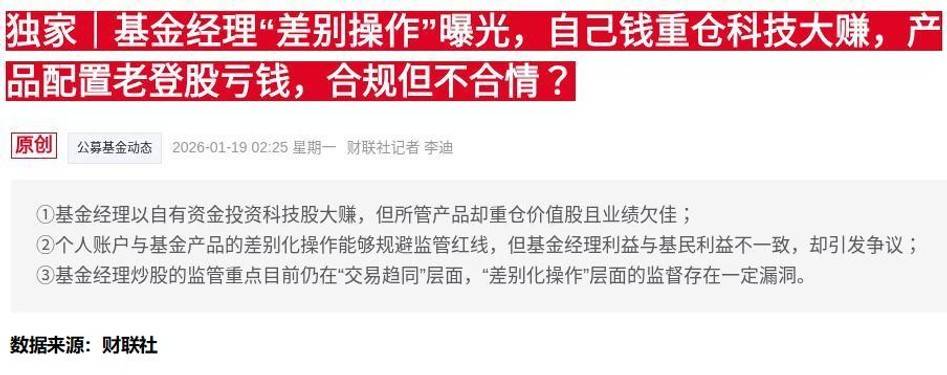
Group 1 - A fund manager has made significant profits from personal investments in technology stocks, exceeding 50 million, while the funds managed for investors are heavily invested in underperforming value stocks like liquor and home appliances [1] - The disparity between the fund manager's personal investment strategy and the managed funds highlights a potential conflict of interest, as the manager's actions do not align with the best interests of the investors [1] - Regulatory scrutiny is increasing on "trading similarity," but there are loopholes allowing for "differential operations," which can only be revealed through quantitative data analysis [1] Group 2 - The concept of "style switching" in the market is often used as an excuse for underperformance, but the real determinants of stock performance are actual capital movements and interactions among various funds [3] - A previously popular stock experienced significant volatility, with multiple sharp declines, indicating that relying solely on subjective judgment can lead to poor investment decisions [4] - Quantitative data analysis can uncover the true nature of capital movements, revealing the underlying dynamics that are often obscured by price fluctuations [5] Group 3 - The analysis of capital behavior shows that what appears to be frustrating volatility is actually a battleground for institutional and retail investors, with significant interactions between different types of capital [12] - The use of quantitative data allows for a clearer understanding of market dynamics, moving beyond subjective perceptions and biases that can cloud judgment [13] - By leveraging quantitative insights, investors can gain a more accurate view of market realities, including potential conflicts of interest in the fund management industry and the intricate dynamics of stock trading [14]

碳酸锂期货先扬后抑,旺季临近生猪震荡偏强|期货周报
2 1 Shi Ji Jing Ji Bao Dao· 2026-01-18 23:24
Commodity Market Overview - The commodity market showed mixed performance from January 12 to January 16, with the base metals sector leading gains while the black metals sector declined [1] - Energy and chemical sectors saw slight increases, with fuel up 0.32% and crude oil up 1.22% [1] - The black metals sector experienced declines, with coking coal down 2.05%, coke down 1.77%, and iron ore down 0.31% [1] - The base metals sector saw lithium carbonate up 1.94%, zinc up 3.06%, and nickel up 1.62% [1] - Precious metals saw significant gains, with gold up 2.57% and silver up 20.03% [1] - Agricultural products showed mixed results, with eggs up 1.05% and live pigs up 1.78%, while soybean meal fell 2.12% [1] Lithium Market Dynamics - Lithium carbonate futures experienced volatility, initially rising 17% before a sharp decline, closing the week at 146,200 yuan/ton after hitting a limit down [2][3] - Supply remained slightly increased, with domestic lithium carbonate production at 22,605 tons for the week, a 0.3% increase [2] - Demand remained strong despite seasonal trends, with December sales of new energy vehicles reaching 1.71 million units, a 28% year-on-year increase [2] Pig Market Trends - The pig futures market showed a strong upward trend ahead of the Spring Festival, with the main contract up 1.78% to 11,950 yuan/ton [4] - Supply dynamics indicated a slowdown in the outflow of pigs, with the number of breeding sows stable at 39.9 million heads [4] - Demand is expected to increase as the Spring Festival approaches, with slaughter rates showing slight improvements [4][5] Export Growth Insights - December 2025 saw a 6.6% year-on-year increase in exports, driven by strong performance in non-US markets and high-end manufacturing [6][7] - Key drivers included a significant increase in automobile exports and a recovery in consumer electronics demand [6][7] - The overall export growth is expected to remain resilient, supported by ongoing capital expenditure needs in Belt and Road Initiative countries [8] Financial Data and Policy Measures - December 2025 financial data revealed a decrease in new social financing, with a total of 2.21 trillion yuan, reflecting a year-on-year decline [9][10] - The People's Bank of China introduced structural monetary policy tools aimed at supporting targeted sectors, indicating a shift from broad monetary easing [12] - The focus on corporate loans showed a significant increase, while household loans continued to decline, indicating cautious consumer behavior [10][11]
碳酸锂期货先扬后抑,旺季临近生猪震荡偏强
2 1 Shi Ji Jing Ji Bao Dao· 2026-01-18 23:18
Group 1: Commodity Market Overview - The commodity market experienced mixed performance from January 12 to January 16, with basic metals leading gains and the black series declining [2] - In the energy and chemical sector, fuel rose by 0.32% and crude oil by 1.22%, while the black series saw declines in coking coal (down 2.05%), coke (down 1.77%), and iron ore (down 0.31%) [2] - The basic metals sector saw lithium carbonate increase by 1.94%, zinc by 3.06%, and nickel by 1.62%, while precious metals like gold and silver rose by 2.57% and 20.03%, respectively [2] Group 2: Lithium Carbonate Market Dynamics - Lithium carbonate futures experienced significant volatility, with a weekly increase of 1.94% but a high-low fluctuation exceeding 17% [3] - The market was initially driven by news of a reduction in battery export tax, leading to a price surge, but subsequent trading restrictions caused a sharp decline, closing at 146,200 CNY/ton [3] - The supply side showed a slight increase, with domestic lithium carbonate production at 22,605 tons, a 0.3% week-on-week increase, while demand remained strong despite seasonal trends [3][4] Group 3: Swine Futures and Market Trends - Swine futures showed a strong upward trend ahead of the Spring Festival, with the main contract rising by 1.78% to 11,950 CNY/ton [5] - The supply side indicated a slowdown in the outflow of pigs, with the number of breeding sows stabilizing at 39.9 million, while the average weight of slaughtered pigs slightly increased [5][6] - Demand is expected to rise as pre-festival stocking begins, with slaughter rates showing marginal improvement, indicating a potential for price stability [6] Group 4: Export Growth and Economic Indicators - In December, China's exports increased by 6.6% year-on-year, supported by strong performance in non-US markets and high-end manufacturing [7][8] - The growth was driven by adjustments in tariff policies and a rebound in consumer electronics demand, particularly through indirect channels [7][8] - Analysts expect continued export growth in 2026, supported by stable demand from non-US markets and capital expenditure needs in Belt and Road Initiative countries [8][9] Group 5: Financial Data and Corporate Financing - In December, the new social financing scale was 2.21 trillion CNY, with a year-on-year growth of 8.3%, indicating a recovery in corporate financing [10][11] - The increase in corporate loans was significant, with new loans reaching 1.07 trillion CNY, reflecting strong financing demand despite a decline in household loans [11][12] - Analysts predict that structural monetary policy tools will continue to support financing needs, particularly in technology and green sectors, while maintaining liquidity [12][13]
不锈钢:盘面锚定矿端矛盾,镍铁跟涨支撑重心:镍:印尼言论反复扰动,镍价宽幅震荡运行
Guo Tai Jun An Qi Huo· 2026-01-18 09:06
1. Report Industry Investment Rating No relevant content provided. 2. Core Views of the Report - The nickel price is expected to fluctuate widely in the short - term policy vacuum period due to the confrontation between industrial and secondary market funds. The key to breaking the deadlock lies in the implementation of Indonesian policies in the first quarter, especially the quota policy. For trading, it is recommended to consider options, and pay attention to structural opportunities. [4][5] - For stainless steel, the expectation of increased supply and weak demand in the off - season exerts pressure, while the cost center moves up due to the increase in ferronickel cost. Attention should be paid to the variables in Indonesian nickel ore policies. [6] 3. Summary by Related Catalogs 3.1 News Affecting the Nickel Market - **Quota Event**: On January 8, the Indonesian Ministry of Energy and Mineral Resources stated that the quota would be adjusted according to industry demand. On January 14, it was mentioned that the target might be cut to 260 million tons of nickel ore quota. The policy for 2026 is still under review, and it is expected that specific policies will be clarified in the first quarter. If the 260 - million - ton quota is implemented, it may lead to a shortage in the ore end and impact high inventories. [1] - **伴生 Mineral Event**: Indonesia wants to include associated minerals such as cobalt in the pricing and taxation system. If cobalt is priced, the direct cost of pyrometallurgy and hydrometallurgy may increase by about 5% - 10%. [2] - **违规 Fine Event**: Multiple companies in Indonesia are facing potential fines of about 80.2 trillion Indonesian rupiah for illegal occupation of forest land. The final fine may be lower than the initial estimate. If the fine is implemented, it may indirectly lead to higher ore prices. [2] - **Other Events**: In early 2026, Vale suspended its nickel mining business but later resumed normal operations after obtaining the 2026 mining quota approval. It is speculated that Indonesia may favor hydrometallurgical projects. [3] 3.2 Market Outlook 3.2.1 Nickel - Industrial players focus on the weak fundamentals of nickel, with over - supply pressure and expectations of low - cost hydrometallurgical production. They mainly adopt a strategy of selling at high prices for hedging. Secondary market funds expect policy changes in Indonesia and tend to go long at low prices in the long - term. In the short - term, nickel prices are expected to fluctuate widely, and the key lies in the implementation of Indonesian policies in the first quarter. [4][5] 3.2.2 Stainless Steel - The expectation of increased supply and weak demand in the off - season puts pressure on stainless steel. However, the increase in ferronickel cost due to various factors in Indonesia may push up the cost of stainless steel. The cost logic may cause the stainless steel price to oscillate with a higher center, but the marginal increase in supply and weak demand still have a drag effect. [6] 3.3 Inventory Tracking - **Refined Nickel**: On January 15, China's refined nickel social inventory decreased by 102 tons to 60,587 tons. LME nickel inventory increased by 942 tons to 285,732 tons. [7] - **新能源**: On January 16, the inventory days of upstream, downstream, and integrated production lines of SMM nickel sulfate increased slightly month - on - month. The precursor inventory and ternary material inventory also increased month - on - month. [7] - **Nickel - Iron - Stainless Steel**: On January 15, the full - industry chain inventory of SMM nickel - iron decreased by 2% month - on - month to 131,000 metal tons. Stainless steel factory inventory decreased in December, and the social inventory of stainless steel decreased week - on - week on January 15. [7] 3.4 Market News - Indonesia has suspended issuing new smelting licenses through the OSS platform for projects producing certain nickel - related products. [8] - China's Ministry of Commerce and General Administration of Customs have implemented export license management for some steel products since January 1, 2026. [8] - The Indonesian Nickel Miners Association revealed that the Ministry of Energy and Mineral Resources would revise the benchmark price formula for nickel ore commodities in early 2026, including treating cobalt as an independent commodity for royalty collection. [8] - The Indonesian government plans to significantly reduce the 2026 nickel ore production target from 379 million tons to 250 million tons. [10]
现货白银跌幅一度扩大至7% 机构提示大幅波动风险
Xin Lang Cai Jing· 2026-01-15 05:03
Group 1 - Silver prices experienced significant volatility, with a drop of up to 7%, falling from a historical high of $93 per ounce to $88.3 per ounce, highlighting the "short squeeze" risk in the market [1] - The current "open interest" in the silver market is approximately 590 million ounces, while the available inventory for physical delivery is only about 50 million ounces, resulting in a coverage ratio of around 7% [1] - Analysts indicate that the silver market is under pressure as the delivery month approaches, with short positions facing potential challenges if long positions opt for actual delivery [1] Group 2 - Recent increases in silver prices are driven by two main factors: lower-than-expected U.S. CPI data for December 2025, which has led to increased bets on interest rate cuts by the Federal Reserve, and escalating tensions between the U.S. government and the Federal Reserve, raising concerns about policy stability [2] - The market is characterized by strong momentum driven by macroeconomic risks, structural tensions, and geopolitical uncertainties, leading to increased investment in precious metals as safe havens [2] - Analysts predict that the precious metals market will maintain a strong trend, with gold as a core safe-haven asset and silver expected to perform strongly as a gauge of market risk appetite [2] Group 3 - Expectations for silver prices in 2026 include "high volatility and upward movement," with targets above $100 per ounce due to ongoing supply-demand imbalances and increased demand from strategic industries such as photovoltaics and electric vehicles [3] - The re-evaluation of silver's strategic resource value, combined with expectations of a loose monetary policy from the Federal Reserve, is expected to enhance silver's price elasticity and volatility [3] - Global geopolitical uncertainties are anticipated to attract investment for hedging against inflation, providing a premium for silver as a safe-haven asset [3] Group 4 - Financial institutions, including UBS and Bank of America, have raised their price forecasts for silver, with UBS noting that increased trading activity in the Chinese market could drive prices higher in the first half of the year [4] - Analysts recommend a strategy of maintaining core positions in gold while tactically participating in high-volatility assets like silver, platinum, and palladium, advising caution due to their unpredictable nature [4]
科创板两融升温,量化视角看融资目的
Sou Hu Cai Jing· 2026-01-13 04:17
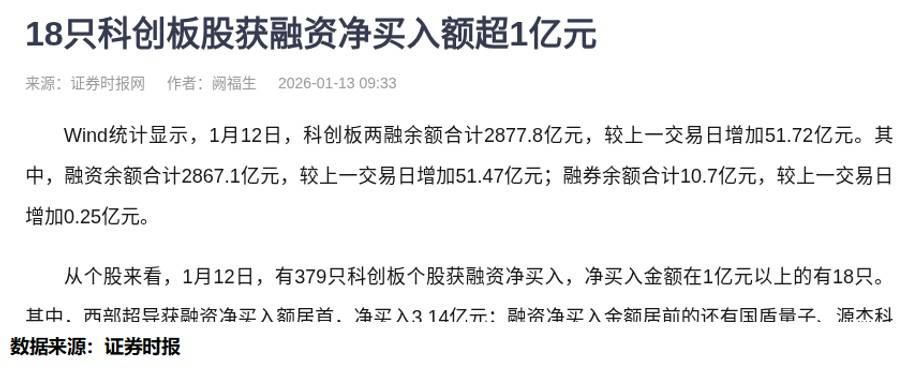
一、跳出表象看核心 很多人在看市场的时候,都会被表面的走势牵着走,比如有些个股涨起来看似毫无征兆,涨势迅猛的时候又不敢轻易介入,担心追高,结果哪怕回头 看有不少可以关注的时机,也只能错过。之前有个同事就经常遇到这种情况,盯着走势反复纠结,最后总是没抓住机会。 看图1: 最近留意到科创板的两融规模有明显提升,不少个股获得大额融资资金的青睐,很多人会好奇,这些被资金盯上的个股,背后有没有什么共通点?其 实与其纠结表面的涨跌,不如换个角度用数据去看背后的交易行为,这才是更贴近市场本质的方式。 但其实所有的走势变化,根源都是交易行为的改变,不管是涨还是调整,都是因为资金的交易行为发生了变化,所以与其去猜走势会怎样,不如直接 去看资金的交易行为到底是什么样的。二、量化数据的独特视角 传统的分析方式往往聚焦在走势或者基本面,容易忽略最核心的交易行为,而量化大数据能帮我们直接拆解这些行为,看到市场背后的真实状态。我 自己用了十多年的量化大数据系统,就能提供这样的交易资金数据。 看图3: 这类走势很容易让人陷入困惑,不知道什么时候该关注,什么时候该保持观望,毕竟从表面上看,没有任何提前的信号可以参考,只能被动跟着行情 走。 ...
年末IPO热背后,我看懂了资金的小心思
Sou Hu Cai Jing· 2026-01-10 02:56
Core Viewpoint - The IPO market is expected to be particularly active by the end of 2025, with companies like Moer Technology and others going public, indicating a shift in investment strategies towards new exit methods such as mergers and acquisitions, and a more lenient approach to buybacks [1][4]. Group 1: IPO Market Dynamics - The essence of the IPO boom is that funds are selecting companies with patience, as evidenced by early investments in Moer Technology, where an institution invested 1.9 million within three months of the company's establishment [4]. - Institutions are not merely gambling on luck; they are interpreting the "attitude of funds," which includes monitoring institutional inventory and the interest of speculative funds in a stock [4][14]. - The increase in institutional inventory indicates ongoing interest and tracking of a company, suggesting it has the potential for growth [4]. Group 2: Understanding Market Signals - Stocks that perform well often exhibit signals of "secondary accumulation," where the first round of speculative buying is followed by a period of consolidation before a second round of buying occurs [5][12]. - The concept of "institutional shaking" refers to institutions not selling but rather consolidating their positions and preparing for a price increase by eliminating weak hands [14]. - The second round of speculative buying is seen as a confirmation of the stock's potential, indicating that institutions are ready to support the price [14][15]. Group 3: Investment Strategy Insights - Understanding the dynamics of fund competition is more beneficial than chasing hot stocks, as demonstrated by a friend's experience with a renewable energy stock that rebounded after institutional accumulation was identified [13]. - The investment philosophy emphasizes finding long-term value rather than seeking quick profits, aligning with the trend of flexible exits reflecting a deeper understanding of high-risk, long-cycle investments [12][16]. - Investors should focus on indicators such as increases in institutional inventory, occurrences of institutional shaking, and the presence of secondary accumulation before making investment decisions [15][16].
高盛调了几家公司评级,我用大数据看出了门道
Sou Hu Cai Jing· 2026-01-07 00:04
Group 1 - Goldman Sachs downgraded Baosteel and China Aluminum while upgrading Yanzhou Coal and China Coal Energy [1] - ByteDance's "Doubao" AI glasses are rumored to be released, but the company clarified there are no concrete sales plans [1][3] - The market's reaction to news is often driven by underlying capital movements rather than the news itself [1][4] Group 2 - Shareholders of various companies, including Pioneer Technology and Baichuan Energy, plan to reduce their holdings by up to 3% [3] - Significant share unlocks are occurring, with Baichuan Energy's unlock amount estimated at 96.319 billion yuan, accounting for 72.20% of total shares [3] - The electric vehicle market is expected to see only a 13% growth in global sales by 2026, influenced by various regulatory changes [3] Group 3 - The perception of stock price movements can be misleading; declines may indicate institutional accumulation rather than weakness [4][9] - Data analysis reveals that stocks experiencing "capital grabbing" often show signs of future price increases [5][6] - Institutions may use price declines as opportunities to accumulate shares, contrary to public sentiment [8][10]




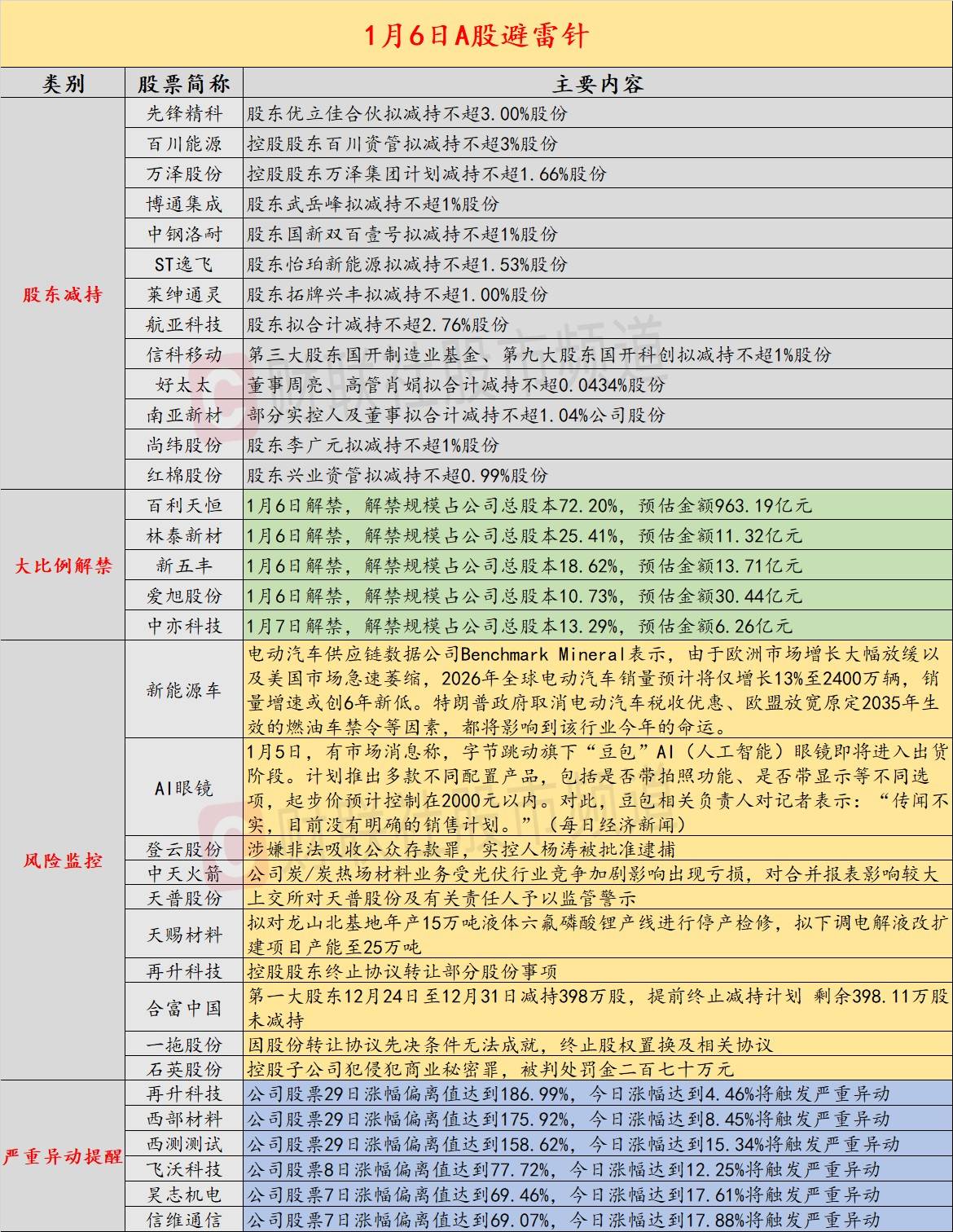
情绪退潮后波动更剧烈 钯期货遭遇一波急速上涨
Jin Tou Wang· 2026-01-05 06:06
Group 1 - The core viewpoint of the article highlights a significant increase in palladium futures, with the main contract reaching a peak of 467.00 yuan and closing at 448.15 yuan, reflecting a rise of 7.75% [1] Group 2 - Galaxy Futures indicates that there is a risk of price jumps in the domestic palladium market after opening, suggesting that the market may operate under a tight fundamental backdrop combined with a loose macro environment [2] - Hualian Futures notes that the short-term market for palladium is characterized by intense capital speculation, with limited fundamental support due to the increasing penetration of new energy vehicles in China, which suppresses demand for palladium [2] - The industrial demand for palladium is primarily driven by gasoline vehicle exhaust catalysts, and the previous price increase was largely influenced by movements in gold and silver, leading to heightened volatility as market sentiment shifts [2]
2026年会是大宗商品的全面牛市吗?
对冲研投· 2026-01-02 11:04
Core Viewpoint - The article discusses the significant trends and dynamics in the commodity market for 2025, highlighting the extreme differentiation in performance among various commodities and the impact of geopolitical factors and supply-demand dynamics on pricing [4][5][6]. Group 1: Commodity Performance - Gold has reached historical highs, with prices nearing $4,550 per ounce, reflecting a year-to-date increase of over 70% [4]. - Silver has also shown remarkable performance, breaking through key price levels and reaching over $79 per ounce [4]. - Other metals like platinum, palladium, and industrial metals such as copper have also achieved significant price increases due to strong market demand [4]. Group 2: Market Dynamics - There is a stark differentiation in commodity performance, with some experiencing speculative trading while others face supply constraints [5]. - The market is witnessing a shift from broad demand recovery to a focus on supply constraints and structural demand, driven by energy transition and AI developments [5]. - The "反内卷" (anti-involution) policy in China has led to price surges in certain commodities, but the sustainability of these price increases is uncertain [7]. Group 3: Import Dependency and Price Trends - Commodities with high import dependency, such as platinum and palladium, are more susceptible to price increases due to domestic pricing power issues [9]. - The market for PX remains tight despite low import dependency, leading to price increases driven by limited supply channels [9]. Group 4: Speculative Trading and Market Sentiment - The article notes that speculative trading has become prevalent, particularly in commodities like lithium carbonate, where market sentiment can drive prices irrespective of fundamental factors [11]. - Predictions for 2026 suggest a continuation of the upward trend for precious and base metals, with copper expected to be a standout performer [12]. Group 5: Future Outlook and Considerations - The article raises questions about the potential for a comprehensive bull market in commodities in 2026, suggesting that current trading may have already priced in many expectations [13][14]. - It emphasizes the need to monitor supply-side changes and valuation concerns as many commodities may struggle to find upward momentum in the face of oversupply [15][18]. - The potential for geopolitical risks and economic uncertainties, such as the AI bubble or conflicts, could impact commodity markets significantly [19].