顺周期板块

Search documents
A股“马上赚钱”?最新解读来了
Zhong Guo Ji Jin Bao· 2026-02-12 07:06
Core Viewpoint - The A-share market is expected to maintain a "slow bull" pattern in the Year of the Horse, supported by multiple favorable factors such as global liquidity easing, steady domestic economic recovery, improving corporate profits, and a supportive policy environment [1][5][8]. Market Outlook - The overall market is anticipated to continue a stable upward trend, potentially achieving a "three consecutive annual gains" for the first time in years, driven by corporate profits, market confidence, and a shift in deposit allocation [5][6]. - The market style is expected to transition from liquidity-driven to profit-driven, highlighting opportunities in technology growth, cyclical recovery, high-end manufacturing exports, and domestic demand recovery [1][3][8]. Sector Opportunities - Key investment themes include: 1. AI industry chain bottlenecks, particularly in infrastructure such as power, storage, and cooling [14]. 2. High-end manufacturing with global competitiveness, especially in engineering machinery, power equipment, and new energy vehicles [14][15]. 3. Cyclical leaders benefiting from supply-demand improvements due to policies against "involution" [14][15]. - The technology growth sector remains a core focus, with ongoing trends in AI and semiconductor hardware expected to drive investment opportunities [12][19]. Economic and Policy Environment - The macroeconomic environment is viewed as stable, with systemic risks being low. The expectation of a positive macro policy in 2026 is anticipated to alleviate supply-demand imbalances [7][8]. - The overall investment environment is expected to improve, with a gradual increase in incremental capital entering the market, driven by the performance of active equity funds [7][8]. Market Style Evolution - The market is likely to experience a "rebalancing" of styles, with both technology and cyclical sectors coexisting and presenting investment opportunities [11][12]. - The anticipated economic recovery may lead to a significant "high-low switch," where funds shift from high-valued sectors to those at historical lows [12][18]. Risks and Challenges - Potential risks include slower-than-expected domestic economic recovery, geopolitical tensions, and fluctuations in AI-related narratives that could impact market stability [23][24][25].
财政"万亿级"弹药就位!基建复苏打响估值修复战,建材ETF(159745)锁仓顺周期龙头
Sou Hu Cai Jing· 2026-02-11 09:28
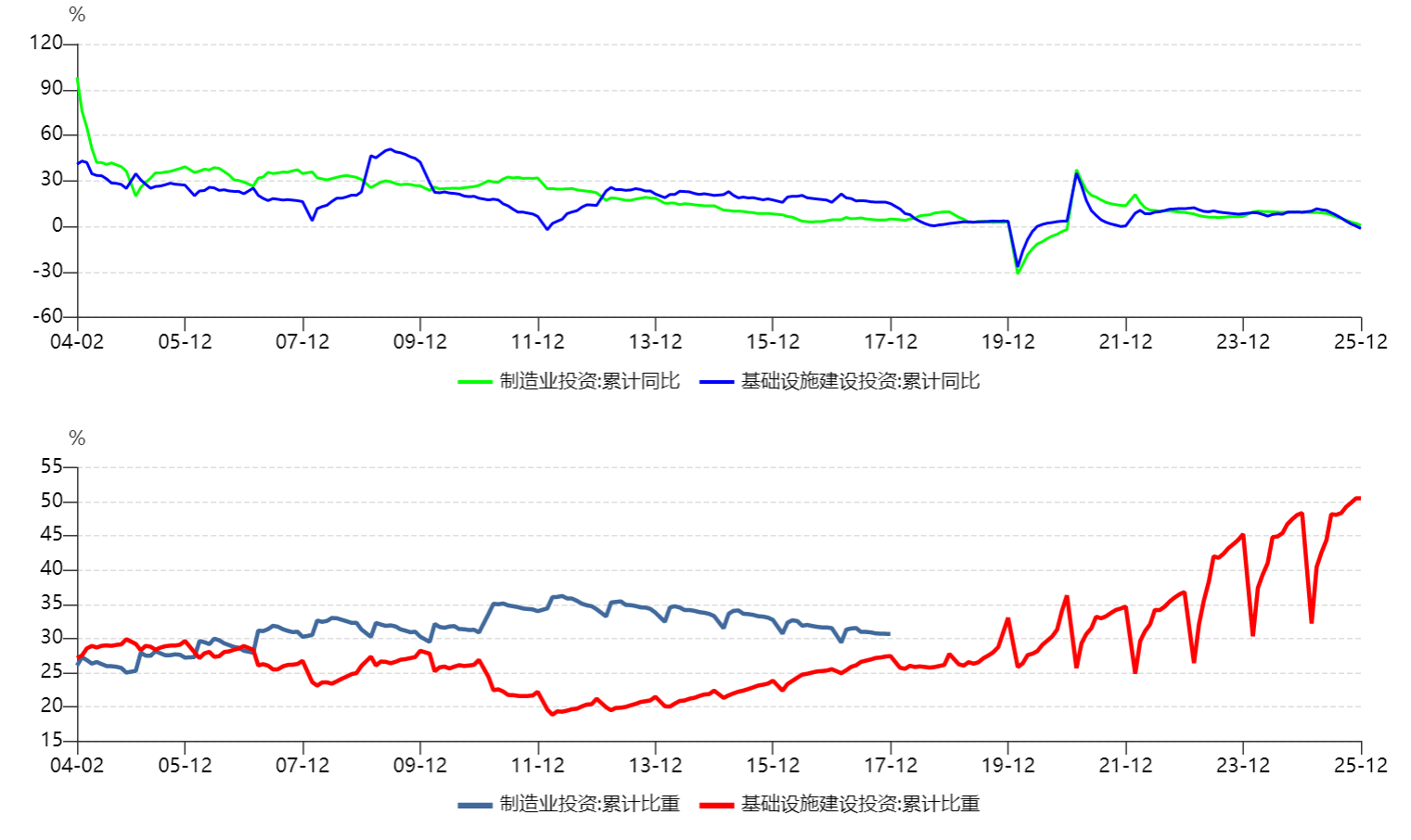
Core Viewpoint - Current infrastructure investment is becoming a crucial support for the economy, with fiscal policies continuously strengthening, leading to a configuration window driven by infrastructure recovery in the building materials sector [1] Group 1: Infrastructure Investment Dynamics - The "14th Five-Year Plan" is entering its final year, accelerating the implementation of major engineering projects, which is providing solid support for the improvement of the industry fundamentals through the demand pull of infrastructure [1] - Since the second half of 2024, active fiscal policies have significantly increased, with the pace of special bond issuance accelerating and the launch of ultra-long special government bonds injecting ample funds into infrastructure investment [1] - Infrastructure investment has a clear policy orientation and planning, unlike the endogenous fluctuations of real estate investment, with 2025 being a key year for the transition between the "14th" and "15th" Five-Year Plans [1][4] Group 2: Investment Trends and Performance - Despite a year-on-year decline in cumulative infrastructure construction investment to -1.48% in December, the cumulative proportion of infrastructure investment remained high at 50.49% in December 2025, reflecting its significant position in fixed asset investment [1][4] - Key areas for current infrastructure investment include urban agglomerations, metropolitan areas, and the connectivity of infrastructure along the "Belt and Road" [4] - Major infrastructure projects are expected to drive demand for cement, pipes, waterproof materials, and other building materials, with a focus on water conservancy and disaster prevention projects [4][5] Group 3: Building Materials Sector Outlook - The building materials industry is currently in a low operating state after inventory destocking, and the concentrated release of infrastructure demand is expected to trigger price elasticity [5] - The profitability transmission from infrastructure recovery is anticipated to drive the development of the building materials sector, with a notable improvement in gross profit margins due to supply-side discipline and cost pressure relief [6] - The building materials sector is characterized by "valuation repair + profit improvement," with the risk of a cliff-like decline in demand eliminated by infrastructure support, leading to a systematic uplift in valuation [8] Group 4: Investment Vehicles and Strategies - The building materials ETF (159745) tracks the CSI All-Share Building Materials Index, covering leading enterprises across the entire industry chain, providing an efficient tool for investors to layout in the building materials sector [8][9] - The top ten holdings in the ETF reflect a high concentration in leading companies across various segments of the building materials industry, accounting for over 60% of the total holdings [9] - The building materials sector is highlighted as a core cyclical investment, with low valuations and high dividends, making it attractive for investors during market shifts towards cyclical stocks [12]




顺周期板块“后劲”十足,水泥需求迎结构性重塑,建材ETF(159745)连续4天获资金净流入,最新规模创成立以来新高
Xin Lang Cai Jing· 2026-02-10 03:36
Core Viewpoint - The construction materials sector is experiencing fluctuations, with the building materials ETF showing a recent increase in net inflows and a positive performance trend, despite some underlying challenges in the cement industry [1][2][3]. Group 1: ETF Performance - The latest size of the building materials ETF reached 2.307 billion, marking a new high since its inception, ranking in the top third among comparable funds [2] - The ETF's shares have also reached a new high of 3.103 billion shares, ranking in the top third among comparable funds [2] - Over the past week, the ETF has seen a cumulative increase of 7.35%, ranking in the top third among comparable funds [1][3] Group 2: Fund Flows and Trading Activity - The building materials ETF has experienced continuous net inflows over the past four days, with a maximum single-day net inflow of 207 million, totaling 513 million in net inflows [2] - The ETF's trading volume has been robust, with an average daily transaction of 274 million over the past week, leading among comparable funds [1] Group 3: Industry Insights - The cement industry is undergoing a structural reshaping of supply and demand, with expectations of a fifth consecutive year of negative growth in cement production by 2025 [2] - The industry is facing dual constraints from stricter capacity replacement and the formal inclusion of the national carbon market, which may lead to a phase of price increases despite limited overall rebound potential [2] - Recent policies in major cities, such as increased second-hand housing transactions and urban renewal initiatives, are expected to support the recovery of construction material demand [3] Group 4: Risk and Return Metrics - The building materials ETF has a one-year Sharpe ratio of 1.29, indicating a favorable risk-adjusted return [4] - The maximum drawdown for the ETF this year is 5.48%, with a recovery time of just 2 days, the fastest among comparable funds [4] Group 5: Management and Tracking - The management fee for the building materials ETF is 0.50%, and the custody fee is 0.10% [5] - The ETF has a tracking error of 0.065% over the past six months, the highest tracking precision among comparable funds [6] - The index tracks the overall performance of listed companies in the construction materials sector, with the top ten weighted stocks accounting for 61.6% of the index [6]
兴银收益增强A(003628)净值再创历史新高! 2026年密切关注顺周期板块
Jin Rong Jie· 2026-02-10 02:56
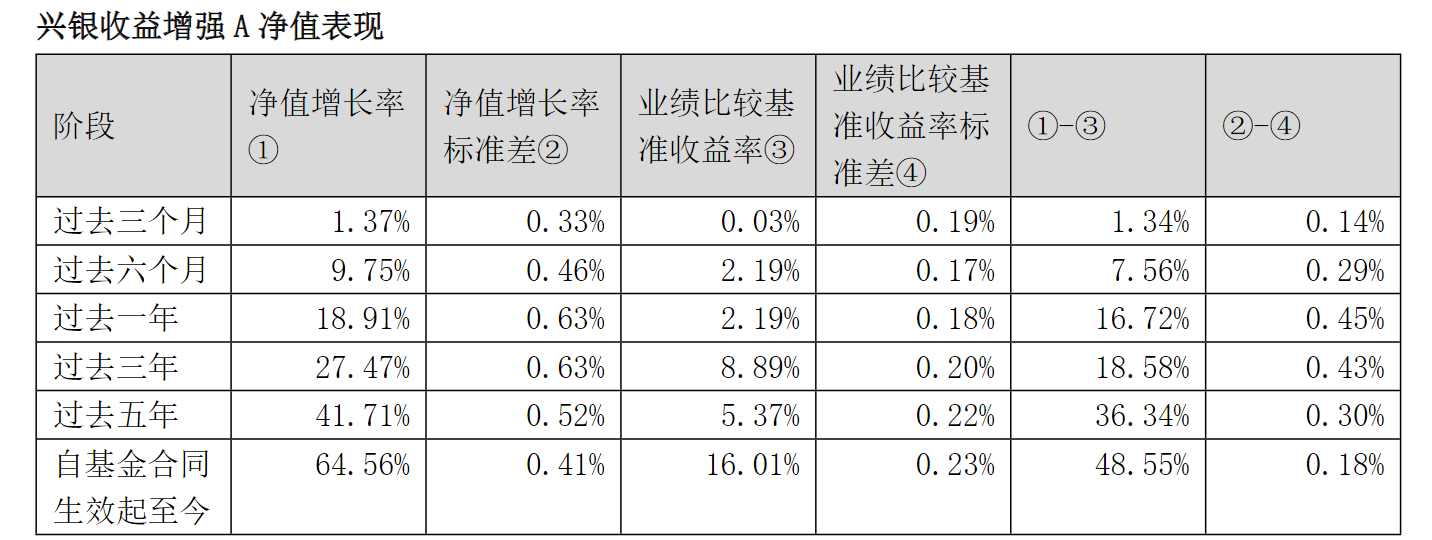
Core Viewpoint - The fund "Xingyin Enhanced Income A" (003628) has achieved a historical net value high of 1.3703 yuan as of February 9, with a daily growth of 0.51% and a five-year return of 44.68%, ranking 27th out of 576 in its category [1][2]. Performance Summary - The fund's one-year return is 18.91%, surpassing the benchmark return of 16.72% [1][2]. - Over the past five years, the fund has delivered a return of 41.71%, exceeding the benchmark return by 36.34% [1][2]. - Since inception, the fund has achieved a total return of 64.56%, outpacing the benchmark by 48.55% [1][2]. Asset Allocation - The fund is classified as a high-flexibility secondary bond fund, with 16.11% in equities and 76.93% in bonds [2]. - The bond allocation primarily consists of government bonds, which account for 54.33% of the net value, a decrease of 17.58% from the previous period [2]. - Convertible bonds make up 16.78% of the net value, reflecting an increase of 16.84% [2]. - The manufacturing sector is the main focus for equity investments, comprising 14.06% of the net value, down by 1.38% [2]. Manager Insights - The fund manager indicates a strategic approach in a low-interest-rate environment, with a focus on convertible bonds and a balanced stock portfolio [3]. - Key sectors of interest include cyclical manufacturing, new consumption trends, and technology applications, particularly in artificial intelligence and renewable energy [3]. - The outlook for the consumer sector is optimistic, with expectations for strong companies to emerge from the downturn and expand into high-end markets [3]. Fund Manager Background - "Xingyin Enhanced Income A" was established on November 28, 2016, and is managed by Luo Yida and Deng Jichao, both of whom hold master's degrees and have significant experience in fund management [4].
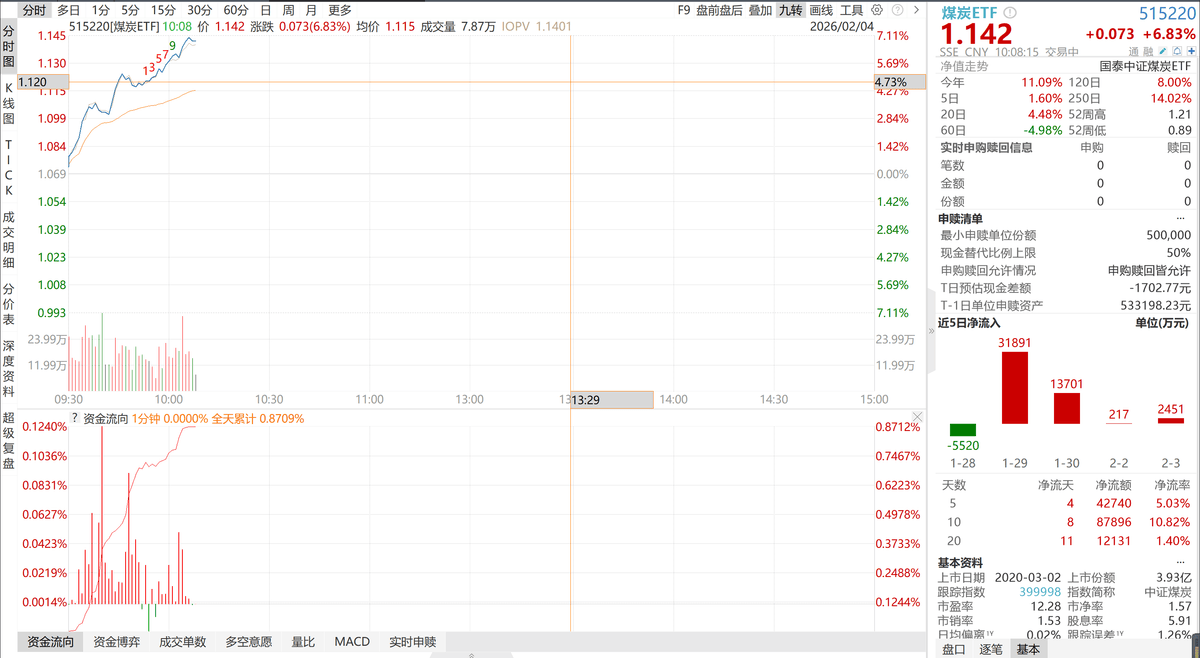
顺周期板块崛起!煤炭ETF(515220)迎来强势反弹涨近7%
Sou Hu Cai Jing· 2026-02-04 02:51
Core Viewpoint - The coal sector is experiencing a strong performance, with significant capital inflow into coal ETFs, driven by attractive valuation metrics and high dividend yields, presenting a dual opportunity for investors [1][3][5] Group 1: Market Performance - The coal ETF (515220) has seen over 400 million yuan in net inflow over the past five days, indicating strong investor interest [1] - As of January 28, 2026, the China Securities Coal Index has a price-to-book ratio of 1.59 and a dividend yield of 5.82%, making it particularly appealing in a low-interest-rate environment [1] Group 2: Supply and Demand Dynamics - The coal industry is currently in a critical phase of supply-demand balance, providing solid fundamental support for a sector rebound [3] - Supply constraints are characterized by enhanced restrictions and slowing growth, with domestic coal production expected to grow only 0.5%-1% by 2026 due to regulatory measures and limited new capacity [3] - Demand is showing marginal improvement, driven by increased electricity consumption during winter and a recovery in industrial production, particularly in chemical and steel sectors [3] Group 3: Valuation and Investment Appeal - The coal sector's valuation is at a historical low, with a price-to-earnings ratio of 13.99 and a price-to-book ratio of 1.56, suggesting ample room for valuation recovery as coal prices rise and corporate profitability improves [4] - The high dividend yield characteristic of the coal industry, with leading companies offering yields between 4%-8%, provides a defensive investment option amid market volatility [5] Group 4: Institutional Interest and Fund Flows - Institutional holdings in the coal sector are at historical lows, but as the fundamental outlook improves, capital is gradually returning, enhancing liquidity and creating a positive feedback loop of improved fundamentals, capital inflow, and rising stock prices [6] Group 5: Investment Tools - The coal ETF (515220) serves as an efficient tool for investors to gain exposure to the coal sector, encompassing leading companies with strong capacity and dividend attributes, thus allowing investors to mitigate individual stock risks while benefiting from sector recovery and high dividends [7]
掘金日报(1.29)|茅台单日吸金57亿夺冠,紫金矿业流出近33亿成“失血”最大个股
和讯· 2026-01-29 10:58
Core Viewpoint - The A-share market shows structural differentiation, with capital shifting from electronic and power equipment sectors to media, food and beverage, and non-ferrous metals sectors [3][5]. Market Overview - As of January 29, the Shanghai Composite Index closed at 4157.98 points, up 0.16%, with a trading volume of 14857.95 billion yuan. The Shenzhen Component Index closed at 14300.08 points, down 0.30%, with a trading volume of 17442.13 billion yuan. The ChiNext Index closed at 3304.51 points, down 0.57%, with a trading volume of 7895.02 billion yuan [1]. Capital Flow Analysis - The top five sectors for capital inflow included media (net inflow of 220.78 billion yuan, up 3.53%), food and beverage (net inflow of 168.06 billion yuan, up 6.57%), and computer (net inflow of 138.80 billion yuan, up 0.01%). The electronic sector experienced the largest capital outflow, with a net outflow of 364.79 billion yuan, followed by power equipment, defense industry, machinery, and communication sectors [4][5]. Individual Stock Performance - The top five stocks for capital inflow were led by Kweichow Moutai (net inflow of 57.08 billion yuan, up 8.61%), followed by BlueFocus (net inflow of 45.30 billion yuan, up 14.93%), and iFlytek (net inflow of 36.30 billion yuan, up 6.42%). The largest capital outflow was from Zijin Mining, with a net outflow of 32.63 billion yuan [6][7]. Market Sentiment and Trends - A total of 89 stocks hit the daily limit up, indicating a relatively high level of localized profit-making opportunities. The food and beverage sector showed strong performance, with 21 stocks hitting the limit up, accounting for about 24% of the total, particularly in the liquor segment [8]. - The market is currently favoring both value and growth, with funds shifting from previously popular tech growth sectors to defensive sectors like consumption and finance, reflecting a preference for stocks with high earnings certainty [8][14]. Sector-Specific Insights - The liquor, oil and gas, and precious metals sectors collectively strengthened, driven by rising consumption expectations for the Spring Festival, soaring international commodity prices, and macroeconomic risk aversion [14]. The liquor sector saw a significant surge, with the China Securities Liquor Index rising 9.93%, marking the largest single-day increase in 16 months [14]. - Kweichow Moutai's wholesale price for 2025 and 2026 increased by 20 yuan, reaching 1620 yuan and 1610 yuan per bottle, respectively, indicating strong price support due to supply control measures [14][15]. Market Structure Characteristics - The market exhibited a "broad first board, concentrated second board, and scarce high-level" structure, with cautious sentiment prevailing. The second board had 9 stocks, primarily in resource sectors, indicating a strengthening of cyclical stocks [10]. - Several stocks demonstrated "N-day M-board" trend patterns, such as Intercontinental Oil and Zhaojin Mining, reflecting the continuation of trend-based trading in resource stocks [11].


一阳穿多阴!贵州茅台大涨超6%,房地产板块掀涨停潮
Mei Ri Jing Ji Xin Wen· 2026-01-29 06:22
Group 1 - The core viewpoint of the article highlights a strong performance in the liquor and real estate sectors, with Kweichow Moutai rising over 6% and other liquor stocks following suit, indicating a bullish trend in these cyclical industries [1] - The real estate sector also saw significant gains, with multiple companies such as Shenzhen Housing A and Joy City hitting the daily limit up, reflecting a positive market sentiment [1] - The Food and Beverage ETF (515170.SH) experienced an increase of over 4% during the trading session, driven by substantial single-day purchases, and it holds a basket of quality liquor stocks, with Kweichow Moutai and Luzhou Laojiao being major components [1] Group 2 - Recent regulatory changes indicate that many real estate companies are no longer required to report "three red lines" data monthly, which may ease operational pressures for these firms [1] - Historical trends show that the real estate and food and beverage sectors typically move in tandem, suggesting a potential for synchronized recovery [1] - The government has prioritized expanding domestic demand as a key task for 2026, aiming to stabilize the real estate market and potentially boost consumer demand, which could benefit both sectors [1]
转债较权益超额延续,可关注顺周期板块
Jianghai Securities· 2026-01-26 08:08
- The report primarily focuses on the performance and analysis of the convertible bond market, including market trends, individual bond performance, valuation analysis, and clause tracking, but does not include any quantitative models or factors for construction or testing[1][3][8] - The convertible bond market's weekly performance (2026-01-19 to 2026-01-23) is highlighted, with indices such as the Shanghai Convertible Bond Index, Shenzhen Convertible Bond Index, and CSI Convertible Bond Index showing weekly returns of 2.790%, 3.175%, and 2.921%, respectively[3][8][11] - The report provides detailed data on trading volume and value for convertible bonds and their corresponding stocks, showing a week-over-week decline in activity, with convertible bond trading volume at 241,961.36 million units and trading value at 46,654,679.30 million yuan[3][8][11] - Individual convertible bond performance is analyzed, with the top five gainers being Jiamei Convertible Bond (48.11%), Fuxin Convertible Bond (30.99%), Tianchuang Convertible Bond (29.26%), Dazhong Convertible Bond (24.16%), and Shuangliang Convertible Bond (22.40%)[20][21] - The report also lists the top five decliners, including Huiche Convertible Bond (-32.91%), Dongshi Convertible Bond (-17.81%), Yinbang Convertible Bond (-7.14%), Huanxu Convertible Bond (-6.45%), and Haohan Convertible Bond (-5.71%)[20][22] - Valuation analysis includes the distribution of convertible bond prices, with 213 bonds priced above 140 yuan, representing 56.50% of the market, and the median conversion premium rate for this category at 26.73%[11][34][39] - Clause tracking reveals that 107 convertible bonds have triggered downward revision clauses, and seven bonds are likely to trigger conditional redemption clauses, including Fuchun Convertible Bond, Jiahe Convertible Bond, Xingfa Convertible Bond, Yongxi Convertible Bond, Yinbang Convertible Bond, Weixin Convertible Bond, and Yaoji Convertible Bond[41]
知名基金经理最新持股曝光!睿远基金赵枫:关注中国企业出海
Shang Hai Zheng Quan Bao· 2026-01-25 00:03
Group 1 - The core viewpoint of the article highlights significant adjustments in fund managers' portfolios, indicating a generally optimistic outlook for the market [1] Group 2 - Fund manager Fu Pengbo increased the equity investment in the Ruiyuan Growth Value Mixed Fund to 90.48% of total assets by the end of 2025, up from 89.93% at the end of the third quarter [2] - The top ten holdings now account for 70.38% of the fund's net asset value, an increase of 4.34 percentage points from 66.04% in the previous quarter [2] - Notably, China Mobile has exited the top ten holdings, replaced by high-performing companies in the photovoltaic and semiconductor equipment sectors [2] - Fu Pengbo is preparing for 2026 by reducing positions in companies with weak fundamentals and increasing investments in data center liquid cooling, storage, and computing-related companies [3] - Fu Pengbo remains optimistic about sectors like AI, non-ferrous metals, and lithium battery materials, expecting high growth in these areas [3] Group 3 - Fund manager Zhao Feng's Ruiyuan Balanced Value Three-Year Holding Mixed Fund maintains a high equity investment ratio of 90.66% [4] - Zhao Feng has reduced positions in overvalued stocks while increasing holdings in quality leading companies with lower valuations [4] - The expected static return from cash flow-rich companies is around 5%, with potential growth leading to returns exceeding 10% for some leading firms [4] - Zhao Feng emphasizes the importance of domestic leading companies expanding overseas, transitioning from simple exports to local manufacturing and services [5] - These companies are expected to see significant revenue growth from overseas markets over the next five to ten years, driven by improved service and brand recognition [5] Group 4 - Fund manager Yang Jinjing has made substantial adjustments in the Jiao Yin Shi Luo De Rui Yuan Three-Year Regular Open Mixed Fund, increasing exposure to cyclical sectors [6] - New additions to the top ten holdings include several airline stocks, while multiple power sector stocks have exited [6] - Yang Jinjing is focusing on industry leaders that are experiencing or about to experience turning points, estimating that only 20%-30% of these leaders will emerge early from the downturn [6][7] - The expectation is that industry leaders will achieve long-term turning points through competitive advantages, leading to profit upgrades and valuation increases [7]

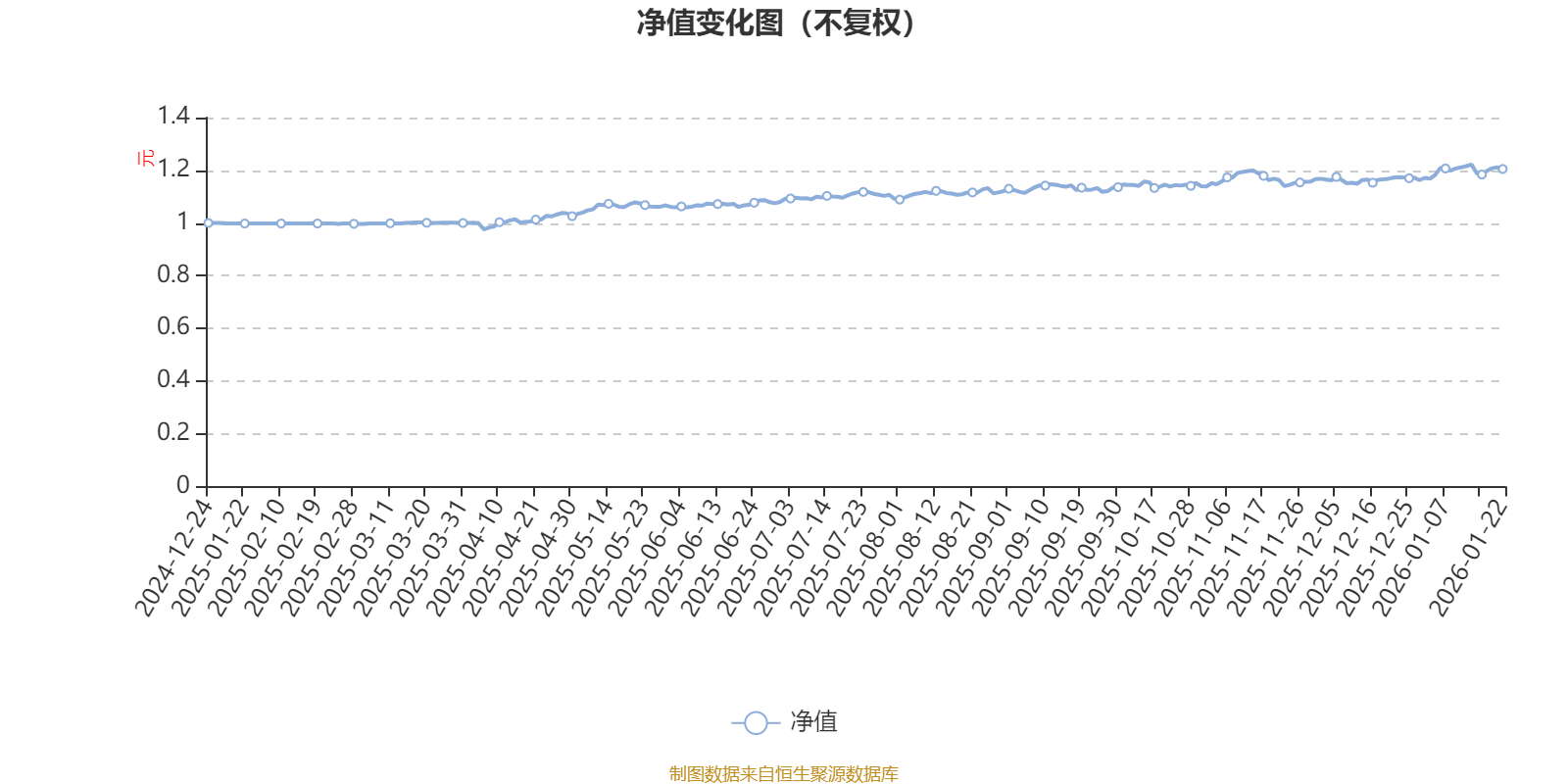
嘉实红利精选混合发起式A:2025年第四季度利润105.87万元 净值增长率2.84%
Sou Hu Cai Jing· 2026-01-23 15:15
Core Viewpoint - The report highlights the performance and outlook of the Jiashi Dividend Select Mixed Fund A (022495) for the fourth quarter of 2025, indicating a profit of 1.0587 million yuan and a net asset value growth rate of 2.84% [3]. Fund Performance - The fund's profit for the fourth quarter was 1.0587 million yuan, with a weighted average profit per share of 0.0327 yuan [3]. - As of January 22, the fund's unit net value was 1.205 yuan [3]. - The fund's net asset value growth rates over different periods are as follows: 8.93% over the last three months, 10.96% over the last six months, and 24.68% over the last year [3]. Fund Management Insights - The fund management anticipates better performance in dividend sectors with growth potential, particularly in insurance, overseas chains, and certain cyclical sectors, with expectations extending into 2026 [3]. - There is an increased focus on bottom dividend sectors, and the potential recovery of consumer sentiment in 2026 is highlighted, especially among leading consumer stocks with attractive dividend yields [3]. Fund Metrics - The fund's Sharpe ratio since inception is 1.7625 [4]. - The maximum drawdown since inception is 4.95%, occurring in the fourth quarter of 2025 [7]. - The average stock position since inception is 71.47%, with a peak of 91.94% at the end of 2025 and a low of 13.94% at the end of the first quarter of 2025 [10]. Fund Size and Holdings - As of the end of the fourth quarter of 2025, the fund's size was 35.6012 million yuan [11]. - The top ten holdings of the fund include major companies such as China Construction Bank, China Merchants Bank, and China National Offshore Oil Corporation [14].