
AI投资泡沫

Search documents
财信证券宏观策略周报(12.8-12.12):指数震荡企稳,逐步低吸科技方向-20251207
Caixin Securities· 2025-12-07 10:56
Group 1 - The report indicates that the A-share market is currently experiencing a low-level oscillation, with initial signs of stabilization as major indices' moving averages converge, awaiting a new trend in the market [4][7][16] - It is anticipated that a new buying window will open around mid-December, driven by institutional funds repositioning for the next year, the Central Economic Work Conference, and the expected interest rate cuts by the Federal Reserve [4][16] - The long-term outlook suggests a "slow bull" market for A-shares in 2026, supported by improved corporate performance, increased household savings entering the market, and a favorable global liquidity environment [4][7] Group 2 - The report highlights the potential for significant growth in the commercial aerospace sector, with the market expected to exceed 2.5 trillion yuan this year, driven by favorable policies and the establishment of dedicated regulatory bodies [11] - There is a focus on strategic minor metals and industrial metals, with expectations for a rebound in prices as the price gap between precious metals and these metals continues to widen [9][10] - The report emphasizes the importance of the AI application sector and domestic AI computing capabilities, which are expected to benefit from policy support and market trends [17][18] Group 3 - The real estate market is showing signs of divergence, with new home prices increasing while second-hand home prices continue to decline, affecting consumer sentiment [8] - The report notes that the financial sector is undergoing a transformation towards high-quality development, with regulatory changes expected to inject significant liquidity into the market [12] - The anticipated interest rate cuts by the Federal Reserve are expected to positively impact sectors such as non-ferrous metals and innovative pharmaceuticals [18]
CME“美联储观察”预测美联储12月降息概率升至87%,500质量成长ETF(560500)涨0.09%
Sou Hu Cai Jing· 2025-12-05 02:57
Group 1 - The core viewpoint of the articles indicates that the U.S. labor market is showing signs of cooling, leading to increased speculation that the Federal Reserve will lower interest rates in December, with a probability of 87% for a 25 basis point cut [1] - The 中证500 quality growth index has shown slight increases, with notable performances from stocks like 杰瑞股份 (up 5.73%) and 天山铝业 (up 3.29%) [1] - Financial institutions are beginning to position themselves for 2026, anticipating improved liquidity in the A-share market as concerns over "AI investment bubbles" subside [2] Group 2 - The discussion around the next Federal Reserve chairperson continues to generate market interest, with opinions suggesting that even if 哈西特 is appointed, rapid rate cuts may not be feasible due to the collective decision-making nature of the Fed [1] - The 中证500 quality growth index is managed by 中证指数有限公司, which does not guarantee the accuracy or completeness of the index [2]


【机构策略】A股市场整体运行偏弱 本阶段需要保持耐心
Zheng Quan Shi Bao Wang· 2025-12-05 01:50
Group 1 - The A-share market is experiencing low activity, with a continuation of volume contraction and a cautious sentiment among investors [1] - The Moer Thread concept and commercial aerospace sectors are showing strength, while the consumer sector is generally adjusting [1] - There is an expectation for a new bullish window in the A-share market as institutional funds begin to position for 2026, alongside anticipated interest rate cuts from the Federal Reserve [1] Group 2 - In December, incremental funds are expected to maintain a stable net inflow, with foreign capital activity likely to continue to rise [2] - The macro liquidity environment remains stable due to the central bank's support, with expectations for reasonable liquidity to persist [2] - The stock market saw a shift to net outflows in November, with new equity fund issuance increasing while refinancing scales decreased [2]
A股持续向好的逻辑并未改变
Zheng Quan Shi Bao· 2025-12-04 18:43
财信证券认为,周二,A股大盘全天弱势震荡,成交量缩量,反映出当前资金追高意愿有限,市场风险 偏好仍有待提升。不过三大指数仍然处于5日均线和10日均线之上,短期修复性行情未出现趋势性变 化。因此从当日走势来看,短期大盘暂时不具备连续放量上攻的动力,或将维持震荡反弹趋势。中期来 看,随着机构资金逐步开始布局2026年方向、美联储降息靴子落地、"AI投资泡沫"担忧阶段性消退,A 股市场或将迎来新一轮做多窗口期。 中原证券认为,周二,A股市场全天震荡走低。盘中船舶制造、医药商业、消费电子以及煤炭等行业表 现较好;贵金属、能源金属、生物制品以及软件开发等行业表现较弱。经过前期的快速波动之后,上周 A股市场逐步企稳回升。中长期看,支撑本轮A股上涨的基础并未发生转变。预计上证指数围绕4000点 附近蓄势整固的可能性较大,市场风格再平衡仍将延续,周期与科技有望轮番表现。 东莞证券认为,周二,A股全天震荡调整,三大指数集体下挫。海外方面,美国供应管理协会周一公布 的数据显示,全美制造业整体景气度进一步下滑,连续第九个月跌破荣枯线。A股市场方面,当前市场 整体呈现高位震荡调整格局,资金分歧有所加大,叠加国际局势不确定性和AI板块 ...
市场早盘探底回升,中证A500指数上涨0.33%,3只中证A500相关ETF成交额超32亿元
Sou Hu Cai Jing· 2025-12-04 04:40
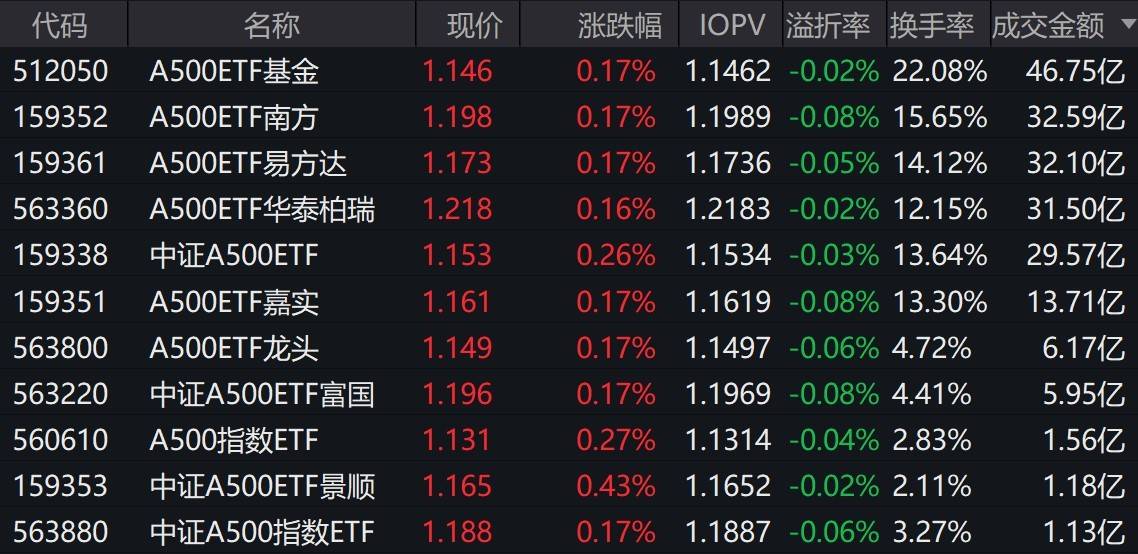
Market Overview - The market showed a rebound after a dip in early trading, with the CSI A500 Index rising by 0.33% [1] - The robotics sector saw collective gains, while the commercial aerospace concept continued to perform strongly; however, the Hainan sector showed weakness [1] ETF Performance - As of the morning close, ETFs tracking the CSI A500 Index experienced slight increases, with 11 ETFs exceeding a transaction volume of 100 million yuan, and 3 surpassing 3.2 billion yuan [1] - Specific transaction volumes for A500 ETFs included: A500ETF Fund at 4.675 billion yuan, A500ETF Southern at 3.259 billion yuan, and A500ETF E Fund at 3.210 billion yuan [1][2] Future Outlook - Some brokerages suggest that, in the medium term, as institutional funds begin to position for 2026, the anticipated interest rate cuts by the Federal Reserve, and the easing of concerns over the "AI investment bubble," the A-share market may enter a new bullish phase [1]

【机构策略】A股持续向好的逻辑并未改变
Zheng Quan Shi Bao Wang· 2025-12-03 01:31
Group 1 - The A-share market experienced a downward trend on Tuesday, with sectors such as shipbuilding, pharmaceutical commerce, consumer electronics, and coal performing well, while precious metals, energy metals, bioproducts, and software development lagged behind [1] - After a period of rapid fluctuations, the A-share market has gradually stabilized and rebounded, with the potential for the Shanghai Composite Index to consolidate around the 4000-point mark [1] - The market is expected to continue a rebalancing of styles, with cyclical and technology sectors likely to alternate in performance [1] Group 2 - The A-share market showed weak fluctuations on Tuesday, with reduced trading volume indicating limited willingness among investors to chase higher prices, suggesting a need for improved market risk appetite [2] - Despite the weak performance, the three major indices remain above the 5-day and 10-day moving averages, indicating that a short-term corrective trend has not yet changed [2] - Looking ahead, as institutional funds begin to position for 2026, the anticipated Federal Reserve interest rate cuts, and the easing of concerns over the "AI investment bubble," the A-share market may enter a new bullish phase [2]
【机构策略】A股慢牛行情仍将持续
Sou Hu Cai Jing· 2025-12-01 01:09
Group 1 - The A-share market is expected to experience a slow bull trend supported by policy shifts and improved liquidity, despite potential short-term volatility [1] - The market's risk appetite is being positively influenced by factors such as breakthroughs in the technology sector and changes in the US-China geopolitical landscape [1] - The expectation of a Federal Reserve rate cut in December is anticipated to provide external support for the A-share market's slow bull trend [1] Group 2 - The A-share market is showing signs of initial stabilization after adjustments caused by multiple internal and external factors, with a long-term upward trend remaining intact [2] - Improvements in dollar liquidity are expected, particularly with the Federal Reserve's dovish signals and the anticipated pause in quantitative tightening starting December 1, 2025 [2] - Institutional investors are expected to begin repositioning for 2026, with a potential increase in buying activity as market pressures ease [2] Group 3 - The A-share market experienced significant volatility and a slight decline in November, influenced by external risk appetite and sectoral differentiation [3] - The banking sector continues to lead, but there are indications that this trend may be nearing its end, while undervalued consumer sectors are showing stronger performance [3] - The market is likely to remain in a high-level oscillation without significant events to drive risk appetite upward, suggesting a focus on patience and strategic positioning for future opportunities [3]
财信证券宏观策略周报(12.1-12.5):市场初步企稳,逐步布局AI科技方向-20251130
Caixin Securities· 2025-11-30 11:59
Group 1 - The report indicates that the market shows initial signs of stabilization, transitioning from a downward trend to an upward trend, supported by factors such as improved dollar liquidity and positive communications between the US and China [4][14]. - It is expected that by mid-December, as institutional funds reposition for the next year and the Federal Reserve is anticipated to lower interest rates, the A-share market will enter a new bullish phase, particularly in the AI technology sector [4][9]. - The report highlights the importance of the "full-stack AI model," which includes hardware, foundational models, and application layers, as major tech companies optimize performance and costs [4][12]. Group 2 - The report notes that the recent market adjustments were driven by multiple internal and external factors, but the overall adjustment is considered healthy and does not alter the long-term upward trend of the market [7]. - Concerns regarding the AI investment bubble are primarily focused on the return on investment, with significant investments in AI yet to yield blockbuster applications [8]. - The report emphasizes the potential for a consumption recovery driven by improved supply-demand matching, particularly in sectors like health, tourism, and entertainment, as outlined in recent government policies [11]. Group 3 - The report provides insights into the performance of various sectors, noting that the TMT sector's trading volume has recently increased, indicating renewed interest [7]. - It also discusses the impact of macroeconomic factors, such as the anticipated easing of the US-China trade tensions and the potential for improved global liquidity, which could benefit the market in 2026 [14]. - The report suggests that the AI investment direction may shift from hardware to application development, with a focus on sectors like media and computing [12].
宝城期货股指期货早报(2025年11月28日)-20251128
Bao Cheng Qi Huo· 2025-11-28 05:31
Group 1: Report Industry Investment Rating - No relevant content found Group 2: Core Viewpoints of the Report - The short - term and medium - term views of the stock index futures are mainly range - bound, with a weak intraday view. The main reason is that the upward momentum of the stock index has weakened due to weak policy signals, and the willingness of funds to liquidate and leave the market temporarily has increased. However, there are still strong support forces for the stock index, such as the strong expectation of future policy benefits and the unchanged trend of long - term funds entering the market. Overall, the current market main line is not clear, and the stock index will mainly fluctuate in the short term [1][5] Group 3: Summary by Related Catalogs Variety Viewpoint Reference - Financial Futures Stock Index Sector - For IH2512, the short - term view is "oscillation", the medium - term view is "oscillation", the intraday view is "weak", and the reference view is "range - bound". The core logic is that the willingness of funds to liquidate has increased in the short term [1] Main Variety Price Market Driving Logic - Financial Futures Stock Index Sector - For IF, IH, IC, and IM, the intraday view is "weak", the medium - term view is "oscillation", and the reference view is "range - bound". The core logic is that the stock index rose and then fell yesterday, with the whole - market turnover shrinking by 93.5 billion yuan compared with the previous day. Due to weak policy signals, overseas Fed rate - cut expectations, and AI investment bubble risks, the willingness of funds to liquidate and leave temporarily has increased. Although the profit growth rate of industrial enterprises above designated size from January to October 2025 has slowed down, and the consumption and investment data in October have weakened, the expectation of future policy benefits is still strong, and the support force for the stock index is strong. Therefore, the stock index will mainly fluctuate in the short term [5]
电从哪里来?美国AI产业如何解决这个最大瓶颈?
Xin Lang Cai Jing· 2025-11-26 06:36
Core Insights - The primary challenge for the expansion of the AI industry in the U.S. is the shortage of electricity, with a projected demand of 69 GW by 2028 and a shortfall of 44 GW, equivalent to 44 nuclear power plants [1][2] - The construction cost for each additional 1 GW of data center capacity is approximately $50 billion, leading to concerns about whether the industry is entering an investment bubble [1][2] - The discussion revolves around two main questions: where will the electricity come from, and how will the funding for this massive infrastructure be secured [1][2] Electricity Shortage Solutions - The first conventional method to address the electricity shortage is the transition of cryptocurrency miners to AI data centers, which could potentially release 15 GW of power within 18-24 months [1][2][6] - Nuclear power is considered a long-term solution, with conventional plants taking over ten years to build, while small modular reactors (SMRs) are not expected to be commercially viable before 2030-2035 [2][3] - Natural gas is another option, but the supply of gas turbines is limited, with a backlog of 2-4 years for orders, making it a challenging short-term solution [4][5] - Fuel cell storage and solar plus storage are also mentioned, but they are not expected to provide immediate relief [5][6] Financing the AI Infrastructure - The financing landscape is complex, with companies like CoreWeave facing significant debt and high-interest rates, indicating a reliance on external funding [16][18] - Investment-grade bonds are expected to be a primary source of financing, with estimates suggesting that the high-rated market could address $300 billion in funding needs next year and $1.5 trillion over five years [26][28] - Asset-backed securities (ABS) and collateralized debt obligations (CDOs) are potential financial instruments that could be utilized to package and sell the underlying assets of data centers [19][20] Market Dynamics and Competition - NVIDIA is positioned as a central player in the GPU market, with its products being critical for AI data centers, while AMD is seen as a competitor trying to gain market share [30][31] - OpenAI is viewed as a disruptive force, driving demand for GPUs and influencing the strategies of other major tech companies [31][32] - The behavior of large tech companies is influenced by the fear of missing out on potential breakthroughs in AI, leading to significant investments despite the risks [33][34] Transition of Cryptocurrency Miners - The transition of cryptocurrency miners to AI data centers is seen as a viable solution, with early movers like CoreWeave benefiting from their timely shift [40] - New entrants in the market may face challenges due to their previous reliance on Bitcoin mining, which could complicate their transition to AI data centers [40]