K型分化

Search documents
刘俏:当你凝视自己,也望见了宇宙的轮廓丨光华@破五
Xin Lang Cai Jing· 2026-02-21 02:00
Core Insights - The article discusses the emergence of a "K-shaped" economic divergence, where high-income groups benefit from technological advancements while low-income groups face stagnation and increased competition [5][24] - It emphasizes the need for a new growth paradigm centered on human investment, highlighting that traditional growth metrics may not adequately reflect the realities of economic disparities [6][26] - The article calls for a shift in policy focus from mere physical investment to investing in human capital, which is essential for sustainable economic growth [7][30] Group 1: Economic Divergence - The "K-shaped" divergence indicates that high-income groups and tech giants thrive, while low-income groups and traditional sectors struggle [5][24] - This divergence is exacerbated by a focus on efficiency and technological worship, leading to a disconnect between macroeconomic growth and individual welfare [5][24] - The article raises concerns about the implications of technological advancements not translating into improved living conditions for the broader population [5][24] Group 2: Human-Centric Growth - A new growth model is proposed that prioritizes human investment, recognizing that people are the most active factor in enhancing productivity [6][26] - The article highlights the importance of addressing structural issues, such as the 2.55 billion urban residents without household registration who lack access to equal public services [7][26] - It argues that investments in education, healthcare, and social services should be viewed as high-return investments rather than mere expenditures [7][26] Group 3: Consumption and Economic Structure - The article points out that China's low consumption rate is a direct result of insufficient investment in human capital, leading to a cycle of low prices, low profits, and low incomes [8][27] - Despite high physical consumption levels, the monetary value of consumption remains below the global average, indicating a disconnect between production and actual economic welfare [8][27] - The need for a shift in growth measurement metrics is emphasized, advocating for a focus on income and quality of life rather than solely on GDP growth [8][28] Group 4: Policy Recommendations - The article calls for innovative policy tools to support human investment, including fiscal measures for social welfare and structural monetary policies to aid small and medium enterprises [11][30] - It suggests that local governments should adjust GDP accounting methods to prioritize labor income and corporate profitability, thereby enhancing the focus on quality growth [11][28] - The need for anti-involution policies and encouraging companies to expand internationally is highlighted as a means to alleviate domestic competition pressures [12][31]


港股首个交易日,恒科的股东已经想报警了
表舅是养基大户· 2026-02-20 13:33
大家新年好啊,今天是周五,港股已经开盘,因此上来和大伙儿聊几句,然后休息两天,等下周一(初七)港股再开盘的晚上,继续完整地聊一 下海外等全球大类资产,在假期的表现,帮大家在A股开盘前热个身。 今天分几个点哈,聊到哪儿算哪儿。 一、春晚的一些想法。 我觉得吐槽是没啥意义的,能看到一些事物发展的本质,才是有价值的。 1、本届春晚的 "含科量" 巨高,炒股的自然都知道,这和对A股提高"含科量"的政策目标,是一脉相承的,显然是自上而下的传导,因为很多工 作,靠春晚导演组,是协调不到的。 2、虽然很多人会揶揄春晚,拿部分地区春晚收视率不高抬杠,但毫无疑问,在传统媒介逐渐凋敝(从大家都集中看几家电视台,变成了人人刷 不同的短视频),人民群众的爱好和目光焦点多元化的当下, 春晚就是全国人民的最大公约数 ,在这个舞台上做些宣传,显然效果是最好的 ——反面例子是这回美国的超级碗,有个波多黎各歌手全程用西班牙语表演"报菜名",川宝发帖子吐槽,称其是史上最差表演,简直礼崩乐坏。 年初展望的时候《 2026年金融市场的十大预测 》,咱们提到过 K型分化 的问题,在第十点。 这回春节就有了个微观的体验,家族里有亲戚,去年在股市里赚的不 ...

国泰海通:美国转向“再通胀” 关注全球流动性“潮汐”下大类资产联动
智通财经网· 2026-02-14 23:32
Core Viewpoint - The transition from "K-shaped divergence" to "reflation" in the U.S. indicates a shift in global liquidity expectations from easing to tightening, impacting various asset classes and market dynamics [1][5]. Group 1: K-shaped Divergence - The structure of the U.S. balance sheet shows a healthy private sector, particularly post-COVID-19 QE, leading to a significant accumulation of net assets among high-net-worth individuals, primarily in real estate and equities [1]. - The current mortgage rate for high-net-worth individuals stands at 4.2%, while the new 30-year loan rate is at 6.1%, highlighting the disparity in borrowing costs [1]. - The "high-net-worth group" can leverage cash-out refinancing to support consumer spending and stock market liquidity, while the "new borrowing group" faces challenges in asset acquisition due to economic uncertainties [2]. Group 2: Transition to Reflation - The recent upward movement of the lower end of the K-shaped divergence suggests that high-net-worth individuals are stabilizing the economy and asset price expectations, creating favorable conditions for the new borrowing group [3]. - The housing sector, which is seen as a source of inflation, is experiencing a recovery, indicating a potential shift towards reflation in the U.S. economy [3]. Group 3: Inflation Expectations - Demand-driven inflation expectations exhibit a self-reinforcing mechanism, which can lower real interest rates and compress credit spreads, leading to a situation where actual mortgage rates are at their lowest in three years [4]. - The current dynamics explain why long-term U.S. Treasury yields are rising while the housing sector is recovering against the trend [4]. Group 4: Global Liquidity Dynamics - The shift from "K-shaped divergence" to "reflation" is mirrored in global liquidity trends, with Bitcoin serving as a barometer for these changes, affecting tech-heavy indices and prompting style shifts within A-shares [5]. - The anticipated policy combination of "rate cuts + balance sheet reduction" suggests a non-typical reflation trade, resembling stagflation in some aspects, with a focus on the interconnectedness of major asset classes under changing liquidity conditions [5].

主权与韧性的时代:五十图“马”说2025
Minsheng Securities· 2026-02-13 05:50
Macro Trends - China's economy is transitioning from a real estate cycle bottoming out to a strategic shift towards high-end manufacturing, with real estate prices stabilizing around 4.53% of GDP, approaching the lower end of the 4%-6% range seen in the US and Japan[12][14]. - The manufacturing sector is accelerating domestic substitution in key areas like automotive and machinery, moving from scale dividends to high-value global value chain competition[2]. Global Expansion - Chinese companies are evolving from merely exporting products to building ecosystems, leveraging channels, capital, and products for comprehensive value and cultural output[3]. - The gaming industry has seen significant success, with 12 Chinese games ranking in the global top 30 revenue list, led by Tencent's "Honor of Kings"[50]. Consumer Behavior - The consumption cycle is shifting from a "total volume era" to a "structural era," focusing on precise segmentation and supply reconstruction, driven by a younger high-net-worth demographic[4]. - Retail and commercial real estate are transitioning from simple sales to a focus on professionalism and experiential offerings, reflecting a K-shaped differentiation in consumer preferences[4]. Asset Management - The global asset management landscape is undergoing a profound transformation, with gold and other assets moving independently from traditional stock-bond frameworks, challenging conventional asset allocation strategies[5]. - The rise of quantitative products and the diversity of ETF funds are significantly impacting active management models, reshaping the funding ecosystem both domestically and internationally[5].
国泰海通 · 晨报260213|宏观、固收
国泰海通证券研究· 2026-02-12 14:02
Group 1: Macro Analysis - The structure of the U.S. balance sheet shows a healthy private sector, particularly after the QE phase post-2020, leading to a significant accumulation of net assets among high-net-worth individuals, primarily in real estate and equities [3] - The refinancing loans available to the high-net-worth group support consumer resilience and liquidity in the U.S. stock market, while the new borrowing group is more sensitive to cash flow and debt for asset acquisition [4] - The U.S. economy appears to be transitioning from "K-shaped divergence" to "re-inflation," with the high-net-worth group stabilizing economic expectations and asset prices, thereby creating favorable conditions for the new borrowing group [5] Group 2: Inflation Expectations - Demand-driven inflation expectations exhibit a self-reinforcing mechanism, where heightened inflation expectations can lower actual interest rates and compress credit spreads [6] - Currently, the actual mortgage rates in the U.S. are at their lowest in three years, despite rising long-term U.S. Treasury yields, indicating a recovery in the housing sector [6] Group 3: Liquidity Trends - The global liquidity environment is shifting from easing to tightening, with Bitcoin serving as a barometer for this transition, impacting liquidity-sensitive assets like the Nasdaq and A-shares [7] - The anticipated policy combination of "rate cuts + balance sheet reduction" suggests a non-typical re-inflation trade, resembling stagflation dynamics [7] Group 4: Industry Analysis of Perpetual Bonds - The issuance of industrial perpetual bonds aims to reduce corporate leverage, with significant peaks in issuance observed during 2018-2020 and ongoing demand from high-leverage state-owned enterprises [9] - The proportion of 5+N maturity bonds has increased, reflecting a shift in issuance trends, with expectations for record issuance in 2025 [10] - The inclusion of equity-like clauses in perpetual bonds has risen, with over 60% of recent issuances containing such features, driven by stricter accounting standards [11] Group 5: Investment Strategies - The recommendation for industrial perpetual bonds includes a yield strategy focusing on coal and steel sectors with high asset quality and a duration strategy for public utilities and transportation state-owned enterprises [12]


全球流动性潮汐研究一:美国的“再通胀”之路
GUOTAI HAITONG SECURITIES· 2026-02-12 05:04
美国的"再通胀"之路 [Table_Authors] 韩朝辉(分析师) ——全球流动性"潮汐"研究一 "再通胀"的归途 当"K型分化"转向"再通胀" 本报告导读: 当美国从"K型分化"转向"再通胀",近期全球流动性似乎也从宽松预期的放缓, 转向紧缩预期的抬头。"降息+缩表"的政策组合预期下,注定这是一场非典型的再 通胀交易(有时更像是滞胀交易)。关注全球流动性"潮汐"下的大类资产联动。 投资要点: [Table_Summary] "K型分化"的来路 美国资产负债表的结构特征。 →美国私人部门的资产负债表相当健康(尤其是 2020 年疫后 QE 阶 段加了一波杠杆的群体),导致美国高净值群体拥有大量的净资产(其中 以房产和股权为主);而疫后美国的利率结构也比较特殊,由于大量的信 贷扩张是发生在 QE阶段,导致高净值群体的存量抵押贷款利率并不算高 (目前是 4.2%)。作为对比,目前 30 年期新发贷款利率在 6.1%。 导致利率敏感度的截然不同。 →"高净值群体"可以通过再融资贷款(cash-out refinance)将净资产 变现,支撑消费端韧性和美股流动性,所以当新旧贷款利差(再融资扩张 的边际成本)收窄 ...
西南航空2026年业务改革与财务展望
Jing Ji Guan Cha Wang· 2026-02-11 16:39
经济观察网西南航空在2026年推进业务模式转型,并发布了最新财务业绩,市场机构对其前景表示乐 观。 截至2026年2月4日,西南航空股价报52.59美元,年初至今上涨27.24%,过去52周涨幅达70.80%,反映 出市场对转型的乐观情绪。 业务进展情况 行业政策与环境 西南航空于2026年1月27日正式终结自由选座模式,转向指定座位制度,这是其向传统运营模式转型的 核心举措。此前,公司已在2025年推出加价腿部空间座位和托运行李费政策,以提升辅助收入。 美国航空业整体呈现"K型分化",达美航空和联合航空垄断行业利润,而西南航空等低成本航司通过聚 焦高端客群和票价分层应对挑战。美国运通全球商务旅行预测2026年机票价格将与2025年持平,需求前 景存在不确定性。 业绩经营情况 西南航空于2026年1月29日公布财报,第四季度营收同比增长7.4%至74.42亿美元,调整后每股收益0.58 美元超出市场预期。公司同时提供了2026年盈利指引,表明成本削减和运营优化已初见成效。在2025年 第三季度,西南航空营收69.5亿美元超预期,调整后每股收益0.11美元,主要受益于行李费等新政策。 机构观点 摩根大通于202 ...
美国失业者看着账单崩溃:GDP创新高,我却连一份工作都找不到
Sou Hu Cai Jing· 2026-02-11 10:45
2026年美国经济会走出高增长、低就业的分裂行情,冷热分化会越拉越大 。 高盛等机构预测全年GDP增速约2.8%,远高于市场共识的2.0%;但失业率会稳定在4.5%左右,比2025 年底的4.6%略降但仍处高位,月度新增就业可能低至1.5万人,典型的"无就业增长" 。 这不是周期波动,是AI、减税、移民收缩叠加的结构性大变局,增长和就业彻底脱节,普通人感受和 宏观数据会严重错位 。 很多人会疑惑,经济好就该多招人,怎么会反过来? 答案藏在三个关键变量里:AI把效率拉满,企业不增人也能扩产出;减税让资本更敢投技术而非人 力;移民收紧和老龄化让劳动力供给持续收缩 。 这三重力量拧在一起,让2026年的美国经济变成"看着热闹,跟你无关"的奇怪状态。 2026年的美国经济,行业、收入、区域的K型分化会更刺眼,好日子只属于少数人 。 高增长的动力,全来自"不用雇人"的新玩法 2026年美国经济的增长引擎,早就不是靠堆人堆产能的老路子 。 最大推力是AI驱动的生产率爆发,半导体、软件、新能源这些赛道疯狂扩产,AI重构研发、生产、客 服全流程,企业用更少的人做出更多产值,还能压成本 。 高盛测算,AI带动的生产率反弹,贡献 ...
分析师警告:经济分化下,美国家庭生活压力陡增
Zhong Guo Xin Wen Wang· 2026-02-06 06:20
华盛顿郊区小城海茨维尔市的居民雪莉安·德索莫坦言:"眼下处处都要花钱——付房租、买食物,压力 太大了。" 她表示,即便家中有两份收入,"依旧入不敷出"。她一心想好好工作,却因企业经营惨淡, 遭遇工时缩减。 中新网2月6日电据法新社报道,分析师警告称,美国经济已陷入"K型分化",中低收入家庭的生活愈发 捉襟见肘,民众对生活成本的焦虑持续攀升。 报道称,美国经济虽然实现了稳健增长,特朗普政府也一再标榜华尔街屡创纪录、减税政策成效显著, 但分析师警告称,美国经济已陷入"K型分化"——富裕家庭坐拥资产增值的红利,中低收入家庭的生活 却愈发捉襟见肘。 美国首都地区食品银行的数据显示,过去一年,华盛顿大都市区约36%的家庭面临食品匮乏问题。该机 构首席执行官拉达·穆提亚表示:"我们发现,越来越多传统意义上的高收入群体也来寻求帮助。" 她向法新社透露,一个年收入9万至12万美元的四口之家,如今也可能需要"额外援助才能填饱肚子"。 穆提亚认为,核心原因是疫情后通胀水平长期居高不下,而工资涨幅却未能跟上通胀步伐。 除首都地区外,《纽约时报》与锡耶纳学院今年1月联合开展的民调显示,多数美国人认为,中产阶级 的生活方式已遥不可及。 ...
配置盘超预期,债市配置价值凸显,关注十年国债ETF(511260)
Sou Hu Cai Jing· 2026-02-05 01:21
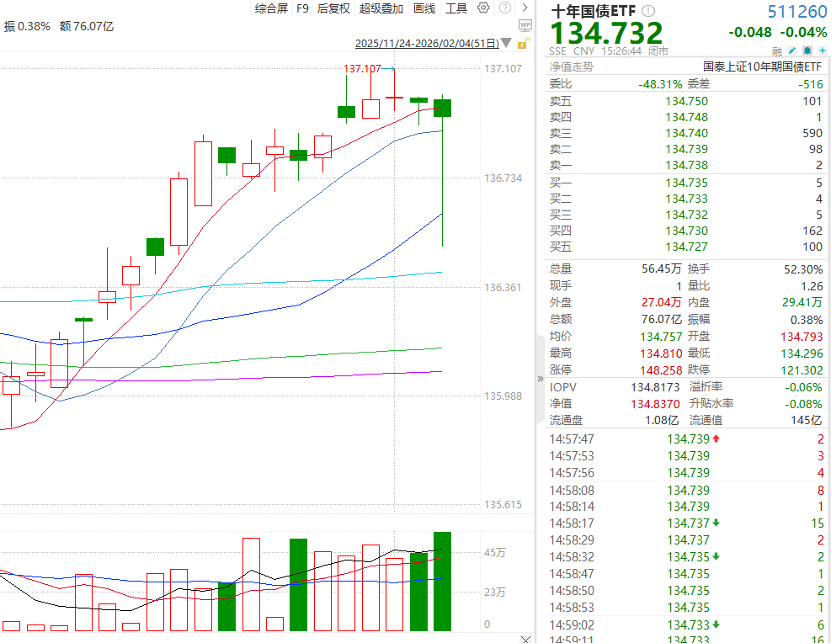
而货币政策态度仍然比较中性,在呵护银行净息差以及汇率稳健升值的目标下,对债市保持合理区间的导向较强。总 体而言,今年债市或仍有利于偏稳健的配置型策略。 风险提示: 年初银行配置超预期后,债市经历了一轮缓慢上行,近期有所犹豫。十年国债ETF(511260)震荡为主,近5日微涨 0.05%。短期利率仍有机会下行,但中长期来看,窄幅震荡或会维持。配置型策略阶段性优于波段交易,或可关注久 期适中的国债ETF(511010)、十年国债ETF(511260)。 | 振0.38% 额76.07亿 | 综合屏 F9 后复权 超级叠加 画线 工具 砂 | 電信用F | | 511260 | | --- | --- | --- | --- | --- | | | | | | -0.048 -0.04% | | | 2025/11/24-2026/02/04(51日) V | | | 中 / @ + | | | 137.107 | 净固走势 | | 国泰上证10年期国债ETF | | | | 影比 | -48.31% 委差 | -516 | | | | 卖五 | 134.750 | 101 | | | | 交回 | 134.748 ...