
特朗普关税

Search documents
华尔街罕见观点:美通缩即将来袭,问题出在房地产市场
Feng Huang Wang· 2025-08-21 08:34
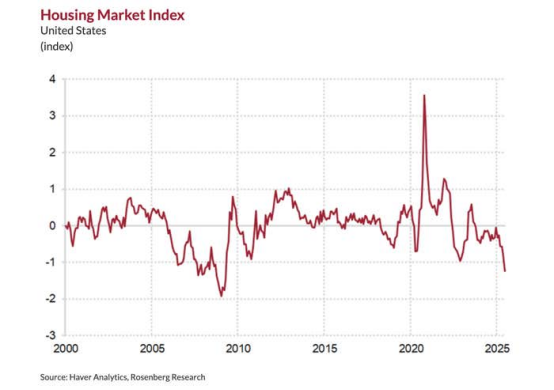
Core Viewpoint - The Rosenberg Research company predicts a significant decline in U.S. inflation, potentially dropping to near 1%, driven primarily by a downturn in the real estate market [1][2]. Real Estate Market Analysis - The company has observed substantial signs of decline in the real estate sector, with its proprietary real estate market activity index indicating the most severe downturn since the 2009 financial crisis [2][4]. - Out of the 11 indicators used to measure real estate activity, 10 have shown significant declines over the past six months, with the largest drops in housing starts (down 23.9%), new single-family home sales (down 23.7%), existing home sales (down 16.1%), quarterly new tenant rent index (down 14.2%), and potential buyer traffic (down 7 percentage points) [4]. Price Impact and CPI Forecast - Despite the overall decline in real estate activity, the Case-Shiller 20-City Composite Home Price Index has increased by 0.8% over the past six months, with housing prices accounting for about one-third of the Consumer Price Index (CPI) [4][5]. - The anticipated decline in housing prices could lead to a year-over-year CPI increase of 1.2% to 1.8% by Q2 2026, depending on the scale of tariff impacts [5]. - The current low rental prices are expected to compress the housing component of the CPI, with a lag time of approximately 12 months, suggesting that the real estate market downturn will have prolonged deflationary effects until 2026 [5].

贸易专题分析报告:对等关税未完待续
SINOLINK SECURITIES· 2025-08-19 14:49
Group 1: Tariff Strategy - Tariffs are a key tool in Trump's economic policy, evolving from targeted strikes to a comprehensive strategy in his second term[2] - The tariff strategy consists of four main components: reciprocal tariffs, punitive tariffs, transshipment tariffs, and industry protection barriers[6] - The average effective tariff rate in the U.S. has increased by 16.2 percentage points, reaching 18.6%, the highest level since the Great Depression[29] Group 2: Trade Relations and Impact - The U.S. is transitioning to a more decentralized trade structure, moving away from reliance on the U.S.-China economic relationship[3] - The imposition of tariffs has led to a significant increase in import costs, with specific tariffs reaching as high as 50% on steel and aluminum products[21] - The U.S. government is using tariffs as a diplomatic tool, with punitive tariffs being applied to countries like Canada and Mexico, and targeting third-party nations involved in trade with adversaries[11] Group 3: Economic Consequences - Pre-tariff import surges led to a 4.67% month-on-month increase in imports in March, followed by a 1.39% year-on-year decline in June, indicating a demand pullback[29] - U.S. businesses are entering a de-inventory phase, with durable goods inventory growth slowing from 1.52% in March to 0.17% in June[29] - The uncertainty surrounding new tariff tools and potential trade negotiations post-midterm elections poses risks to global supply chains and capital markets[4]
泰贸促厅推多项政策应对“特朗普关税”
Shang Wu Bu Wang Zhan· 2025-08-18 10:53
Group 1 - The Thai Ministry of Commerce is actively responding to the U.S. announcement of a 19% "reciprocal tariff" by implementing measures to support the private sector [1] - Initial assistance measures include coordinating with banks to offer low-interest loans, deploying trade representatives to explore new markets, and monitoring the impact of tariffs on Thai exports to the U.S. [1] - The "Team Thailand" initiative will focus on preventing the entry of substandard products and transshipment issues, with collaboration between the International Trade Negotiation Department and the Trade Development Department [1] - A "One Stop Service" center will be launched on August 7 to streamline the process for permits and loan consultations, as well as to showcase specialty products for export [1] - The Trade Promotion Department has received a budget allocation of 50 million THB from a 115 billion THB economic stimulus plan to gather business needs and adjust the SMEs Pro-active project to increase export market development subsidies [1] Group 2 - The closure of the Thai-Cambodian border has necessitated adjustments in transportation routes, leading to increased logistics costs and liquidity pressures for businesses [2] - The Trade Promotion Department is discussing low-interest loan measures with banks, including a budget of 10 billion THB from the Export-Import Bank of Thailand to assist affected export companies [2]
流动性宽松与风险偏好共振,A股有望再创新高
Tong Guan Jin Yuan Qi Huo· 2025-08-18 10:49
Report Title - The report is titled "Macro and Major Asset Semi-Annual Report: Loose Liquidity and Risk Appetite Resonance, A-shares Expected to Reach New Highs" [1] Investment Rating - No investment rating for the industry is provided in the report Core Views - In the first half of 2025, under the impact of Trump's domestic and foreign policies, global major asset fluctuations intensified. Stocks performed the best, followed by bonds. Commodities were divided, with externally-driven varieties outperforming domestic-demand products. The currencies of the G2 countries were under pressure, with both the US dollar and the RMB weakening [2][3][8] - In the domestic market, equities (+5.83%) > bonds (+0.87%) > commodities (-2.09%) > RMB (-6.03%). A-shares' performance was centered around China's AI breakthroughs and Trump's tariff disruptions. AI利好 catalyzed the technology and growth sectors to lead in stages, boosting risk appetite. Tariff uncertainties dragged down the export chain, suppressing the valuation repair of the cyclical and manufacturing sectors. Bonds mainly fluctuated based on tight liquidity, tariff-induced risk aversion, and their gains significantly converged compared to 2024. The RMB appreciated against the US dollar and depreciated against non-US currencies. Commodities were divided, with precious metals shining and domestic-demand commodities such as black metals and industrial products remaining weak [3][8] - In the overseas market, bonds (+7.27%) > equities (+6.07%) > commodities (+5.96%) > US dollar (-10.79%). In the first half of the year, global risk appetite fluctuated significantly. Trump's tariff policies once triggered a sharp market shock, but the recession remained at the expected level. Global stock markets quickly recovered after a sharp decline, with the Hong Kong, German, and South Korean stock markets rising by over 20%. Global bonds generally rose, led by emerging markets and US bonds, while European bonds were weaker. Commodities generally rose slightly, led by livestock and oils, with metals and industrial raw materials having moderate increases. The US dollar index fell by over 10%, dragged down by cooling soft data, tariff impacts on credit, and doubts about the Fed's independence [3][8] - Looking ahead, A-shares are expected to reach new highs due to the continuation of loose global central bank liquidity and the approaching of the profit bottom. In the bond market, treasury bond yields may decline further but with weak odds. Gold prices are bullish in the medium to long term, supported by global loose liquidity, geopolitical risks, and anti-globalization. Copper prices are expected to rise as the global economy is expected to recover and the supply of concentrates is expected to tighten. Oil prices are expected to be weak in the second half of the year due to oversupply and weak demand [3] Summary by Directory 1. Major Asset Performance - In the first half of 2025, under the impact of Trump's domestic and foreign policies, global major asset fluctuations intensified. Stocks performed the best, followed by bonds. Commodities were divided, with externally-driven varieties outperforming domestic-demand products. The currencies of the G2 countries were under pressure, with both the US dollar and the RMB weakening [8] - In the domestic market, equities (+5.83%) > bonds (+0.87%) > commodities (-2.09%) > RMB (-6.03%). A-shares' performance was centered around China's AI breakthroughs and Trump's tariff disruptions. AI利好 catalyzed the technology and growth sectors to lead in stages, boosting risk appetite. Tariff uncertainties dragged down the export chain, suppressing the valuation repair of the cyclical and manufacturing sectors. Bonds mainly fluctuated based on tight liquidity, tariff-induced risk aversion, and their gains significantly converged compared to 2024. The RMB appreciated against the US dollar and depreciated against non-US currencies. Commodities were divided, with precious metals shining and domestic-demand commodities such as black metals and industrial products remaining weak [8] - In the overseas market, bonds (+7.27%) > equities (+6.07%) > commodities (+5.96%) > US dollar (-10.79%). In the first half of the year, global risk appetite fluctuated significantly. Trump's tariff policies once triggered a sharp market shock, but the recession remained at the expected level. Global stock markets quickly recovered after a sharp decline, with the Hong Kong, German, and South Korean stock markets rising by over 20%. Global bonds generally rose, led by emerging markets and US bonds, while European bonds were weaker. Commodities generally rose slightly, led by livestock and oils, with metals and industrial raw materials having moderate increases. The US dollar index fell by over 10%, dragged down by cooling soft data, tariff impacts on credit, and doubts about the Fed's independence [8] 2. Equity Market 2.1 A-shares - In the first half of 2025, A-shares performed well, with broad-based indices generally rising. The Beizheng 50, CSI 1000, and CSI 2000 led the gains, showing a significant structural market. The performance of large-cap blue-chip indices such as the SSE 50 and CSI 300 was relatively limited. Overall, the market fluctuated greatly in the first half of the year, and risk appetite fluctuated between "China's AI narrative" and "Trump's tariffs." The market generally trended upward, with a decent profit-making effect. The market can be roughly divided into four stages [13] - Stage 1 (January 1 - January 13): The market declined weakly due to a lack of economic data, weakening policy effects from the fourth quarter of 2024, and rising overseas uncertainties ahead of Trump's inauguration. During this period, most indices adjusted, with the ChiNext Index leading the decline and the growth sector performing weakly [16] - Stage 2 (January 14 - March 18): The market rose significantly as the strong expectations for China's AI industry outweighed the weak economic reality. The market's pessimistic sentiment was significantly repaired after the China-US presidential call in mid-January, and risk appetite recovered. The popularity of DeepSeek in late January triggered strong expectations for China's AI innovation, becoming the core driver of the market. The "strong expectations" for China's AI industry outweighed concerns about Trump's tariffs and the "weak reality" of economic data, driving the market's trading volume to an average of 1.8 trillion yuan and the margin trading balance to a 10-year high of 1.9 trillion yuan. During this period, most indices rose, with small-cap growth stocks such as the Beizheng 50 and CSI 2000 leading the gains [17] - Stage 3 (March 19 - April 7): Risk appetite declined as the market shifted from strong industry expectations to economic reality. The market's expectations for a Q1 reserve requirement ratio (RRR) cut and interest rate cut were disappointed, and the liquidity remained tight until the end of March. The 10-year treasury bond yield rose, and overseas liquidity tightened marginally, putting pressure on valuations. The market's trading volume declined. On April 7, Trump's announcement of "reciprocal tariffs" far exceeded market expectations, triggering a global risk-off sentiment. The A-share market tumbled after the Tomb-Sweeping Festival holiday, with the Shanghai Composite Index falling by more than 7% and thousands of stocks hitting the daily limit down [18][19] - Stage 4 (April 8 - June 30): The market gradually recovered as policy support and a stabilization of global risk appetite boosted investor confidence. Trump's decision to delay the implementation of reciprocal tariffs for 90 days helped to stabilize global risk appetite. In response to the US tariffs, the Chinese government quickly introduced a series of policies to support the economy and counter the US measures. The central bank injected liquidity through a stabilization fund, helping to restore market confidence. The market entered a structural recovery phase with strong support at the bottom [19] - Looking ahead to the second half of the year, A-shares still have upward momentum. On the earnings side, policy support is expected to improve the economic fundamentals, and the "earnings bottom" is approaching. On the valuation side, loose monetary policies at home and abroad are expected to continue, providing support for equity valuations. Policy support is expected to strengthen market expectations, and the A-share market is expected to reach new highs this year, breaking through the high set on September 24 last year. The market's performance will depend on the timing of the Fed's interest rate cuts and the recovery of domestic risk appetite [20][21][22] 3. Bond Market 3.1 Treasury Bonds - In the first half of 2025, the bond market entered an adjustment phase after a unilateral upward trend at the end of 2024. The market's pricing of the weak domestic economic momentum became more comprehensive, and tight liquidity, tariff policies, and the recovery of risk appetite became the core variables driving interest rate fluctuations. The bond market can be roughly divided into three stages [27] - Stage 1 (January 1 - March 19): Interest rates rose as the market's expectations for loose monetary policies were revised, liquidity tightened, and the stock market strengthened. In early 2025, the 10-year treasury bond yield quickly fell below 1.6% due to the continued impact of loose policy expectations at the end of 2024. Subsequently, tight liquidity, disappointed expectations for a Q1 RRR cut and interest rate cut, and the recovery of risk appetite driven by the revaluation of technology stocks led to a rebound in interest rates. The yield curve showed a "bear flattening" trend. By mid-March, the 10-year treasury bond yield approached 1.9%, reaching a new high for the year [30] - Stage 2 (March 20 - April 7): Interest rates declined as the central bank shifted its focus to supporting the economy, risk aversion increased due to Trump's tariff policies, and regulatory guidance was introduced. As economic data weakened and external risks increased, the central bank shifted its policy focus from "risk prevention" to "growth stabilization." The tight liquidity in the first quarter gradually eased, and the equity market entered an adjustment phase. The 10-year treasury bond yield declined to 1.8%. In early April, Trump's tariff policies far exceeded market expectations, triggering a global stock market crash. Risk aversion drove funds into the bond market, and the 10-year treasury bond yield dropped to 1.6% [30] - Stage 3 (April 8 - June 30): Interest rates fluctuated within a narrow range as the market balanced the recovery of risk appetite, the implementation of loose monetary policies, and the increase in bond supply. In the second quarter, the bond market generally fluctuated within a narrow range as the market weighed the recovery of risk appetite, RRR cuts and interest rate cuts, and the supply of government bonds. The market mainly focused on two factors: 1) The China-US trade talks in Geneva reached an unexpected consensus, boosting market sentiment. The resilience of exports in the second quarter also provided some support for the economy and put pressure on the bond market. 2) The central bank announced RRR cuts and interest rate cuts in early May, leading to a marginal easing of liquidity. Despite the large supply of government bonds, the central bank's open market operations showed a strong intention to support liquidity, providing some support for interest rates [31] - Looking ahead to the second half of the year, treasury bond yields may break through their previous lows, but the odds are weak. The economic fundamentals have not reversed, and the bond market is still likely to benefit from loose monetary policies. However, the recovery of risk appetite and the increasing attractiveness of risk assets may limit the downside potential of bond yields. The bond market may face some challenges in the second half of the year, including a potential increase in inflation expectations and the uncertainty of Trump's domestic and foreign policies [32][34][35] 4. Commodity Market 4.1 Gold - In the first half of 2025, the gold price continued its upward trend from last year, rising by more than 25%. The price increase was mainly driven by the risk aversion sentiment triggered by Trump's policies, increasing recession expectations, and doubts about the US dollar's credit. The gold market can be roughly divided into three stages [43] - Stage 1 (January 1 - April 2): The gold price rose as Trump's inauguration increased trade tensions, and weak US economic data and rising recession expectations drove investors to seek safe-haven assets. The US dollar index and the US treasury bond yield declined, and central banks around the world continued to increase their gold reserves, driving the gold price higher. During this period, the gold price trended upward [44][47] - Stage 2 (April 3 - April 21): The gold price reached a new high as Trump's tariff policies triggered a global risk-off sentiment and a crisis of confidence in the US dollar. The global market was shocked by Trump's announcement of "reciprocal tariffs," which far exceeded market expectations. The initial sell-off of gold due to liquidity shortages and panic was quickly reversed as investors sought the safe-haven properties of gold. The gold price reached a record high of over $3,500 per ounce on April 22 [47] - Stage 3 (April 22 - June 30): The gold price fluctuated within a narrow range as the market's risk appetite recovered, and geopolitical risks increased. The US government's decision to ease its tariff policies and the strong US economic data put pressure on the gold price. However, the escalating geopolitical tensions in the Middle East provided some support for the gold price. During this period, the gold price fluctuated between $3,175 and $3,450 per ounce [48] - Looking ahead to the second half of the year, the gold price is expected to continue its upward trend, supported by loose global liquidity, rising geopolitical risks, and the acceleration of anti-globalization. However, the narrowing of macro uncertainties and the increasing odds of a price correction may limit the upside potential of the gold price. The gold market may face some challenges in the second half of the year, including the implementation of Trump's tariff policies, the Fed's interest rate cuts, and the geopolitical situation in the Middle East [49] 4.2 Copper - In the first half of 2025, the copper price generally trended upward, with a brief correction in April due to Trump's tariff policies. The copper market can be roughly divided into three stages [51] - Stage 1 (January 1 - March 26): The copper price rose as the global manufacturing sector recovered, and the expectation of fiscal expansion in China and Europe supported the copper demand. The supply of copper concentrates tightened, and the spot treatment charge (TC) price reached a record low, putting upward pressure on the copper price. The expectation of copper tariffs and the US government's investigation into copper imports also contributed to the increase in the copper price [53] - Stage 2 (March 27 - April 9): The copper price declined as Trump's tariff policies triggered a global risk-off sentiment, and the demand for copper decreased. The copper price dropped by more than 20% in a short period, reaching its lowest level of the year [53] - Stage 3 (April 10 - June 30): The copper price recovered as the market's risk appetite improved, and the supply of copper concentrates continued to tighten. The decision to delay the implementation of reciprocal tariffs and the weakening of the US dollar supported the copper price. The supply-demand balance of the copper market remained tight, and the spot TC price continued to trade below $40 per ton, providing strong support for the copper price [54] - Looking ahead to the second half of the year, the copper price is expected to be supported by loose global monetary and fiscal policies and the tightening of the copper concentrate supply. The global central banks are still in the process of cutting interest rates, and the fiscal expansion plans of China, the US, and Europe are expected to boost the copper demand. The supply of copper concentrates is expected to remain tight, and the spot TC price is expected to stay at a low level, providing support for the copper price. Overall, the copper price is expected to trend upward in the second half of the year [54][55] 4.3 Crude Oil - In the first half of 2025, the crude oil price fluctuated significantly, mainly driven by geopolitical tensions and Trump's tariff policies. The supply-demand imbalance in the crude oil market put downward pressure on the oil price. The crude oil market can be roughly divided into five stages [59] - Stage 1 (January 1 - January 15): The oil price reached a new high for the year as the US government's sanctions on Russian oil and the tense situation in the Middle East increased the market's concerns about supply disruptions. The OPEC+ countries reaffirmed their commitment to the production cut agreement, and the cold weather in the US and Europe increased the demand for heating oil. The West Texas Intermediate (WTI) crude oil price approached $80 per barrel [61] - Stage 2 (January 16 - March 10): The oil price declined as the market's concerns about the supply-demand imbalance increased, and the weak US economic data and Trump's tariff policies put pressure on the oil price. The OPEC+ countries postponed their planned production increase until April, but the increasing production from non-OPEC countries such as the US, Brazil, and Canada deepened the oversupply situation. The demand for oil was also weak due to the weak global economic growth and the increasing trade tensions. The oil price dropped by 16% from its high to around $65 per barrel [61] - Stage 3 (March 11 - March 31): The oil price fluctuated within a narrow range as the market balanced the expectation of an increase in oil supply and the recovery of the oil demand in Asia. The OPEC+ countries confirmed their plan to gradually exit the production cut agreement in April, and the increasing US crude oil inventory put pressure on the oil price. However, the strong economic data from China and the expectation of policy stimulus increased the demand for oil in Asia, providing some support for the oil price [62] - Stage 4 (April 1 - May 5): The oil price dropped sharply as the market's concerns about the supply-demand imbalance increased, and the weak global economic data and Trump's tariff policies put pressure on the oil price. The OPEC+ countries prematurely lifted some of the voluntary production cuts, and the increasing production from non-OPEC
美国国债首次突破37万亿美元,美媒:纳税人面临的成本压力增加
Huan Qiu Shi Bao· 2025-08-13 22:39
Group 1 - The total U.S. national debt has surpassed $37 trillion for the first time, highlighting the accelerating growth of debt and increasing cost pressures on taxpayers [1] - The U.S. national debt reached $34 trillion in January 2024, $35 trillion in July, and $36 trillion in November, indicating a rapid accumulation of $1 trillion every five months, which is twice the average speed of the past 25 years [1] - The current U.S. national debt exceeds the combined debt of China and the Eurozone, suggesting unsustainable fiscal policies [1] Group 2 - Tariff revenues from the Trump administration are projected to generate approximately $1.3 trillion in net new revenue by the end of his current term, accumulating to $2.8 trillion by 2034 [2] - Despite the potential tariff revenue, it constitutes a small fraction of total federal income, insufficient to replace income taxes or bridge the debt gap, with income and payroll taxes contributing over 75% of federal revenue [2] - The burden of tariffs is primarily borne by consumers, with low-income households facing an annual cost increase of $1,700 and high-income households over $8,100, indicating a significant economic impact [2]
这是高盛顶尖交易员对本周市场的思考
华尔街见闻· 2025-08-09 10:00
Group 1 - The market is experiencing contradictory signals, with significant capital expenditures from tech giants driving investment and M&A activity, while macro uncertainties like potential "Trump tariffs" and future interest rate paths cast a shadow over market prospects [1][5] - The earnings season has seen an unprecedented "violent" stock price reaction, with the actual price volatility of S&P 500 constituents on earnings days exceeding implied volatility for the first time in 18 years [1][2] - The impact of "Trump tariffs" is highlighted as a major variable affecting future inflation paths, with Goldman Sachs indicating that without tariffs, the actual inflation momentum in the U.S. economy remains moderate [5][6] Group 2 - The risk for individual stock investors is increasing sharply during the earnings season, with European markets showing record penalties for companies that miss earnings expectations, a trend now evident in the U.S. market as well [2][3] - The capital expenditure growth of cloud service providers is remarkable, with projections indicating that spending by the "seven giants" will exceed 1% of U.S. GDP next year, surpassing the capital expenditures of the telecom sector during the 1999-2000 period [4] - The ongoing debate between growth and interest rates is becoming a central market issue, with attention focused on U.S. employment and consumption data as indicators for future interest rate cuts [5][6] Group 3 - The investment landscape is challenging traditional views, with European bank stocks outperforming U.S. mega-cap tech stocks over the past five years unless investors timed their purchases perfectly around late 2022 [7] - The acquisition battle for Spectris, with a premium exceeding 100%, underscores the trend of "de-equitization" in the UK stock market, presenting investment opportunities regardless of policy outcomes [7] - Despite economic concerns, retail speculative trading remains robust, with Goldman Sachs suggesting that this trend may persist longer than professional investors anticipate, not necessarily signaling a bearish outlook [7][8]


这是高盛顶尖交易员对本周市场的思考
Hua Er Jie Jian Wen· 2025-08-09 04:08
Group 1 - The market is experiencing contradictory signals, with significant capital expenditures from tech giants driving investment and M&A activity, while macro uncertainties like potential "Trump tariffs" and future interest rate paths cast a shadow over market outlook [1] - The stock price reactions during earnings season have become exceptionally volatile, with the actual price movements of S&P 500 constituents on earnings days exceeding implied volatility for the first time in 18 years [1][2] - The impact of "Trump tariffs" is highlighted as a major variable affecting future inflation paths, with Goldman Sachs indicating that the inflationary pressure from tariffs is substantial, while the underlying inflation momentum in the U.S. economy remains moderate when excluding tariff effects [1][3] Group 2 - The risk for individual stock investors is increasing sharply during the earnings season, with European markets showing record penalties for companies that miss earnings expectations, a trend now evident in the U.S. market as well [2] - Capital expenditure growth among cloud service providers is projected to exceed 1% of U.S. GDP next year, surpassing the capital expenditures of the telecom sector during the 1999-2000 period, although still below the peak of approximately 5% during the railroad boom [2] - The debate over growth versus interest rates is becoming a central market theme, with a focus on U.S. employment and consumption data as key indicators [3] Group 3 - The market is challenging established investment beliefs, with European bank stocks outperforming U.S. mega-cap tech stocks unless investors bought at a specific narrow window around Christmas 2022 [4] - The trend of "de-equitization" in the UK stock market is underscored by a significant acquisition battle for Spectris, indicating potential investment opportunities regardless of policy outcomes [4] - Retail speculative trading remains robust despite economic concerns, suggesting that this trend may persist longer than professional investors anticipate [5]
特朗普关税为啥无法重振制造业
Guo Ji Jin Rong Bao· 2025-08-07 15:41
Group 1 - The article highlights that despite Trump's promises to revive manufacturing through tariffs, the reality shows little improvement in the sector, with ongoing pressures from tariffs and consumer spending uncertainty [1][2] - Manufacturing activity in the U.S. has been shrinking, with the latest Purchasing Managers' Index (PMI) at 48, indicating contraction [2] - The effective average tariff rate on imported goods in the U.S. has risen to approximately 18%, the highest level since the 1930s, but economists suggest it is not high enough to bring back all manufacturing jobs [2][4] Group 2 - Various factors are impacting U.S. manufacturing, including consumer spending uncertainty, which has led companies like Whirlpool to reduce production [3] - The manufacturing sector has lost approximately 26,000 jobs in May and June, with an estimated 11,000 jobs lost in July, indicating challenges in finding skilled labor [3] - High tariffs may provide some competitive advantage to domestic manufacturers, but they also increase production costs, putting pressure on those unable to pass costs onto consumers [7] Group 3 - The U.S. has implemented tariffs ranging from 10% to 41% on imports from 69 countries, with additional tariffs on semiconductor imports reaching 100% [4] - The average effective tariff rate has increased sixfold since the beginning of the year, leading to a significant rise in tariff revenue [4] - Large manufacturers are still reliant on global supply chains for essential materials, which complicates the impact of tariffs on production costs [7] Group 4 - The ambitious $2 trillion manufacturing initiative promoted by the White House may take years to materialize, as establishing domestic supply chains and expanding facilities is a lengthy process [6] - Companies like Apple are making significant investment commitments in the U.S., but analysts caution that such investments may not fundamentally alter the global nature of their supply chains [7]

任天堂Switch 2七周售出600万台
日经中文网· 2025-08-05 02:43
Core Viewpoint - The launch of Nintendo Switch 2 has exceeded expectations, achieving 6 million units sold within the first 7 weeks, marking the highest sales for any Nintendo console in history [2][4]. Sales Performance - As of the end of June, the sales target for the fiscal year 2025 (ending March 2026) is set at 15 million units, with a current achievement rate of 40% [4]. - In Japan, approximately 1 month post-launch, Switch 2 sold 1.53 million units, surpassing previous records for console sales since 1996 [5]. Financial Performance - For the fiscal quarter of April to June, Nintendo reported a net profit increase of 19% year-on-year, reaching 96 billion yen [2]. - The operating income for the same period was 572.3 billion yen, a 2.3-fold increase, with operating profit growing by 4% to 56.9 billion yen [2]. Profitability Outlook - Nintendo maintains its fiscal year 2025 performance forecast, expecting a 63% increase in operating revenue to 1.9 trillion yen, a 13% increase in operating profit to 320 billion yen, and an 8% increase in net profit to 300 billion yen [6]. - The profit contribution from Switch 2 is anticipated to be lower compared to game software, with a focus on increasing profitability through software sales in the future [6]. Market Challenges - The potential impact of U.S. tariffs poses a risk, as over 40% of Nintendo's revenue comes from the U.S. market [6]. - Price adjustments for some peripherals have already occurred, raising concerns about the impact on overall revenue, while the console price remains unchanged for now [7]. Strategic Focus - Maintaining momentum and driving sales during the year-end shopping season is identified as a critical challenge for Nintendo [8]. - The company aims to leverage the popularity of Switch 2 to boost long-term revenue through software sales, which is essential for sustaining growth [8].

黄金要反转?美国经济数据助力上涨,分析师再次唱多
Feng Huang Wang· 2025-08-04 07:50
黄金传统上被视为政治和经济不确定时期的避险资产,往往在低利率环境下蓬勃发展。Trade Nation高 级市场分析师David Morrison表示,就业数据下修利好黄金,但短期内金价不会突破当前区间。 他认为金价还需要整固一段时间才能获得突破3400美元的动力。他警告,虽然就业数据增加了美联储在 9月降息的可能性,但其也只是一系列波动性较大的数据中的一个。 充满"弹性"的经济数据显然不足以完全建立市场对黄金的信心。Tastylive期货策略和外汇主管Chris Vecchio进一步指出,关税也将产生重大的影响。 他表示,特朗普关税将推动各国在交易中减少使用美元,因此黄金将继续表现良好。之前由于美元反弹 及空头仓位解体,黄金经历了艰难的几周,但这或许是黄金恢复光彩所需要的必要过程。 上周的金价走势颇为动荡,受到美国第二季度GDP增长超预期,以及美联储主席鲍威尔鹰派言论的推 动,金价一度跌破3300美元/盎司水平。 然而,上周五美国非农数据大修再次改变了黄金的疲软走势。花旗银行周一将未来三个月的金价预测从 每盎司3300美元上调至3500美元,并将预期交易区间从3100至3500美元上调至3300至3600美元 ...