
TACO交易

Search documents
“TACO交易”成信仰!特朗普真的会乖乖“认怂”?
Jin Shi Shu Ju· 2025-07-10 14:14
Group 1 - The VIX index has dropped to 16, significantly below the long-term average of around 20, indicating lower short-term volatility expectations for the S&P 500 [1] - Nvidia's market capitalization has surpassed $4 trillion, leading a surge in technology stocks [1] Group 2 - Despite President Trump's recent threats of new tariffs, market reactions have been muted, with investors less concerned about his statements compared to earlier in the year [3] - The "TACO trade" has emerged, reflecting investor sentiment that Trump is likely to back down from aggressive tariff actions that could harm U.S. growth [3][4] - The foreign exchange market remains calm, with volatility indices returning to early-year levels, suggesting that the market does not expect a repeat of the turmoil seen in April [4] Group 3 - Some investors express concerns that the current stock market exuberance may embolden Trump to implement more aggressive trade actions than anticipated [5] - The S&P 500 is nearing historical highs, with forward P/E ratios reaching 24, raising concerns about low safety margins in valuations [5]


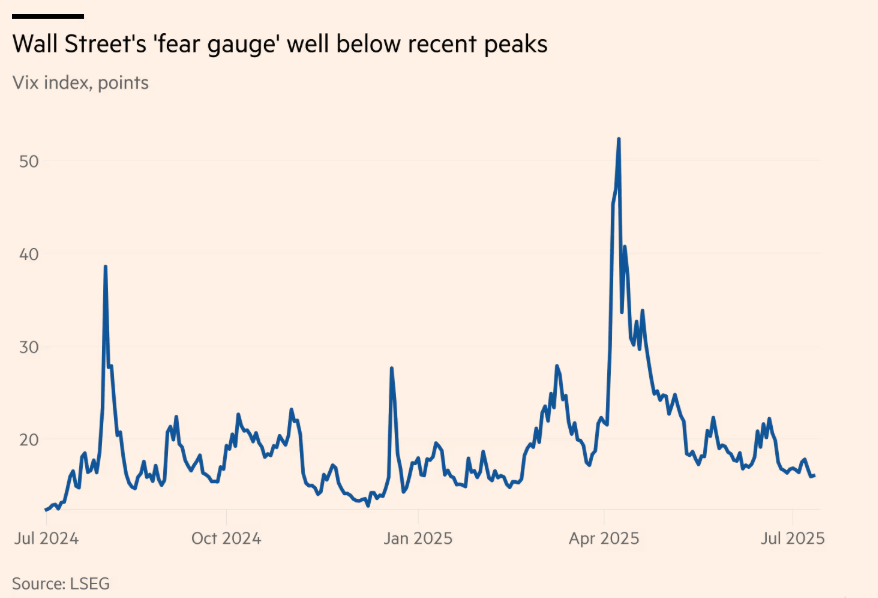
波动率降至年内低点,投资者对特朗普关税威胁渐趋淡定
Hua Er Jie Jian Wen· 2025-07-10 13:43
Core Viewpoint - Market volatility has decreased to its lowest level of the year, with the U.S. stock market reaching an all-time high despite escalating trade threats from Trump, indicating a shift in investor sentiment towards tariffs [1][2]. Group 1: Market Conditions - The VIX index, which measures short-term volatility expectations for the S&P 500, has dropped to 16, significantly below the long-term average of around 20 [1]. - Nvidia's market capitalization surpassed an unprecedented $4 trillion, driving a surge in technology stocks [1]. - The U.S. Treasury market's expected volatility index is nearing its lowest level in three years [1]. Group 2: Investor Sentiment - Investors are less concerned about Trump's trade threats compared to earlier statements, betting that he will ultimately back down on tariffs that could severely harm U.S. growth [1]. - The "TACO" trading strategy, which stands for "Trump Always Chickens Out," reflects this sentiment shift among investors [1][2]. - HSBC's multi-asset strategy head, Max Kettner, noted a significant change in investor attitudes towards tariffs after May 12 [2]. Group 3: Economic Forecasts - Goldman Sachs raised its year-end target for the S&P 500 from 6,100 to 6,600, driven by expectations of earlier interest rate cuts by the Federal Reserve and strong performance from large U.S. companies [2]. - The upcoming second-quarter earnings season is expected to deliver solid results, contributing to market optimism [2]. Group 4: Risks and Warnings - Despite the prevailing optimism, some investors caution that the stock market's buoyancy may embolden Trump to adopt a more aggressive stance on trade than currently anticipated [3]. - Concerns have been raised about the lack of caution in the market, with the S&P 500 trading at a forward P/E ratio of 24 times, indicating potential overvaluation [3][4]. - Nordea's CIO, Kasper Elmgreen, expressed worries about the absence of concern regarding the significant tariff increases experienced recently [4].
债市专题研究:三季度海外宏观主线再校准
ZHESHANG SECURITIES· 2025-07-10 10:55
1. Report Industry Investment Rating No relevant content provided. 2. Core Views of the Report - Non - farm data cooled the interest - rate cut trading significantly, and the macro mainline returned to Trump's tariff policy. Trump's administration's "apparently tough but actually soft" stance strengthened the TACO consensus, but Trump may not always "follow the rules", so the risk of TACO trading reversal should be watched, and attention should be paid to the progress of EU - US and China - US trade negotiations [1]. - The better - than - expected non - farm employment data in June showed that the US labor market remained resilient, and the sufficient condition for the Fed to cut interest rates was not triggered, leading to a significant cooling of interest - rate cut trading. The trading mainline may return to Trump's tariff policy [12][15][16]. - After the expiration of the reciprocal tariff suspension period, Trump's tariff policy was "apparently tough but actually soft", further strengthening the market's TACO trading consensus [20][22]. - In the third quarter, the macro trading mainline may revolve around TACO trading. The potential risk was that Trump might become tougher on tariff policy after domestic pressure eased, which could lead to a reversal of TACO trading [22][31]. - The next - stage macro trading mainline still revolved around Trump's tariff policy. There was a possibility of switching from TACO trading to interest - rate cut trading in September. Attention should be paid to the EU - US trade negotiations and the China - US trade negotiations after August 12 [4][32]. 3. Summary According to the Table of Contents 3.1 Third - Quarter Overseas Macro Mainline Recalibration 3.1.1 Non - farm Data and Interest - rate Cut Trading - The US added 147,000 non - farm jobs in June, higher than the market expectation, and the unemployment rate dropped to 4.1%, indicating the resilience of the US labor market. The government sector's employment increase supported the data, while the private sector's employment declined, showing some structural problems [12]. - Inflation was a necessary but not sufficient condition for the Fed to cut interest rates, while a significant weakening of the labor market was a sufficient condition. The good labor data in June likely closed the door for a July interest - rate cut, and interest - rate cut trading cooled [15][16]. 3.1.2 Trump's Tariff Policy - Before the expiration of the reciprocal tariff suspension period on July 9, Trump's administration adopted a "tough - and - soft" negotiation strategy. It sent tariff letters to 22 countries in two batches on July 7 and 9 [2][20]. - In terms of countries, the first two batches of letter - receiving countries were mainly Asian countries, with a "warning" meaning. In terms of tax rates, except for Brazil, only three countries had higher new tariff rates, and the increase was small. In terms of the implementation period, the new tariffs would be implemented on August 1, about three weeks later than the original plan [20][21]. - Trump's "apparently tough but actually soft" tariff policy strengthened the market's TACO trading consensus. After the letters were sent, the stock markets in Japan and South Korea showed a "bad news is good news" trend [22]. 3.1.3 Potential Risks of TACO Trading Reversal - Compared with April, Trump's domestic pressure had eased. The US financial market had recovered, and the "Great Beauty" bill had passed, which was a major victory for Trump [22][23][25]. - After the "Great Beauty" bill was passed, Trump's administration might shift its policy focus to tariffs to increase tariff revenue, promote re - industrialization, and strengthen the "victory narrative" for the 2026 mid - term elections [27]. - Trump's administration showed a tendency to weaponize tariff policy, such as significantly increasing the tariff rate on Brazil, which might lead to a reversal of TACO trading [29][31].
每日投资策略-20250709
Zhao Yin Guo Ji· 2025-07-09 01:51
2025 年 7 月 9 日 招银国际环球市场 | 市场策略 | 招财日报 每日投资策略 全球市场观察 全球市场观察 招银国际研究部 邮件:research@cmbi.com.hk | 环球主要股市上日表现 | | | | | --- | --- | --- | --- | | | 收市价 | | 升跌(%) | | | | 单日 | 年内 | | 恒生指数 | 24,148 | 0.97 | 41.65 | | 恒生国企 | 8,709 | 1.15 | 50.97 | | 恒生科技 | 5,326 | 2.10 | 41.49 | | 上证综指 | 3,497 | 0.72 | 17.56 | | 深证综指 | 2,102 | 1.28 | 14.39 | | 深圳创业板 | 2,181 | 1.15 | 15.32 | | 美国道琼斯 | 44,241 | -1.31 | 17.38 | | 美国标普 500 | 6,226 | -0.86 | 30.52 | | 美国纳斯达克 | 20,418 | -0.89 | 36.02 | | 德国 DAX | 24,207 | 1.76 | 44.50 | | ...
3500点不破,是故意的还是不小心?
表舅是养基大户· 2025-07-08 13:31
Market Overview - The A-share market showed strong performance, with the Shanghai Composite Index reaching a high of 3499.89, just shy of the 3500 mark, indicating a bullish sentiment among investors [1][3] - Global markets experienced a rally, influenced by the TACO trading and perceived hesitance from the U.S. administration regarding negotiations with Japan and South Korea [3] - The implementation of new quantitative regulations led to a significant influx of capital, with trading volume returning to 1.5 trillion and a notable recovery in financing [4] Financial Industry Insights - The asset management sector is under pressure to adapt to the improving market conditions, as previously poor performance made it understandable for funds to struggle [8] - The rapid growth of the "Wangshang Bank's" "Stable Treasure" product, which has over 4 million users, highlights the power of internet platforms in the financial sector [9][11] - The overall scale of the wealth management industry has reached approximately 32 trillion, driven by a shift from traditional savings to investment products [12] Product Strategy and Market Trends - The success of Xiaomi's automotive sales offers valuable lessons for asset management firms, emphasizing the importance of a focused and transparent product strategy [14][21] - The "Stable Treasure" product adopts a boutique approach, prioritizing quality over quantity, which has resulted in high user retention and repurchase rates [25] - The asset management industry is encouraged to move towards a model that emphasizes standardization, transparency, and premium offerings to meet evolving consumer demands [22][23] Regulatory Changes and Future Outlook - The expansion of the southbound bond connect will allow insurance companies to invest in offshore bonds, potentially reshaping the investment landscape [29][31] - The ability to access international debt markets may divert some capital away from domestic long-term bonds and REITs, necessitating close monitoring of policy developments [32]

目前市场的一大风险:压根不信特朗普关税
Hua Er Jie Jian Wen· 2025-07-08 08:04
Core Viewpoint - The market appears to be indifferent to Trump's latest tariff threats, reflecting a belief that these threats may not be implemented or will have minimal impact on the economy and corporate profits [1][3]. Group 1: Market Reaction - Trump's announcement to delay tariff negotiations until August 1 and impose 25% tariffs on Japanese and South Korean products, as well as up to 40% on products from 12 other countries, resulted in a modest decline of 0.2% in the S&P 500 index [1]. - The South Korean stock market saw a significant increase, with the Seoul Composite Index rising by 1.5% at one point, indicating a positive market sentiment despite the tariff threats [1]. - Analysts suggest that the market's calm response indicates a belief that the tariffs will not have a substantial effect on economic growth or corporate profits [3]. Group 2: Investor Sentiment - Investors seem to be ignoring the latest tariff announcements, interpreting them as a negotiation tactic rather than a definitive stance on tariff levels [4]. - The market has adapted to the unpredictable nature of tariff policies, with significant structural misalignments observed, as evidenced by the stability of U.S. inflation swap prices despite ongoing tariff threats [4]. - The prevailing sentiment is that the tariff threats are not taken seriously, leading to potential risks if Trump adopts a more aggressive stance unexpectedly [3][4].
策略深度报告:如何看待特朗普TACO交易?
ZHESHANG SECURITIES· 2025-07-06 14:21
Core Insights - The "TACO trade" has significantly influenced asset pricing and volatility since Trump's inauguration in January 2025, with a notable convergence in the contribution of fundamental data such as inflation and employment to asset pricing [1] - During Trump's pressure phase, it is advisable to buy safe-haven assets like gold and bonds, while sectors such as agriculture in A-shares, healthcare in Hong Kong, and utilities in the US stock market have shown relative stability [1] - In the retreat phase, equity assets are favored, with A-share financial and technology sectors performing better [1] - The current key risk overseas is the slow pace of Federal Reserve rate cuts, which raises concerns about the sustainability of US fiscal policy [1] TACO Trade Strategy Cases - Case I highlights the liquidity shock to global capital markets from reciprocal tariffs [2] - Case II discusses Trump's tariff pressure on the EU and its market implications [2] - Case III examines the interplay of interests between Musk and Trump, showcasing the TACO trade's dynamics [2] Deep Reasons for TACO Trade - The TACO trade stems from Trump's negotiation strategy of "seeking the upper hand" [3] - The Trump administration aims to balance multiple objectives in negotiations [3] - Non-US economies like China have gained more negotiating power [3] Asset-Level Review of TACO Trade - In the first half (January 13 - April 7), the market experienced a "stagflation trade" with US stocks declining, US bonds rising, and non-US currencies strengthening [4][23] - The second half (April 8 - July 4) saw a rebound in US stocks, with the Nasdaq rising 32% and the S&P 500 recovering significantly [4][24] Equity Sector Review of TACO Trade - In the first half, defensive sectors in A-shares outperformed, while technology and healthcare in Hong Kong showed strong performance [5][27] - In the second half, financial and military sectors in A-shares excelled, with Hong Kong's financial, healthcare, energy, and new consumption sectors also performing well [5][32] TACO Trade Outlook - The domestic equity market is expected to be "self-reliant," with recommendations to focus on banks as a stabilizing force and to balance investments in brokerages, military, and TMT sectors [6] - Globally, the trend of "de-dollarization" is anticipated to slow down, with a focus on rebalancing dollar asset allocations [6] - The potential for a "Buy The Dip" strategy remains effective, but caution is advised regarding the risk of stagflation [6]

特朗普政策摇摆原因与长期美债定价新框架
Di Yi Cai Jing· 2025-06-29 12:47
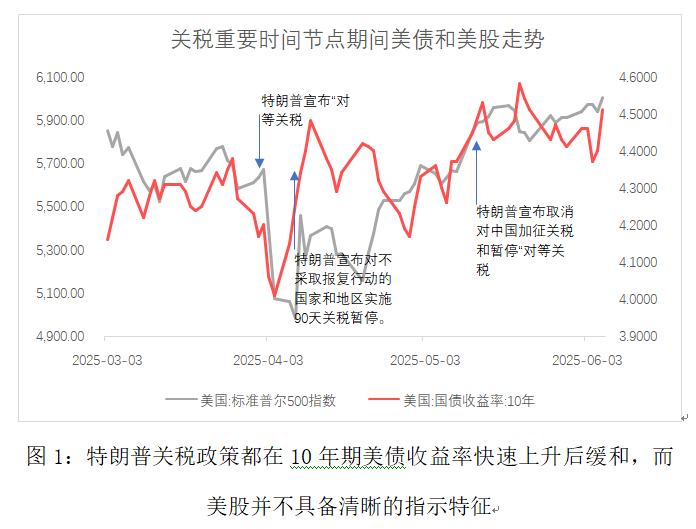
Group 1: Trump's Policy Logic - The logic behind Trump's policy is structured, focusing on increasing government revenue through tariffs, promoting manufacturing return, and adjusting tariffs based on industry rather than country [2][3] - The "Big and Beautiful" plan aims to reduce taxes and spending while raising the debt ceiling, with projected federal revenue loss of approximately $4 trillion over the next decade [3] - Deregulation is intended to stimulate the economy by removing banking regulations related to cryptocurrency and expediting government approval processes [3] Group 2: Market and Election Pressures - Market pressure plays a significant role in Trump's policy adjustments, particularly in response to movements in the U.S. Treasury market, with a tendency to ease policies when 10-year Treasury yields rise significantly [4][5] - Election pressures are also a factor, as economic downturns and inflation from tariff wars could negatively impact Trump's voter base, necessitating a softening of tariff policies [6] Group 3: U.S. Treasury Market Dynamics - High U.S. Treasury yields are unlikely to be sustained due to the Federal Reserve's current stance and the need for policy space amid economic uncertainties [8][9] - The long-term outlook suggests that U.S. Treasury yields may exceed nominal economic growth rates, which could suppress economic growth [9][10] - A new framework for long-term Treasury pricing is proposed, incorporating a sovereign risk premium to account for market concerns about U.S. debt [20][22] Group 4: Broader Economic Considerations - The U.S. is seeking new support for the dollar through high-tech exports and controlling supply chains, which may mitigate inflation domestically [23][24] - The U.S. Treasury's debt ceiling situation is critical, with current measures to manage liquidity potentially leading to a "fiscal window" before a new debt agreement is reached [25][26]
宋雪涛:马斯克之后,DOGE何去何从?
雪涛宏观笔记· 2025-06-20 00:25
Group 1 - The article discusses the evolution of the relationship between Trump and Musk, highlighting their initial close alliance and subsequent public fallout due to ideological differences and personal conflicts [4][5][7] - Musk's role in the Trump administration was initially seen as pivotal, addressing key economic issues like inflation and national debt, but conflicts over tariffs and fiscal policies led to a gradual deterioration of their relationship [3][6][8] - The article emphasizes that the breakdown of their partnership was not sudden but rather a result of systemic erosion of trust and influence, driven by policy decisions that conflicted with Musk's business philosophy [7][8] Group 2 - The "DOGE" initiative, which aimed for significant budget cuts, achieved approximately $175 billion in spending reductions during Musk's tenure, representing 8.75% of the $2 trillion target [11] - Despite these achievements, the article notes that the entrenched structural resistance within the U.S. government limits the effectiveness of top-down reforms like those attempted by Musk [11][14] - The article suggests that the future of "DOGE" may transition into a more systematic and institutionalized phase under Trump's leadership, focusing on fiscal sustainability and efficiency improvements [15][16] Group 3 - The article critiques the systemic inefficiencies of the U.S. government, attributing them to a culture of over-regulation that fosters a compliance-driven mentality among civil servants, which ultimately hampers effective governance [12][14] - Examples of inefficiencies, such as the prolonged delays in major projects like the California high-speed rail and the new Air Force One, illustrate the challenges faced in government operations [13] - The article posits that for "DOGE" to succeed, it must address these deep-rooted structural issues rather than merely implementing superficial cost-cutting measures [14] Group 4 - The article discusses the misjudgment of Wall Street regarding Trump's economic policies, particularly the "TACO" trade, which underestimated his commitment to fiscal tightening and debt sustainability [17][18] - It highlights the potential for Trump's future policies to diverge from market expectations, particularly if he pursues aggressive spending cuts alongside tax reductions, which could lead to economic recession [18] - The overarching narrative suggests that Trump's fiscal strategies are aimed at ensuring long-term financial health and maintaining the global status of the U.S. dollar, despite short-term economic pain [18]
5月宏观月度观察:经济仍需政策呵护-20250619
Minmetals Securities· 2025-06-19 03:16
Group 1: Overseas Macro Insights - Developed countries show relative resilience under tariff shocks, with May manufacturing PMI for developed nations rising to 50.0%, up 0.9 percentage points from April[6] - Emerging economies' manufacturing PMI dropped to 49.2%, down 1.3 percentage points from April, indicating higher reliance on global trade[6] - U.S. inflation remained stable in May, with CPI increasing by 2.4% year-on-year, a slight rise of 0.1 percentage points from April[8] Group 2: Domestic Macro Insights - China's retail sales grew by 6.4% year-on-year in May, driven by early e-commerce promotions and trade-in policies[2] - Fixed asset investment growth slowed to 2.9% year-on-year in May, down 0.7 percentage points from April, with manufacturing investment declining for two consecutive months[16] - Exports to the U.S. fell sharply by 34.5% year-on-year in May, significantly impacting overall export performance[19] Group 3: Policy and Trade Negotiations - U.S.-China tariff negotiations saw a temporary breakthrough, with a joint statement on May 13 maintaining tariffs at 10% and suspending 24% tariffs for 90 days[3] - The ongoing trade talks are expected to face high uncertainty, with potential delays in reaching a final agreement exceeding 90 days[23] Group 4: Economic Risks and Outlook - Deflationary pressures persist, with May CPI down 0.1% and PPI down 3.3%, indicating significant deflation risks[20] - The overall economic data for May shows resilience, but concerns remain regarding the sustainability of consumption and export growth[20]