
去美元化

Search documents
长江期货贵金属周报:非农失业率上升,价格延续偏强-20251222
Chang Jiang Qi Huo· 2025-12-22 02:28
2025/12/22 长江期货股份有限公司交易咨询业务资格:鄂证监期货字[2014]1号 长江期货贵金属周报 目录 01 行情回顾 02 周度观点 03 海外宏观经济指标 04 当周重要经济数据 05 当周重要宏观事件和政策 06 库存 07 基金持仓 08 本周关注重点 01 行情回顾:上周 2500 2700 2900 3100 3300 3500 3700 3900 4100 4300 4500 2025-01-02 2025-02-02 2025-03-02 2025-04-02 2025-05-02 2025-06-02 2025-07-02 2025-08-02 2025-09-02 2025-10-02 2025-11-02 2025-12-02 美国11月失业率升至4.6%,上升程度超预期,降息预 期升温,黄金价格偏强震荡。截至上周五,美黄金报收 4369美元/盎司,周内上涨0.9%,关注上方压力位4430, 下方支撑位4270。 美黄金连:日线 美白银连:日线 17.0000 27.0000 37.0000 47.0000 57.0000 67.0000 2021-01-01 2022-01 ...
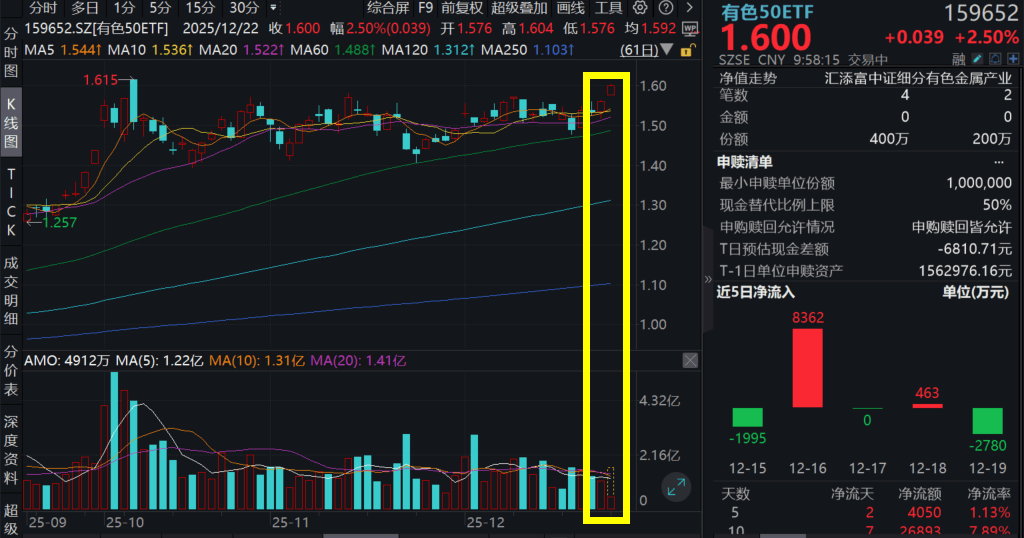
锂、金、银暴涨,紫金矿业涨超4%!有色50ETF(159652)跳空高开放量大涨,劲升2%,盘中资金涌入!年末收官将至,有色“夺冠在望”?
Sou Hu Cai Jing· 2025-12-22 02:23
Core Viewpoint - The A-share market is experiencing a significant upward trend, particularly in the non-ferrous metal sector, with the Non-Ferrous 50 ETF (159652) showing a notable increase and substantial trading volume [1][4]. Group 1: Market Performance - As of 9:58 AM, the Non-Ferrous 50 ETF (159652) opened with a gap up, rising by 2.5% and seeing a significant increase in trading volume, with 200,000 net subscriptions recorded during the session [1]. - Key stocks in the non-ferrous metal sector, such as Zijin Mining and Shandong Gold, have shown strong performance, with Zijin Mining increasing by 4.66% and Shandong Gold by 4.37% [2][4]. Group 2: Commodity Trends - Precious metals are experiencing a surge, with spot gold rising over 1% to exceed $4,383 per ounce, setting a new historical high, while silver has also reached a record of over $67 per ounce [3]. - The overall non-ferrous metal sector has seen an impressive increase of over 85% this year, indicating a strong market performance [4]. Group 3: Economic and Policy Context - Following the December Federal Reserve policy decisions, a monthly operation of $40 billion in reserve management purchases is expected to provide liquidity support to the market [7]. - The Bank of Japan has raised interest rates by 25 basis points to 0.75% to combat rising inflation, marking the highest rate in 30 years [7]. Group 4: Investment Opportunities - The Non-Ferrous 50 ETF (159652) is highlighted as a leading investment vehicle, covering a wide range of metals including gold, copper, aluminum, lithium, and rare earths, which are expected to benefit from the ongoing super cycle in the non-ferrous sector [18][20]. - The ETF has a high concentration of key metals, with copper accounting for 31% and gold for 14%, making it a competitive option in the market [20]. Group 5: Long-term Outlook - The long-term outlook for gold remains positive, driven by factors such as declining real interest rates and increasing central bank gold purchases, with forecasts suggesting gold prices could exceed $4,500 per ounce in the near future [15][16]. - The copper market is also expected to see a growing supply-demand gap, with projections indicating that copper prices may reach new highs due to robust demand from emerging sectors like AI and renewable energy [16][17].




现货黄金再创历史新高!金价放大器黄金股ETF(517520)涨超黄金高开3%
Sou Hu Cai Jing· 2025-12-22 02:06
Group 1 - The core viewpoint is that the gold market is experiencing significant upward momentum due to geopolitical tensions and expectations of future interest rate cuts by the Federal Reserve, leading to a surge in gold prices and related stocks [1][2]. - As of December 22, 2025, the China Securities Index for gold industry stocks rose by 3.38%, with notable increases in individual stocks such as Silver Nonferrous (up 8.69%) and China Gold International (up 5.87%) [1]. - The spot gold price reached a historical high of $4,381.4 per ounce, driven by heightened market risk aversion [1]. Group 2 - Concerns over global debt and the trend of "de-dollarization" are prompting central banks and investors to increase their gold holdings, indicating a long-term bullish outlook for gold prices [2]. - The current valuation of gold resource stocks is considered low, presenting a potential investment opportunity as their profit expectations rise with increasing gold prices [2]. - The gold stock ETF (517520) is highlighted for its higher elasticity during gold price increases, making it an attractive option for investors seeking exposure to gold assets [2].


新世纪期货交易提示(2025-12-22)-20251222
Xin Shi Ji Qi Huo· 2025-12-22 01:56
Report Industry Investment Ratings - Iron ore: Oscillating [2] - Coking coal and coke: Oscillating [2] - Rolled steel and rebar: Oscillating [2] - Glass: Oscillating [2] - Soda ash: Oscillating [2] - CSI 500 Index Futures/Options: Rebounding [3] - CSI 1000 Index Futures/Options: Rebounding [3] - 2 - year Treasury bonds: Oscillating [3] - 5 - year Treasury bonds: Oscillating [3] - 10 - year Treasury bonds: Consolidating [3] - Gold: Oscillating with a bullish bias [3] - Silver: Oscillating with a bullish bias [3] - Logs: Rebounding from the bottom [4] - Pulp: Oscillating [4] - Offset paper: Weakly oscillating [4] - Soybean oil: Oscillating with a bearish bias [7] - Palm oil: Oscillating with a bearish bias [7] - Rapeseed oil: Oscillating with a bearish bias [7] - Soybean meal: Oscillating with a bearish bias [7] - Rapeseed meal: Oscillating with a bearish bias [7] - Soybean No. 2: Oscillating with a bearish bias [7] - Soybean No. 1: Oscillating with a bearish bias [7] - Live pigs: Bullish - biased [8] - Rubber: Oscillating [8] - PX: Widely oscillating [9] - PTA: Widely oscillating [9] - MEG: Oscillating [9] - PR: On the sidelines [9] - PF: On the sidelines [9] Core Views - The iron ore market is characterized by "loose supply, low demand, and port inventory accumulation" in 2026, and the implementation of the steel export license management system is a definite negative for raw materials [2]. - The coking coal and coke market is supported by capacity inspections, safety supervision, and anti - involution policies, but the steel export policy has shifted market expectations from supply - side policy benefits to demand - side negatives [2]. - The steel market has seen a rebound due to improved sentiment and short - term fundamentals, but the implementation of the steel export license management system requires a downward adjustment of export expectations and attention to production control policies [2]. - The glass market has a supply - demand contradiction due to weakening demand and insufficient supply contraction, and attention should be paid to macro and production line cold - repair situations [2]. - The financial market is in short - term shock adjustment, with the mid - term trend continuing and the high - tech industry growing. The gold price is affected by central bank gold purchases, geopolitical risks, and Fed interest rate policies [3]. - The log market has weakening supply pressure and non - weak demand in the off - season, and the price is expected to rebound from the bottom but with weak driving force [4]. - The pulp market has a loose supply - demand pattern, and the price is expected to oscillate [4]. - The double - offset paper market has supply pressure and general social orders, and the price is expected to weakly oscillate [4]. - The oil and fat market has uncertain demand prospects, high inventory pressure, and abundant supply, and is expected to oscillate with a bearish bias [7]. - The meal market has a relatively loose supply, and the price is expected to oscillate with a bearish bias due to factors such as the weakness of US soybeans and the expected high yield in South America [7]. - The live pig market has stable supply and increased downstream consumption demand, and the weekly average price is expected to increase slightly [8]. - The rubber market has supply affected by weather and demand with limited support, and the price is expected to oscillate [8]. - The polyester market has different trends for each product, with prices mainly affected by cost, supply - demand, and inventory factors [9]. Summary by Related Catalogs Black Industry - **Iron ore**: The global mine supply will increase significantly in 2026, while the current iron - making demand is weak, and the steel export policy is negative. Short - term rebounds can be used to enter short positions [2]. - **Coking coal and coke**: Supported by policies, but the steel export policy has a negative impact on demand. Short - term, the price may be affected by the disappearance of export orders, and the long - term anti - involution policy provides some support [2]. - **Rolled steel and rebar**: The market sentiment has been boosted, and the short - term fundamentals are good. However, the steel export policy requires attention to production control and export expectations [2]. - **Glass**: The supply - demand contradiction is prominent due to weak demand and insufficient supply contraction. The price is expected to oscillate at the bottom and may rebound due to sentiment [2]. Financial - **Stock index futures/options**: The market is affected by policy arrangements and regulatory changes. Different stock indexes have different trends, with some rebounding and some oscillating [3]. - **Treasury bonds**: The yield of 10 - year Treasury bonds is flat, and the market is in a state of consolidation with a slight rebound [3]. - **Precious metals**: The gold - pricing mechanism is changing, and factors such as central bank gold purchases, geopolitical risks, and Fed interest rate policies affect the price, which is expected to oscillate with a bullish bias [3][5]. Light Industry - **Logs**: The supply pressure is weakening, and the demand is non - weak in the off - season. The price is expected to rebound from the bottom, but the driving force is not strong [4]. - **Pulp**: The supply - demand pattern is loose, with cost support and weak demand. The price is expected to oscillate [4]. - **Double - offset paper**: The supply pressure exists, and the social orders are general. The price is expected to weakly oscillate [4]. Oilseeds and Oils - **Oils and fats**: The demand prospects are uncertain, the inventory is high, and the supply is abundant. The price is expected to oscillate with a bearish bias, and attention should be paid to weather and production - sales changes [7]. - **Meals**: The supply is relatively loose, affected by the weakness of US soybeans and the expected high yield in South America. The price is expected to oscillate with a bearish bias [7]. Agricultural Products - **Live pigs**: The supply is stable, the downstream consumption demand has increased slightly, and the weekly average price is expected to increase slightly [8]. Soft Commodities - **Rubber**: The supply is affected by weather, the demand support is limited, and the inventory is in a seasonal accumulation period. The price is expected to oscillate [8]. Polyester - **PX**: Geopolitical factors increase supply risks, and the price is affected by oil prices. The demand from downstream polyester can support it for the time being [9]. - **PTA**: The cost end is affected by oil price fluctuations, and the short - term supply - demand is improved but will deteriorate in the future. The price follows the cost end [9]. - **MEG**: There is a long - term inventory accumulation pressure, and the short - term price oscillates with an upward suppression [9]. - **PR**: The cost support is strong, but the terminal demand restricts the price increase [9]. - **PF**: The cost is strong, but the demand is expected to shrink after New Year's Day, and the processing fee may be compressed [9].
现货黄金再创历史新高,黄金基金ETF(518800)涨超1%
Sou Hu Cai Jing· 2025-12-22 01:55
Group 1 - The core viewpoint of the article highlights that spot gold has reached a historical high, with a daily increase of 1%, while COMEX gold futures rose approximately 0.6% [1] - Market expectations for the Federal Reserve to lower interest rates in 2026 are increasing, alongside rising geopolitical uncertainties as the Christmas and New Year holidays approach, which supports gold prices [1] - In the medium to long term, the initiation of a rate-cutting cycle by the Federal Reserve, increasing macroeconomic policy uncertainties overseas, and the global trend of "de-dollarization" continue to be favorable for gold prices, maintaining the long-term bullish outlook [1] Group 2 - The gold ETF (518800) closely tracks gold price movements, with one unit of the ETF corresponding to 1 gram of gold, serving as a certificate of physical gold ownership, and offers good liquidity for investors interested in related opportunities [1]
铂钯专家交流
2025-12-22 01:45
Summary of Key Points from the Conference Call Industry Overview - The conference focuses on the platinum and palladium markets, highlighting significant price increases and supply-demand dynamics in the precious metals sector [2][5][12]. Core Insights and Arguments 1. **Price Trends**: - Platinum prices are projected to approach $2000 per ounce by 2025, up from $900 at the end of the previous year, marking a 90% increase in November alone [2][3][5]. - Palladium prices have also risen, although at a lower rate compared to platinum [5]. 2. **Supply and Demand Dynamics**: - Global platinum production is approximately 176 tons, with total supply (including recycling) reaching 218 tons. South Africa contributes about 70% of this supply [2][6]. - Palladium production is around 200 tons, with total supply (including recycling) at 292 tons, primarily sourced from Russia (40%) and South Africa (36%) [2][7]. - A significant supply shortage of platinum was noted in 2023, with a shortfall of 16.1 tons expected to increase in the following years [5][11]. 3. **Cost Factors**: - Production costs for platinum have risen from $614 per ounce in 2022 to an estimated $884 per ounce by 2024, indicating a 44% increase over two years [5][11]. 4. **Market Drivers**: - The demand for platinum is expected to grow due to advancements in hydrogen fuel cell technology, with projections indicating that by 2030, China could have 1 million fuel cell vehicles, significantly increasing platinum demand [3][14]. - The European Union's fluctuating policies regarding the ban on internal combustion engine vehicles are impacting market dynamics, contributing to price volatility [4][5]. 5. **Investment and Trading Developments**: - New trading products for platinum and palladium were introduced in November, which are expected to attract more investment into the market [3][17]. Additional Important Insights 1. **China's Market Dependency**: - China is heavily reliant on imports for platinum and palladium, with 2024 consumption projected at 68.6 tons for platinum and 58 tons for palladium. The country imports over 100 tons of platinum and nearly 30 tons of palladium annually [12]. - The introduction of a unified import VAT rebate policy in China aims to level the playing field for businesses, although it may cause short-term disruptions [3]. 2. **Future Outlook**: - The platinum market is expected to face tightening supply due to production challenges in South Africa and Russia, while palladium may experience a balance or surplus due to declining demand from traditional automotive sectors [24]. - The historical price relationship between platinum and gold has shifted, with platinum currently priced lower than gold, which is unusual given that platinum has traditionally been valued at about 1.5 times the price of gold [15][18]. 3. **Applications Beyond Automotive**: - Platinum is increasingly used in various sectors, including hydrogen production, pharmaceuticals, and aerospace, indicating a broadening scope of demand beyond traditional automotive applications [21][22]. 4. **Risks and Challenges**: - The supply of platinum faces risks from power issues in South Africa, geopolitical tensions affecting Russian exports, and rising production costs, which could further strain the market [11][24]. This summary encapsulates the critical insights and trends discussed in the conference call regarding the platinum and palladium markets, providing a comprehensive overview of the current landscape and future expectations.
我国离岸金融迈入企稳回升新阶段
Xin Lang Cai Jing· 2025-12-21 20:41
Core Insights - The report indicates that China's offshore financial index increased from 106.16 to 106.50 from 2023 to 2024, marking a significant stabilization and recovery phase for China's offshore finance despite complex international monetary conditions [1] Group 1: Offshore Financial Index - The increase in the offshore financial index is seen as a sign of structural optimization rather than mere scale expansion [1] - The score for China's international balance of payments capital and financial projects improved by 7.7% in 2024 [1] - The offshore RMB asset scale continues to expand, with micro-risk indicators improving by over 25% [1] Group 2: Regional Collaboration - The report suggests enhancing collaboration among Shanghai, Hong Kong, and Hainan to create a complementary offshore financial ecosystem [2] - Shanghai is positioned as an "innovation source," focusing on institutional innovation and RMB liquidity supply [2] - Hong Kong is described as a "global hub," emphasizing pricing and clearing advantages [2] Group 3: Future Development - The report anticipates a structural increase in demand for offshore financial services driven by external environments and the deepening of RMB internationalization [1] - Recommendations include building an offshore RMB asset pool and innovating offshore financial products to attract investor participation [2] - The focus of China's offshore financial development is shifting from increasing volume to establishing functions and systems, aiming to create a comprehensive and secure financial hub [2]
美高层起内讧,特朗普公开表态,贝森特因搞不定中国遭解雇?
Sou Hu Cai Jing· 2025-12-21 17:50
Core Viewpoint - The article discusses the precarious situation of U.S. Treasury Secretary Besant, highlighting the tension between political pressures from President Trump and the independent monetary policy of the Federal Reserve, amidst a backdrop of significant national debt and economic instability [1][25]. Group 1: Economic Context - The U.S. national debt has reached an unprecedented $38 trillion, raising concerns about its sustainability and the potential classification of U.S. Treasuries as "credit assets" rather than risk-free [1][25]. - Analysts are increasingly skeptical about the long-term viability of U.S. debt, with some predicting that the U.S. may rank at the bottom among major global markets in terms of asset returns over the next decade [1][25]. - The economic growth driven by debt rather than productivity or innovation suggests that long-term returns may be overestimated [2]. Group 2: Political Dynamics - The political landscape is characterized by extreme polarization, making it difficult to implement long-term reforms necessary for economic recovery [7][25]. - Trump's administration is seen as shifting blame internally, with Besant becoming a scapegoat for broader systemic issues rather than a reflection of his capabilities [5][19]. - The article suggests that the U.S. is experiencing a decline similar to that of the British Empire, where internal weaknesses are masked by attempts to maintain external dominance [12][13]. Group 3: Market Implications - The independence of the Federal Reserve is under threat from political pressures, which could undermine the credibility of U.S. financial markets and the dollar's status as the world's reserve currency [10][25]. - The yield curve inversion indicates that investors are anticipating a future economic recession, reflecting a lack of confidence in the current economic trajectory [9][25]. - The ongoing political maneuvering and failure to address structural economic issues may lead to a permanent reduction in the "safety premium" associated with U.S. assets [10][25].

贵金属周报:美联储主席候选人之争进入白热化阶段-20251221
Nan Hua Qi Huo· 2025-12-21 13:30
1. Report Industry Investment Rating No information provided in the document. 2. Core Viewpoints of the Report - Last week, precious metal prices continued to be strong, with London spot gold approaching the historical high of $4,380 in October, and London spot silver reaching a new historical high of $67. The short - term K - line shows no turning signal. After Tuesday, the Fed's interest rate cut expectation rebounded slightly due to补发 of non - farm and CPI employment data, indicating downward pressure on the US economy and easing inflation [2]. - Since the end of November, silver has outperformed gold, and the gold - silver ratio has dropped significantly due to factors such as low supply elasticity and low inventory of silver, large deliveries of COMEX 2512 contracts, rigid industrial demand, continuous inflow of ETF investment demand (but a weekly outflow of 36.7 tons from the iShares Silver ETF last week), growth expectations of silver demand from green new energy and digital AI economy, and concerns about import tariffs caused by the uncertainty of the US 232 mineral survey results [3]. - Near - term trading logic (before January 2026): Be cautious about chasing high silver prices as price correction risks are accumulating. Factors include high implied volatility of SHFE silver options, potential technical support for the gold - silver ratio, alleviation of concentrated delivery pressure, possible release of the US 232 mineral survey results, and potential phased selling of silver by some indices and products [3]. - Long - term trading logic (after January 2026): Pay attention to the change of the US dollar index, the Fed's interest rate cut rhythm and RMP operation in the first half of 2026, central bank gold purchases under the de - dollarization trend, and the growth prospects of investment demand. Also, focus on key resource demand and tariff policies under anti - globalization and trade protection [4]. - Trend judgment: The short - term trend remains oscillating and strong. Gold should pay attention to the previous high resistance, and silver should be aware of the profit - taking pressure. The support and resistance levels for London spot gold are $4,100 - $4,250 - $4,400, and for London spot silver are $60 - $65 - $70. The unilateral strategy is to hold existing long positions cautiously. For gold, if it breaks through the historical high on the daily line, consider chasing the long position; for silver, be cautious about chasing high in the short term [4][5]. 3. Summary by Relevant Catalogs 3.1 Core Contradictions and Strategy Recommendations 3.1.1 Core Contradictions - Precious metal price trends: London spot gold and silver showed strong performance last week, with no short - term turning signal in the K - line [2]. - Factors influencing price: The Fed's interest rate cut expectation rebounded slightly after Tuesday due to economic data, and the competition for the Fed Chairman candidate continued to ferment, with all three candidates being dovish supporters of loose money [2]. - Silver performance: Since the end of November, silver has far outperformed gold, and the gold - silver ratio has dropped significantly due to multiple factors [3]. - Trading logic: Near - term trading logic focuses on the appointment of the new Fed Chairman and economic data's impact on monetary policy expectations. Long - term trading logic involves factors such as the US dollar index, the Fed's interest rate cut rhythm, and investment demand [3][4]. 3.1.2 Trading - type Strategy Recommendations - Trend judgment: Short - term oscillation is still strong, with different key points for gold and silver [4]. - Support and resistance levels: Given for London spot gold and silver [5]. - Strategy: Unilateral strategy suggests cautious holding of existing long positions, with different approaches for gold and silver [5]. 3.1.3 Interest Rate Cut Expectation Changes - Tables show the changes in interest rate cut expectations in the US from December 2025 to April 2027, including target rates, effective rates, implied overnight rates, and expected interest rate cuts or increases at different meetings [8][11]. 3.2 Market Information 3.2.1 This Week's Event Concerns - Monday: Fed Governor Milan will speak at 22:30, and FOMC permanent voter and New York Fed President Williams will speak on the economic outlook at 23:30. - Wednesday: FOMC permanent voter and New York Fed President Williams will give an opening speech at the 2025 Foreign Exchange Market Structure Conference hosted by the New York Fed at 22:05. - Thursday: The Bank of England will announce the interest rate decision and meeting minutes at 20:00, and the European Central Bank will announce the interest rate decision at 21:25. - Friday: Bank of Japan Governor Ueda Kazuo will hold a monetary policy press conference at 14:30, and the Bank of Japan will also announce the interest rate decision [15][16]. 3.2.2 Last Week and This Week's Data Concerns - Last week, the US and China released a series of economic indicators, including non - farm employment, inflation, and consumption data. This week, the US and China are expected to release economic indicators such as construction permits, GDP, and industrial profits [17]. 3.3 Futures and Price Data 3.3.1 International Precious Metal Market - Shows the latest prices, weekly changes, and weekly change rates of international precious metals such as London gold and silver spot, COMEX gold and silver, and related ETF holdings and CFTC positions [20]. 3.3.2 Domestic Precious Metal Market - Presents the latest prices, weekly changes, and weekly change rates of domestic precious metals such as SHFE gold and silver futures and related inventories [21]. 3.3.3 US Financial Asset Performance - Displays the latest prices, weekly changes, and weekly change rates of US financial assets such as the US dollar index, US Treasury yields, and major stock indices [21]. 3.3.4 Domestic Financial Market - Shows the latest prices, weekly changes, and weekly change rates of domestic financial assets such as the US dollar - RMB exchange rate, domestic stock indices, and domestic Treasury yields [22]. 3.3.5 Futures Positions - Includes information on CFTC positions related to gold and silver, and the relationship between domestic futures indices and positions [24][25][27]. 3.4 Macroeconomic Information 3.4.1 FOMC Post - meeting Statements - Compares the FOMC post - meeting statements on December 11, 2025, and October 30, 2025, including fundamental assessment, risk assessment, policy goals, policy decisions, and voting results [30]. 3.4.2 Economic Forecast Tables - Presents the economic forecast tables of the December FOMC, including real GDP growth, unemployment rate, inflation rate, and federal funds rate from 2025 to 2028 and in the long - term [31]. 3.4.3 US CPI and Related Data - Displays the US CPI data by category, including food, energy, and core CPI, and shows the year - on - year and month - on - month changes [37]. 3.5 Sensitive Demand and Valuation 3.5.1 Sensitive Demand - ETF Investment Demand - Includes information on the relationship between gold and silver long - term fund holdings and prices, as well as the holdings of Chinese TOP3 gold ETFs and Huaan Gold ETF [47][48]. 3.5.2 Valuation Anchoring - Related Assets - Covers the COMEX gold - silver ratio, the relationship between gold and the US dollar index, US Treasury real interest rates, and other related assets and indicators [49][51][52]. 3.5.3 Global Major Exchange Inventories - Shows the inventories of gold and silver in LBMA, COMEX, and SHFE, as well as the total inventories of gold and silver in multiple exchanges [68][70][71].
全球央行罕见大分裂,资金会往哪里跑?
Sou Hu Cai Jing· 2025-12-21 11:56
Group 1 - The global monetary policy landscape is undergoing a significant "divergent" adjustment, with Japan expected to initiate interest rate hikes while the Federal Reserve maintains a loose stance, leading to a reconfiguration of global capital flows [1][2] - Developed economies are experiencing a comprehensive policy divergence characterized by "U.S. easing, Japan tightening, stable Europe, and the U.K. likely concluding its easing cycle" [2][3] - Japan's central bank is anticipated to raise its benchmark interest rate to 0.75% by December 2025, marking a pivotal shift from ultra-loose monetary policy, which could disrupt global carry trades valued at approximately $30 trillion [3][4] Group 2 - The Federal Reserve faces uncertainty with internal divisions regarding future rate cuts, as economic indicators show signs of structural weakness, including a rising unemployment rate and persistent inflation [4][5] - The European Central Bank is expected to maintain its cautious stance, with hawkish tendencies becoming more pronounced as the Eurozone economy shows moderate recovery [5][6] - The Bank of England is likely to implement its final rate cut in December 2025, signaling a shift in its monetary policy focus [6] Group 3 - Emerging markets exhibit a dual-speed pattern, with many countries pursuing easing policies while others maintain a more cautious approach due to inflation and debt pressures [7][8] - Asian emerging markets, particularly Thailand and Indonesia, are expected to continue easing, while China maintains a moderately loose monetary policy to support growth [7][8] - Latin American and African emerging markets are facing increasing debt pressures, limiting their ability to implement easing measures [8][9] Group 4 - The divergence in monetary policy is driven by a triad of factors: inflation levels, economic growth resilience, and debt pressures, which collectively influence central bank decisions [9][10] - Global inflation is projected to decline from 3.4% in 2025 to 2.5% by 2027, with significant regional disparities affecting monetary policy paths [10][11] - Developed economies are experiencing slowing growth, while emerging markets, particularly in Asia, are expected to lead global growth, with India and Indonesia projected to maintain robust growth rates [12][13] Group 5 - The global debt burden is rising, with OECD economies expected to see public debt levels reach 113% by 2027, creating constraints on monetary policy [15][16] - The U.S. faces severe debt challenges, with a national debt exceeding $36 trillion and a fiscal deficit rate of 7%, raising concerns about long-term fiscal sustainability [15][16] - Developing countries are at risk of debt crises, with many needing to repay significant external debts, which could limit their monetary policy flexibility [16] Group 6 - The reconfiguration of global capital flows is influenced by interest rate differentials, economic fundamentals, and risk preferences, with a notable shift towards Asian emerging markets as safe havens [17][18] - The interest rate landscape is changing, with the U.S. dollar's attractiveness diminishing as the Federal Reserve continues to cut rates while other economies tighten [18][19] - Economic fundamentals are driving capital towards high-growth, low-risk economies, particularly in Asia, while Latin American and African markets are experiencing cautious capital inflows due to economic and debt challenges [20][21] Group 7 - The outlook for global capital flows suggests a focus on Japan, Europe, and Asian emerging markets, with a preference for high-quality assets and safe-haven investments like gold [24][25] - Japan is expected to see a return of capital as its economic fundamentals improve, while European markets benefit from a stable policy environment and moderate recovery [25][26] - Asian emerging markets, particularly China and India, are positioned to attract significant foreign investment due to their strong growth prospects and favorable economic conditions [27][28]