
哑铃策略

Search documents
博时基金宏观策略部王橹舟:下半年关注两大资产配置主线
2 1 Shi Ji Jing Ji Bao Dao· 2025-08-28 03:39
Group 1: Market Outlook and Strategies - The current stock market shows a recovery in risk appetite, but fundamental pressures maintain a range-bound pattern, with overall trends positive but subject to periodic corrections and sector rotations [2] - The driving forces behind market movements are primarily capital flows and policy expectations, with sustainability dependent on corporate earnings and overall demand improvements [2] - The "barbell strategy" remains relevant, with adjustments suggested for both sides based on risk-reward considerations and trend analysis [2] Group 2: Asset Allocation Insights - In a low-interest-rate environment, the focus should be on emerging market equities and gold or short-term U.S. Treasuries as key asset allocation themes [1] - The importance of low-correlation strategies is emphasized, as single strategies struggle to manage drawdowns effectively; integrating various strategies can enhance overall portfolio Sharpe ratios [1][4] - The shift in bond market strategy from "yield-driven" to "portfolio optimization" is noted, with an emphasis on maintaining liquidity and managing duration to reduce volatility [6] Group 3: Risk Management Approaches - The risk of losses can be managed through both preemptive and reactive measures, with a focus on strategic asset allocation and tactical short-term signals to mitigate "missing out" risks [5] - The bond market faces multiple pressures, including capital diversion to equities and inflation expectations, necessitating a defensive approach with a focus on short to medium-term credit bonds [6]


建信期货股指日评-20250827
Jian Xin Qi Huo· 2025-08-27 01:49
Group 1: Report Overview - Report Type: Stock Index Daily Review [1] - Date: August 27, 2025 [2] - Researchers: Nie Jiayi, He Zhuoqiao, Huang Wenxin [3] Group 2: Market Review - On August 26, the Wind All A index opened lower, oscillated upward, and then quickly declined in the late session, closing down 0.09%. Over 60% of stocks rose. Among index spot markets, CSI 300, SSE 50, and CSI 1000 closed down 0.37%, 0.67%, and 0.02% respectively, while CSI 500 closed up 0.18%, indicating better performance of small and medium - cap stocks. Index futures generally performed weaker than spot markets. IF and IH main contracts closed down 0.57% and 0.71% respectively, while IC and IM main contracts closed up 0.10% and 0.04% respectively [6] Group 3: Market Outlook - Externally, Trump's statement about imposing 200% tariffs on China if it fails to ensure US rare - earth magnet supply has reignited market risk - aversion sentiment. Domestically, the economy is in a weak recovery phase. July economic data shows a decline in both supply and demand, but market expectations for the future are positive. Margin trading balance has exceeded 2 trillion yuan and is growing. The A - share trading volume decreased slightly today, reflecting capital's risk - aversion behavior under external market disturbances, but the overall trading volume remains at a relatively high level of 2.71 trillion yuan. Currently, the stock market valuation is relatively high but not extremely high. There is still room for further capital inflow. However, the latest US tariff statement has impacted market sentiment, increasing the pressure for the Shanghai Composite Index to break through 3900. In terms of market style, the dumbbell strategy remains unchanged, with SSE 50 with stable earnings and CSI 1000 with higher earnings - repair elasticity likely to perform better [8] Group 4: Data Overview - The report provides data on domestic major indexes, market style, industry sectors, stock index futures trading volume and open interest, and major ETF fund shares and trading volume, with data sources from Wind and the Research and Development Department of Jianxin Futures [10][13][14][17][18][20][22][24][27][28][29] Group 5: Industry News - On August 25, six departments in Shanghai jointly issued a notice on optimizing and adjusting real - estate policies, including reducing housing purchase restrictions, optimizing housing provident funds, optimizing personal housing credit, and improving personal housing property tax [30]
中欧基金:市场赚钱效应正从科技板块向其他领域扩散
Zheng Quan Shi Bao Wang· 2025-08-25 10:07
Group 1 - The core viewpoint of the article highlights that the trading volume in the Shanghai and Shenzhen markets has exceeded 3 trillion yuan for the first time since October of the previous year, indicating a significant increase in market activity [1] - According to Central European Fund, the market's profit-making effect is spreading from the technology sector to other areas, with trading activity remaining at historically high levels [1] - In light of the rising market enthusiasm, it is suggested to adjust the existing dividend sector in the barbell strategy towards the technology growth sector [1] Group 2 - The growth sector to focus on includes high-value-added overseas-related fields, particularly those leveraging short videos and algorithms to gain traffic and channel advantages, aimed at exporting the consumption aesthetics of Chinese youth [1] - Additionally, attention should be given to high-end manufacturing, which has global research, scale, and capitalization advantages, as well as the potential for capital investment and technological research and development in China [1] - Other areas of interest include innovative pharmaceuticals, robotics, and AI hardware themes [1]
高股息和科技成长双管齐下 “哑铃策略”或仍适配当下行情
Cai Fu Zai Xian· 2025-08-25 05:20
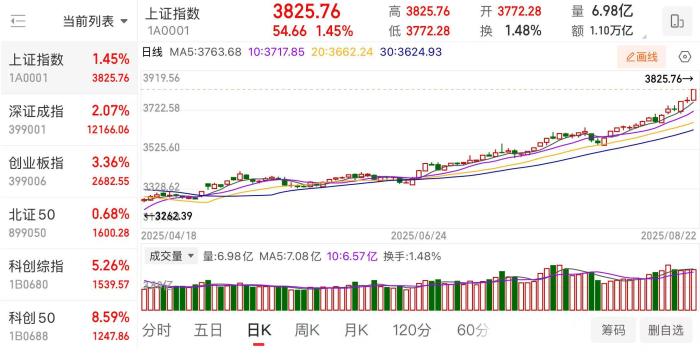
Core Viewpoint - The Shanghai Composite Index has reached a 10-year high, closing at 3825.76 points on August 22, raising concerns about market overheating and sustainability of the rally [1] Group 1: Market Trends - The insurance capital has been actively increasing its stake in the market, with nearly 30 instances of stake increases recorded in 2025, the highest in four years [1] - The focus of these investments is primarily on low-valuation, high-dividend sectors such as banking, public utilities, and energy [1] - The ongoing low interest rate environment and "asset shortage" are driving funds towards high-dividend stocks, particularly in the banking sector [1] Group 2: Investment Strategies - A "barbell" investment strategy is recommended for ordinary investors, balancing low-volatility, high-dividend sectors with high-growth technology sectors [2] - The Huian Zhongzheng Dividend Low Volatility 100 Index Fund is being launched, which tracks a diversified index focused on low volatility and high dividend yield [2] - The index includes stocks from 23 primary industries, mainly concentrated in banking, transportation, and coal, providing a solid equity base for investors [2] Group 3: Fund Performance - Huian Fund offers several high-performing products to help investors capitalize on market trends, including funds focused on AI and technology micro-cap stocks [3] - The Huian Growth Preferred Mixed Fund has received five-star ratings from both China Merchants Securities and Guotai Junan Securities, focusing on AI-related assets [4] - The Huian Multi-Factor Mixed Fund utilizes a quantitative investment approach combined with active equity research to adapt to current market styles and future industry trends [4]
外资重估中国:再平衡下的新机遇
Zhong Guo Xin Wen Wang· 2025-08-23 05:09
Core Viewpoint - The A-share market is experiencing a significant upward trend, with the Shanghai Composite Index surpassing 3,800 points, marking a 10-year high, driven by multiple favorable factors and a reassessment of asset values in China [1][3]. Group 1: Economic Resilience and Policy Support - In the first half of 2025, China's economy demonstrated unexpected resilience with a GDP growth rate of 5.3%, supported by proactive macro policies and liquidity measures from the central bank [3][6]. - External uncertainties have led to a shift in global capital allocation, with funds moving from the U.S. to undervalued markets like China, as indicated by a net inflow of over 80 billion yuan in foreign capital [4][5]. Group 2: Investment Strategies and Market Dynamics - Foreign investors are increasingly viewing Chinese assets as long-term investments rather than short-term trades, with a notable shift in attitude towards "investable" assets [3][10]. - The "barbell strategy" is gaining traction among foreign investors, focusing on growth leaders and high-dividend blue-chip stocks to balance growth and income opportunities [7][9]. Group 3: Sector Preferences and Growth Opportunities - Foreign capital is particularly attracted to sectors such as technology and consumer goods, with significant inflows into Hong Kong's market, reflecting a preference for structural opportunities in these areas [7][8]. - The rise of new consumption patterns, particularly among Generation Z, is creating growth opportunities in sectors like emotional consumption, which includes trendy products and cultural exports [8]. Group 4: Valuation and Market Positioning - Current valuation levels indicate that A-shares are relatively attractive compared to H-shares, with a low premium and strong support from state-owned capital [9]. - The high dividend yield of A-shares presents a potential advantage over government bond yields, making them appealing to foreign investors seeking income [9].
资产配置新趋势:解码 2025 年跨市场投资密码
Sou Hu Cai Jing· 2025-08-21 02:44
Core Viewpoint - The article discusses the need for a balanced asset allocation strategy among stocks, bonds, and gold in the context of the 2025 global capital market, which is characterized by significant differentiation and changing dynamics [1] Group 1: Stock Investment - Investors are advised to focus on Hong Kong stocks with core competitive advantages, particularly in digital infrastructure, smart city solutions, and electric vehicle charging networks [1] - Specific companies highlighted include those with a 37% year-on-year revenue growth in smart city solutions and strategic breakthroughs in electric vehicle charging networks [1] - Other notable sectors include biopharmaceutical innovation and metaverse application development, which have established differentiated competitive advantages [1] Group 2: Bond Market - The bond market is experiencing a divergence between government bonds and corporate credit bonds, with the 10-year U.S. Treasury yield stabilizing around 3.8% and investment-grade corporate bond spreads narrowing to 150 basis points [1] - Green bonds issued by certain companies received oversubscription due to carbon neutrality certification, while convertible bonds are favored by hedge funds due to their conversion premium advantages [1] - A "barbell strategy" is recommended for bond portfolio allocation, focusing on high-rated short-duration bonds and inflation-protected securities (TIPS) [1] Group 3: Gold as an Asset - Gold is undergoing a repositioning as a traditional safe-haven asset, with physical gold ETF holdings reaching record highs, although digital currencies are increasingly seen as alternatives [1] - The current price of London gold is around $1,950 per ounce, reflecting a 12% decline from its 2024 peak [1] - Investment strategies include indirect exposure through gold mining stocks or structured products linked to gold prices to capture rebound opportunities while managing volatility risks [1] Group 4: Investment Portfolio Construction - The Morningstar Q2 2025 report suggests a "433" allocation strategy: 40% in stocks, 30% in bonds, and 30% in alternative assets, including gold ETFs and commodity funds [1] - This allocation considers the growth potential of certain growth stocks while providing yield protection through high-yield bonds and hedging tail risks with precious metal derivatives [1] - As the Federal Reserve's balance sheet reduction nears its end, investors are encouraged to monitor interest-sensitive assets, credit spread indices, and volatility indicators for dynamic asset allocation adjustments [1]
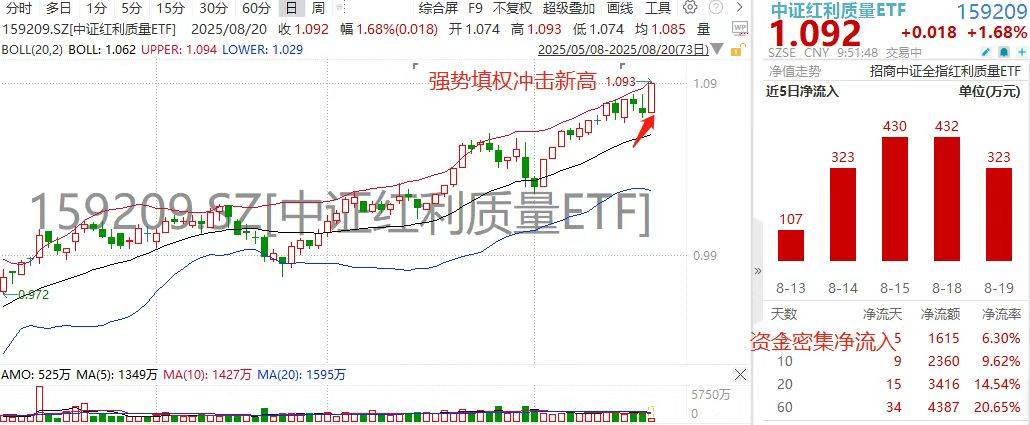
强势填权!中证红利质量ETF(159209)放量飙涨1.58%冲新高,资金连续7日汹涌加仓
Sou Hu Cai Jing· 2025-08-20 02:04
Core Insights - The Shanghai Composite Index opened lower but saw a rise, with the CSI Dividend Quality ETF (159209) increasing by 1.58%, marking its 28th new high of the year as of 9:49 AM on August 20 [1] - The CSI Dividend Quality ETF has experienced a continuous net inflow of funds for seven consecutive days as of August 19 [1] Fund Characteristics - The CSI Dividend Quality ETF employs a "dividend + quality" dual-factor screening mechanism to identify high-quality companies that possess both "low valuation" and "high quality" attributes [1] - This investment philosophy aligns closely with Warren Buffett's value investment logic of "investing in excellent companies at reasonable prices" [1] Investment Strategy - The combination of the CSI Dividend Quality ETF (159209) in the A-share market and the Hong Kong Dividend Low Volatility ETF (520550) can create a cross-market "dumbbell strategy" that balances offensive and defensive positions while diversifying risks across two markets [1] - The product design features low fees and monthly dividends, which are expected to enhance long-term returns for investors [1]
A股回暖催生基金“新高潮”,上千只主动权益基金月内创新高
Di Yi Cai Jing· 2025-08-18 11:58
Core Insights - The A-share market has shown a strong recovery, with over a thousand active equity funds reaching new net asset value (NAV) highs as of August 15, 2023, indicating a significant market rebound [1][3] - The number of "billion-dollar club" funds has drastically decreased, with over three-quarters disappearing in four years, highlighting a stark differentiation in fund performance [1][4] - The average return of the 24 billion-dollar active equity funds over the past year reached 41.95%, with some funds achieving returns exceeding 100% [3][4] Fund Performance - As of August 15, 2023, 1,164 active equity funds have refreshed their historical NAVs, representing over 25% of the total, showcasing a notable market profit effect [3] - The top-performing funds are closely aligned with market themes, managed by well-known fund managers, with some funds like Yongying Advanced Manufacturing Select A achieving a return of 169.33% [4][5] - The total number of billion-dollar active equity funds has decreased from 98 in Q2 2021 to only 18 currently, with the scale ceiling dropping from 898.89 billion to 349.43 billion [4][5] Market Trends - The current A-share market is characterized as a "slow bull" market, driven by the return of overseas capital and a positive cycle of improved corporate earnings [6][7] - The market's recent surge is attributed to a combination of macroeconomic fundamentals, regulatory approaches, and investor confidence, with a notable increase in retail investor participation [7][8] - Analysts suggest a potential shift in investment strategies, recommending a tilt from dividend sectors to technology growth sectors, particularly in high-value export-related areas [8]
500质量成长ETF(560500)盘中涨近1%,成分股上海电力、中鼎股份10cm涨停,长城证券4连板
Xin Lang Cai Jing· 2025-08-18 03:56
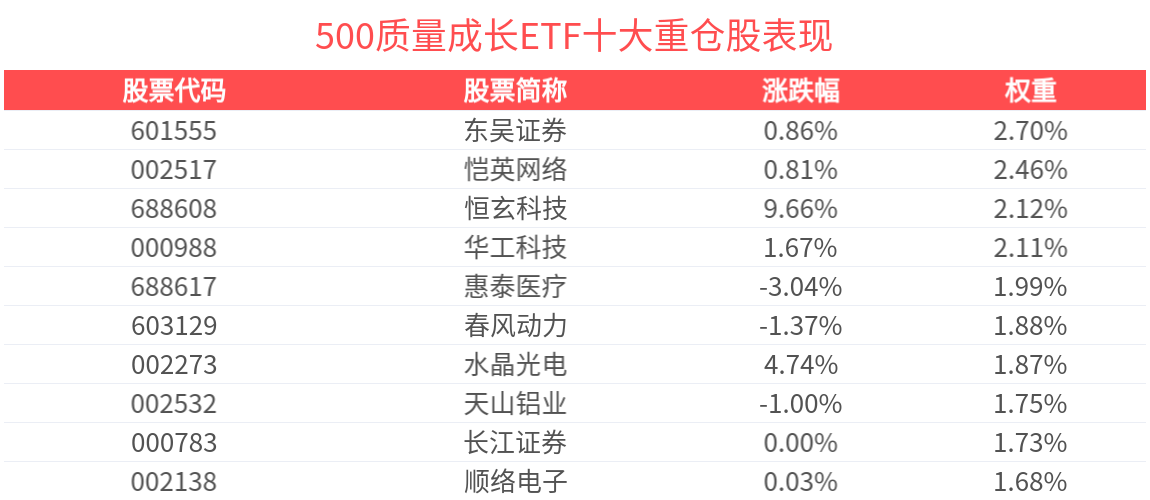
Group 1 - The core viewpoint of the news highlights the performance and growth of the CSI 500 Quality Growth Index and its associated ETF, indicating a positive market trend with significant inflows and stock price increases [1][2][3] - The CSI 500 Quality Growth Index consists of 100 stocks selected for their high profitability, sustainable earnings, and strong cash flow, providing diverse investment opportunities for investors [2][3] - The top ten weighted stocks in the CSI 500 Quality Growth Index account for 20.47% of the index, with notable performers including Dongwu Securities, Kaiying Network, and Hengxuan Technology [3][5] Group 2 - The CSI 500 Quality Growth ETF has seen a significant increase in scale, with a growth of 24.6 million yuan over the past week, ranking in the top third among comparable funds [1] - The ETF's share count increased by 11 million shares in the same period, indicating strong investor interest and participation [1] - Recent trading activity shows that the ETF has attracted a total of 11.7 million yuan in inflows over the last five trading days, reflecting a stable demand for the fund [1][2]


建信期货股指日评-20250814
Jian Xin Qi Huo· 2025-08-14 02:22
Report Summary 1. Report Type and Date - Report type: Stock Index Daily Review [1] - Date: August 14, 2025 [2] 2. Researchers - Nie Jiayi (Stock Index), contact: 021 - 60635735, email: niejiayi@ccb.ccbfutures.com, futures qualification number: F03124070 [3] - He Zhuoqiao (Macro Precious Metals), contact: 18665641296, email: hezhuoqiao@ccb.ccbfutures.com, futures qualification number: F3008762 [3] - Huang Wenxin (Macro Treasury Bonds and Shipping), contact: 021 - 60635739, email: huangwenxin@ccb.ccbfutures.com, futures qualification number: F3051589 [3] 3. Market Review and Outlook 3.1 Market Review - On August 13, the Wind All - A Index oscillated upward after the opening, closing up 1.02%, but over 3000 stocks declined. Among index spot, the CSI 300, SSE 50, CSI 500, and CSI 1000 closed up 0.79%, 0.21%, 1.40%, and 1.45% respectively, with small - and medium - cap stocks performing better. Index futures outperformed spot, with the IF, IH, IC, and IM main contracts closing up 0.96%, 0.333%, 1.72%, and 1.72% respectively (calculated based on the previous trading day's closing price) [6] 3.2 Market Outlook - **External Market**: In the US, the unadjusted CPI in July was 2.7% year - on - year, lower than the expected 2.8% and the same as the previous value; the month - on - month was 0.2%, in line with expectations and lower than the previous 0.3%. The core CPI annual rate in July was 3.1%, higher than the expected 3% and the previous 2.9%, and the month - on - month was 0.3%, in line with expectations and higher than the previous 0.2%. The market currently expects a 95% probability of the Fed cutting interest rates at the September meeting [8] - **Domestic Market**: The Ministry of Finance, the People's Bank of China, and the National Financial Regulatory Administration recently formulated the Implementation Plan for the Fiscal Interest Subsidy Policy on Personal Consumption Loans. State - owned banks have followed up and announced the fiscal interest subsidy work on personal consumption loans, boosting the sentiment of the consumer sector. A - share trading volume increased again to 2.18 trillion yuan today, and the SSE Composite Index broke through the high point in October last year. Among sectors, communication, non - ferrous metals, and electronics led the gains, while the pharmaceutical and military sectors continued to rise after adjustments [8] - **Investment Suggestion**: The current market sentiment remains strong, and the index still has upward momentum. It is necessary to continue to monitor changes in trading volume and the disclosure of corporate semi - annual reports. Cautious investors can consider reducing positions to take profits and then adding positions after the SSE Composite Index stabilizes. In terms of market style, the dumbbell strategy remains unchanged, and the SSE 50 with stable earnings and the CSI 1000 with higher earnings recovery elasticity may perform relatively better [9] 4. Data Overview - The report provides various data charts, including the performance of domestic major indexes, market style performance, industry sector performance (Shenwan Primary Index), trading volume of the Wind All - A Index, trading volume of stock index spot, trading volume and open interest of stock index futures, basis trend of main contracts, inter - period spread trend, statistics of major ETF fund shares, and statistics of major ETF trading volume. All data sources are from Wind and the Research and Development Department of CCB Futures [11][13][14] 5. Industry News - The Ministry of Finance, the People's Bank of China, and the National Financial Regulatory Administration recently formulated the Implementation Plan for the Fiscal Interest Subsidy Policy on Personal Consumption Loans. After the news was released, state - owned banks followed up. On August 12, Agricultural Bank of China and Postal Savings Bank of China were the first to respond, announcing that they would implement interest subsidies on eligible personal consumption loans from September 1, 2025, in accordance with market - oriented and legal principles [30]