
财政赤字

Search documents
IMF与美国财政部意见相反,特朗普关税真能扭转美国赤字危局?
Di Yi Cai Jing· 2025-10-23 10:01
Core Insights - The U.S. public debt is projected to rise from 122% of GDP in 2024 to 143% by 2030 under current fiscal policies [1] - The U.S. Treasury and the IMF have differing views on the outlook for the U.S. fiscal deficit [1][4] - The U.S. budget deficit for FY 2025 is estimated at approximately $1.8 trillion, a decrease of about $41 billion from the previous fiscal year [1][3] Fiscal Trends - The U.S. Treasury reports a significant slowdown in government spending, with a year-over-year increase of only 0.2% in Q2 and a decrease of 2.5% in Q3 [3] - Cumulative deficit from April to September was $468 billion, the lowest level since 2019, down nearly 40% from the same period last year [3][4] - The Treasury attributes the improvement in fiscal conditions to increased tariff revenues and a slowdown in spending growth [1][3] Revenue Projections - Trump's tariff policy is expected to generate $300 billion in revenue this year, potentially rising to $400 billion next year [4] - The CBO predicts that the "Big and Beautiful Act" will increase the deficit by $4.1 trillion, countering the optimistic revenue forecasts [4] - The IMF warns that despite potential revenue from tariffs, the fiscal deficit is expected to widen further due to stimulative policies [4] Debt and Interest Payments - U.S. national debt has surpassed $38 trillion, increasing by $1 trillion in just over two months [5] - Interest payments on U.S. debt have reached approximately $1 trillion annually, becoming the fastest-growing item in the federal budget [5] - Over the past decade, total interest payments have amounted to $4 trillion, projected to balloon to $14 trillion over the next decade [5] Government Shutdown Impact - The ongoing government shutdown exacerbates fiscal challenges, with past shutdowns leading to significant increases in federal spending [6] - The Treasury warns that the U.S. is on an "unsustainable fiscal path," with current policies deemed unsustainable [6] - Compared to previous economic crises, the pace of deficit reduction is significantly lagging [6]

贵金属日评:美元指数走强使贵金属价格承压-20251023
Hong Yuan Qi Huo· 2025-10-23 02:37
Report Industry Investment Rating - No investment rating information provided in the report Core Viewpoints - The strengthening of the US dollar index may put pressure on precious metal prices, but concerns about a weakening US job market, potential future interest rate cuts by the Fed, uncertainty in China-US trade negotiations, geopolitical conflicts in Russia-Ukraine and the Middle East, and the expansion of fiscal deficits in many countries globally, along with continuous gold purchases by central banks, support precious metal prices in the medium to long term [1] Summary by Relevant Catalogs Precious Metal Market Data - **Shanghai Gold**: The closing price was 948.84 yuan/g, down 38.05 yuan from the previous day and 18.45 yuan from the previous week; trading volume was 87,610, with a position of 254,754, down 186 from the previous day and up 5,052 from the previous week [1] - **Shanghai Silver**: The closing price was 11,381 yuan/10g, down 378 yuan from the previous day and 600 yuan from the previous week; trading volume was 2,347,356, with a position of -182,550 [1] - **COMEX Gold Futures**: The closing price was 4,116.60 US dollars/ounce, down 21.90 US dollars from the previous day and 43.00 US dollars from the previous week; trading volume was 396,022, with a position of 357,370, down 4,708 from the previous day and 16,561 from the previous week [1] - **COMEX Silver Futures**: The closing price was 48.16 US dollars/ounce, down 2.17 US dollars from the previous day; trading volume was -66,532, with a position of 122,583, down 3,620 from the previous day and 7,608 from the previous week [1] Important Information - The secondary lending market is in turmoil, and PrimaLend has filed for bankruptcy. The Fed is considering reducing bank capital requirements from 19% to a minimum of 3% [1] - The US government shutdown has entered its 22nd day, the second-longest on record. Unemployment may rise temporarily. Trump has cancelled his meeting with Putin in Budapest [1] - The US has lifted key restrictions on Ukraine's use of long-range missiles and imposed sanctions on two major Russian oil companies [1] Trading Strategy - Temporarily wait and see. For London gold, focus on support levels around 3,900 - 4,100 and resistance levels around 4,383 - 4,778; for Shanghai gold, support levels around 890 - 930 and resistance levels around 1,000 - 1,100; for London silver, support levels around 42 - 48 and resistance levels around 57 - 68; for Shanghai silver, support levels around 9,800 - 10,800 and resistance levels around 13,000 - 14,800 [1]
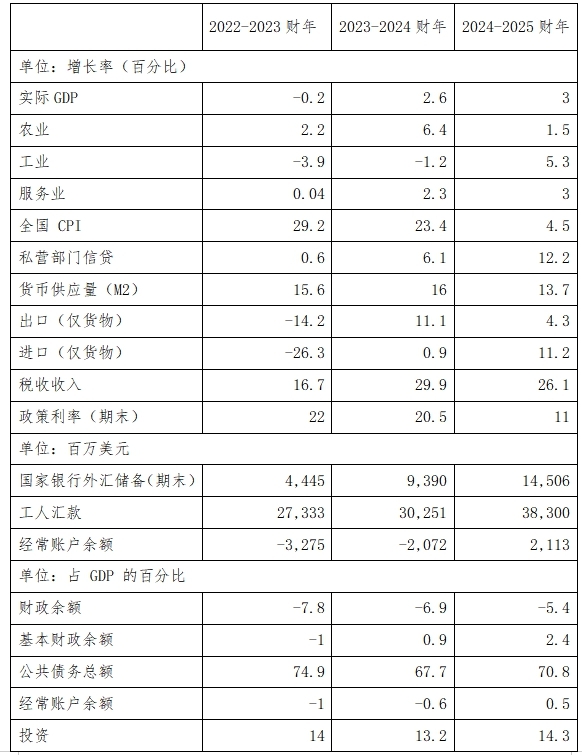
巴基斯坦2024-2025财年宏观经济出现企稳向好态势
Zhong Guo Jing Ji Wang· 2025-10-22 08:37
Group 1 - The State Bank of Pakistan released its annual report for the fiscal year 2024-2025, indicating significant macroeconomic stability and positive trends in the financial sector, laying a solid foundation for economic recovery [1] - The GDP growth for the fiscal year 2024-2025 is projected at 3.0%, an increase from 2.6% in the previous fiscal year, driven mainly by the services and industrial sectors, which grew by 3.0% and 5.3% respectively [1][3] - Inflation has been effectively controlled, with the Consumer Price Index (CPI) dropping from 23.4% in the previous fiscal year to 4.5%, marking an eight-year low [1][3] Group 2 - The current account recorded a surplus of $2.113 billion, the first surplus in fourteen years, indicating an improvement in the international balance of payments [1][3] - The State Bank's foreign exchange reserves reached $14.506 billion by the end of the fiscal year, reflecting a year-on-year increase of 54.48% [1][3] - Remittances from overseas workers continued to grow, totaling $38.3 billion for the year [1][3] Group 3 - The monetary policy committee of the State Bank reduced the policy interest rate by 1100 basis points during the fiscal year, ending at 11.0%, which has stimulated private sector credit growth by 12.2%, doubling from the previous fiscal year [1][3] - The fiscal deficit narrowed to 5.4% of GDP, while public debt as a percentage of GDP was 70.8%, slightly up from the previous year, but improved tax revenue and foreign exchange income enhanced debt repayment capacity [1][3] Group 4 - Three major international rating agencies upgraded Pakistan's credit rating at the start of the new fiscal year, although challenges remain due to flood damage to agriculture and infrastructure, geopolitical factors, and global trade uncertainties [2] - The State Bank forecasts GDP growth for the new fiscal year to be near the lower end of the previous estimate range of 3.25% to 4.25%, with the fiscal deficit potentially reaching 3.8% to 4.8% of GDP [2]
崩了!金价巨震!创12年来最大单日跌幅
Sou Hu Cai Jing· 2025-10-22 03:11
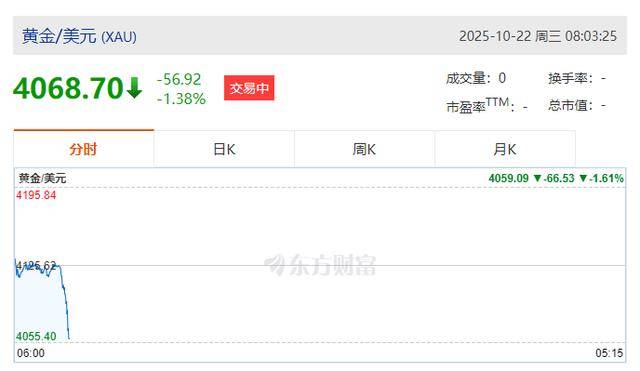
Core Viewpoint - The recent sharp decline in gold prices, dropping over 6.3% to below $4100 per ounce, is attributed to easing geopolitical tensions and a softening of trade attitudes from Trump, leading to profit-taking in the precious metals market [1][3]. Group 1: Market Performance - On October 21, gold prices experienced a significant drop, falling from around $4342 to $4068.7 per ounce within hours, marking the largest single-day decline since April 2013 [1]. - Prior to the drop, gold had surged over 2.5% on October 20, reaching a historical high of $4381.29 per ounce before closing at $4356.26 [3]. - The volatility in gold and silver prices indicates a potential overheating in the market, with the implied volatility of gold options exceeding 20, suggesting increased trading risks [3]. Group 2: Future Outlook - HSBC forecasts that gold's upward momentum may continue until 2026, with a target price of $5000 per ounce, driven by strong central bank purchases and ongoing concerns over U.S. fiscal deficits [5]. - The demand for gold is increasingly viewed as a hedge against debt sustainability risks and potential dollar weakness, particularly among emerging market central banks [5]. - However, HSBC warns that if the Federal Reserve's rate cuts are fewer than market expectations, the upward trajectory of gold prices may face challenges [5].
深夜突发,金价崩了!短短7小时,就跌掉240多美元,网友懵圈:我今天刚买啊
Sou Hu Cai Jing· 2025-10-21 15:15
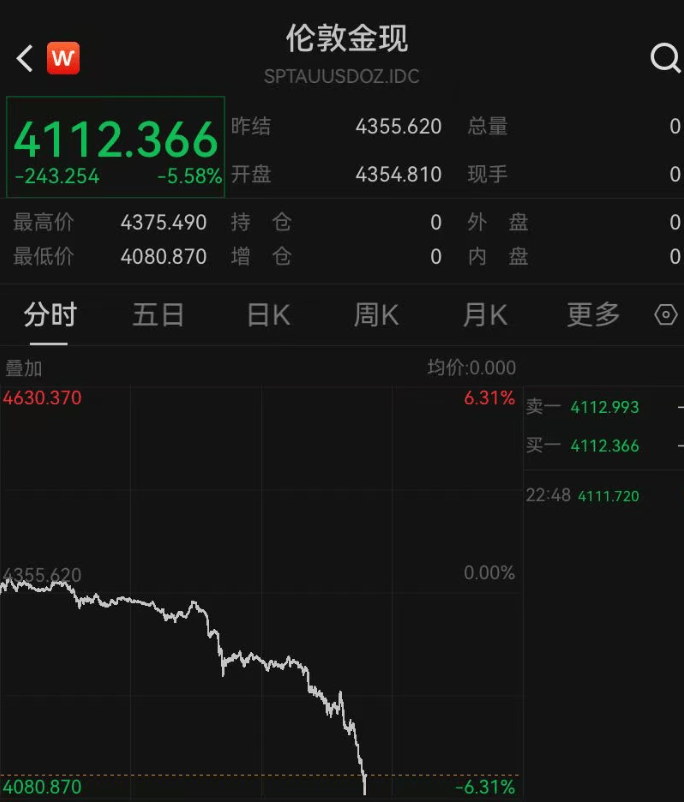
Core Viewpoint - The gold and silver markets experienced a significant crash, with gold prices dropping over 6% within a short period, leading to concerns among investors about the sustainability of recent price increases [1][3][4]. Market Performance - As of the latest report, spot gold fell to $4,112.37 per ounce, down 5.58%, while COMEX futures were at $4,145 per ounce, down 4.92% [1][2]. - Silver also saw a sharp decline, with London silver trading at $48.18 per ounce, down 8.02%, and COMEX silver futures dropping 7.69% to $47.44 per ounce [3][4]. Investor Behavior - The recent price drop is attributed to profit-taking by investors after a period of strong performance, driven by expectations of further interest rate cuts by the Federal Reserve and strong safe-haven demand [6][8]. - Social media reactions indicate confusion among new gold investors who recently entered the market [7]. Market Analysis - Analysts suggest that the combination of profit-taking and reduced inflow of safe-haven funds has pressured gold prices. However, any price corrections are viewed as potential buying opportunities if the Fed maintains its current rate-cutting path [8]. - The rapid increase in precious metal prices, including gold and silver, has led to concerns of market overheating, especially with easing geopolitical tensions and a softening trade stance from the U.S. [6][8]. Future Outlook - The future trajectory of gold prices remains uncertain, with some analysts suggesting that the likelihood of a decline is greater than further increases. The sustainability of high-net-worth individual investments in gold is a key factor [9]. - HSBC's commodity outlook report indicates that gold's upward momentum may continue until 2026, driven by strong central bank purchases and ongoing fiscal concerns in the U.S., with a target price of $5,000 per ounce [10].
强劲反弹近4%,黄金再冲4400美元
Di Yi Cai Jing· 2025-10-21 00:22
克里斯蒂安称:"若明年某个时候金价突破每盎司5000美元,这一走势的前提是当前存在的政治问题持 续发酵甚至恶化 —— 事实上,目前的局势正朝着这一方向发展。" 因投资者等待近期中美贸易谈判及美国通胀数据发布,叠加市场对美联储进一步降息的预期与避险需求 持续升温,国际金价周一大幅上涨超4%。纽约商品交易所12月交割的COMEX黄金期货日内触及4398美 元/盎司高位,再创历史新高,截至记者发稿时,金价交投于4380美元附近。 V型反转 上周五,金价曾触及每盎司4392美元的历史高点,随后尾盘跳水当日收盘下跌1.8%,创下自5月中旬以 来的最大单日跌幅。消息面上,美国总统特朗普的表态在一定程度上缓解了市场对贸易紧张形势的担 忧,与此同时,地区银行危机降温也打压了避险情绪。 周一,黄金在欧洲交易时段再起升势,CPM集团(CPM Group)管理合伙人克里斯蒂安(Jeffrey Christian)表示,政治与经济层面的担忧正推动金价回升。"我们预计,未来数周乃至数月内金价将进 一步走高,若短期内触及每盎司4500美元,我们也不会感到意外。"他补充道。 美国政府停摆状态进入第20天。上周,参议员们第十次尝试打破僵局, ...
哥伦比亚政府拟推进柴油涨价
Shang Wu Bu Wang Zhan· 2025-10-20 13:27
Group 1 - The Colombian government is exploring plans to implement an unfinished diesel price increase, aiming for freight contractors to bear the cost rather than transport operators [1] - The fuel price stabilization fund (FEPC) subsidies for gasoline and diesel are identified as a major cause of the fiscal deficit [1] - The government has canceled subsidies for large consumers and certain non-freight vehicles, which account for approximately 30% of total diesel consumption [1] Group 2 - The government plans to reduce the scale of the original tax reform proposal, eliminating tax increases on gasoline and beer, while only adjusting income tax for high-income individuals [1] - Wealth tax, financial sector tax, and certain environmental taxes will be maintained to concentrate the tax burden on high-income groups [1]
【华西大类资产】美欧日政策差异下的弱美元——2025Q4海外经济与资产展望
Sou Hu Cai Jing· 2025-10-20 00:20
Group 1: Economic Overview - The US economy is experiencing marginal slowdown, with both manufacturing and service sectors showing decreased activity, and the labor market showing signs of fatigue [1] - In Europe, the economy is stabilizing under the influence of continuous interest rate cuts, leading to increased credit growth for households and businesses, although structural issues and energy bottlenecks persist [1] - Japan's economy remains relatively stable with rising household income and improved consumer confidence, but faces new challenges from US tariffs and yen appreciation impacting manufacturing and exports [1] Group 2: Asset Outlook - US Treasury yields are expected to decline towards 3.5% as the Federal Reserve continues to cut rates, with European bond yields also expected to decrease due to easing inflation pressures [2] - The US dollar is anticipated to weaken due to the Federal Reserve's rate cuts and the differing monetary policy trajectories among the US, Eurozone, and Japan [2] - Short-term pressures on gold prices are noted due to increased margin requirements and prior price surges, while medium-term support remains strong from fiscal debt, monetary easing, and sovereign gold purchases [2]
钢铁:金属金融属性进一步放大
GOLDEN SUN SECURITIES· 2025-10-19 08:38
Investment Rating - The report maintains a rating of "Buy" for the steel industry [5]. Core Insights - The steel industry is experiencing a shift in focus from demand to supply as countries enter a mature industrialization phase. The overall economy is expected to remain stable, with potential for recovery in the steel sector [2][4]. - The report highlights the importance of government fiscal policies in influencing trade balances and commodity prices, particularly gold, which is seen as a counter to the U.S. dollar's credit [2]. - The report emphasizes the need for steel mills to implement production cuts effectively to stabilize the market and improve valuations of certain companies within the industry [2][4]. Supply Analysis - The average daily pig iron production has slightly decreased to 2.409 million tons, with a decline in rebar and hot-rolled coil production [11]. - The capacity utilization rate for blast furnaces across 247 steel mills is reported at 90.3%, a slight decrease of 0.2 percentage points from the previous period [16]. - The total inventory of five major steel products has decreased by 1.2% week-on-week, indicating a tightening supply [23]. Demand Analysis - Apparent consumption of five major steel products has rebounded by 16.5% week-on-week, although it remains down 2.0% year-on-year [47]. - Rebar demand has shown a significant increase of 43.5% week-on-week, while overall building material transactions have decreased by 6.3% [37][38]. Price and Profitability - The report notes a slight decline in the current steel prices, with the Myspic comprehensive steel price index down by 1.5% week-on-week [69]. - The current profit margins for long-process rebar and hot-rolled products are negative, indicating pressure on profitability [70]. Key Companies - The report recommends several companies for investment, including: - Hualing Steel (华菱钢铁) [8] - Nanjing Steel (南钢股份) [8] - Baosteel (宝钢股份) [8] - New Steel (新钢股份) [8] - Jiuli Special Materials (久立特材) [8] - Yongjin Co., Ltd. (甬金股份) [8] - Changbao Steel (常宝股份) [8] - Wujin Stainless Steel (武进不锈) [2][8].


2025Q4海外经济与资产展望:美欧日政策差异下的弱美元
HUAXI Securities· 2025-10-18 09:51
Economic Outlook - The US economy is experiencing marginal slowdown, with a projected annualized GDP growth rate of 2%-2.5%[10] - The unemployment rate in the US is currently at 4.3%, showing signs of concern in the labor market[15] - In Europe, economic stability is observed due to continuous interest rate cuts, but structural issues persist, particularly in Germany[4] - Japan's economy remains stable, with consumer confidence improving, but faces challenges from US tariffs and yen appreciation[4] Asset Projections - US Treasury yields are expected to decline towards 3.5% as the Federal Reserve continues to cut rates[4] - The US dollar is projected to weaken due to divergent monetary policies among the US, Eurozone, and Japan[4] - Gold prices may face short-term correction pressure but have strong medium-term support due to fiscal debt and monetary easing[4] Fiscal Policy Impact - The "Big and Beautiful" fiscal plan is projected to increase the US federal deficit by approximately $2 trillion over five years and $3.4 trillion over ten years[19] - The Congressional Budget Office (CBO) predicts a future deficit rate of 6.8%, up from a baseline of 5.8% due to the fiscal plan[23] - High deficit levels have led to increased government debt and rising interest pressures, with the average deficit rate since FY 2025 being 6.8%[28]