促消费政策

Search documents
5月社会零售品消费数据点评:5月社零同比+6.4%,国补相关品类及金银增速领先
Shenwan Hongyuan Securities· 2025-06-16 14:26
Investment Rating - The industry investment rating is "Overweight," indicating that the industry is expected to outperform the overall market [11]. Core Insights - In May 2025, the total retail sales in China reached 4.1 trillion yuan, showing a year-on-year growth of 6.4%, exceeding market expectations of 4.9% [5][6]. - The online retail sales growth for the first five months of 2025 was 8.5%, which is 3.5% higher than the overall retail sales growth [5]. - The "old-for-new" policy has significantly boosted consumption in various categories, with the sales of consumer electronics and gold jewelry showing remarkable growth [5]. Summary by Sections Retail Sales Performance - May 2025 retail sales grew by 6.4% year-on-year, with a month-on-month increase of 1.3 percentage points [5]. - Excluding automobiles, retail sales of consumer goods increased by 7.0% year-on-year [5]. - The "May Day" holiday and the preemptive "618" shopping festival contributed to the growth in both online and offline retail [5]. Online and Offline Retail Trends - Online retail sales in May reached 1,061.3 billion yuan, growing by 8.19% year-on-year [5]. - The online penetration rate increased to 25.7% in May, up from 25.3% in the same month last year [5]. - Offline retail continues to focus on supply chain optimization and enhancing consumer experience [5]. Consumption Categories - In May, the retail sales of goods grew by 6.5%, driven by government subsidies and the "old-for-new" policy [5]. - The restaurant sector also saw improvements, with a year-on-year growth of 5.9% in May [5]. - Various categories experienced significant growth, such as communication equipment (+33.0%) and gold jewelry (+21.8%) [5]. Investment Recommendations - The report suggests a positive outlook for e-commerce and instant retail sectors, highlighting companies like Alibaba, JD.com, and Meituan [5]. - It also recommends investing in quality gold jewelry brands and the travel industry, anticipating growth in consumer demand during the summer [5]. - The report emphasizes the importance of enhancing product offerings and store experiences in the department store and supermarket sectors [5].
杨德龙:全面解读五月国民经济数据 稳增长政策有望加码
Xin Lang Ji Jin· 2025-06-16 05:29
Group 1: Economic Performance - In May, the total retail sales of consumer goods increased by 6.4% year-on-year, with online retail sales growing at 8.5%, outpacing offline consumption [1] - The "trade-in" policy significantly boosted retail sales in categories such as home appliances (up 53%), communication equipment (up 33%), cultural and office supplies (up 30.5%), and furniture (up 25.6%) [1] - Real estate market transactions remain sluggish, with a 10.7% year-on-year decline in real estate development investment from January to May, indicating weakened investment attributes [2] Group 2: New Consumption Trends - New consumption formats are emerging as key drivers, with companies like Mixue Ice City, Pop Mart, and Pang Donglai successfully capturing young consumer demand and promoting domestic brands globally [2] - Pop Mart's stock price surged over 11 times in 2024, highlighting the market potential for innovative consumer products [2] Group 3: Trade and Investment - In May, exports grew by 6.3% year-on-year, while imports increased by 2.5%, demonstrating resilience in trade [2] - China is diversifying its export markets, reducing reliance on the U.S. from 18% to 14%, and increasing the share of high-value-added products [2] - The export performance of new energy vehicles, photovoltaics, and lithium batteries is strong, with automotive exports surpassing Japan, making China the global leader [2] Group 4: Inflation and Policy Outlook - The Consumer Price Index (CPI) fell by 0.1% year-on-year in May, marking three consecutive months of negative growth, indicating a need for policies to enhance consumer capacity [3] - There are expectations for increased domestic demand stimulus policies in the second half of the year, including expanding the trade-in program and possibly issuing consumption vouchers [3]
5月汽车零售同比环比增长均超10%,经销商要抓住窗口期
Zhong Guo Qi Che Bao Wang· 2025-06-16 01:23
Group 1 - The retail sales of passenger cars in China reached 1.932 million units in May 2025, representing a year-on-year increase of 13.3% and a month-on-month increase of 10.1% [1] - Cumulative retail sales for the year reached 8.811 million units, showing a year-on-year growth of 9.1% [1] - The retail market has shown a strong growth trend, with May 2025 sales surpassing the peak level of 1.81 million units in May 2018 by 6% [1] Group 2 - The automotive market has been buoyed by the "two new" policies, with local consumption promotion policies being implemented across various provinces [3] - As of May 31, the number of applications for the old-for-new vehicle subsidy reached 4.12 million, with May's applications estimated at 1.23 million, a 13% increase from April [3] - Approximately 70% of private car buyers benefited from the old-for-new policy, indicating a shift towards consumption upgrades [3] Group 3 - The automotive industry is undergoing significant changes in product structure, user demand, and channel development, necessitating proactive measures from dealers and industry players [3] - Dealers are encouraged to leverage favorable policies to explore new revenue streams and adapt their strategies accordingly [4] - The importance of digital transformation and the shift from sales to service in the automotive dealership model is emphasized, with a focus on utilizing digital marketing and data assets [4] Group 4 - The relationship between manufacturers and dealers is evolving, with a need for harmonious partnerships to adapt to the new market dynamics [5] - The automotive industry is facing challenges such as excessive dealership networks and profitability issues, leading to a necessary industry consolidation [5] - The establishment of exit mechanisms in dealership contracts is proposed to create a fairer and more orderly brand authorization cooperation model [6]


数据显示今年5月我国经济多领域“热力”升腾 折射经济向好向“新”、活力强劲
Yang Shi Wang· 2025-06-15 03:23
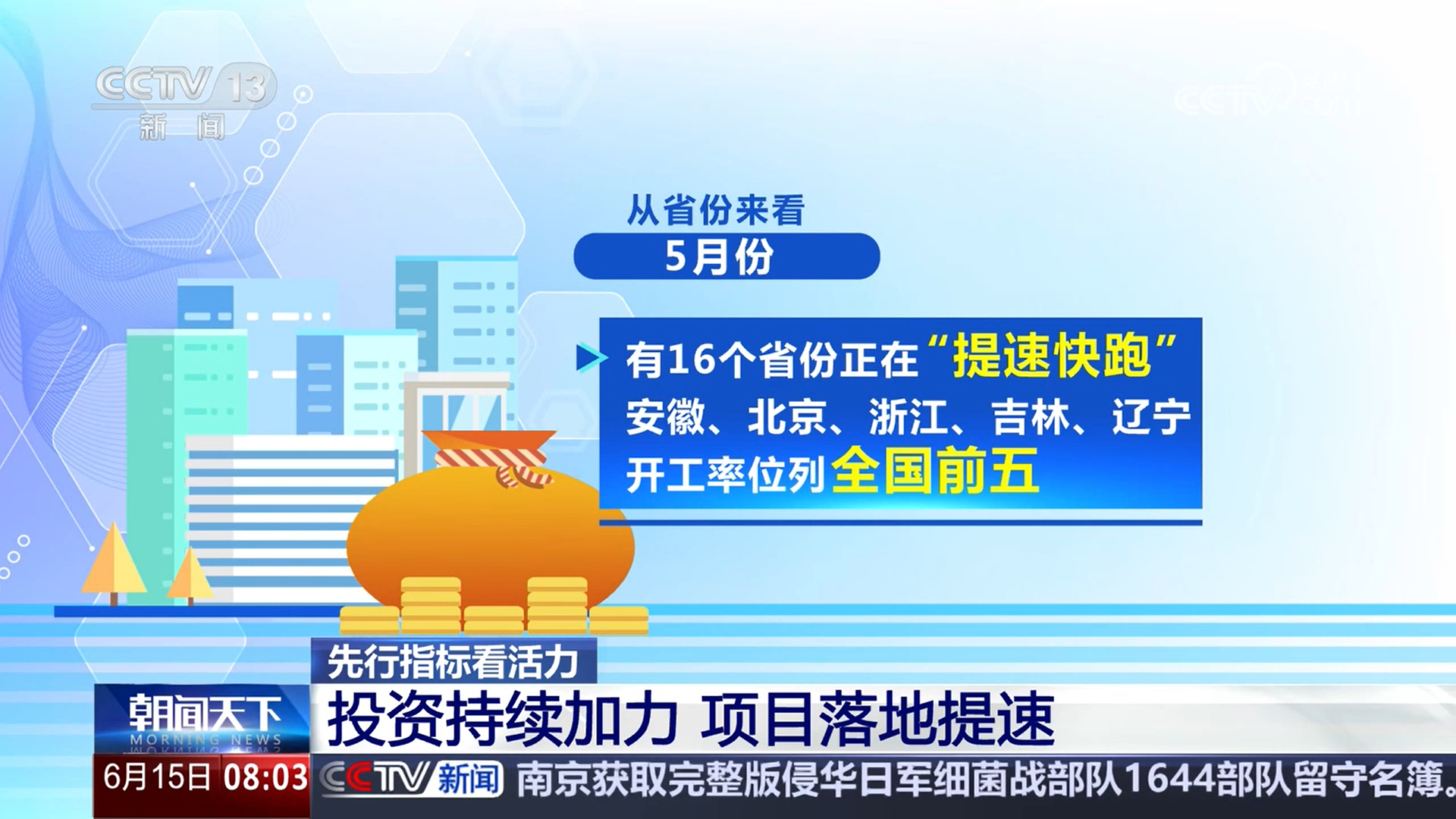
Economic Indicators - In May, various leading indicators from the National Information Center indicate a strong economic recovery in multiple sectors, reflecting a positive trend towards "new" growth and robust vitality [1] - Government investment has been increasing, with project approvals accelerating [1] Investment Trends - The national excavator index in May was 47.34%, with 16 provinces showing rapid construction activity, particularly Anhui, Beijing, Zhejiang, Jilin, and Liaoning [3] - The Northeast region had the highest construction rate at 60.39%, with a year-on-year increase of 3.58% and a month-on-month increase of 17.01% in workload [3] - Project bidding amounts in May increased by 21.5% year-on-year, marking a new high for the year, with significant growth in healthcare, municipal facilities, energy, and transportation sectors [3] Industrial Production - The industrial economy is exhibiting dual vitality from "traditional momentum recovery" and "new productive forces emergence" [4] - The industrial park production heat index rose by 21.2% year-on-year, indicating sustained high production activity and enhanced industrial clustering effects [6] - Traditional industries are experiencing widespread increases in operational heat, with significant improvements in textiles, chemicals, steel, and plastics [6] - Innovation among startups and technology-driven enterprises has also surged, with growth rates exceeding 20% year-on-year [6] Consumer Trends - In May, multiple consumer sector indicators showed an upward trend, indicating a steady improvement in overall consumption [8] - The offline consumption heat index increased by 25.7% year-on-year, while the life service consumption heat index rose by 14.6%, with significant growth in leisure, accommodation, and dining sectors [9] - Consumer enthusiasm has been bolstered by effective promotional policies, with home appliance online retail sales increasing by 31.0% year-on-year [9]
5月中国电商物流供求两端均现稳步上涨态势
Huan Qiu Wang Zi Xun· 2025-06-10 10:40
Core Insights - The e-commerce logistics index in China rose to 111.6 points in May, indicating a steady increase in both supply and demand [1][2] - The total business volume index for e-commerce logistics reached 130.2 points, marking a 0.8 point increase from the previous month [1] - The rural e-commerce logistics business volume index also increased to 129.6 points, reflecting a 0.6 point rise [1] Supply and Demand Dynamics - Both supply and demand sides showed steady growth, with the total business volume index and rural business volume index hitting new highs for the year [2] - The "old-for-new" consumption policy boosted demand for home appliances and communication equipment [2] - Companies are enhancing their supply capabilities in anticipation of mid-year promotional activities, as indicated by a 0.2 point increase in the personnel index [1] Logistics Efficiency - The logistics timeliness index rose to 101.2 points, surpassing 100 for the first time this year, indicating improved service efficiency among e-commerce logistics companies [1] - The inventory turnover rate index increased by 0.2 points, suggesting faster inventory turnover as demand rises [1] - The market feedback remains positive, with a 0.4 point increase in the satisfaction index [1] Future Outlook - The easing of monetary policy is expected to provide significant support for the implementation of consumption-promoting policies, enhancing the vitality of the e-commerce market [2] - With major e-commerce platforms preparing for mid-year shopping promotions, the logistics index in June is anticipated to rise further [2]
5月通胀数据解读:5月价格趋势“不变”背后的潜在变化
Huachuang Securities· 2025-06-10 09:33
1. Report Industry Investment Rating No relevant content provided. 2. Core View of the Report - In May, the month - on - month decline of PPI remained the same as in April, and the year - on - year decline of CPI also stayed unchanged. However, after excluding the impact of supply factors such as oil prices and food, marginal new structural changes emerged [1][9]. - In terms of PPI, the drag effect based on trade eased after excluding the 0.2 - percentage - point drag of oil prices. The PPI of export - oriented industries improved marginally, and the price of PPI durable consumer goods manufacturing industry rebounded [1][9]. - In terms of CPI, food performed better than the seasonal level, but the upward momentum of core consumer goods prices continued to weaken. Attention should be paid to the launch of a new round of consumption - promotion policies [2][13]. 3. Summary According to the Directory 3.1 May Price Trend: Potential Changes Behind the "Unchanged" Trend - **PPI**: The month - on - month decline in May remained at - 0.4%. After excluding the 0.2 - percentage - point drag of oil prices, the drag effect based on trade eased. The PPI of export - oriented industries improved marginally after the progress of the China - US trade meeting in May. The price of PPI durable consumer goods manufacturing industry rebounded, with a month - on - month increase of 0.1% in May and the year - on - year decline narrowing from 3.7% in April to 3.3% [1][9][11]. - **CPI**: Food performed better than the seasonal level, but the upward momentum of core consumer goods prices continued to weaken. Food supply tightening supported prices, short - term consumption demands such as tourism and clothing continued to be released, while prices of rent, furniture, and cars linked to residents' long - term income were still falling. Core consumer goods have dragged down CPI for two consecutive months after excluding the impact of gold prices, and a new round of consumption - promotion policies may be launched [2][13]. 3.2 May CPI: Food and Tourism Perform Better than Seasonal Levels, but Month - on - Month Decline Continues Due to Oil Price Drag - **Overall Situation**: In May 2025, the listing of fresh vegetables supported the food item, tourism in non - food items performed better than the seasonal level. However, affected by oil prices, durable consumer goods, and rent, CPI declined month - on - month to - 0.2% and remained at - 0.1% year - on - year. The factors affecting CPI month - on - month change from high to low were: services (0)> livestock meat (- 0.01pct)> fresh produce (- 0.03pct)> core consumer goods (- 0.03pct)> energy (- 0.13pct) [2][16]. - **Food Item**: The month - on - month decline of the food item fell back to around - 0.2%, stronger than the seasonal level, affecting CPI to decline by about 0.04 percentage points. Beef prices rose due to reduced imports, while pork prices fell. Fresh vegetable prices decreased, while limited supplies of fresh fruits and aquatic products supported food prices [2][19]. - **Non - food Item**: The month - on - month decline of the non - food item exceeded the seasonal level, falling to - 0.2%, affecting CPI to decline by about 0.16 percentage points. Oil prices dropped, clothing was the main supporting item in core consumer goods, while furniture and car prices still had a drag. Travel - related prices in services were resilient, but rent was still weak [23][24][25]. 3.3 May PPI: Oil Price Drag Increases, Price Decline of Export Industries Narrows, and Month - on - Month Decline Remains at - 0.4% - **Overall Situation**: The month - on - month decline of PPI remained around - 0.4%, mainly dragged down by production materials, while the performance of living materials improved. In May, production material prices decreased by 0.6% (- 0.1pct), and the prices of living materials turned from negative to flat [30]. - **By Industry**: The number of industries with price declines among industrial producers was still around two - thirds. The drag factors were the crude oil industry chain, building - material - related prices, and energy prices such as coal and gas. The supporting factors were export - related industries such as automobiles and machinery, and the non - ferrous metal industry [4][31][36].
核心CPI企稳的三个特征?——5月通胀数据点评(25.05)(申万宏观·赵伟团队)
申万宏源宏观· 2025-06-10 03:59
Core Viewpoints - The improvement in consumer demand stabilizes the core CPI, but supply-side factors significantly suppress inflation readings [3][68] Group 1: Key Features of Core CPI Stabilization - Feature 1: The core commodity PPI shows a significant rebound, primarily due to improved demand and a lack of further tariff impacts. In May, the core commodity PPI increased by 0.3 percentage points to -1.4% [3][68] - Feature 2: Consumption promotion policies combined with rising gold prices lead to an increase in core commodity CPI. In May, the core commodity CPI rose by 0.1 percentage points to 0.2% [4][19] - Feature 3: The increase in holiday days in May allows for a more substantial release of service demand, pushing the core service CPI higher. The service CPI rose by 0.2 percentage points to 0.5% in May [4][22] Group 2: Outlook and Regular Tracking - The combination of policy reinforcement and recovery in domestic demand is expected to alleviate inflationary pressures, but supply-side changes must be monitored for their impact on price readings [5][33] - The overall CPI in May was -0.1%, slightly better than market expectations, with food supply showing a mixed performance [5][27] - The non-food CPI saw improvements in transportation and communication, while fuel prices for transportation significantly declined [51][71]
通胀数据点评:核心CPI企稳的三个特征?
Shenwan Hongyuan Securities· 2025-06-09 10:13
Group 1: Inflation Data Overview - In May, the CPI decreased by 0.1% year-on-year, matching the previous value and slightly better than the expected decrease of 0.2%[1] - The PPI fell by 3.3% year-on-year, a decline from the previous value of 2.7% and worse than the expected 3.2%[1] Group 2: Core CPI Stabilization Features - Core commodity PPI rebounded by 0.3 percentage points to -1.4%, driven by improved demand and a moderation in tariff impacts[2] - The core commodity CPI increased by 0.1 percentage points to 0.2%, supported by consumption policies and rising gold prices, which boosted jewelry prices by 40.1%[3] - Service CPI rose by 0.2 percentage points to 0.5%, aided by increased holiday days in May, enhancing service demand[4] Group 3: Future Outlook - Continued policy support and recovery in domestic demand are expected to alleviate inflationary pressures, but supply-side constraints remain a concern[5] - The ongoing "trade-in" policy may provide significant support to core commodity CPI and PPI, while abundant supply of bulk commodities and food could exert downward pressure on prices[5]
受降雨天气影响,端午出行略显平淡
HTSC· 2025-06-03 04:25
Investment Rating - The industry investment rating is "Overweight" [7] Core Viewpoints - The Dragon Boat Festival holiday travel was relatively subdued, with a total of 657 million people traveling, a year-on-year increase of 3.0%, which is lower than the initial forecast of 7.7% by the Ministry of Transport [2] - Short-distance travel demand showed slightly better performance compared to medium and long-distance travel, primarily due to frequent rainfall in southern regions and the proximity of the holiday to the college entrance examination [2] - The report recommends the aviation sector, particularly China National Aviation (A/H), as well as highway companies such as Anhui Wanshan Expressway (A/H), Zhejiang Huhang Expressway, and Guangdong Expressway A [2] Summary by Sections Aviation - During the Dragon Boat Festival, the average daily passenger volume for civil aviation was 1.867 million, a year-on-year increase of 1.22%, which is lower than the growth rates of rail and road transport [3] - The three-day holiday saw stable growth rates of 0%, 1.3%, and 2.4% respectively, with international routes showing a significant increase of 17.6% in flight volume [3] Road Transport - The total road passenger flow during the holiday was estimated at 600 million, with a daily average of 200 million, reflecting a year-on-year growth of 3.14% [4] - The growth rate of road passenger flow was slightly lower than the growth rate of vehicle ownership, which increased by 5.1% year-on-year by the end of 2024 [4] Rail Transport - The total railway passenger volume during the holiday was 47.108 million, with a daily average of 15.7027 million, showing a year-on-year increase of 2.3% [5] - The railway passenger volume experienced a good start on the first day with a 5.0% year-on-year increase, but saw a decline of 11.2% on the second day due to weather impacts [5] Recommended Stocks - China National Aviation (601111 CH) with a target price of 10.20 and a "Buy" rating [10] - Anhui Wanshan Expressway (600012 CH) with a target price of 18.60 and a "Buy" rating [10] - Zhejiang Huhang Expressway (576 HK) with a target price of 7.82 and a "Buy" rating [10] - Guangdong Expressway A (000429 CH) with a target price of 15.59 and a "Buy" rating [10]



金十图示:2025年05月29日(周四)新闻联播今日要点
news flash· 2025-05-29 13:09
● 俄称新控制两个定居点 乌称打击俄军工设 施 * 俄罗斯国防部28日称,俄军在苏梅州和顿涅茨克 地区各控制一个定居点。俄防空系统拦截、击落 339架乌方无人机。乌克兰军方称,乌特种作战 部队和国家安全局展开联合行动,用无人机打击 俄境内三处关键军工设施。 金十图示:2025年05月29日(周四)新闻联播今日要点 @JIN10.COM 金十数据 | 聚焦市场热点 法规依据。 ● 前4月规上轻工企业实现营收利润双增长 * 中国轻工业联合会最新数据显示,今年前4个 月,规模以上轻工企业实现营业收入7.35万亿 元,同比增长4.9%;实现利润4190.6亿元,同 比增长3.8%。在一系列扩内需、促消费政策支 持下,轻工业经济运行延续稳中有进态势。 ...