产能出清

Search documents
《特殊商品》日报-20250725
Guang Fa Qi Huo· 2025-07-25 09:12
Group 1: Natural Rubber Report Industry Investment Rating Not provided Core View Short - term rubber prices continue to rebound due to macro - sentiment and supply - side disturbances. It is recommended to wait and see for now and pay attention to the raw material supply situation after the weather in the main producing areas improves [1] Summary by Directory - **Spot Price and Basis**: On July 24, the price of Yunnan Guofu full - latex rubber (SCRWF) in Shanghai was 15,000 yuan/ton, up 50 yuan/ton from the previous day, with a daily increase of 0.33%. The price of Thai standard mixed rubber was 14,900 yuan/ton, up 300 yuan/ton from the previous day, with a daily increase of 2.05%. The FOB intermediate price of cup rubber in the international market was 50.00 Thai baht/kg, up 0.05 Thai baht/kg from the previous day, with a daily increase of 0.10% [1] - **Inter - monthly Spread**: The 9 - 1 spread was - 795 yuan/ton, down 45 yuan/ton from the previous day, with a daily decrease of 6.00%. The 1 - 5 spread was - 120 yuan/ton, down 5 yuan/ton from the previous day, with a daily decrease of 4.35% [1] - **Fundamental Data**: In May, Thailand's production was 272,200 tons, up 166,500 tons from the previous month, with a monthly increase of 157.52%. In June, the domestic tire production was 102.749 million pieces, up 756,000 pieces from the previous month, with a monthly increase of 0.74% [1] - **Inventory Change**: As of July 24, the bonded area inventory (bonded + general trade inventory) was 636,383 tons, up 4,006 tons from the previous day, with a daily increase of 0.63%. The factory - warehouse futures inventory of natural rubber on the Shanghai Futures Exchange was 36,691 tons, down 303 tons from the previous day, with a daily decrease of 0.82% [1] Group 2: Logs Report Industry Investment Rating Not provided Core View Recently, the sentiment of commodities has improved under the tone of anti - involution and stable growth, and commodity prices have risen significantly. In terms of fundamentals, the arrival volume at ports is expected to gradually recover this week. Currently, the log demand is in the off - season, and weak demand drags down the spot price. Under the current strong expectations, investors need to pay attention to market sentiment changes and log supply and inventory. They can consider buying on dips [6] Summary by Directory - **Futures and Spot Prices**: On July 24, the 2509 log contract closed at 827.5 yuan/cubic meter, up 4.5 yuan/cubic meter from the previous day. The price of the main standard delivery item increased by 10 yuan. The price of 3.9 - meter medium - A radiata pine in Shandong was 740 yuan/cubic meter, and the price of 4 - meter medium - A radiata pine in Jiangsu was 760 yuan/cubic meter [6] - **Supply**: In June, the port shipment volume was 1.76 million cubic meters, up 37,000 cubic meters from the previous month, with a monthly increase of 2.12%. The number of departing ships from New Zealand to China, Japan, and South Korea was 53, down 5 from the previous month, with a monthly decrease of 8.62% [6] - **Inventory**: As of July 18, the total inventory of coniferous logs in China was 3.29 million cubic meters, up 70,000 cubic meters from the previous week, with a weekly increase of 2.17% [6] - **Demand**: As of July 18, the daily average log delivery volume was 62,400 cubic meters, up 3,600 cubic meters from the previous week, with a weekly increase of 0.36% [6] Group 3: Polysilicon Report Industry Investment Rating Not provided Core View After the sharp rise in futures prices, the arbitrage window opens, and upstream enterprises have the motivation to hedge. The increase in warehouse receipts requires attention to the risk of price decline. Currently, the option volatility is high. If the volatility falls, investors can consider buying put options. They need to pay attention to risk management [7] Summary by Directory - **Spot Price and Basis**: On July 24, the average price of N - type polysilicon feedstock was 46,000 yuan/ton, unchanged from the previous day. The average price of N - type granular silicon was 44,000 yuan/ton, unchanged from the previous day [7] - **Futures Price and Inter - monthly Spread**: The futures main contract price opened low and moved high, rising 3,685 yuan/ton to close at 53,765 yuan/ton. The spread between PS2506 and PS2507 was - 25 yuan/ton, down 140 yuan/ton from the previous day, with a daily decrease of 121.74% [7] - **Fundamental Data (Weekly)**: The silicon wafer production was 11.20 GM, up 0.10 GM from the previous week, with a weekly increase of 0.90%. The polysilicon production was 25,500 tons, up 2,500 tons from the previous week, with a weekly increase of 10.87% [7] - **Fundamental Data (Monthly)**: The polysilicon production was 101,000 tons, up 4,900 tons from the previous month, with a monthly increase of 5.10%. The polysilicon import volume was 110 tons, up 20 tons from the previous month, with a monthly increase of 16.59% [7] - **Inventory Change**: The polysilicon inventory was 243,000 tons, down 6,000 tons from the previous month, with a monthly decrease of 2.41%. The silicon wafer inventory was 17.87 CM, up 1.85 CM from the previous month, with a monthly increase of 11.55% [7] Group 4: Industrial Silicon Report Industry Investment Rating Not provided Core View Industrial silicon futures followed coking coal futures and fluctuated upward but dived in the late session. The fundamentals are weak. Although the industry profit has been repaired and the arbitrage window has opened, demand has weakened, and attention should be paid to inventory pressure. In the short term, it may still fluctuate strongly following coking coal, but the risk increases. If the prices of polysilicon and coking coal futures fall, the price will decline from the high level. Investors can try to buy put options. They need to pay attention to position control and risk management [8] Summary by Directory - **Spot Price and Main Contract Basis**: On July 24, the price of East China oxygen - passing S15530 industrial silicon was 10,100 yuan/ton, up 100 yuan/ton from the previous day, with a daily increase of 1.00%. The price of Hua Le SI4210 industrial silicon was 10,350 yuan/ton, up 100 yuan/ton from the previous day, with a daily increase of 0.98% [8] - **Inter - monthly Spread**: The spread between 2508 and 2509 was - 60 yuan/ton, down 40 yuan/ton from the previous day, with a daily decrease of 200.00%. The spread between 2509 and 2510 was 55 yuan/ton, down 25 yuan/ton from the previous day, with a daily decrease of 31.25% [8] - **Fundamental Data (Monthly)**: The national industrial silicon production was 300,800 tons, down 41,400 tons from the previous month, with a monthly decrease of 12.10%. The Xinjiang industrial silicon production was 167,500 tons, down 43,300 tons from the previous month, with a monthly decrease of 20.55% [8] - **Inventory Change**: The Xinjiang factory - warehouse inventory was 126,100 tons, up 2,500 tons from the previous week, with a weekly increase of 2.02%. The Yunnan factory - warehouse inventory was 29,000 tons, up 1,700 tons from the previous week, with a weekly increase of 6.23% [8] Group 5: Glass and Soda Ash Report Industry Investment Rating Not provided Core View The market's macro - bullish sentiment continues. The market information about coal production cuts this week continues to boost the market's bullish sentiment. The supply - demand pattern of soda ash is still in obvious surplus, and the demand for soda ash has no obvious growth in the future. The glass market is currently in the off - season, and the rigid demand has certain pressure. The current market is mainly driven by sentiment, and investors should pay attention to risk avoidance [10] Summary by Directory - **Glass - related Prices and Spreads**: On July 25, the 2505 glass contract was 1,437 yuan/ton, up 65 yuan/ton from the previous day, with a daily increase of 4.74%. The 2509 glass contract was 1,307 yuan/ton, up 96 yuan/ton from the previous day, with a daily increase of 7.93% [10] - **Soda Ash - related Prices and Spreads**: The 2505 soda ash contract was 1,518 yuan/ton, up 66 yuan/ton from the previous day, with a daily increase of 4.55%. The 2509 soda ash contract was 1,408 yuan/ton, up 70 yuan/ton from the previous day, with a daily increase of 4.82% [10] - **Supply**: The soda ash operating rate was 83.02%, down 1.08 percentage points from July 18. The weekly soda ash production was 723,800 tons, down 9,000 tons from July 18 [10] - **Inventory**: The glass factory - warehouse inventory was 61.89 million weight boxes, down 3.049 million weight boxes from July 18, with a decrease of 4.70%. The soda ash factory - warehouse inventory was 1.8646 million tons, down 41,000 tons from July 18, with a decrease of 2.15% [10] - **Real Estate Data Year - on - Year**: The new construction area decreased by 0.09%, the construction area decreased by 2.43%, the completion area decreased by 0.03%, and the sales area decreased by 6.50% [10]
政策引导叠加供需变化 碳酸锂价格持续上涨
Zheng Quan Ri Bao Wang· 2025-07-25 06:21
Group 1 - Lithium carbonate futures prices have been on a continuous rise, with a maximum intraday increase of 7.86% on July 24, reaching 77,140 yuan/ton, and closing at 76,680 yuan/ton, up over 20% since the beginning of the month [1] - The average price of battery-grade lithium carbonate in Shanghai has rebounded to 70,150 yuan/ton as of July 24, marking a 14.9% increase since the start of July [1] - The price increase is attributed to a combination of policy guidance, supply adjustments, and improved demand, with policies aimed at reducing excess capacity and increasing strategic reserves [1] Group 2 - Local authorities in Yichun, Jiangxi Province, have mandated eight lithium mining companies to compile resource verification reports by September 30, tightening regulations on lithium resource development [2] - Cangge Mining's subsidiary has been ordered to cease illegal mining activities and rectify compliance issues before resuming production [2] - Industry experts suggest that the market is nearing a clearing phase, with prices expected to stabilize if further capacity reductions and substantial downstream demand materialize [2] Group 3 - Several lithium-related companies have reported positive earnings forecasts for the first half of 2025, with Tianqi Lithium expecting a net profit of 0 to 155 million yuan, a turnaround from a loss of 5.206 billion yuan in the previous year [3] - Welling New Energy anticipates a net profit of 0 to 5 million yuan, recovering from a loss of 51 million yuan, due to diversification into multi-metal mining [3] - Tibet Summit Resources expects a net profit of 204 million to 306 million yuan, a year-on-year increase of 59.31% to 138.96%, while Cangge Mining forecasts a profit of 1.75 billion to 1.9 billion yuan, up 34.93% to 46.49% [3] Group 4 - The positive earnings outlook for lithium companies is driven by cost optimization and price rebounds, although there are concerns that supply-side stabilization could pressure prices and affect second-half performance [4]



“不怕供应商赚钱”,周期下的光伏企业如何避免“互害”
Bei Ke Cai Jing· 2025-07-24 13:42
Group 1: Industry Challenges - The photovoltaic industry is still facing significant losses, with upstream silicon material suppliers exerting pressure on downstream companies to reduce prices [1][2] - The current supply-demand imbalance is attributed to excessive capacity expansion driven by greed among industry players, necessitating government intervention for capacity clearance [2][3] - The decline in product quality since 2022 indicates that companies are resorting to cost-cutting measures that may compromise safety [3][4] Group 2: Government and Policy Intervention - Government involvement is seen as crucial for clearing excess capacity, with potential measures including raising approval thresholds for new capacity and supporting industry consolidation [3][4] - Recent policy initiatives aim to regulate low-price competition and promote the orderly exit of outdated capacity, fostering a healthier industry environment [2][3] Group 3: Industry Ecosystem and Collaboration - Industry leaders emphasize the need for a healthy ecosystem where companies do not fear suppliers making profits, as mutual harm among companies leads to resource wastage [5][6] - The focus should shift towards creating a symbiotic environment that allows all stakeholders to thrive, aligning with the industry's original intent of profitability for all [5][6] Group 4: Market Expansion and Differentiation - Expanding application scenarios for photovoltaic products is essential for market growth, with suggestions to explore uses in sectors like automotive and energy storage [7][8] - Companies are encouraged to adopt specialized paths rather than a one-size-fits-all approach, as diverse application scenarios provide opportunities for differentiated business models [9]
国泰海通|海外策略:从产能周期视角看“反内卷”
国泰海通证券研究· 2025-07-24 13:27
Core Viewpoint - The report highlights the phenomenon of "involution" in various industries within the A-share market, particularly emphasizing the midstream manufacturing sector's more pronounced competition compared to upstream resource industries. It notes that the willingness to expand production has significantly decreased across most industries, with over half showing strong capacity for expansion [1][2]. Existing Capacity Utilization Level - The industry capacity utilization rate is calculated using the Cobb-Douglas production function, measuring the ratio of actual output to potential maximum output under given capital and labor factors. As of Q1 2025, most industries are operating at historically low capacity utilization levels, with only the home appliance and electronics sectors showing upward trends [1]. Potential Incremental Capacity Level - The marginal changes in industry capacity will influence capacity utilization trends, particularly the timing of turning points. The willingness to expand production is assessed through the historical ratio of capital expenditures to depreciation. As of Q1 2025, most industries are at historically low levels of expansion willingness, except for utilities, coal, and non-ferrous metals, which show relatively stronger willingness. The expansion capacity is primarily determined by current cash reserves and cash flow, with most primary industries at historically high levels of expansion capacity [2]. Historical Capacity Clearing in Different Industries - In emerging industries, the clearing signal is linked to cash capability and a drop in expansion willingness. For instance, the solar industry experienced a rapid decline in capacity utilization from 2011 to 2015, reaching a low point in Q1 2013, followed by two years of low-level fluctuations until significant relief in overcapacity occurred in Q2 2014 when both cash capability and expansion willingness dropped to 0%. In traditional industries like steel and coal, the clearing signal is an improvement in cash capability, with both industries undergoing a prolonged decline in potential incremental capacity, leading to a "V" shaped trajectory in capacity utilization [3]. Current Capacity Clearing Trajectory - Drawing from past experiences, the report discusses the current capacity clearing trajectory. In the renewable energy sector, lithium battery and solar capacity utilization rates have reached historical lows, with lithium's potential incremental capacity and utilization rates declining earlier than solar. Both sectors' expansion willingness is nearing 0% for the first time in a decade, while cash capability remains around historical median levels. Traditional industries, such as steel and coal, are not facing severe overcapacity issues like in previous cycles, with current capacity utilization rates approaching 19-year lows, and signs of improving cash capability in basic chemicals and steel [4].


从产能周期视角看“反内卷”
GUOTAI HAITONG SECURITIES· 2025-07-24 04:59
Core Insights - The report highlights that most primary industries in the A-share market are experiencing intense competition, particularly in the midstream manufacturing sector compared to upstream resource products [1] - It notes that the willingness to expand production has dropped to a low point across most industries, with over half showing strong capacity for expansion [1] - The report emphasizes different signals for capacity clearance in traditional versus emerging industries, focusing on improving expansion capabilities for traditional sectors and low expansion willingness for emerging sectors [1] Existing Capacity Utilization Levels - The methodology for measuring industry capacity utilization is based on the Cobb-Douglas production function, assessing the ratio of actual output to potential maximum output under given capital and labor conditions [8] - As of Q1 2025, most industries are at historical low levels of capacity utilization, with only the home appliance and electronics sectors showing upward trends [8][9] Potential Incremental Capacity Levels - The report evaluates potential new capacity based on two dimensions: willingness to expand and capacity to expand. The willingness is measured by the historical ratio of capital expenditures to depreciation, indicating active investment in expansion [9] - As of Q1 2025, most industries are at historical low levels of expansion willingness, with only utilities, coal, and non-ferrous metals showing relatively strong willingness [9] - The capacity to expand is primarily determined by current cash reserves and cash flow conditions, with most primary industries at historical mid-high levels of expansion capacity [9] Historical Capacity Clearance Patterns - Emerging industries signal clearance through cash capability and low expansion willingness. The report references the solar industry's overcapacity from 2011 to 2015, where capacity utilization rapidly declined and remained low until cash capability and expansion willingness dropped to zero [10][12] - Traditional industries signal clearance through improvements in cash capability. The steel and coal industries experienced a prolonged decline in potential incremental capacity, with capacity utilization showing a "V" shape trajectory [12] Current Capacity Clearance Trajectories - In the current cycle, the lithium battery and solar sectors have reached low capacity utilization levels, with both showing expansion willingness near the 0% percentile over the past decade, while cash capability remains around historical median levels [25] - Traditional resource sectors are not facing severe overcapacity issues as seen in previous cycles, with steel and coal industries nearing 2019 low points in capacity utilization, although signs of cash capability improvement are emerging in basic chemicals and steel [25]
光伏50ETF(159864)涨超1.2%,硅产业链价格传导或加速产能出清
Mei Ri Jing Ji Xin Wen· 2025-07-24 03:23
光伏50ETF(159864)涨超1.2%,硅产业链价格传导或加速产能出清。 江海证券指出,国家部委与协会正通过"反内卷"行动、产能并购、绩效标准等措施多维度干预,加 快过剩产能出清。硅料报价上涨推动硅片价格集体上行,多晶硅n型复投料成交均价周环比上涨 12.4%,n型颗粒硅成交均价周环比上涨15.2%,硅片价格最高涨幅达22.09%。组件价格亦小幅上涨,分 布式项目均价上调0.72%~2.92%。当前多晶硅产业正处于深刻调整、结构重塑的关键阶段,光伏行业防 内卷加速推进,产业链价格上涨有望向下游传导。 光伏50ETF(159864)跟踪的是光伏产业指数(931151),该指数由中证指数有限公司编制,从沪 深市场中选取涉及光伏产业链上下游的上市公司证券作为指数样本,覆盖硅料、硅片、电池片、组件等 核心环节,以反映中国光伏行业相关上市公司证券的整体表现。该指数具有较高的行业集中度和显著的 成长性特征。 没有股票账户的投资者可关注国泰中证光伏产业ETF发起联接A(013601),国泰中证光伏产业 ETF发起联接C(013602)。 注:如提及个股仅供参考,不代表投资建议。指数/基金短期涨跌幅及历史表现仅供分析参考 ...
反内卷情绪交易,生猪远月拉涨
Zhong Xin Qi Huo· 2025-07-24 02:22
1. Report Industry Investment Ratings | Variety | Rating | | --- | --- | | Oils and Fats | Oscillating [5] | | Protein Meal | Oscillating [5] | | Corn/Starch | Oscillating [6][7] | | Live Pigs | Oscillating Strongly [7] | | Natural Rubber | Oscillating [8] | | Synthetic Rubber | Oscillating [11] | | Cotton | Oscillating [11] | | Sugar | Oscillating Weakly in the Long - Term, Oscillating in the Short - Term [13] | | Pulp | Oscillating Strongly [14][15] | | Logs | Oscillating Weakly [16] | 2. Core Viewpoints of the Report The report analyzes the market conditions of various agricultural products, including supply, demand, inventory, and price trends. It also evaluates the impact of policies, weather, and other factors on these products. Overall, the market shows a mixed trend with some products expected to be strong, some to oscillate, and some to be weak in different time frames [1][5][7]. 3. Summaries According to Relevant Catalogs 3.1 Market Views - **Oils and Fats**: Yesterday, it oscillated and diverged, with a strong production increase expectation for Malaysian palm oil in July. International data shows a production increase in Malaysian palm oil from July 1 - 20, while exports decreased. The market is influenced by factors such as US soybean weather, trade agreements, and biodiesel demand [5]. - **Protein Meal**: Spot prices lagged behind the futures, and the market fluctuated more. Internationally, US soybeans are expected to oscillate due to mixed factors. Domestically, there is a short - term adjustment risk, but it is expected to be strong in the long run [5]. - **Corn/Starch**: Affected by the market atmosphere, both futures and spot prices oscillated strongly. Supply may tighten in July - August, but demand is weak due to low livestock and poultry breeding profits and losses in the deep - processing industry [6][7]. - **Live Pigs**: Driven by anti - involution sentiment, far - month futures rose. Supply is under pressure in the short, medium, and long terms, but demand and inventory show some changes. The market is expected to oscillate strongly in the short - term with policy influence [1][7]. - **Natural Rubber**: Market bullish sentiment persists, and rubber prices oscillate at a high level. The rubber market is affected by the overall commodity market sentiment, with short - term supply limited and demand relatively stable [8][9]. - **Synthetic Rubber**: The market has entered an adjustment stage. Although it was affected by the overall commodity market adjustment, the price center may rise slightly in the short - term [11]. - **Cotton**: Cotton prices oscillated strongly. In the short - term, low inventory supports prices, but upward momentum may be insufficient. In the medium - term, prices may be under pressure due to expected increased production [11]. - **Sugar**: Sugar prices continued to rebound, and attention should be paid to the upper pressure. In the long - term, prices are expected to be weak due to expected supply increase, while in the short - term, they are expected to oscillate [13]. - **Pulp**: Driven by the macro - environment, it is recommended to go long. Although there are supply pressures in the medium - term, the macro - environment remains favorable [14][15]. - **Logs**: The market adjusted downward as the overall market adjusted. The short - term fundamentals are weak, and the market is expected to maintain a supply - demand weak pattern in the medium - term [16]. 3.2 Variety Data Monitoring The report provides data on various agricultural products, including prices, production, inventory, and other aspects, to help analyze the market trends of these products [20][52][82][108][121][142][160]. 3.3 Rating Standards The report defines different rating standards, such as "strongly bullish", "oscillating strongly", "oscillating", "oscillating weakly", and "weakly bearish", along with the corresponding expected price change ranges and time periods [174].
广发期货《特殊商品》日报-20250723
Guang Fa Qi Huo· 2025-07-23 03:30
Group 1: Rubber Industry Report Industry Investment Rating Not provided. Core View In the short term, rubber prices continue to rebound due to macro - sentiment and rainfall in the producing areas. It is recommended to wait and see for the time being and pay attention to the improvement of raw material supply after the weather in the main producing areas gets better [2]. Summary by Directory - **Spot Price and Basis**: On July 22, the price of Yunnan state - owned whole - latex rubber in Shanghai was 14,950 yuan/ton, up 0.67% from the previous day. The basis of whole - latex rubber (switched to the 2509 contract) was - 110, down 144.44%. The price of Thai standard mixed rubber was 14,650 yuan/ton, up 0.69%. The price of cup rubber in the international market was 49.30 Thai baht/kg, up 1.44%. The price of raw materials in Hainan also increased to varying degrees [2]. - **Monthly Spread**: The 9 - 1 spread was - 795 yuan/ton, down 3.92%; the 1 - 5 spread was - 125 yuan/ton, down 38.89%; the 5 - 9 spread was 920 yuan/ton, up 7.60% [2]. - **Fundamental Data**: In May, Thailand's rubber production was 272,200 tons, up 157.52% from the previous month; Indonesia's production was 200,300 tons, up 3.19%; India's production was 47,700 tons, up 5.07%; China's production was 97,000 tons, up 38,900 tons from the previous month. The weekly starting rates of semi - steel and all - steel tires increased. The domestic tire production in May was 102.749 million pieces, up 0.74%. The export volume of new pneumatic rubber tires was 60.31 million pieces, down 2.44%. The total import volume of natural rubber was 463,400 tons, up 2.21% [2]. - **Inventory Change**: The bonded area inventory was 636,383 tons, up 0.63%. The factory - warehouse futures inventory of natural rubber on the SHFE was 36,691 tons, down 0.82%. The inbound and outbound rates of dry rubber in Qingdao's bonded and general - trade warehouses changed to varying degrees [2]. Group 2: Polysilicon Industry Report Industry Investment Rating Not provided. Core View On July 22, 2025, the futures prices of industrial silicon and polysilicon opened high and closed higher, with multiple contracts hitting the daily limit. Driven by the rise in coal prices and the smooth transmission of price increases in the silicon - based photovoltaic industry chain, there may still be room for price increases in the future. However, as the delivery month approaches, investors need to pay attention to position control and risk management [4]. Summary by Directory - **Spot Price and Basis**: The average price of N - type re - feedstock and N - type granular silicon remained unchanged at 46,000 yuan/ton and 43,000 yuan/ton respectively. The basis of N - type material (average price) was - 3,105 yuan/ton, down 1013.24%. The prices of some silicon wafers, battery cells, and components were stable, while the average price of Topcon components (distributed) and N - type 210mm components (for centralized projects) increased slightly [4]. - **Futures Price and Monthly Spread**: The price of the PS2506 contract was 49,105 yuan/ton, up 7.54%. The spreads between different contracts also changed to varying degrees, such as the PS2506 - PS2507 spread increasing by 15.56% [4]. - **Fundamental Data**: Weekly, the silicon wafer production was 11.10 GM, down 3.48%; the polysilicon production was 23,000 tons, up 0.88%. Monthly, the polysilicon production was 101,000 tons, up 5.10%; the import volume of polysilicon was 11,000 tons, up 16.59%; the export volume was 22,000 tons, up 5.96%. The silicon wafer production was 58.84 GM, up 1.34%; the import volume was 6,000 tons, down 15.41%; the export volume was 61,000 tons, up 11.37% [4]. - **Inventory Change**: The polysilicon inventory was 249,000 tons, down 9.78%; the silicon wafer inventory was 16.02 CM, down 11.64%. The number of polysilicon warehouse receipts remained unchanged at 2,780 hands [4]. Group 3: Industrial Silicon Industry Report Industry Investment Rating Not provided. Core View On July 22, 2025, the futures prices of industrial silicon and polysilicon opened high and closed higher, with multiple contracts hitting the daily limit. Driven by coal price increases and the smooth transmission of price increases in the silicon - based photovoltaic industry chain, the price of industrial silicon may continue to rise. However, attention should be paid to the inventory pressure caused by the decline in silicone demand. For the 09 contract with a large open interest, it is recommended to control positions and manage risks [5]. Summary by Directory - **Spot Price and Basis**: On July 22, the price of East China oxygen - passing S15530 industrial silicon was 9,700 yuan/ton, up 2.11%. The basis of different grades of industrial silicon changed significantly, such as the basis of SI4210 industrial silicon (benchmark) being - 505 yuan/ton, down 62.90% [5]. - **Monthly Spread**: The 2508 - 2509 spread was - 25 yuan/ton, down 25.00%; the 2509 - 2510 spread was 85 yuan/ton, up 21.43%; the 2510 - 2511 spread was 60 yuan/ton, down 25.00%; the 2511 - 2512 spread was - 320 yuan/ton, down 52.38%; the 2512 - 2601 spread was 85 yuan/ton, up 70.00% [5]. - **Fundamental Data**: Monthly, the national industrial silicon production was 300,800 tons, down 12.10%; Xinjiang's production was 167,500 tons, down 20.55%; Yunnan's production was 13,500 tons, up 9.35%; Sichuan's production was 11,300 tons, up 145.65%. The national industrial silicon starting rate was 51.23%, down 11.37%. The production of silicone DMC, polysilicon, and recycled aluminum alloy increased, and the industrial silicon export volume was 60,500 tons, up 1.64% [5]. - **Inventory Change**: The Xinjiang factory - warehouse inventory was 123,600 tons, down 0.24%; the Yunnan factory - warehouse inventory was 27,300 tons, up 0.37%; the Sichuan factory - warehouse inventory was 23,000 tons, down 1.29%. The social inventory was 547,000 tons, down 0.73%; the warehouse - receipt inventory was 250,300 tons, down 0.18%; the non - warehouse - receipt inventory was 296,700 tons, down 1.19% [5]. Group 4: Log Industry Report Industry Investment Rating Not provided. Core View On July 22, the log futures first rose and then fell. In the short term, due to the high - temperature season being the off - season for log demand and the decline in spot prices, it is recommended to be cautious about chasing up. One can consider buying on dips. Attention should be paid to market sentiment changes and policy expectations [6]. Summary by Directory - **Futures and Spot Price**: On July 22, the price of log 2507 was 825 yuan/m³, up 0.61%; the price of log 2509 was 838 yuan/m³, unchanged; the price of log 2511 was 842 yuan/m³, down 0.30%; the price of log 2601 was 853 yuan/m³, down 0.93%. The 9 - 11 spread was - 4 yuan/m³, up 2.5; the 9 - 1 spread was - 15 yuan/m³, up 8. The basis of the 09 contract was - 98 yuan/m³, unchanged. The spot prices of logs in major ports remained stable [6]. - **Supply**: In June, the port shipping volume was 1.76 million m³, up 2.12%. The number of departing ships from New Zealand to China, Japan, and South Korea was 53, down 8.62% [6]. - **Inventory**: As of July 18, the total inventory of coniferous logs in China was 3.29 million m³, up 2.17% from July 11. The inventory in Shandong increased by 2.01%, while the inventory in Jiangsu decreased by 0.67% [6]. - **Demand**: As of July 18, the daily average outbound volume of logs in China was 62,400 m³, up 6.12% from July 11. The daily average outbound volume in Shandong decreased by 5%, while that in Jiangsu increased by 25% [6]. Group 5: Glass and Soda Ash Industry Report Industry Investment Rating Not provided. Core View The market sentiment was boosted by coal - related information, and the futures prices of glass and soda ash hit the daily limit. For soda ash, the supply - demand pattern is still in excess, and there is pressure on the demand side in the second half of the year. For glass, although the spot market has improved, it is currently in the off - season, and the demand side is under pressure. In the short term, the market fluctuates greatly due to policy and news, and risk avoidance should be noted [7]. Summary by Directory - **Glass - Related Price and Spread**: On July 22, the price of glass in North China was 1,200 yuan/ton, up 1.69%; in East China, it was 1,250 yuan/ton, unchanged; in Central China, it was 1,140 yuan/ton, up 0.88%; in South China, it was 1,290 yuan/ton, unchanged. The price of glass 2505 was 1,317 yuan/ton, up 6.21%; the price of glass 2509 was 1,173 yuan/ton, up 8.51%. The 05 basis was - 117 yuan/ton, down 95.00% [7]. - **Soda Ash - Related Price and Spread**: The price of soda ash in North China was 1,350 yuan/ton, unchanged; in East China, it was 1,230 yuan/ton, unchanged; in Central China, it was 1,200 yuan/ton, unchanged; in Northwest China, it was 1,020 yuan/ton, up 4.08%. The price of soda ash 2505 was 1,390 yuan/ton, up 6.43%; the price of soda ash 2509 was 1,295 yuan/ton, up 6.05%. The 05 basis was - 40 yuan/ton, down 190.91% [7]. - **Supply**: The soda ash starting rate was 84.10%, up 3.42%; the weekly soda ash production was 733,200 tons, up 3.41%. The daily melting volume of float glass was 157,800 tons, down 0.38%; the daily melting volume of photovoltaic glass was 91,840 tons, down 2.70% [7]. - **Inventory**: The glass factory - warehouse inventory was 64.939 million heavy boxes, down 3.22%. The soda ash factory - warehouse inventory was 1.9056 million tons, up 2.26%; the soda ash delivery - warehouse inventory was 246,600 tons, up 3.61%. The glass factory's soda ash inventory was 23.4, up 11.34% [7]. - **Real Estate Data**: The year - on - year growth rate of new construction area was - 18.73%, an increase of 2.99 percentage points; the growth rate of construction area was - 33.33%, a decrease of 7.56 percentage points; the growth rate of completion area was - 11.68%, an increase of 15.67 percentage points; the growth rate of sales area was - 1.55%, an increase of 12.13 percentage points [7].
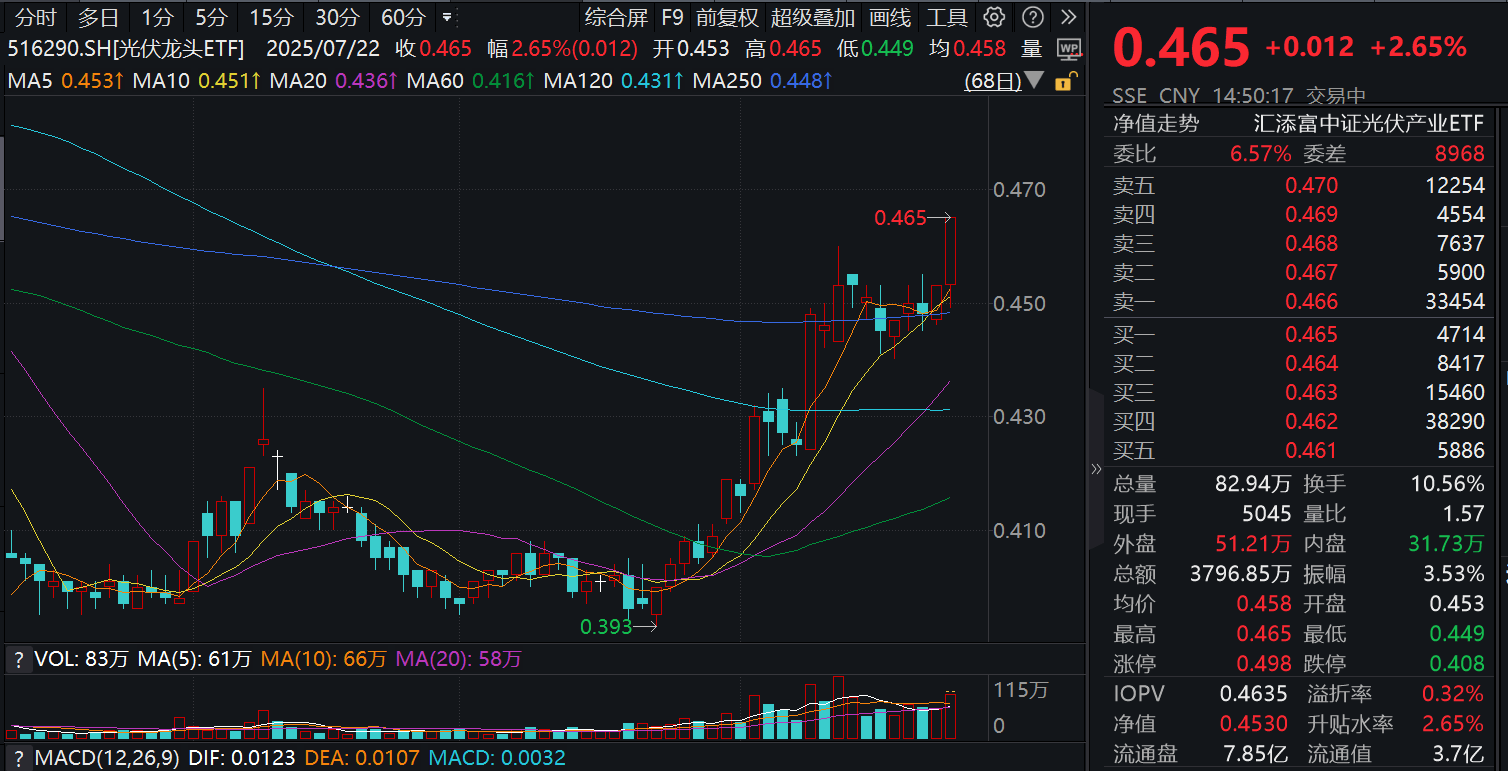
“反内卷”主线发酵,光伏板块午后拉升!费率最低档的光伏龙头ETF(516290)涨近3%,光伏供给侧出清怎么看?
Sou Hu Cai Jing· 2025-07-22 07:16
Group 1 - The core viewpoint of the article highlights the significant upward movement in the stock prices of leading photovoltaic companies, with notable gains in companies such as TBEA and Tongwei [2][3] - The photovoltaic sector is currently facing challenges related to the elimination of outdated production capacity, with a focus on supply-side reforms and technological advancements [4][5] - The photovoltaic glass segment is expected to undergo supply adjustments starting from July 2025, aiming to alleviate inventory pressures and restore price stability within the industry [4] Group 2 - Technological advancements in the battery module segment are anticipated to redefine industry standards for advanced production capacity, with a focus on cost reduction and efficiency improvements [5] - The photovoltaic sector is projected to experience a fundamental recovery, with positive sentiment expected to shift towards the right side, particularly for leading photovoltaic ETFs [5] - The photovoltaic leading ETF (516290) is noted for its low management and custody fees, making it an attractive option for investors [5]
壹快评丨光伏亏损潮中价格异动,产能出清才是真考验
第一财经· 2025-07-22 07:06
Core Viewpoint - The article emphasizes the urgent need for capacity reduction in the photovoltaic (PV) industry, highlighting the disparity between market expectations and actual performance, as well as the necessity for effective policy implementation to facilitate this process [2][4][10]. Group 1: Industry Dynamics - The PV industry is experiencing a significant price surge, particularly in the silicon material and silicon wafer markets, with prices increasing over 10% within a week, and N-type G10L monocrystalline silicon wafers seeing a rise of over 22% [2][3]. - Despite the price increases, the fundamental support for these prices remains weak, with the China Nonferrous Metals Industry Association indicating that the supply-demand situation has not materially improved [3][4]. - The PV sector has reported widespread losses in the first half of the year, with only a few companies showing signs of reduced losses or profitability, indicating a stark contrast between market speculation and actual financial performance [4][5]. Group 2: Company Performance - Companies like Longi Green Energy and JinkoSolar have managed to reduce their losses in the second quarter, suggesting some positive operational adjustments, with Longi Green Energy expecting a loss of 2.4 to 2.8 billion yuan for the first half of the year, but a reduction in losses in the second quarter compared to the first [5][6]. - The article notes that the industry needs to see convincing data on production cuts to validate market expectations and improve the overall supply-demand balance [5][9]. Group 3: Capacity Reduction and Policy Implications - Effective capacity reduction is critical, with the article outlining three key indicators: the effective reduction of silicon material inventory, maintaining low operating rates among companies, and the permanent exit of inefficient production capacities [6][7][9]. - The Ministry of Industry and Information Technology's recent directives are seen as timely, as the PV industry has faced continuous losses for seven consecutive quarters, indicating a pressing need for self-correction within the industry [8][10]. - The article concludes that the success of the PV industry's recovery hinges on the commitment to production cuts and the elimination of outdated capacities, which will ultimately determine the industry's ability to thrive in the global green energy revolution [9][10].