
扩内需

Search documents
风语筑董事长李晖:文旅拥抱科技 重塑线下空间价值
Zhong Guo Zheng Quan Bao· 2025-12-15 22:27
Core Insights - The company has launched the "Intangible Cultural Heritage Millet Youth Art Support Program" in collaboration with art schools, utilizing AI technology to explore new value in intangible cultural heritage [2][3] - The integration of AI technology into the company's operations is a key focus for business development this year, with initiatives including the establishment of the "Embodied Intelligence Research Institute" [2][4] AI Technology Utilization - In November, the company announced a partnership with ByteDance's AI content creation platform, aiming to apply AI-generated content in cultural tourism practices [3] - The "Millet Youth Art Support Program" will serve as a practical example of this initiative, focusing on IP development and content creation through AI [3] - The company is implementing a model of "AI intelligent production + professional human verification" to achieve precise digital preservation of intangible cultural skills [3] Smart Devices Empowering Cultural Tourism - The company is integrating embodied intelligent robots and smart glasses into cultural tourism scenarios, enhancing visitor experiences [4][5] - The "Embodied Intelligence Research Institute" was established to promote the fusion of AI technology with practical applications in cultural tourism [4] - The company has deployed interactive service robots in various venues, enhancing visitor engagement and cultural interpretation [4][5] Revenue Growth and Business Strategy - In the first three quarters of the year, the company achieved revenue of 1.331 billion yuan, a year-on-year increase of 38.88%, and a net profit of 52.7 million yuan, up 116.78% [6] - The company is focusing on finding new growth avenues and optimizing management to improve cash flow [6] - The strategy emphasizes revitalizing existing spaces rather than large-scale redevelopment, aligning with national "expanding domestic demand" initiatives [6] Cultural Value Re-creation - The company aims to leverage local cultural values through digital technology and marketing to create unique competitive advantages in cultural tourism [7] - By utilizing big data analysis, the company tailors content design and interaction methods to align with public preferences, creating replicable practical experiences [7]


投资于物和投资于人紧密结合 明年财政政策“工具箱”有望进一步扩容
Zhong Guo Zheng Quan Bao· 2025-12-15 21:39
Group 1 - The core viewpoint of the articles emphasizes the effectiveness of proactive fiscal policies in supporting major national strategies, expanding domestic demand, stabilizing growth, and improving people's livelihoods in 2025 and the continuation of these policies into 2026 [1][2][3]. Group 2 - In 2025, significant fiscal measures included the allocation of 800 billion yuan in special bonds to support major projects, which involved 1,459 projects in key areas such as ecological restoration and transportation infrastructure [2]. - The consumer goods replacement policy led to a 26.5% increase in sales revenue for home appliances and a 20.3% increase for communication retail in the first eleven months of 2025 [2]. - The fiscal spending since the 14th Five-Year Plan has directed over 70% towards improving people's livelihoods, indicating a strong focus on social welfare [2]. Group 3 - The fiscal policy has played a crucial role in boosting consumption and expanding investment, contributing to the achievement of economic and social development goals [3]. - Investment in human capital through subsidies for childcare and education is seen as essential for high-quality development and improving residents' living standards [3]. Group 4 - The government plans to optimize expenditure structures and enhance financial support for major national strategies, focusing on investments in human capital and expanding domestic demand [4]. - The Ministry of Finance has outlined strategies to promote income growth and optimize income distribution to stimulate consumption [4]. Group 5 - Experts suggest that policies aimed at expanding domestic demand, such as the consumer goods replacement policy, may need optimization to avoid diminishing returns [5]. - There is potential for expanding the subsidy range to include new consumption-related products, such as AI products and electric vehicle charging stations [6]. Group 6 - The government aims to leverage various types of government bond funds to support major projects and enhance the effectiveness of fiscal policies [7]. - Optimizing project reserves and expanding the fiscal "toolbox" are seen as ways to improve the effectiveness of investment policies [8].
政策与地缘研究12月第1期:海外联储降息落地,中国政策定调积极
GUOTAI HAITONG SECURITIES· 2025-12-15 15:00
策略研究 /[Table_Date] 2025.12.15 海外联储降息落地,中国政策定调积极 [Table_Authors] 方奕(分析师) 政策与地缘研究 12 月第 1 期 本报告导读: 资产概览:全球风偏降温,贵金属领涨 2025.12.15 成交活跃度升高,创业板指估值领涨 2025.12.13 资产概览:商品/权益上涨,中债熊陡 2025.12.09 AI 产业延续高景气,服务消费同比偏强 2025.12.09 融资资金延续流入,ETF 平稳回流 2025.12.08 国外方面,美联储 12 月降息落地并开启扩表。国内方面,中央经济工作会议召开, 强调扩内需继续优先,推动投资止跌回稳,科技突破是产业重心。 投资要点: 策 略 观 察 [Table_Summary] 2025 年 12 月美联储议息会议如期宣布降息 25BP,将联邦基金利率 目标区间下调至 3.5%-3.75%,符合市场普遍预期,但内部分歧显 著加大。12 位 FOMC 投票委员中 3 人反对,为 2019 年以来首次出 现三名委员反对利率决议,其中 1 人主张降息 50BP,2 人主张维持 利率不变,点阵图中 2026 年降息预测 ...
夏乐:需求端数字显著低于供给端 未来政策重点就是扩内需|首席读数据
Di Yi Cai Jing· 2025-12-15 13:33
国家统计局数据显示,11月份,规模以上工业增加值同比实际增长4.8%。从环比看,11月份,规模以 上工业增加值比上月增长0.44%。1—11月份,规模以上工业增加值同比增长6.0%。西班牙对外投资银 行亚洲首席经济学家夏乐认为,4.8%的增长数字与整体GDP增长目标基本一致,显示我国制造业相当 强的竞争力。而针对于需求端数据弱于供给端的问题,刚刚结束的中央经济工作会议或将在未来有针对 性的政策推出。 国家统计局数据显示,11月份,规模以上工业增加值同比实际增长4.8%。从环比看,11月份,规模以 上工业增加值比上月增长0.44%。1—11月份,规模以上工业增加值同比增长6.0%。西班牙对外投资银 行亚洲首席经济学家夏乐认为,4.8%的增长数字与整体GDP增长目标基本一致,显示我国制造业相当 强的竞争力。而针对于需求端数据弱于供给端的问题,刚刚结束的中央经济工作会议或将在未来有针对 性的政策推出。 ...
公募基金行业正在热议!
Jin Rong Shi Bao· 2025-12-15 10:32
Group 1 - The Central Economic Work Conference held on December 10-11 in Beijing is a crucial meeting that outlines the direction for economic work in 2026, marking the transition from the "14th Five-Year Plan" to the "15th Five-Year Plan" [1] - Public fund industry professionals view the conference as a guide for the capital market and public fund industry to serve the real economy and national strategy while meeting residents' wealth management needs [1] - The public fund industry aims to fully engage in high-quality development in 2026, integrating its growth into the national development framework to contribute to the stable and healthy development of the capital market [1] Group 2 - The conference emphasizes the importance of innovation-driven growth and the cultivation of new economic drivers, urging the public fund industry to enhance its research on new technologies and industries [2] - The core of new productive forces is technological innovation, which requires long-term capital support, positioning public funds as "patient capital" to foster a market ecosystem conducive to long-term investments [2][3] - The meeting highlights the need for the capital market to deepen reforms and establish a distinctive technology finance system to better support the national innovation strategy [3] Group 3 - The conference stresses the need to expand domestic demand and build a strong domestic market while addressing "involution" in competition [4] - The public fund industry is encouraged to help residents achieve wealth growth through capital markets, enhancing investor experience and promoting the conversion of savings into investments [4] - The industry is tasked with improving product offerings and investor education to adapt to long-term funding needs, thereby increasing residents' financial well-being [4] Group 4 - The themes of "expanding domestic demand" and "countering involution" are expected to be key investment themes for the market in 2026, with significant potential for service consumption recovery [5] - The "investment in people" policy is anticipated to enhance service consumption, while measures to counter involution are expected to shift the economy from scale expansion to quality improvement [6] - The financial market is seen as a critical area for establishing a unified national market, with the free flow of financial elements contributing to high-quality economic development [6]
超半数装修建材股实现增长 松霖科技股价涨幅6.98%
Bei Jing Shang Bao· 2025-12-15 09:27
Core Viewpoint - The renovation and building materials sector experienced a slight increase, closing at 16,115.56 points with a growth rate of 0.64% [1] Group 1: Stock Performance - Several stocks in the renovation and building materials sector saw price increases, with Songlin Technology leading at 35.70 CNY per share, up 6.98% [1] - Gu Di Technology closed at 4.02 CNY per share, marking a 5.24% increase, ranking second in the sector [1] - Meike Home closed at 3.06 CNY per share, with a growth of 4.79%, ranking third [1] - Conversely, Zhongyuan Home led the decline with a closing price of 22.07 CNY per share, down 7.42% [1] - *ST Yazhen closed at 33.28 CNY per share, down 5.00%, ranking second in losses [1] - Qisheng Technology closed at 19.96 CNY per share, down 4.91%, ranking third in losses [1] Group 2: Market Outlook - China Galaxy's research report indicates that both consumption and investment are working together to expand domestic demand, with consumption upgrades driving the high-quality transformation of building materials [1] - The Central Economic Work Conference mentioned the implementation of special actions to boost consumption by 2026, which aligns with the 14th Five-Year Plan's suggestion to eliminate unreasonable restrictions in consumption [1] - It is anticipated that housing purchase restrictions will gradually ease by 2026, enhancing expectations for a recovery in the home decoration market and boosting demand for building materials [1]

美联储如期降息,经济工作会议召开
Guo Mao Qi Huo· 2025-12-15 05:25
2012 31 2025-12-15 F3014717 Z0013223 01 PART ONE 主要观点 | 影响因素 | 主要逻辑 | | --- | --- | | 回顾 | 本周国内商品继续回落,多数品种走弱,其中,工业品、农产品指数均下跌,品种间走势分化。一是,美联储12月如期降息,黄金、有色板块表现亮眼;二是, | | | 国内经济疲软,供强需求,黑色系继续调整,表现较弱;三是,多空因素交织,能化板块震荡运行。 | | 海外 | 1)美联储宣布将联邦基金利率目标区间下调0.25个百分点至3.5%-3.75%,符合市场预期。鲍威尔在新闻发布会上重申了双重使命,并强调由于缺乏增量数据, | | | 就业和通胀预期变化不大。但对于劳动力市场,鲍威尔提到就业增长可能被高估了约6万人,暗示自4月以来月均就业人数实际可能减少了2万人。因此在当前就业 | | | 下滑和通胀上行的矛盾走势中,美联储选择在当前更加重视就业的问题,所以选择降息。12月美联储降息如期落地,而且与市场预期不同的是,鲍威尔的发言更 | | | 偏鸽派,目前市场预期2026年仍有两次各25bp降息可能,后续就业和通胀的走势仍是关键。2)日本 ...
万亿巨头,A股第一
Zhong Guo Zheng Quan Bao· 2025-12-15 05:16
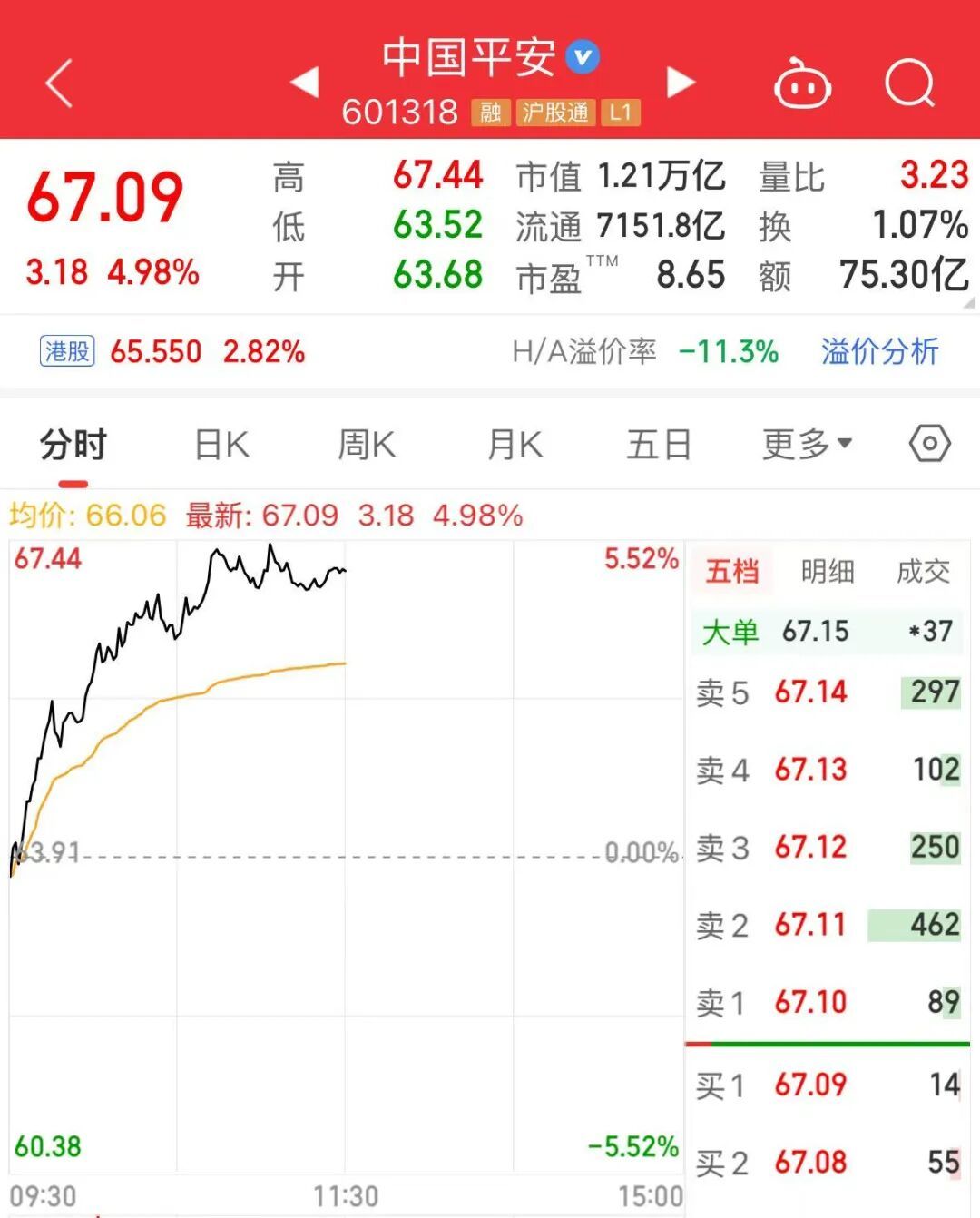
Group 1: Company Performance - China Ping An's stock price has been rising, with a 4.98% increase today, reaching a new high since April 2021, and a market capitalization of 1.21 trillion yuan [1] - China Life also saw a 2.1% increase today, hitting a new high for the year [1] - Morgan Stanley raised its target price for China Ping An's H-shares to 89 HKD and A-shares to 85 CNY, while CICC increased its A-share target price from 74.4 CNY to 89.8 CNY and H-share target price from 71 HKD to 99.4 HKD [5] Group 2: Industry Trends - The insurance sector experienced significant gains, with China Ping An and China Pacific Insurance leading the rise [3] - A recent notification from the National Financial Regulatory Administration has eased capital regulations for insurance companies, potentially benefiting large insurers with high stock investment ratios [5] - The consumer sector is also showing strength, with various sub-sectors like dairy, liquor, and retail experiencing notable increases [6][9] - The central economic work conference emphasized the importance of domestic demand, aiming to build a strong domestic market [9]

万亿巨头 A股第一!
Zhong Guo Zheng Quan Bao· 2025-12-15 05:06
Group 1: Company Performance - China Ping An's stock price has been rising, with a 4.98% increase today, reaching a new high since April 2021, and a market capitalization of 1.21 trillion yuan [2] - China Life also saw a 2.1% increase, hitting a new high for the year [2] - Institutional investors have been raising target prices for China Ping An, with Morgan Stanley increasing its H-share target price to 89 HKD and A-share target price to 85 CNY [5] - CICC raised China Ping An's A-share target price from 74.4 CNY to 89.8 CNY and H-share target price from 71 HKD to 99.4 HKD [5] Group 2: Industry Trends - The insurance sector experienced significant gains, with leading stocks like China Ping An and China Pacific Insurance leading the rise [3] - A recent notification from the National Financial Regulatory Administration has eased capital regulations for insurance companies, potentially benefiting large insurers with high stock investment ratios [6] - The consumer sector also showed strength, particularly in dairy, liquor, retail, and beer segments, with notable stock increases in companies like Knight Dairy and Huangshi Group [6][8] - The central economic work conference emphasized the importance of domestic demand and outlined key tasks for economic work through 2026, aiming to enhance the domestic market [9]
中国银河证券:反内卷+扩内需重塑格局 出海共振引领估值修复
智通财经网· 2025-12-15 02:00
消费、投资共同发力扩内需,消费升级推动建材高品质转型 消费端,中央经济工作会议提到,2026年要"深入实施提振消费专项行动,清理消费领域不合理限制措 施",与十五五规划建议稿中提到的"清理汽车、住房等消费不合理"相呼应,预计26年各地区居民住房 限购政策将逐步放开,家装市场回暖预期增强,有望带动消费建材需求恢复。投资端,中央经济工作会 议提到"推动投资止跌回稳,优化实施'两重'项目",与十五五规划建议稿对"扩大有效投资"的描述相契 合,水泥等传统建材需求与基建投资高度相关,"两重"项目建设将是缓解地产新开工疲软的主要对冲力 量,预计明年"两重"项目将托底传统建材市场需求。与此同时,近年我国居民消费水平不断提高,中央 经济工作会议提到"高质量推进城市更新"及"有序推动'好房子'建设",在地产进入存量时代背景下,城 市更新及高品质建设成为建材市场重要抓手,一方面,随着明年城市更新工作的推进与落地,城市基础 设施建设及城市综合管廊建设等相关的建材产品需求有望加速释放;另一方面,消费升级趋势下,具备 品牌属性及品质优势的龙头企业有望受益。 深化推进"反内卷",传统建材供需格局预期向好 中央经济工作会议提到"制定全国统 ...
