
货币宽松

Search documents
宝城期货国债期货早报(2025年9月23日)-20250923
Bao Cheng Qi Huo· 2025-09-23 01:21
Report Summary 1. Investment Rating No investment rating is provided in the report. 2. Core View The report suggests that Treasury bond futures are expected to trade in a low - level range in the short term, with both upward and downward pressures. There is potential for medium - to long - term interest rate cuts, but the possibility of an immediate full - scale rate cut is low [1][5]. 3. Summary by Section 3.1 Variety View Reference - Financial Futures Stock Index Sector - For the TL2512 variety, the short - term view is "sideways", the medium - term view is "sideways", the intraday view is "sideways - bullish", and the overall view is "sideways". The core logic is that there are still medium - to long - term expectations of interest rate cuts, but the possibility of a short - term full - scale rate cut is low [1]. 3.2 Main Variety Price and Market Driving Logic - Financial Futures Stock Index Sector - The varieties include TL, T, TF, and TS. The intraday view is "sideways - bullish", the medium - term view is "sideways", and the reference view is "sideways". - The core logic is that Treasury bond futures fluctuated and rose yesterday. Although the September LPR remained unchanged, there is still potential for medium - to long - term interest rate cuts. The weak credit data in August, the marginal slowdown in consumption growth, and the weak inflation data have increased the expectation of macro - policies to stabilize demand in the fourth quarter. With the Fed's rate cut in September and two more expected cuts this year, there is still an expectation of monetary easing in the future, providing strong support for Treasury bond futures in the medium - to long - term. - However, the upward momentum of Treasury bond futures is insufficient. Firstly, there is no high need for an immediate full - scale rate cut, which needs to be coordinated with fiscal policies. Secondly, the stock - bond seesaw effect suppresses the demand for Treasury bonds [5].
研究人员:未来几个月的黄金需求料将继续得到有力支撑
Sou Hu Cai Jing· 2025-09-22 08:22
Core Viewpoint - Gold prices have surged to new record highs due to concerns that the Federal Reserve may begin to ease monetary policy while the U.S. economy remains resilient [1] Group 1: Demand for Gold - Future demand for gold appears to be strongly supported in the coming months [1] - Gold is recognized as the oldest inflation hedge globally, which is expected to enhance its appeal as the Federal Reserve seems poised to initiate a new round of monetary easing [1]
流动性周报:30年国债利差还能回来吗?-20250922
China Post Securities· 2025-09-22 07:06
Report Summary 1. Report Industry Investment Rating No industry investment rating is provided in the report. 2. Core Viewpoints - Short - term bond market sentiment remains under pressure. It is crucial to verify that the rebound high of long - term interest rates is gradually decreasing. If 1.8% is confirmed as the relatively high level of the 10 - year Treasury bond, the bond - bull logic can be maintained. In the medium term, the recovery of risk appetite is mainly reflected in the term spread premium, which may reach 50 - 60BP in extreme cases. In September 2025, the bond market is more likely to experience a weak recovery rather than a seasonal adjustment [2][9]. - The term spread of ultra - long bonds is difficult to return to extremely low levels but is unlikely to expand significantly, and there is no need to refer to the historical range above 40BP before 2023 [3][14]. - The short - term recovery of the bond market may be driven by monetary easing. If a 10BP policy rate cut is implemented, the central level of funds and short - term varieties will decline by more than 10BP. The performance of long - term bonds is more affected by expected pricing, and the resistance at 1.7% - 1.75% of the 10 - year Treasury bond may be significant [4][19]. 3. Summary by Related Content 3.1 Bond Market Situation in September 2025 - The bond market has not significantly recovered, long - term bond interest rates are oscillating, and the term spread is expanding. After the public offering fee new rule and the central bank bond - buying expectation emerged, the long - term interest rate rebounded after breaking through 1.8% and then maintained an oscillating state. The term spread has not stopped recovering due to the unclear impact of the public offering fee new rule on the liability side [3][9]. 3.2 Analysis of Ultra - Long Bond Term Spread - **Difficulty in Returning to Low Levels and Limited Expansion**: The ultra - long bond term spread is closely related to risk appetite, reflecting the marginal change in the household debt cycle. As the household sector's leverage ratio has entered the stable - leverage stage and the real - estate cycle has not ended, the improvement of household risk appetite is limited, so the term spread is difficult to return to the high - level range before extreme compression [14][15]. - **Uncertainty from Supply and Demand**: Although the supply of ultra - long - term interest - rate bonds has increased (as of mid - September, the stock of ultra - long - term interest - rate bonds over 10 years has reached 27.3 trillion yuan, and the proportion has increased from 7% in Q1 2019 to 23%), it is difficult to determine the term spread trend from the supply side alone because the demand elasticity has a greater and unpredictable impact. Historically, the term spread has compressed even when the supply increased. In the short term, the completion of ultra - long bond issuance in Q4 may reduce the spread expansion pressure [17]. 3.3 Short - Term Bond Market Recovery Drivers - The short - term recovery of the bond market may be driven by monetary easing. A 10BP policy rate cut will lead to a central decline of more than 10BP in the funds and short - term varieties. The 10 - year Treasury bond has heavy chips around 1.7% - 1.75%, and the resistance to unwinding may be obvious [4][19].
市场对央行重启国债买卖操作预期升温,30年国债ETF博时(511130)早盘小幅飘红
Sou Hu Cai Jing· 2025-09-22 04:05
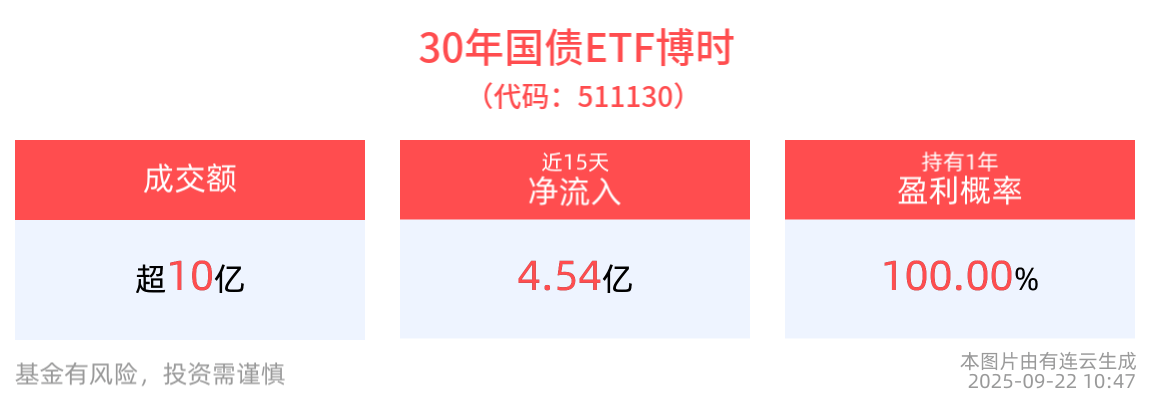
Group 1 - The 30-year government bond ETF from Bosera has seen a price increase of 0.24%, reaching 106.93 yuan as of September 22, 2025 [2] - The trading volume for the 30-year government bond ETF was 10.47 billion yuan, with a turnover rate of 5.38% [2] - The average daily trading volume over the past month was 44.63 billion yuan, indicating strong market activity [2] Group 2 - The 10-year government bond yield has risen above 1.8%, reflecting significant market fluctuations [2] - The People's Bank of China is expected to resume government bond trading operations, following a net purchase of 1 trillion yuan in government bonds from August to December 2024 [2] - Economic indicators such as weak credit data and slowing consumption growth have led to expectations of stable macroeconomic policies in the fourth quarter [2] Group 3 - The latest scale of the 30-year government bond ETF from Bosera is 19.415 billion yuan [3] - There has been a net outflow of 282 million yuan from the ETF recently, although there were net inflows on 8 out of the last 15 trading days, totaling 454 million yuan [3] - The ETF closely tracks the Shanghai Stock Exchange 30-year government bond index, which reflects the overall performance of corresponding maturity government bonds [3]

LPR调整在即,央行重磅信号!
Sou Hu Cai Jing· 2025-09-20 03:33
Group 1 - The People's Bank of China (PBOC) will announce the new Loan Prime Rate (LPR) on September 22, with the current 1-year LPR at 3.0% and the 5-year LPR at 3.5%, unchanged for three months [1] - A press conference on the achievements of the financial sector during the 14th Five-Year Plan will be held on the same day, featuring key financial leaders [3] - The PBOC plans to issue 600 billion yuan of central bank bills with a 6-month maturity to enhance the RMB yield curve in Hong Kong [4] Group 2 - Following the Federal Reserve's recent rate cut, there is speculation that global central banks, including the PBOC, may follow suit, potentially leading to a second wave of market rally in A-shares [5] - The PBOC has adjusted its 14-day reverse repo operations to a fixed quantity and multi-price bidding, which is seen as a move to enhance liquidity management [6] - The PBOC's liquidity management tools are being optimized to ensure stability in the financial system, especially ahead of major holidays [6] Group 3 - The external environment, including the Fed's rate cut and trade policies, may exert downward pressure on the US dollar, providing upward momentum for the RMB [7] - The PBOC is expected to flexibly manage liquidity through various instruments to stabilize the economy and support the RMB exchange rate [7] - A report from Galaxy Securities indicates that the priority for monetary policy in the fourth quarter will focus on economic growth and employment, with potential interest rate cuts anticipated [8]
东莞证券财富通每周策略-20250919
Dongguan Securities· 2025-09-19 09:12
Market Overview - The Shanghai Composite Index experienced a fluctuation and consolidation this week, with trading volume consistently above 2 trillion, indicating active trading sentiment. The index fell by 1.30%, while the Shenzhen Component rose by 1.14%, the ChiNext Index increased by 2.34%, and the STAR Market 50 Index rose by 1.84. The North Exchange 50 Index decreased by 1.43% [1][3][8]. Economic Analysis - Economic data for August shows a continued weakening trend, with various indicators reflecting a slowdown. The industrial added value for August grew by 5.2% year-on-year, a slight decline of 0.5 percentage points from the previous value. Fixed asset investment from January to August increased by only 0.5% year-on-year, down 1.1 percentage points from the previous value [9][10]. - The fiscal revenue for August was 1.24 trillion, a year-on-year increase of 2.03%, but down 0.62 percentage points from the previous month. Tax revenue was 1.02 trillion, up 3.39% year-on-year, but also down 1.61 percentage points from the previous month. Non-tax revenue fell to 220.7 billion, marking a 3.79% decline, continuing a four-month streak of negative growth [10][11]. Federal Reserve Impact - The Federal Reserve lowered the federal funds rate by 25 basis points to a range of 4.00%-4.25%, aligning with market expectations. The Fed's decision is seen as a neutral signal, with expectations of two more rate cuts within the year. This move creates external space for monetary easing in China [3][11][14]. Sector Recommendations - It is recommended to focus on sectors such as public utilities, finance, electric equipment, non-ferrous metals, and TMT (Technology, Media, and Telecommunications) [4][15]. Stock Performance Tracking - The report includes a tracking of potential stocks for the month, highlighting companies like Xinhua Insurance, which closed at 45.05 with a maximum increase of 5.92%, and Xiamen Tungsten, which closed at 20.30 with a maximum increase of 3.48% [22][23]. Conclusion - Overall, the market is expected to continue its oscillating upward trend in the short term, despite the high-level fluctuations. The ongoing economic pressures and the need for policy support suggest a cautious but optimistic outlook for the capital market [3][14].
中辉有色观点-20250919
Zhong Hui Qi Huo· 2025-09-19 03:55
1. Report Industry Investment Ratings - Gold: Long - term holding [1] - Silver: High - level correction [1] - Copper: High - level correction [1] - Zinc: Under pressure [1] - Lead: Rebound [1] - Tin: Under pressure [1] - Aluminum: Under pressure [1] - Nickel: Under pressure [1] - Industrial silicon: Rebound [1] - Polysilicon: High - level oscillation [1] - Lithium carbonate: Wide - range oscillation [1] 2. Core Views of the Report - The long - term bullish logic of gold and silver remains unchanged, despite short - term adjustments. Copper's long - term trend is positive, while zinc shows a supply - increase and demand - decrease situation in the medium - long term. Aluminum prices are under pressure, and nickel prices are also facing downward pressure. Lithium carbonate will maintain a wide - range oscillation in the short term due to strong terminal demand [1]. 3. Summary by Related Catalogs Gold and Silver - **Market Review**: After the Fed's interest rate cut, the probability of rate cuts in 2026 is lower than expected, and gold and silver prices have significantly adjusted [2]. - **Basic Logic**: US employment data has improved month - on - month, and many countries have followed the Fed in cutting interest rates. In the short term, the market is selling on the news, leading to a correction in gold prices. In the long term, gold will benefit from global monetary easing, the decline of the US dollar's credit, and the reconstruction of the geopolitical pattern [3]. - **Strategy Recommendation**: In the short term, the selling on the news is common, but the volatility is expected to be limited. Silver has support around 9730. Wait for it to stabilize before making long - position purchases. The long - term upward trend of gold and silver remains unchanged [4]. Copper - **Market Review**: Shanghai copper has been oscillating and testing the support of the lower moving average [6]. - **Industrial Logic**: The supply of copper concentrates is tight. High copper prices have suppressed demand, and inventories have continued to accumulate. Pay attention to the strength of domestic policies and the performance of the peak season [6]. - **Strategy Recommendation**: The Fed's interest rate cut was in line with expectations. The market has fully priced in the rate cut. Copper has oscillated and corrected, testing the support of the lower moving average. The long - term logic remains unchanged. Wait for copper to stop falling and stabilize before re - entering the market. For the medium - long term, be optimistic about copper [7]. Zinc - **Market Review**: Shanghai zinc has been under pressure and testing the support of the 22,000 - yuan level [8]. - **Industrial Logic**: In 2025, the supply of zinc concentrates was abundant. In September, domestic smelter maintenance increased, and zinc ingot production was expected to decrease. Domestic zinc ingot social inventories have accumulated, while LME zinc inventories have continued to decline. The demand in September is expected to be good, but downstream buyers are purchasing on dips [9]. - **Strategy Recommendation**: The Fed's interest rate cut was in line with expectations. In the short term, LME zinc has risen and then fallen. Shanghai zinc is oscillating weakly and may test the support of the lower integer level. In the medium - long term, maintain the view of shorting on rebounds [10]. Aluminum - **Market Review**: Aluminum prices have been under pressure, and alumina has shown a relatively weak trend [12]. - **Industrial Logic**: Overseas interest rate cuts were in line with expectations. In August, domestic electrolytic aluminum production increased year - on - year and month - on - month. Inventories have accumulated. The demand side has shown a step - by - step recovery. The supply of bauxite in Guinea is abundant, and the supply pressure of alumina has increased [13]. - **Strategy Recommendation**: It is recommended to go long on Shanghai aluminum on dips in the short term, paying attention to the changes in the operating rate of downstream processing enterprises [14]. Nickel - **Market Review**: Nickel prices have been under pressure, and stainless steel has rebounded and then fallen [16]. - **Industrial Logic**: Overseas interest rate cuts were in line with expectations. Domestically, the supply of refined nickel has a large surplus pressure, while the supply of nickel sulfate is relatively tight. The inventory of stainless steel has continued to decline, and the production volume in September is expected to increase. Pay attention to the improvement of terminal consumption during the peak season [17]. - **Strategy Recommendation**: It is recommended to short on rebounds for nickel and stainless steel in the short term, paying attention to the improvement of terminal consumption [18]. Lithium Carbonate - **Market Review**: The main contract LC2511 opened low and moved lower, with the decline narrowing at the end of the session [20]. - **Industrial Logic**: The supply side has continued to release incremental production. Terminal demand is in the peak season, and the inventory of lithium carbonate has decreased. The price of lithium carbonate has support at the bottom and will maintain a wide - range oscillation in the short term [21]. - **Strategy Recommendation**: Adopt a low - buying strategy in the range of [72300 - 73500] [22].
美联储降息25个基点 特朗普“自己人”投下唯一一张反对票
Sou Hu Cai Jing· 2025-09-18 02:10
Group 1 - The Federal Reserve announced a 25 basis point cut in the federal funds rate target range to 4.00% to 4.25%, marking its first rate adjustment since December of the previous year and the first for 2025 [1][2] - The decision to lower rates was primarily driven by concerns over a weakening labor market, with non-farm payroll data indicating stagnation in job creation and an increase in the unemployment rate to 4.3% [2][5] - The internal voting on the rate cut showed a strong consensus, with an 11 to 1 vote in favor, indicating a unified stance among most Federal Reserve members despite previous dissent [5][6] Group 2 - The only dissenting vote came from Stephen Moore, who advocated for a more aggressive 50 basis point cut, highlighting differing views within the Federal Reserve [6] - The Federal Reserve's focus on inflation remains significant, as the Consumer Price Index (CPI) year-on-year inflation rate rose to 2.9%, the highest level since January of the current year [2][7] - Future rate cuts are anticipated in the upcoming meetings in October and December, as the Federal Reserve aims to address the risks in the labor market while balancing inflation concerns [7][8]
中金公司:预计美联储或将于10月再次降息
Zheng Quan Shi Bao Wang· 2025-09-18 00:10
Core Viewpoint - The People's Financial News reports that the Federal Reserve's decision to cut interest rates by 25 basis points in September aligns with market expectations, indicating a measured response to economic concerns while maintaining restraint [1] Summary by Relevant Categories Federal Reserve Actions - The Federal Reserve's decision to lower interest rates by 25 basis points was anticipated by the market, but the expected 50 basis point cut did not materialize, reflecting significant divisions among policymakers regarding future rate cuts [1] Economic Outlook - Looking ahead, due to weak employment data, the Federal Reserve is expected to consider another rate cut in October. However, rising inflation will likely increase the threshold for further cuts, limiting the scope for monetary easing [1] Economic Challenges - The current issues facing the U.S. economy are not due to insufficient demand but rather rising costs. Excessive monetary easing may not resolve employment challenges and could exacerbate inflation, potentially leading the economy into a "stagflation-like" scenario [1]

中金:美联储在供给症结下克制降息
Sou Hu Cai Jing· 2025-09-18 00:00
Core Viewpoint - The Federal Reserve's decision to cut interest rates by 25 basis points in September aligns with market expectations, indicating a measured response to economic concerns while maintaining restraint [1] Group 1: Interest Rate Decisions - The anticipated 50 basis point cut did not materialize, reflecting significant divisions among decision-makers regarding future rate cuts [1] - A further rate cut is expected in October due to weak employment data, but subsequent cuts may face higher thresholds due to rising inflation [1] Group 2: Economic Conditions - The current issue in the U.S. economy is not insufficient demand but rising costs, suggesting that excessive monetary easing may exacerbate inflation rather than resolve employment issues [1] - The economy may risk entering a "stagflation-like" scenario if inflation continues to rise alongside economic challenges [1]