贸易摩擦

Search documents
Trump threatens China with cooking oil embargo as soybean spat escalates
Yahoo Finance· 2025-10-15 09:30
Core Points - The U.S. President has labeled China as "economically hostile" due to its refusal to purchase American soybeans, which has led to threats of halting imports of cooking oil and other products from China as retaliation [1][2] - The U.S. administration is considering terminating business relations with China regarding cooking oil and other trade elements, emphasizing the capability to produce cooking oil domestically [3] - China's recent export controls on rare earth elements have prompted a significant escalation in trade tensions, leading to increased tariffs on imports from China [5][6] Industry Impact - Soybeans are a critical agricultural product in the U.S., with cooking oil being one of the main derivatives, alongside animal feed [4] - The U.S. primarily imports cooking oil from Canada, but China is a significant supplier of used cooking oil (UCO) for biofuels, indicating a potential disruption in the biofuel supply chain due to trade tensions [4] - The demand for used cooking oil in the U.S. has surged, particularly as the previous administration aimed to support green transportation initiatives [7]
中科创达(300496.SZ):贸易摩擦对公司业务没有影响
Ge Long Hui· 2025-10-15 07:09
Core Viewpoint - The trade friction has no impact on the company's business, and it will continue to monitor trade policies and adjust strategies accordingly [1] Company Summary - The company has stated that its product solutions possess strong competitiveness, enabling it to adapt to changes in the external environment [1]

中科创达:贸易摩擦对公司业务没有影响
Ge Long Hui· 2025-10-15 07:05
格隆汇10月15日丨中科创达(300496.SZ)在投资者互动平台表示,目前看, 贸易摩擦对公司业务没有影 响。公司将持续关注相关贸易政策情况,并会对战略、业务进行积极的调整和适配。公司的产品解决方 案有较强的竞争力, 可以应对外部环境的变化。 ...
旺季不旺 螺纹钢维持偏弱走势
Qi Huo Ri Bao· 2025-10-15 05:32
Core Viewpoint - The steel market, particularly rebar, is experiencing weakened demand and price fluctuations due to ongoing adjustments in the real estate sector, leading to increased inventory pressure and a lack of significant improvement in demand [1][2]. Group 1: Rebar Market Dynamics - The traditional peak season for rebar, known as "Golden September and Silver October," has diminished, with inventory levels during the National Day holiday exceeding historical averages [1]. - Rebar prices are showing weak fluctuations, while raw material prices remain strong, indicating a lack of negative feedback in the supply chain [1]. - Steel mills are implementing production control measures to alleviate inventory pressure, resulting in lower rebar production levels this year [1]. Group 2: Hot Roll and Steel Billet Risks - The main risks for hot-rolled steel in Q4 include a decline in domestic demand and pressure on exports, with downstream orders for cold-rolled galvanized products shrinking [2]. - Hot-rolled steel inventory levels are higher than the same period last year, indicating potential oversupply [2]. - Steel billet exports have surged, reaching a historical high of 1.76 million tons in August, but production profits are now negative, raising concerns about future output [2]. Group 3: Raw Material and Cost Dynamics - High pig iron production is supporting raw material prices, with coal and iron ore prices outperforming finished steel since August [3]. - Rebar production profits are currently low, with long-process profits below 100 yuan per ton and short-process profits around -100 yuan per ton [3]. - The cost support for rebar remains intact due to healthy fundamentals in the raw material sector, despite the lack of significant upward momentum in rebar prices [3]. Group 4: Macro Factors and Market Sentiment - The market is closely monitoring macroeconomic factors, including upcoming political meetings and monetary policy decisions, which could influence rebar prices [3]. - There is a notable contradiction between weak demand and strong cost support for rebar, but the situation has not yet reached a level of negative feedback that would significantly impact prices [3]. - Overall, the rebar market is expected to maintain a weak and fluctuating trend, with caution advised regarding potential volatility due to changing market expectations [3].
石油沥青日报:利好因素匮乏,盘面弱势运行-20251015
Hua Tai Qi Huo· 2025-10-15 05:11
Report Industry Investment Rating - The unilateral strategy is cautiously bearish, with a short - term focus on waiting and seeing. There are no strategies for inter - period, cross - variety, spot - futures, and options [2] Core View - The asphalt market has few positive factors and the market is running weakly. The asphalt futures and spot prices are showing a downward trend. The overall supply - demand situation of asphalt remains weak, with insufficient demand growth momentum and local pressure emerging. The market may fluctuate repeatedly due to the impact of crude oil trends and increased macro - level disturbances, so caution is recommended [1] Market Analysis - On October 14, the closing price of the main BU2511 contract of asphalt futures in the afternoon session was 3,290 yuan/ton, a decrease of 20 yuan/ton or 0.6% from the previous day's settlement price. The open interest was 99,108 lots, a decrease of 4,179 lots from the previous day, and the trading volume was 100,725 lots, a decrease of 41,232 lots from the previous day [1] - The spot settlement prices of heavy - traffic asphalt from Zhuochuang Information are: 3,506 - 4,086 yuan/ton in the Northeast, 3,330 - 3,670 yuan/ton in Shandong, 3,380 - 3,550 yuan/ton in the South China, and 3,450 - 3,550 yuan/ton in the East China [1] - The asphalt market has been on a continuous downward trend recently. The spot prices of asphalt in the Northwest, Northeast, and South China remained relatively stable yesterday, while those in other regions decreased to varying degrees [1] Figures - There are figures showing the spot prices of heavy - traffic asphalt in different regions (Shandong, East China, South China, North China, Southwest, Northwest), the closing prices of the asphalt futures index, main contract, and near - month contract, the monthly spread of the near - month asphalt futures, the trading volume and open interest of the asphalt futures, the weekly domestic asphalt production, the asphalt production of independent refineries and in different regions (Shandong, East China, South China, North China), the domestic asphalt consumption in different fields (road, waterproofing, coking, ship fuel), and the asphalt refinery and social inventories [3]
避险资金流入能否助日元破局
Jin Tou Wang· 2025-10-15 03:20
Core Viewpoint - The USD/JPY exchange rate is experiencing downward pressure due to escalating US-China trade tensions, leading to a stronger demand for safe-haven currencies like the Japanese yen and Swiss franc [1][2]. Group 1: Market Dynamics - The USD has weakened further, offsetting the recovery in risk sentiment, with all eyes on the Federal Reserve's statements and Japanese political developments for new trading incentives [1]. - Following a brief period of calm, global markets have re-entered a state of tension, with increased safe-haven demand reflected in the performance of the yen and franc compared to the USD [1]. - The outlook for the USD/JPY exchange rate has shifted from bullish to cautious, as traders prefer the defensive attributes of the yen amid current uncertainties [1]. Group 2: Political and Economic Factors - The potential for reaching agreements or extending tariff truce remains uncertain, with rising associated risks [1]. - The political instability in Japan, particularly due to the Komeito party's exit from the coalition government, is expected to impact the yen's performance, with the temporary National Assembly session postponed from October 15 to October 21 [1]. Group 3: Technical Analysis - The USD/JPY exchange rate faces short-term downside risks, with key support levels identified at 151.40 and 151.15 [3]. - Additional technical support is noted at the 200-hour moving average of 151.27 and the psychological level of 151.00, while any rebound attempts may encounter significant resistance [3].
美联储降息迹象令金价维持在高位
Ge Long Hui· 2025-10-15 00:55
Core Viewpoint - Gold prices have slightly increased, approaching historical highs, driven by trade tensions and expectations of two more interest rate cuts by the Federal Reserve this year [1] Group 1: Gold Market - Federal Reserve Chairman Jerome Powell hinted at a potential 25 basis point rate cut later this month, leading to a decline in U.S. Treasury yields to their lowest levels in weeks [1] - Lower yields and borrowing costs are generally favorable for precious metals [1] Group 2: Silver Market - Insufficient liquidity in the London market has plagued the silver market, resulting in a global surge in demand and pushing benchmark prices above New York futures prices [1] - Traders remain anxious ahead of the U.S. government's conclusion of the Section 232 investigation into critical minerals, including silver, platinum, and palladium [1] - There are renewed concerns that these metals may be included in new tariff ranges, despite being officially exempted from tariffs in April [1]
热门中概股下挫,金价再创新高
第一财经· 2025-10-14 23:37
Core Viewpoint - The article discusses the mixed performance of the US stock market, influenced by strong quarterly results from major banks, comments from Federal Reserve Chairman Jerome Powell, and rising uncertainties in trade policy [3][4]. Market Performance - The Dow Jones Industrial Average rose by 202.88 points to close at 46,270.46, an increase of 0.44% - The S&P 500 index fell by 10.41 points to 6,644.31, a decrease of 0.16% - The Nasdaq Composite Index dropped by 172.91 points to 22,521.70, a decline of 0.76% [3]. Sector Performance - Technology stocks faced pressure, with notable declines in Nvidia (down 4.41%), Amazon (down 1.67%), and Tesla (down 1.53%) - The Consumer Staples sector led gains, increasing by 1.72%, followed by the Industrial sector, which rose by 1.17% [3][4]. Banking Sector Highlights - Several major US banks reported strong earnings, with investment banking performance driving the financial sector higher - Wells Fargo shares rose by 7.15%, marking the largest single-day increase since November 2024, while Citigroup shares increased by nearly 4% [4]. - JPMorgan raised its full-year net interest income forecast, and Goldman Sachs also reported better-than-expected quarterly profits, although both saw their stock prices decline by about 2% [5]. Economic Indicators - The yield on the 10-year US Treasury bond fell by 2.1 basis points to 4.03%, reaching a near one-month low - Market expectations for a 25 basis point rate cut by the Federal Reserve at the end of October stand at 96.7% [5]. - Powell indicated that the labor market remains weak with low hiring and layoffs, but the overall economy may be more resilient than expected [5]. Commodity Market - International oil prices declined, with WTI crude oil futures closing at $58.70 per barrel, down 1.33% - Gold prices reached a new historical high, with COMEX gold futures rising by 0.74% to $4,163.4 per ounce [6].


美股三大指数收盘涨跌不一,英伟达跌逾4%,国际金价再创历史新高
Di Yi Cai Jing· 2025-10-14 23:35
Group 1 - U.S. stock market showed mixed results with the Dow Jones Industrial Average rising by 202.88 points to 46270.46, while the S&P 500 and Nasdaq Composite fell by 10.41 points to 6644.31 and 172.91 points to 22521.70 respectively [2] - Major U.S. banks reported strong earnings, with Wells Fargo rising 7.15% and Citigroup nearly 4%, while JPMorgan and Goldman Sachs saw their stock prices drop by about 2% despite exceeding profit expectations [3] - The S&P 500 index saw 10 out of 11 sectors increase, led by consumer staples which rose 1.72% and industrials which increased by 1.17% [2][3] Group 2 - The International Monetary Fund (IMF) slightly raised its global economic growth forecast for 2025, citing lower-than-expected impacts from tariffs and financial conditions, but warned that escalating trade tensions could hinder global output [4] - International oil prices declined, with WTI crude oil futures closing at $58.70 per barrel, down 1.33%, and Brent crude oil futures at $62.39 per barrel, down 1.47% [4] - Gold prices reached a historic high, with COMEX gold futures rising 0.74% to $4163.4 per ounce [4]

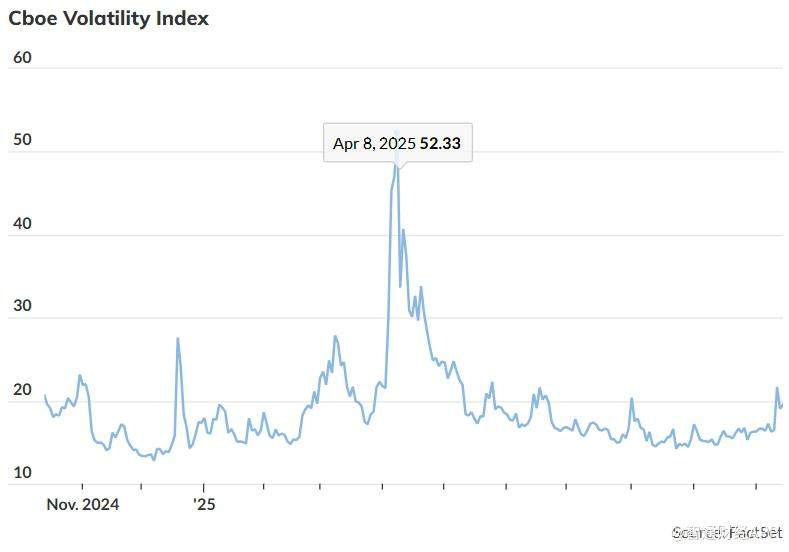
贸易紧张局势升温!华尔街“恐慌指数”飙至近五个月来新高
智通财经网· 2025-10-14 22:30
Group 1 - The VIX, known as the "fear index," surged to 22.94 points, the highest level since May 23, indicating increased investor anxiety over potential escalation in US-China trade tensions [1][4] - The long-term average of the VIX is slightly below 20 points, marking a critical threshold for market sentiment transitioning from calm to tense [4] - Since early September, a divergence between implied volatility and actual volatility has emerged, suggesting that some investors are adopting defensive strategies through options [4] Group 2 - Recent US-China trade tensions have reignited concerns, with President Trump threatening to impose 100% tariffs on all Chinese imports [7] - JPMorgan's CEO warned of credit risks expanding due to losses on loans to a subprime auto lender, indicating instability in the credit market [7] - Institutional investors, including BlackRock, have requested redemptions from a Jefferies fund that suffered significant losses due to the bankruptcy of an auto parts supplier [7]