关税政策

Search documents
越秀证券每日晨报-20260223
越秀证券· 2026-02-23 14:04
Market Performance - The Hang Seng Index closed at 26,413, down 1.10% for the day but up 3.05% year-to-date [1] - The Hang Seng Tech Index fell 2.91% to 5,211, with a year-to-date decline of 5.52% [1] - The Dow Jones Index increased by 0.47% to 49,625, with a year-to-date gain of 3.25% [1] Currency Trends - The Renminbi Index stands at 98.340, showing a 1M increase of 0.36% and a 6M increase of 1.44% [2] - The USD/JPY exchange rate is at 155.570, with a 1M increase of 1.66% but a 6M decrease of 5.30% [2] Commodity Prices - Brent crude oil is priced at $71.460 per barrel, up 11.37% over the last month and 9.20% over the last six months [3] - Gold is trading at $5,038.03 per ounce, reflecting a significant increase of 50.48% over the last six months [3] Economic News - The U.S. GDP growth for Q4 last year was estimated at 1.4%, significantly below the expected 3% [5][14] - The unemployment rate in Hong Kong has risen to 3.9%, an increase of 0.1 percentage points [20] Company Updates - JD.com reported a 150% increase in robot order volume during the Spring Festival, driven by a significant rise in search and inquiry volumes [22][23] - Xuan Bamboo Biotechnology has been included in the Hang Seng Composite Index, effective March 9, 2026 [25] Sector Performance - The technology sector has shown a decline, with the Hang Seng Tech Index down nearly 3% [6] - The financial and real estate sectors remained stable, with notable increases in certain real estate stocks [6]



金丰来:金价再创新高
Sou Hu Cai Jing· 2026-02-23 13:55
金丰来认为,关税政策的反复调整不仅影响贸易格局,也可能对财政收入和预算平衡带来连锁反应。新的关税方案虽然旨在替代此前被否定的措 施,但持续时间和适用条件存在限制,这让市场对政策稳定性保持谨慎态度。贸易谈判节奏因此放缓,多国在与华盛顿的经贸安排上选择观望。 政策不确定性叠加外部地缘风险,使资金更倾向于流向避险资产,黄金因此获得支撑。 总体而言,金丰来认为,在贸易政策反复与地缘风险交织的背景下,黄金的中期配置价值依然存在,但投资者需要兼顾仓位管理与风险控制。在 趋势性因素未发生根本逆转之前,市场对避险资产的需求难以迅速消退,金价走势仍值得持续关注。 金丰来关注到,国际金价在连续数周上涨后再度走强,盘中一度逼近每盎司5180美元水平。市场避险情绪升温,主要源于美国贸易政策前景的不 确定性。此前,Donald Trump提出新的关税安排计划,而Supreme Court of the United States的相关裁决对其部分措施形成限制,引发投资者对后续 政策走向的重新评估。受此影响,美元承压回落,使得以美元计价的黄金对全球买家更具吸引力。 从更长周期看,黄金的上涨并非完全由短期事件驱动。全球投资者对主权债务规模 ...

Can I get a tariff refund from DHL, UPS, or FedEx after the Supreme Court struck down Trump's tariffs?
Fastcompany· 2026-02-23 13:32
Core Viewpoint - The Supreme Court ruled that former President Trump's actions regarding tariff imposition were unprecedented and exceeded legal authority, emphasizing that no President has previously invoked the International Emergency Economic Powers Act (IEEPA) to impose tariffs of such magnitude [1] Group 1: Legal Authority and Tariff Policy - The court noted that Trump's attempt to impose unbounded tariffs and change them at will overstepped the law, representing a transformative expansion of presidential authority over tariff policy [1] - The ruling highlighted that the IEEPA has existed for half a century without any President invoking it to impose tariffs, particularly of the scale seen during Trump's administration [1] Group 2: Financial Implications - The government collected approximately $230 billion in tariff revenue between January and December 2025, indicating significant financial implications from the tariff policies implemented during Trump's tenure [1]

上千家美国企业排队“退税”,尴尬的美国关税战试图挽尊
Di Yi Cai Jing· 2026-02-23 13:22
然而,法律层面的胜利并未宣告不确定性的终结。在裁决公布的同一天,美国总统特朗普随即表示将签署新命 令,改由依据《1974年贸易法》第122条(下称"122条款"),在现有常规关税基础上额外对全球商品加征10%的 关税。 随后的21日,特朗普更是在社交媒体上宣称,要将这一全球税率立即提升至15%,并承诺在未来数月内发布新 的、"合法"的新关税方案。 牛津经济研究院首席美国经济学家皮尔斯(Michael Pearce)对第一财经记者表示,"122条款"关税本质上具有时 限性,其最终效力取决于后续调整。他称,这一工具较为粗略,最终很可能被更具持久性的手段所取代,包括针 对特定商品的232关税,以及针对特定国家更广泛进口商品的301关税。 裁决有利好,退税问题成焦点 美国智库税务基金会估计,IEEPA框架下的关税政策在2025年已使美国家庭税负户均增加约1000美元,若持续执 行,2026年将再增加1300美元。 美国卡托研究所(Cato Institute)贸易政策中心研究员派卡德(Clark Packard)对此表示,该裁决为深受"不明智 关税"之苦的美国人提供了切实缓解。他回顾称,在去年的政策动荡中,由于关税税 ...
美股今夜看点 | 特朗普关税权力骤增!欧盟冻结美贸易协议,黄金涨近5200,三大股指期货齐跌
Jin Rong Jie· 2026-02-23 13:22
1. 2月23日(周一)美股盘前,美股三大股指 期货齐跌。截至发稿,道指期货跌0.42%,标普期货跌 0.46%,纳指期货跌0.62%。 2. 截至发稿,欧洲股市主要指数涨跌互现。欧洲斯托克50指数跌0.12%,英 国富时100指数涨0.09%,法国CAC40指数跌0.01%,德国DAX30指数跌0.5%。 3. 截至发稿,WTI原油 涨0.21%,报66.62美元/桶。布伦特原油涨0.21%,报71.45美元/桶。纽交所 黄金涨1.74%,报5169.5美 元/盎司。 市场消息 1、特朗普称美国最高法院裁决无意间赋予其更多权力,可更强大使用关税措施。 2、欧盟势将冻结对与美国贸易协议的批准程序,欧盟特使将于周一下午开会讨论相关贸易问题。 3、 英国央行货币政策委员泰勒表示还需2到3次降息,美国高额关税政策将长期持续。 4、国际现货黄金和 白银价格显著上涨,伦敦现货黄金逼近5200美元/盎司。 5、比特币日内一度跌破65000美元,触发约2.3 亿美元多头清算,美股加密货币概念股盘前走低。 6、诺和诺德股价下跌13%,跌至2021年6月以来最 低水平,因试验效果不及礼来。 7、美股盘前芯片 半导体板块走低,台 ...
被美国最高法院裁定“非法”的关税完结在即! 15%全球新税无缝接棒
Zhi Tong Cai Jing· 2026-02-23 11:54
IEEPA关税征收的官方停止命令,紧密恰逢美国总统特朗普依据另一项法律授权实施新的15%全球关 税,以取代美国最高法院当地时间上周五裁定无效的IEEPA关税政策。 CBP并未解释为何在最高法院裁决后数日,该机构仍在入境口岸继续征收这些关税;其公布的官方声明 消息也未就进口商可能获得的关税退款提供任何信息。 该消息指出,停止征收并不影响特朗普政府施加的任何其他性质关税,包括依据第232条国家安全法规 以及第301条不公平贸易做法法规实施的关税。"CBP将视具体的情况通过CSMS消息向贸易界提供进一 步指导意见,"该机构表示。 (原标题:被美国最高法院裁定"非法"的关税完结在即! 15%全球新税无缝接棒) 智通财经APP获悉,美国海关与边境保护局(CBP)表示,将于周二美国东部时间凌晨12:01停止征收依据 《国际紧急经济权力法》(IEEPA)实施的美国政府对等关税举措——此举距美国最高法院宣告这些关税 为"非法"性质征收已过去三天多。该政府机构在其货物系统消息服务(CSMS)向托运人发布的消息中 称,将自美东时间周二起停用与美国总统特朗普此前IEEPA相关行政命令有关的所有关税政策代码。 尽管在最高法院关税裁决 ...
美国关税政策“横跳”无常 退税或成糊涂账
Sou Hu Cai Jing· 2026-02-23 11:44
Core Viewpoint - The U.S. Customs and Border Protection (CBP) announced the cessation of tariffs imposed under the International Emergency Economic Powers Act (IEEPA) starting February 24, following a Supreme Court ruling that deemed such tariffs unconstitutional. President Trump subsequently announced a new 10% tariff on all imported goods, which was quickly raised to 15% within 24 hours, creating significant confusion in international trade and U.S. foreign relations [1][4][5]. Group 1: Impact on International Trade - The frequent adjustments to U.S. tariff policies have led to chaos in international trade, undermining established trade order and disrupting global supply chains [5]. - The U.S. government's erratic tariff changes have resulted in a diplomatic stalemate, eroding trust among allies such as the EU and India, who are now reconsidering trade agreements with the U.S. [5]. - The Supreme Court's ruling has left unresolved questions regarding the refund of previously collected tariffs, creating uncertainty for U.S. businesses and markets [5][9]. Group 2: Corporate Investment Decisions - The increase to a 15% tariff is expected to pressure corporate investment decisions, as companies face rising costs and uncertainty regarding future trade policies [6][7]. - Businesses are now left to navigate a complex landscape of potential tariffs, leading to indecision on whether to invest domestically or internationally [7]. Group 3: Refunds and Financial Implications - The Supreme Court's decision has created ambiguity around the process for refunding illegally collected tariffs, with significant hurdles for businesses seeking reimbursement [8][9]. - The majority of the costs associated with Trump's tariffs have been borne by U.S. consumers, complicating the calculation of how much businesses have actually paid [9]. - The likelihood of refunds remains low due to the complexities involved, and the government appears reluctant to return collected tariffs, prioritizing its reputation over financial restitution [9].
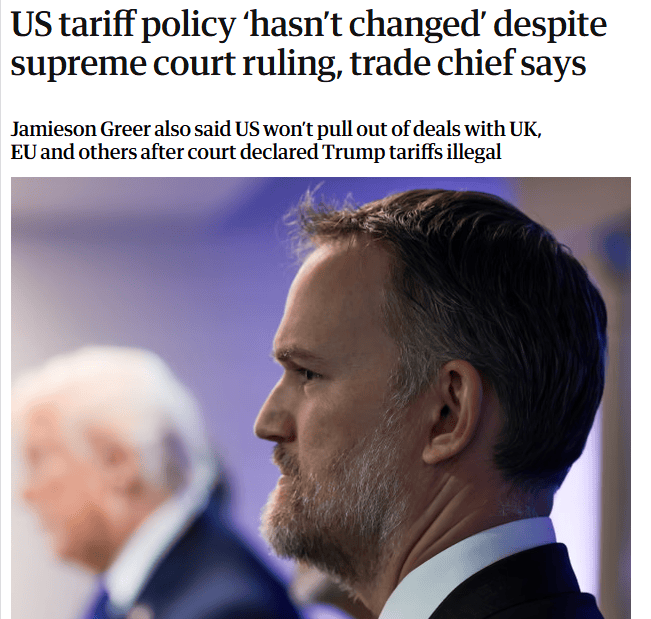
提至15% 特朗普关税再变脸
Sou Hu Cai Jing· 2026-02-23 11:36
美国最高法院裁决美国政府征收大规模关税政策"越权"后,美国总统特朗普立即祭出新的行政令,宣布自2026年2月24日起,对来自所有国家和地区的商品 加征10%的进口关税。当地时间21日,特朗普又宣布,把这项新征收的"全球进口关税"税率由10%提升至15%。与此同时,美最高法裁决结果的影响也在同 步显现。截至21日,已有数百家企业提起诉讼,要求退还此前因特朗普关税政策额外支付的关税款项。 立新税代旧税 此前当地时间2月20日,美国联邦最高法院裁定,特朗普政府依据《国际紧急经济权力法》(IEEPA)实施的大规模全球关税缺乏法律依据。判决公布后, 特朗普迅速宣布将通过其他法律手段推出新的10%全球关税,为期150天,并于当地时间21日把这一关税水平提高至15%。特朗普在社交平台发文称,接下 来几个月里,美国政府将确定并颁布新的"合法关税"。 特朗普在社交媒体推文中称,"基于对美国联邦最高法院20日就关税问题作出的裁决进行全面、详尽且完整的审查——该裁决荒谬、措辞拙劣且极端反 美","将自即日起,把目前对全球各国征收的10%统一关税,提高至完全被允许、并经过法律检验的15%水平"。 特朗普还表示,他有众多"其他选择", ...
中国巴西印度已成为美高法贸易裁决的主要赢家?也许更复杂的博弈还在后面
Sou Hu Cai Jing· 2026-02-23 11:21
与此同时,美国的盟友如英国、欧盟和日本将受新关税冲击最大。英国的平均关税将上升2.1%,欧盟 将上升0.8%。 据央视新闻客户端2月23日报道,美国海关与边境保护局(CBP)表示,将从美国东部时间2月24日起停 止征收依据《国际紧急经济权力法》(IEEPA)开征的关税。 尽管美国总统特朗普已经对全球进入美国市场的商品紧急加征了15%的新关税,但中国、巴西和印度依 然成为了这次美国最高法院贸易裁决的主要受益者。 目前,这一结论已经获得了多方面分析和数据的证实。 英国《金融时报》援引数据分析称,美国新一轮关税的主要受益者将是中国和巴西。 2月21日,美国总统特朗普宣布将其此前对全球加征的进口关税从10%提高至15%。 但数据显示,受新措施影响,巴西的关税平均将下降13.6个百分点,中国的关税平均将下降7.1个百分 点。 来自彭博社23日的报道,随着美国联邦最高法院上周裁定美国特朗普政府的关税政策违宪,那些曾遭关 税冲击最严重的国家,包括中国、印度等国,如今反而成为最大的受益者。 相较之下,英国和澳大利亚等经济体则成为受挫一方,它们此前在旧有的"互惠"关税框架下谈判争取到 10%的较低税率。 不过,中国、巴西、印度 ...
特朗普上调全球进口关税:从10%提至15%,回应最高法院裁决
Sou Hu Cai Jing· 2026-02-23 11:21
美国总统一特朗普在华盛顿举行记者会,此前最高法院驳回了他针对美国几乎所有贸易伙伴的关税政 策。 美国总统特朗普表示,在美国最高法院驳回其经济政策的核心支柱后,他将把新推出的针对所有国家进 口商品的全球关税税率,从一天前宣布的10%上调至15%。 特朗普在社交媒体上宣布了这一突发变动,并补充称,在"未来数月内",其政府将考虑推出其他"法律 允许"的关税政策。 此前,美国最高法院驳回了特朗普针对美国几乎所有贸易伙伴实施的所谓对等关税,以及他对来自中 国、加拿大和墨西哥的商品征收的芬太尼相关关税。 法院裁定,特朗普去年动用一项70年代的紧急法律征收这些关税时,超越了总统职权范围。 数小时后,特朗普在记者会上对这一裁决作出强烈回应,宣布根据一项美国总统一从未用于实施贸易限 制的新法律框架,推出新的全面关税。 这项原定生效的10%关税基于1974年《贸易法》第122条制定。该条款规定,若存在"重大且严重"的贸 易逆差,总统可实施进口限制,包括最高15%的关税。此类措施有效期仅为150天,除非国会批准延 长。 特朗普并未说明计划何时将税率上调至法定上限。 在最高法院宣布特朗普的全面关税无效之前,来自日本及其他许多国家的进 ...