
东升西降

Search documents
押注“东升西降”!桥水最新持仓曝光:爆买阿里加仓百度,砍仓标普500ETF
Zheng Quan Shi Bao· 2025-05-15 14:22
Core Insights - Bridgewater Associates made significant changes to its portfolio in Q1 2023, notably increasing its stake in Alibaba and gold ETFs while reducing its holdings in major tech stocks like Nvidia [1][2][3] Group 1: Portfolio Adjustments - Bridgewater purchased over 5.4 million shares of Alibaba, investing $710 million, making it the largest position in its portfolio [2] - The fund also initiated a position in SPDR Gold ETF, acquiring over 1.1 million shares valued at approximately $319 million, representing 1.48% of its total holdings [2] - In the Chinese stock market, Bridgewater increased its holdings in Baidu by nearly 1.88 million shares and in Pinduoduo by around 500,000 shares, while also establishing a position in JD.com [3] Group 2: Major Sell-offs - Bridgewater significantly reduced its position in SPDR S&P 500 ETF by $2.74 billion, decreasing its weight from 22% to less than 9% of the total portfolio [3] - The fund also cut its holdings in Nvidia by 65,540 shares (18.74%), Google by 579,000 shares (15.99%), and Meta by 19,550 shares (31.47%) [3] - Additionally, Bridgewater almost completely exited its position in AppLovin, which had seen an 18% decline in Q1, and also sold off shares in several other companies including ON Semiconductor and Moderna [4] Group 3: Market Outlook - Bridgewater's founder, Ray Dalio, emphasized the importance of a well-thought-out investment strategy in light of the changing global economic landscape, driven by factors such as debt monetization and international power restructuring [5][6] - Dalio highlighted the critical question of whether the U.S. fiscal deficit can be reduced to 3% of GDP, which will influence the future of debt and currency value [5]



【寻访金长江之十年十人】星石投资江晖:内需空间广阔,消费是未来10年大趋势
券商中国· 2025-05-14 07:36
Core Viewpoint - The article emphasizes the ongoing dual easing policies in China, focusing on domestic demand and consumption as the main investment strategy for the next decade, while highlighting the resilience of the Chinese economy against external pressures [2][4][7]. Group 1: Investment Strategy - The future investment strategy in A-shares will focus on "domestic demand as king, emphasizing consumption," which is seen as a major trend for the next 10 years [2][8]. - The multi-fund manager team system at Star Stone Investment has been successfully implemented for 10 years, allowing for high portfolio operation without significant market timing, achieving effective volatility control [2][16]. - The "fund manager secondary recommendation mechanism" encourages collaboration among fund managers, enhancing the quality of investment decisions [2][15]. Group 2: Economic Context - The U.S. faces significant fiscal pressure with a national debt of $36 trillion, leading to challenges in balancing economic growth and deficit reduction [3]. - China has prepared adequately for external economic pressures, with a diversified industrial layout and significant technological advancements reducing previous vulnerabilities [4][6]. - The current broad deficit rate in China may reach 8.4%, comparable to the pandemic period, indicating strong policy responses to economic challenges [7]. Group 3: Market Trends - The narrative of "East rising, West declining" is gaining traction, with capital flows shifting from the U.S. to China, driven by technological breakthroughs and supportive policies [5][6]. - The consumption sector is expected to see significant growth, with the potential for the proportion of household consumption in GDP to rise from around 40% to 70% over the next 10-20 years [8][10]. - Key investment themes include consumer services, high-growth consumer goods, innovative pharmaceuticals, and AI-driven applications, all poised for recovery as the economy improves [10][11].

“美国例外论”崩塌声中,全球股市踏向新纪元:欧洲携南美齐飞,中国异军突起
智通财经网· 2025-05-09 10:50
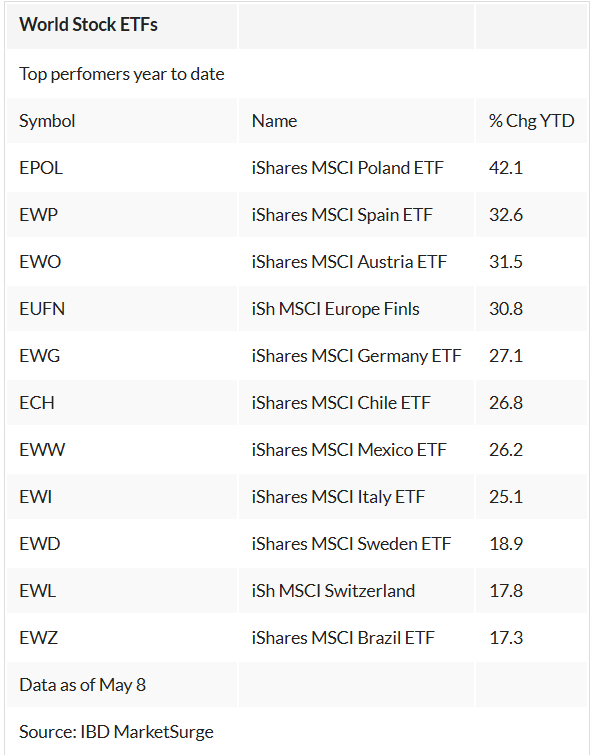
Group 1: Market Performance - The U.S. stock market is showing signs of weakness, with the S&P 500 and Nasdaq 100 indices down approximately 3% and 6% respectively this year, while many foreign markets, including Germany, Poland, Spain, and Brazil, have seen increases of up to 20% [1][2] - ETFs tracking foreign markets have outperformed U.S. indices, with many showing gains exceeding 20% [1] - The MSCI Emerging Markets Index has lagged behind the S&P 500 by an average of 3.8 percentage points every 100 days since 2015, but this year, the trend is reversing as foreign markets rise [4][5] Group 2: Investment Strategies - Investors are increasingly recognizing the value of geographic diversification, moving away from the "American exceptionalism" narrative that dominated for over a decade [2][3] - The shift in focus towards overseas markets is driven by lower valuations and more aggressive stimulus measures in countries like Germany compared to the U.S. [2][3] - Financial giants like BlackRock are advising investors to look beyond U.S. tech giants and consider European value stocks and Asian AI innovators [3] Group 3: Economic Factors - The uncertainty surrounding U.S. trade policies, particularly under the Trump administration, is contributing to a decline in investor confidence in the U.S. economy, leading to a weakening dollar and a shift towards foreign assets [5][7] - The European Central Bank has been more aggressive in its monetary policy compared to the Federal Reserve, providing a more favorable economic outlook for Europe [9][10] - Increased military spending in Europe is also seen as a significant driver for the region's stock market performance, with defense stocks gaining substantial investment [10][11] Group 4: Emerging Markets - China’s stock market is outperforming the U.S. market, with the Hang Seng Index up 13.5% and the Hang Seng Tech Index up 16% this year [20][22] - The rise of Chinese tech companies, particularly in AI, is attracting global investor interest, with DeepSeek leading a new paradigm in low-cost AI training and inference [22][23] - The influx of capital from the U.S. to China is expected to continue as investors seek better valuations and growth potential in the Chinese market [24]
“相对论”的世界
Jing Ji Guan Cha Bao· 2025-05-06 09:38
Group 1 - The announcement of global tariffs by Trump has led to a significant decline in the U.S. stock market and a depreciation of the dollar, indicating a shift away from the old order of globalization and free trade [1][2] - The current geopolitical climate highlights China's stability and development as increasingly valuable in contrast to the chaos in the U.S. and other regions [1][2] - The ongoing trade war and the impact of DeepSeek have exposed the undervaluation of Chinese high-tech companies, which are now being recognized as potential investment opportunities [2][3] Group 2 - The U.S. is facing a crisis in its ability to build and maintain infrastructure, as exemplified by the prolonged delays and budget overruns in simple projects like the renovation of a skating rink in New York [5][6][7] - The inability of the U.S. government to effectively manage public projects is attributed to excessive regulation and a lack of coordination among contractors, leading to inefficiencies [5][6][11] - The contrast between the U.S. and China in infrastructure development is stark, with China demonstrating a "can-do" attitude that allows for rapid project completion, such as the high-speed rail between Beijing and Shanghai [3][8] Group 3 - The structural issues in the U.S. economy are highlighted by the increasing difficulty in providing essential public goods like housing, education, and healthcare, which are critical for the working class [10][18] - The decline in social mobility in the U.S. has resulted in a more rigid class structure, making it harder for individuals to improve their economic status [14][16] - The need for the U.S. to learn from China's approach to economic development is emphasized, particularly in terms of enhancing government capabilities to provide public goods and stimulate domestic consumption [18][21]
徐小庆 贸易战
2025-04-23 07:56
Summary of Conference Call Notes Industry or Company Involved - The discussion primarily revolves around the U.S. economy, inflation, tariffs, and the implications for the stock market and government debt. Core Points and Arguments 1. **Low Probability of Inflation Due to Tariffs**: The likelihood of a second wave of inflation in the U.S. due to tariffs is low, as imported goods account for only 16% of consumer spending, and goods only represent 25% of the core CPI, with services dominating at 75% [1][17][13]. 2. **Economic Recession Concerns**: The potential for a "deep" recession is linked to private sector leverage during prosperous times, rather than tariffs. Current government debt expansion does not indicate a private sector crisis [1][31]. 3. **Trump's Focus on Bond Yields**: Trump's actions suggest a concern for U.S. Treasury yields rather than stock market performance, especially following a significant rise in bond yields [1][35]. 4. **Historical Context of Tariffs and Inflation**: Historical analysis indicates that high tariffs in the 1930s did not lead to inflation, as consumer income did not rise correspondingly, leading to a reduction in other spending [5][7]. 5. **Impact of Globalization**: The slowing of globalization since 2018 has diminished the U.S. economy's influence on the global economy, leading to a weaker dollar and underperformance of U.S. stocks compared to other markets [2][52][56]. 6. **Service Consumption Impact**: Rising commodity prices primarily affect service consumption, as consumers may cut back on services when faced with higher prices for goods [58]. 7. **Debt Dynamics**: The current trajectory of U.S. government net interest payments is increasing at a rate faster than in the 1980s, raising concerns about fiscal sustainability [39][38]. 8. **Future Corporate Debt Maturities**: A significant amount of corporate debt is set to mature starting in 2025, which could impact market dynamics [42]. Other Important but Possibly Overlooked Content 1. **Consumer Spending Dynamics**: The rigid nature of consumer spending on goods means that even if tariffs increase prices, overall consumption may not rise significantly due to income constraints [13][5]. 2. **Historical Precedents of Economic Downturns**: The analysis of past economic downturns shows that significant declines in the S&P 500 often correlate with private sector leverage and government debt dynamics [29][31]. 3. **Global Economic Interdependence**: The increasing reliance of economies on domestic fiscal measures rather than global trade could lead to greater divergence among nations [60]. 4. **Comparison with Japan's Economic History**: The historical performance of Japan's stock market during its economic challenges offers insights into potential future trends for the U.S. market [63][64].
“东升西降”:我的美国见闻
Hu Xiu· 2025-04-20 12:27
Group 1 - The article discusses the contrasting investment sentiments between the Chinese and US markets, highlighting the optimism in the A-share market and the struggles of the Nasdaq index [1] - The author shares personal experiences in the US, particularly in New Jersey and Las Vegas, providing insights into local economic conditions and consumer behavior [2][4] Group 2 - The transportation sector is emphasized, with a focus on the prevalence of car usage in the US, contrasting with public transport in China, which affects living space and commuting patterns [32] - The article notes the impact of Tesla's Full Self-Driving (FSD) technology on the transportation market, with concerns about potential job losses in the ride-sharing industry [5][9] Group 3 - Food prices in the US are analyzed, with specific examples from Costco, indicating that while prices have risen, they are not as severe as reported [10][11] - The article compares the cost of living in New Jersey with other regions, noting that housing costs are significant but manageable relative to income levels [23][24] Group 4 - The real estate market in New Jersey is described as a seller's market, with rising home prices and a median listing price of approximately $560,000 [24][31] - The article discusses the implications of remote work on housing choices, suggesting a shift in where people choose to live based on affordability and quality of life [36] Group 5 - The author reflects on the cultural differences between the US and China, particularly in consumer behavior and lifestyle choices influenced by transportation methods [33][34] - The article concludes with observations on the everyday lives of ordinary people in the US, emphasizing the simplicity and directness of their experiences [45][46]



中银证券全球首席经济学家管涛:美国经济“滞胀”风险增加 对美元信用深度担忧显现
news flash· 2025-04-14 03:01
Core Viewpoint - The risk of "stagflation" in the US economy is increasing, with deep concerns about the creditworthiness of the US dollar emerging due to aggressive tariff policies [1] Group 1: Economic Impact - The aggressive tariff policies under Trump's administration are disrupting the global situation, with the US economy and financial markets being the most affected [1] - The recent decline in US Treasury prices over five consecutive days has led to a cumulative increase of nearly 50 basis points in the 10-year Treasury yield, reaching 4.48%, marking the largest weekly increase since 2002 [1] Group 2: Market Reactions - The US dollar index has experienced a significant drop, with foreign institutions like Goldman Sachs shifting to a bearish outlook on the dollar's performance [1] Group 3: Comparative Analysis - In contrast, China's economic fundamentals, policy support, and valuation advantages are expected to continue driving the "revaluation of Chinese assets," reinforcing the narrative of "the East rising and the West declining" [1]


对等关税之后,特朗普将重启什么?
李迅雷金融与投资· 2025-04-10 11:10
(转载请注明出处:微信公众号 lixunlei0722 ) 引 言 "风乍起,吹皱一池春水"。4月3日,特朗普政府一纸关税新政再次搅动全球资本市场。与五年前不同,这一 次美国政府高调宣布启动"对等关税",对全球主要经济体再次加征高额关税。 4月4日,中国国务院关税税则 委员会宣布对原产于美国的所有进口商品加征34%的关税。受此冲击,全球资本市场迅速作出剧烈反应,标 普500指数两日累计下跌逾10%,创下自2020年3月疫情初期以来最大两日跌幅,欧洲及亚太市场主要股指也 齐齐重挫。 "山雨欲来风满楼"。 4月9日, 美国正式落地对中国加征的 50% 关税,累计税率达到 104% 。随即中国反 制,迅速追加对美关税至 84% 。直至10日凌晨,特朗普宣称对中国税率提高至 125% 。 表面看,"对等关 税"似乎不过是美国政府在贸易博弈中的又一次强硬施压,但深究其本质,这更可能是特朗普政府在"制度层 面"发起的一次路径变革。 历史表明,当国际制度收益不再普遍共享时,变革的动力往往来自制度外部的极限冲击。特朗普的关税举措正 代表了这一类型的外部冲击——其看似政策博弈的外表之下,暗藏的是全球资本秩序重塑的制度锚点。 本 ...
中信建投:美国加征关税力度超市场预期,关注年报季回归基本面、关注国内增量政策把握政策节奏
Sou Hu Cai Jing· 2025-04-07 00:16
当地时间4月2日,美国总统特朗普在白宫宣布对贸易伙伴征收所谓的"对等关税"措施。特朗普展示的图 表显示,美国对中国实施34%的对等关税,对其他多个国家征收10%以上税率不等的关税。美国定于5 日开始对所有贸易伙伴加征10%的"最低基准关税",对某些贸易伙伴征收更高的"对等关税",这些措施 将于9日生效。此次关税措施力度超出市场预期,引发市场广泛关注。 尽管美国加征关税力度较大,但从4月3日A股市场表现来看,市场整体情绪好于预期,显示出较强的韧 性。尽管出海导向板块受到明显冲击,但A股整体情绪稳定,未出现大幅波动,反而美股出现连续暴 跌,这进一步凸显了"东升西降"的趋势。重点观察周一市场走势,如果能够上行或至少横盘,说明市场 情绪已基本稳定,除出海板块外,其他板块无需过度悲观。 当前正值年报季,4月是全年最贴近基本面的时期,市场风格将阶段性从关注预期向关注基本面业绩转 化。投资者将更加关注企业的实际业绩表现,这有助于稳定市场情绪,减少因贸易摩擦带来的短期波 动。建议投资者关注业绩稳定、具有核心竞争力的企业,特别是在国内市场需求旺盛的板块中寻找机 会。同时,引导市场资金流向业绩优良的企业,通过优化上市公司结构,提 ...

【川普为什么敢胡言乱语】
债券笔记· 2025-04-05 05:20
转发一篇小文章"川普为什么敢胡言乱语",这篇文章所举的现实案例生动地揭示了全球正在经历一轮50-60年"康波周期"的底部,这是老人政治下掌权一 代对50-60年前峥嵘岁月的怀念,是对曾经荣耀的怀旧。 《川普为什么敢胡言乱语》 2025.3.20 我妈是邮政局职工,九几年的时候她去郊区仓库批发杂志书籍,然后用单位平台去零售,一个月就能赚六七千。 我舅是电信局的,邮电刚分家那会儿,他们去给人装电话,装交换机,人户主不但要好烟好茶的伺候着,而且平均每装一台他都能得1000块钱,那可是二 十多年前啊。 还有当年国企的货车司机,跑一趟长途都有人求他捎东西去外地,顺便给他车里塞几条华子或者两瓶茅台啥的,吃喝住全部单位报销,小日子赛神仙,比 公务员还快活。 只是美国刚开始,我们刚来过。 全球化的协作分工、市场化的资源配置都是人类社会发展的必然选择,无论谁,打着什么旗号,最终都会头破血流,重回正轨。 反思后的再出发傲慢下的瞎折腾; 东升西降。 但随着中国的快速发展,以上这些红利都不复存在,我妈现在有时候看到"中通""京东"这些物流公司都会吐槽几句,说这些人把邮政的饭碗都给抢了。 还有经典的300多岁老人领社保,其实那是个系统 ...