优质优价

Search documents
上市半月销售超5000公斤 江心洲上“红美人”唱响丰收曲
Zhen Jiang Ri Bao· 2025-12-11 23:32
Core Viewpoint - The "Hong Meiren" citrus variety is experiencing a successful harvest and sales season, showcasing the effectiveness of modern agricultural practices in enhancing traditional citrus production [1][2]. Group 1: Production and Yield - The "Hong Meiren" citrus began sales in late November, approximately 10 days earlier than the previous year, with overall production showing a significant increase [1]. - Each tree yields between 17.5 to 20 kilograms, with an average yield of about 1250 kilograms per mu (approximately 0.067 hectares) [1]. - The total sales volume has exceeded 5000 kilograms within the first half month of sales, with average sales per mu exceeding 40,000 yuan [1]. Group 2: Quality and Growth Conditions - The "Hong Meiren" citrus is characterized by its juicy texture, rich flesh, vibrant color, thin skin, and high sugar content, making it a premium product [2]. - The cultivation employs organic fertilizers and innovative techniques to enhance soil quality and reduce chemical pesticide use, ensuring a healthier growth environment [2]. - The sales strategy includes timing the market entry to avoid competition with other regions, allowing for premium pricing [2]. Group 3: Market and Sales Strategy - The sales period for "Hong Meiren" citrus is expected to last until just before the Spring Festival, with measures in place to maintain quality during colder weather [3]. - The customer base primarily consists of repeat buyers, indicating strong brand loyalty and product satisfaction [2].
优质优价,让市场有效运行
Xin Hua Wang· 2025-12-10 23:35
拒绝"内卷式竞争",构筑健康市场生态—— 优质优价,让市场有效运行 消费者更加看重品质与体验,愿意为"值得"买单;越来越多的企业从"价格战"中抽身,潜心于技 术、质量与品牌;日益完善的营商环境,则为"优者胜出"提供了舞台……从一味强调低价,到注重优质 优价,中国市场正经历一场重要的转变。 "十五五"规划建议明确提出,"形成优质优价、良性竞争的市场秩序"。在多位专家看来,这是纵深 推进全国统一大市场建设的重要要求,意味着今后5年,中国将着力引导和保障市场竞争聚焦于价值创 造,通过价格信号有效激励创新与提质,从而为构建新发展格局、增强经济内生动能奠定更坚实的市场 基础。 从"卷价格"转向"优价值" 如何理解优质优价? "优质优价是'十五五'规划建议中提出的一个新要求,具有鲜明的时代特征和指导意义。"许光建 说。优质优价是市场经济有效运行的基本要求。竞争是市场经济的本质特征,合理的价格机制是市场竞 争机制发挥作用、激发市场活力和增强发展动力的前提和基础。随着我国经济社会发展进入新阶段,生 产者将生产出质量更加优异的产品,越来越多的消费者也会购买高质量的产品。 优质优价写入国家发展规划建议,体现了当下怎样的变化? 消 ...
优质优价,让市场有效运行(这些新提法,写入“十五五”规划建议⑧)
Ren Min Ri Bao Hai Wai Ban· 2025-12-10 23:01
Core Viewpoint - The Chinese market is undergoing a significant transformation from a focus on low prices to an emphasis on quality and value, as consumers increasingly prioritize quality and experience over mere cost savings [6][10][11]. Group 1: Consumer Behavior Changes - Consumers are shifting their purchasing criteria from "absolute low prices" to safety, quality, and service, indicating a rational pursuit of a better quality of life [7][10]. - The middle-income group is expanding, and Generation Z is becoming the main consumer force, focusing more on quality, health, experience, and emotional resonance [10][14]. Group 2: Industry and Market Dynamics - Many companies are moving away from price wars and are instead focusing on technology, quality, and brand development [6][12]. - The "Fifteen Five" plan emphasizes the creation of a market order that prioritizes quality and fair competition, which is essential for fostering innovation and enhancing economic vitality [6][8][11]. Group 3: Implications for Business - Companies are encouraged to adopt a "quality over price" strategy, which can lead to higher customer satisfaction and loyalty, even if it results in lower foot traffic compared to low-price competitors [12][13]. - The integration of quality standards and branding can help businesses focus on producing high-quality products while ensuring fair compensation for producers [7][13]. Group 4: Regulatory and Policy Framework - The market regulatory authority is actively implementing policies to combat "involution" in competition, including holding discussions with businesses and enforcing fair competition practices [15][16]. - Experts suggest that breaking down local protectionism and enhancing market access for high-quality products are crucial for achieving a balanced market environment [16][17].

国投期货农产品日报-20251128
Guo Tou Qi Huo· 2025-11-28 11:13
Report Industry Investment Ratings - Soybeans: ☆☆☆, indicating a relatively clear long - term trend with a current appropriate investment opportunity [1] - Palm Oil: ★★★, representing a more distinct long - term trend and a current appropriate investment opportunity [1] - Soybean Meal: ☆☆☆, showing a relatively clear long - term trend and a current appropriate investment opportunity [1] - Rapeseed Oil: ★★★, meaning a more distinct long - term trend and a current appropriate investment opportunity [1] - Rapeseed Meal: ★★★, suggesting a more distinct long - term trend and a current appropriate investment opportunity [1] - Corn: ★★★, indicating a more distinct long - term trend and a current appropriate investment opportunity [1] - Live Pigs: ★★★, representing a more distinct long - term trend and a current appropriate investment opportunity [1] - Eggs: ☆★☆, meaning a clear upward - looking trend and the market is developing [1] Core Views - The overall agricultural product market is in a state of complex supply - demand and price fluctuations, with different products having different influencing factors and development trends. Short - term and medium - term factors such as export, weather, and policy need to be continuously monitored [2][3][4] Summary by Related Catalogs Soybeans - Domestic soybeans are de - stocking, with stable spot prices. The new - crop domestic soybeans follow the principle of good quality at a good price. The price difference between domestic and imported soybeans fluctuates horizontally. Imported soybeans are volatile, and short - term attention should be paid to US soybean exports, while medium - term attention should be on South American weather [2] Soybeans and Soybean Meal - US soybeans are on holiday. The main contract of Dalian soybean futures is shifting from 01 to 05, with prices fluctuating. Brazil's 2025/26 soybean production is expected to reach a record 178.1 million tons. Argentina's soybean planting progress is slow. The domestic soybean supply is sufficient, with increased crushing volume and rising soybean meal inventory. The M2605 contract has reached the upper edge of the shock platform, and its upward breakthrough depends on US soybean exports and South American weather [3] Soybean Oil and Palm Oil - The high - frequency data of Malaysia's palm oil export market is still poor, and Indonesia's inventory increased slightly in September. The overseas supply - demand of palm oil is weak, but the marginal negative factors have eased. The output of palm oil in November 1 - 20 is expected to increase by 3.24% month - on - month. Soybean oil has a de - stocking rebound. Short - term attention should be on US soybean exports, and medium - term on South American weather [4] Rapeseed Meal and Rapeseed Oil - The positions of near - month contracts of rapeseed futures are decreasing, and prices are slightly falling. Canada's rapeseed export is poor, and domestic attention is on Australian rapeseed customs clearance and crushing. The short - term driving force of rapeseed is not significant, and a wait - and - see strategy is recommended [6] Corn - Corn futures are in a wide - range shock at a high level. North port corn prices are firm, and Northeast farmers are reluctant to sell. The quality of North China corn is poor, and the market is worried about Northeast corn supply and transportation. The downstream inventory is low, and the replenishment willingness has increased. New grain is in the peak release period, and attention should be paid to the Sino - US trade agreement, Northeast grain sales progress, and expired wheat auctions. The 01 contract of Dalian corn futures is technically strong, and it is recommended to wait and see first [7] Live Pigs - Live pig futures are weakly volatile, and spot prices continue to decline slightly. The demand for curing and sausage - making in the South will gradually start, but there is also pressure on the supply side. Historically, the bottom of the pig cycle is mostly in a double - bottom "W" shape, and it is expected that pig prices will likely have a second bottom in the first half of next year [8] Eggs - Egg futures are rising sharply, and capital is pushing up the far - month contracts. The spot price in Hebei has increased slightly. In the long - term, the egg industry's inventory is expected to decline, but the current spread between near - and far - month contracts is too large, so chasing the rise is not recommended [9]
让阳澄湖大闸蟹“金字招牌”越来越亮
Bei Ke Cai Jing· 2025-11-28 03:56
Core Viewpoint - The Yangcheng Lake hairy crab industry is undergoing a transformation from "disorder" to "order," with a focus on quality and brand protection through various new measures and regulations [1][5][25]. Group 1: Industry Development and Measures - The brand value of Yangcheng Lake hairy crab has reached 28.2 billion yuan, and the industry association is committed to maintaining quality advantages amid increasing competition [5][25]. - The association has implemented over 90% of the measures outlined in the 2025 development plan, including promoting high-quality ecological farming and establishing a comprehensive regulatory framework [6][20]. - A "five-in-one" anti-counterfeiting traceability system has been introduced, allowing consumers to verify the authenticity of products through various means [10][14]. Group 2: Regulatory and Service Enhancements - The establishment of local offices aims to provide precise services to members and enhance regulatory efficiency, addressing previous challenges faced by farmers [7][20]. - A new "circuit breaker mechanism" limits the number of crabs per acre to 600, ensuring sustainable farming practices and preventing misleading sales tactics [22][23]. - The association has developed a strict membership and regulatory framework, including a 14-point penalty system for violations to ensure quality control [24][25]. Group 3: Brand Protection and Market Expansion - The association has taken significant steps to combat counterfeit products and improve the industry's image, emphasizing the importance of quality over price competition [8][9][21]. - Yangcheng Lake hairy crab has begun exporting to Southeast Asian markets and is actively pursuing international brand protection and market expansion [26][27]. - Future plans include enhancing private channel regulation, developing deep processing capabilities, and increasing international visibility [26][27].

我国消费品供给进入优质优价新发展阶段
Ren Min Wang· 2025-11-28 00:22
Core Viewpoint - The Chinese government has issued a plan to enhance the adaptability of consumer goods supply and demand, aiming to promote consumption and address structural mismatches in the market [1][4]. Group 1: Current State of Consumer Goods - The total variety of consumer goods in China has reached 230 million, with over 100 categories such as home appliances and furniture leading global production [2]. - The quality of consumer goods has improved significantly, with a compliance rate of over 96% for major products meeting domestic and international standards [2]. - High-end domestic products are increasingly favored, with a market penetration rate of 85% for 4K ultra-HD smart TVs and 98% for energy-efficient variable-frequency air conditioners [2]. Group 2: Structural Issues and Future Goals - Despite advancements, there are still structural mismatches in supply and demand, particularly in high-end brands for jewelry, bags, and cosmetics, as well as personalized products for the elderly and smart terminals [3]. - By 2027, the plan aims to optimize the supply structure, creating three trillion-yuan consumer sectors and ten hundred-billion-yuan consumption hotspots, including elderly products and smart connected vehicles [4]. - The goal is to transition from quantity to quality in production, addressing mismatches in consumer desires and resource allocation [4]. Group 3: Targeted Consumer Needs - The focus is shifting from mere availability of products to their quality, with an emphasis on diverse consumption scenarios [5]. - Key tasks include enhancing the supply of baby products, quality student supplies, fashionable items, and products tailored for the elderly [5][6]. - The government aims to promote large-scale consumption and upgrade the market by reforming the automotive sector and fostering green and smart home consumption [6]. Group 4: Regulatory and Quality Assurance Measures - The market regulatory authority plans to strengthen the quality and safety governance of consumer goods, ensuring a high-quality development-oriented standard system [7]. - Continuous monitoring and enforcement actions will be taken to maintain consumer confidence and improve the supply of quality products [7].
农产品日报-20251126
Guo Tou Qi Huo· 2025-11-26 12:38
Report Industry Investment Ratings - Soybean: ☆☆☆ [1] - Soybean Oil: ☆☆☆ [1] - Palm Oil: ☆☆☆ [1] - Soybean Meal: ☆☆☆ [1] - Rapeseed Oil: ☆☆☆ [1] - Rapeseed Meal: ☆☆☆ [1] - Corn: ☆☆☆ [1] - Live Pigs: ☆☆☆ [1] - Eggs: ☆☆☆ [1] Core Views - The soybean market needs to focus on US soybean exports in the short - term and South American soybean产区 weather in the medium - term. For soybean meal, wait for the end of the correction and look for buying opportunities after stabilization. Palm oil's marginal changes may trigger short - covering, and soybean oil is affected by US soybean prices. The short - term driver of the rapeseed sector is not obvious, and it is recommended to wait and see. The corn market should pay attention to the new grain sales progress in the Northeast and the auction of overdue wheat. The live pig industry's capacity reduction supports far - month futures prices, and the egg market's medium - term supply pressure is expected to ease [2][3][4][6][7][8][9]. Summary by Related Catalogs Soybean - The domestic soybean main contract is reducing positions and prices are correcting. The new domestic soybean market features high - quality, high - price. The price difference between domestic and imported soybeans fluctuates. Short - term focus on the domestic soybean spot market and policy guidance, and also pay attention to US soybean exports in the short - term and South American weather in the medium - term [2]. Soybean & Soybean Meal - The domestic soybean supply is sufficient and the crushing volume has increased. Last week, the domestic oil mill soybean crushing volume exceeded 2.3 million tons, and the soybean meal inventory of major oil mills rose above 1.1 million tons. South American new - season soybeans are affected by La Nina, with slow planting progress. Wait for the signing of the new Sino - US economic and trade agreement and look for buying opportunities after the correction [3]. Soybean Oil & Palm Oil - The marginal negative factors in the palm oil market have eased. MPOA expects a 3.24% month - on - month increase in production from November 1 - 20, much lower than the previous forecast. The basis of palm oil in East China has strengthened slightly. The price difference between soybean oil and palm oil has turned positive and strengthened. Palm oil's changes may trigger short - covering. Soybean oil is affected by US soybean prices [4]. Rapeseed Meal & Rapeseed Oil - Domestic rapeseed futures prices have risen slightly, mainly following the rise of foreign oil prices. Canadian rapeseed crushing demand is high, but the export demand trend is hard to reverse. The import of Australian rapeseed has profit potential. The short - term driver of the rapeseed sector is not obvious, and it is recommended to wait and see [6]. Corn - Corn futures rose and then fell today, interrupting the upward trend. The spot price of Northeast corn is firm, while that of North China is weak. The price difference between the two regions has widened. The downstream corn inventory is low, and the replenishment intention has increased. Wait for the signing of the Sino - US trade agreement and pay attention to the new grain sales progress in the Northeast and the auction of overdue wheat [7]. Live Pigs - In October 2025, the inventory of breeding sows decreased to 39.9 million, a 1.1% month - on - month decline. The industry's capacity reduction supports far - month futures prices. The spot price of live pigs continues to decline. The demand for curing and sausage - making in the South will gradually start, but there is also pressure from the second - fattening pigs. It is expected that the pig price may form a second bottom in the first half of next year [8]. Eggs - Egg futures continue to increase positions, and the far - month contracts have risen significantly. Since July this year, the chick replenishment volume has declined sharply. The number of newly - laid hens will decrease, and the number of old hens to be culled will increase. The medium - term supply pressure of the egg market is expected to ease. The short - term near - month contracts will focus on the convergence of the spot - futures price difference [9].
咖啡豆价格创历史新高,云南咖啡豆的机遇要来了吗?
Tai Mei Ti A P P· 2025-10-29 04:27
Core Insights - The price of Yunnan coffee has reached historical highs, with fresh fruit procurement prices peaking at 10 yuan per kilogram, and coffee bean prices surpassing 60 yuan per kilogram by February 2025, driven by global market dynamics and domestic consumption growth [2][3][6]. Price Trends - Yunnan coffee prices have seen a significant increase, with prices rising from 14.78 yuan per kilogram in 2018 to approximately 66 yuan per kilogram in 2025 [6]. - The price of Arabica coffee futures in New York has reached a record high of 4.36 USD per pound, influenced by adverse weather in Brazil, which is the world's largest coffee producer [3]. Market Dynamics - The Chinese coffee market is expanding rapidly, with the industry scale projected to reach 313.3 billion yuan in 2024, reflecting an 18.1% year-on-year growth [3]. - Yunnan coffee accounts for 98% of China's total coffee production, benefiting from a growing domestic market and geopolitical trade fluctuations [3][6]. Quality Improvement Initiatives - Starbucks has implemented a "quality for price" strategy in Yunnan, which has significantly improved the quality of coffee beans and increased farmers' incomes [5][6]. - By 2024, the area planted with coffee in Yunnan reached 1.1931 million acres, with a total production of 150,200 tons, marking a 4% increase in planting area and a 3% increase in production year-on-year [6]. Future Prospects - Starbucks plans to incorporate high-quality Yunnan coffee beans into every cup of classic espresso sold in mainland China, indicating strong future demand [7]. - The Yunnan coffee industry is at a turning point, focusing on not just increasing production but also enhancing the quality and variety of coffee beans [10].


【财经分析】产区新季大豆上市:价格稳中有涨 “优质优价”格局凸显
Xin Hua Cai Jing· 2025-10-24 08:45
Core Viewpoint - The soybean market in Heilongjiang, China's main soybean production area, is experiencing a clear differentiation in supply and demand, with low-protein soybeans being abundant while high-protein soybeans are in tight supply, indicating a trend towards quality-oriented production [1][4]. Group 1: Market Dynamics - The domestic soybean spot market is showing a stable yet slightly strengthening trend, with farmers reluctant to sell and traders actively purchasing, leading to higher prices at the grassroots level [2]. - The current purchase price for soybeans in Northeast China ranges from 1.75 to 2.20 yuan per jin, with prices for high-protein soybeans exceeding 2.3 yuan per jin [2]. - As of now, the soybean harvest in Heilongjiang for the 2025 season is nearly complete, with a progress rate of 98%-99% [2]. Group 2: Policy Support - Policy incentives are boosting farmers' enthusiasm for soybean planting, with an expected stable planting area of over 68 million acres in Heilongjiang, accounting for approximately 47% of the national total [3]. - Various subsidies are provided to support soybean production, including direct subsidies, crop rotation subsidies, and production subsidies, which collectively enhance the production capacity [2]. Group 3: Quality and Pricing - There is a notable contrast in profitability between high-quality and lower-quality soybeans, with high-quality soybeans yielding significantly higher profits [4]. - The market is signaling a preference for high-quality soybeans, which is driving traders to prioritize the purchase of these products, thereby increasing overall soybean prices [4]. Group 4: Future Market Outlook - The future soybean market will be influenced by the interplay between the pressure of new grain entering the market and the demand for storage improvement [5]. - Key variables affecting the long-term market trends include state reserve pricing, progress in China-U.S. trade negotiations, and fluctuations in the futures market [6].
优质优价、“更营养、更健康”……夏粮收购亮点频现 端稳端牢“中国饭碗”
Yang Shi Wang· 2025-09-15 05:43
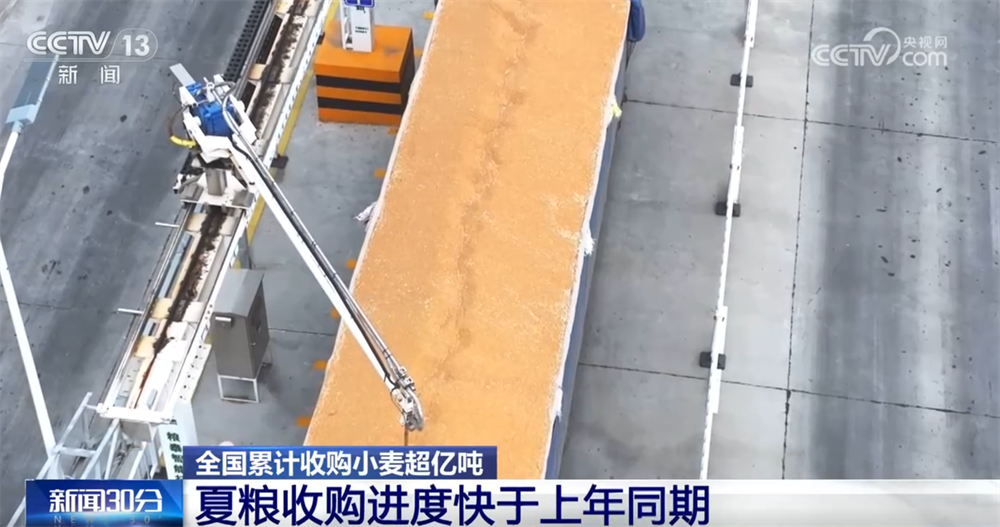
Group 1 - The core viewpoint is that wheat procurement in China has started strong this year, with over 100 million tons purchased, maintaining a high level of procurement [1] - Wheat prices have remained stable, with a clear trend of higher prices for quality wheat, supported by minimum purchase price policies [3][5] - The wheat market is expected to become more active as traditional peak consumption seasons approach, particularly with the upcoming Mid-Autumn Festival and National Day [5] Group 2 - The grain processing industry in China has seen its output value exceed 4 trillion yuan, indicating a significant growth in the sector [7] - There are currently 68,000 grain emergency guarantee enterprises in the country, reflecting an enhanced capacity for grain security [7] - New types of grain and oil products aimed at being "more nutritious and healthier" have been launched, showcasing innovation in the industry [7]