化债政策

Search documents
【广发•早间速递】化债政策持续加码,重视高股息方向
Sou Hu Cai Jing· 2025-10-23 00:01
Group 1: Baijiu Industry Analysis - The baijiu industry experienced a four-year adjustment period, with expectations for a "valuation + performance" double bottom by 2025, indicating improved investment attractiveness due to high dividend yields compared to ten-year government bond yields [3] - From 2012 to 2014, the performance of baijiu stocks was influenced by quarterly earnings reports, with 2012 showing a divergence between industry performance and stock prices, while 2013 saw earnings as a key driver for stock performance [2] - In 2014, as the industry continued to stabilize, marginal changes in market conditions became the core catalyst for stock prices, with stable earnings expectations leading to excess returns for companies that did not further downgrade their earnings [2] Group 2: Consumer Goods Sector Insights - The consumer goods sector is undergoing channel transformations, with consumers increasingly seeking "value for money + high value," prompting companies to focus on price-performance ratio, health, convenience, and functionality [3] - The overall trend in the consumer goods market remains stable, with beer sales holding steady, dairy products showing a decline, and beverage growth continuing [2] - The performance of snacks and health products is diverging, with new growth logic emerging from single products and trends [2] Group 3: Environmental Policy and Investment Opportunities - The ongoing debt reduction policies emphasize the clearance of corporate receivables and resolution of PPP issues, which are expected to improve industry financial statements and cash flow [6] - Accelerated national subsidies for biomass and waste incineration power generation are noted, alongside adjustments in public utility pricing mechanisms, which are expected to enhance cash flow for waste and water service companies [7] - Investment opportunities in the environmental sector are identified in three areas: companies with high accounts receivable and debt reduction flexibility, growth stocks benefiting from debt improvement, and high-dividend sectors like solid waste and water services [7] Group 4: Construction Industry Opportunities - The development and utilization of deep earth resources are highlighted as a potential focus for the 14th Five-Year Plan, with significant implications for the construction industry [10] - Deep earth resource extraction, including mineral and geothermal resources, is expected to double the supply of solid resources at depths of 2000 meters [10] - Construction companies are encouraged to engage in front-end design, engineering, and subsequent operations in deep earth projects, with a focus on high dividends and low valuations [10]

长周期下城投企业财务表现追踪:政策成效显著,加杠杆进程中断
Lian He Zi Xin· 2025-10-21 11:23
Financial Performance - The net asset return and total capital return of sample urban investment enterprises have been declining since 2015, reaching 0.87% and 0.92% respectively in 2024, the lowest levels since 2015[10][12] - The overall profitability of urban investment enterprises is weakening, necessitating cautious debt management[10][12] Financing Activities - In 2024, under stringent debt reduction policies, the net financing amount for sample urban investment enterprises decreased significantly, down 60.85% compared to 2023, with a financing rate of 1.10, the lowest since 2015[18][19] - The net financing amount for AA- level urban investment enterprises turned negative for the first time in 2024, indicating increased financing difficulties[18][30] Debt Management - The total debt of sample urban investment enterprises has been growing since 2015, but the growth rate has slowed significantly, with a debt growth rate of only 4.03% in 2024[54][58] - By the end of 2024, the leverage level of sample urban investment enterprises saw its first decline, marking a halt in the process of increasing leverage[54][59] Regional and Credit Level Disparities - The distribution of urban investment enterprises is concentrated in five provinces, which account for over 50% of the total number of enterprises in the country[9] - Different regions and credit levels show significant disparities in the internal dynamics and challenges of transformation, with higher credit-rated enterprises exhibiting more resilience[18][30]
19个月来首次,核心CPI回升至1%
经济观察报· 2025-10-15 13:14
Group 1 - The core viewpoint of the article highlights the pressure on the household sector due to declining housing prices, despite improvements in government and corporate balance sheets supported by debt reduction policies and related industry support [1][2][3] - The September CPI showed a year-on-year decline of 0.3%, with food prices being a significant factor, as they dropped by 4.4%, impacting the CPI by approximately 0.83 percentage points [2][4] - The core CPI, excluding food and energy, increased by 1.0% year-on-year, marking the first return to above 1% growth in 19 months, indicating a potential shift in consumer price trends [2][3] Group 2 - The article discusses the contrasting trends in food and gold prices, with food prices experiencing negative growth since July, while gold prices surged, with gold jewelry and platinum jewelry prices rising by 42.1% and 33.6% respectively in September [4][5] - The report from Nomura China indicates that the CPI remains negative, but the decline has slightly narrowed, driven by rising gold prices, while the service sector continues to be a drag on overall consumption [5][6] - To stimulate market demand, experts suggest enhancing stock market performance and improving social security levels to boost consumer confidence and increase household income [7][8]

【机构观债】2025年9月信用债交易热度回温 市场风险偏好分层
Xin Hua Cai Jing· 2025-10-14 14:24
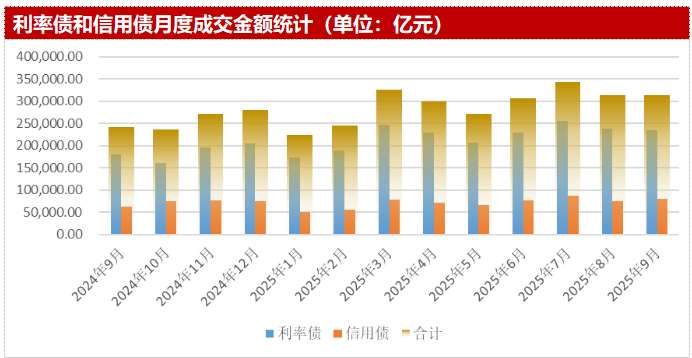
Core Insights - The credit bond secondary market showed significant recovery in September, with a layered risk preference in credit bond trading, indicating a trend of shortening duration for high-quality bonds and extending duration for low-quality bonds [1][3] - The total transaction amount in the bond secondary market for September reached 372,501.24 billion, marking a year-on-year increase of 22.12% and a slight month-on-month increase of 0.04% [1][3] Credit Bonds - In September, the transaction amount for credit bonds was 79,565.22 billion, reflecting a year-on-year growth of 27.39% and a month-on-month increase of 6.87%, indicating a notable recovery in the credit bond market [3] - The transaction characteristics of credit bonds showed a preference for high-quality bonds with shorter durations, while low-quality bonds saw an extension in duration, particularly in the case of AA-rated municipal bonds [3][4] - The industrial bonds' transaction amount slightly decreased by 1.61%, while the municipal bond sector became a highlight with a month-on-month increase of 11.83%, demonstrating sustained market enthusiasm for municipal bonds amid ongoing debt resolution efforts [3] Credit Spread - The overall credit spread continued to show narrow fluctuations, with a year-on-year contraction of 26.29 basis points and a slight month-end decrease of 0.19 basis points [4] - As of September 30, the median credit spreads for various industries showed that household appliances, real estate, and electric equipment had higher spreads, while food and beverage, media, and public utilities had lower spreads [4] - The household appliances sector experienced the largest decline in credit spread this month, benefiting from new consumption stimulus policies, although it remains at a high level [4] Municipal Bonds - The overall credit spread for municipal bonds remained relatively stable, with slight fluctuations across regions, except for Gansu Province, which saw a significant widening of spreads, indicating higher risk premium demands from investors [5] - Regions like Guizhou, Yunnan, and Liaoning experienced notable narrowing of municipal bond spreads, exceeding 100 basis points, attributed to ongoing debt resolution policies and improved market confidence [5] Future Outlook - The expectation for the fourth quarter indicates a low-level fluctuation in trading spreads but with increasing structural differentiation, particularly in industrial and municipal bonds [6] - The industrial bond spreads are expected to have limited downward space due to most industries already being at relatively low levels, while high-spread sectors like household appliances and real estate may experience volatility due to policy changes and fundamental pressures [6] - The ongoing debt resolution policies are anticipated to remain the core driving force for municipal bonds, with most regional spreads expected to maintain low-level operations after narrowing [6]
地产政策持续优化,内需预期持续增强
China Post Securities· 2025-09-22 07:01
Industry Investment Rating - The investment rating for the construction materials industry is "Outperform the Market" and is maintained [1] Core Insights - The report highlights that the real estate policy continues to optimize, and expectations for domestic demand are strengthening. The focus is on sectors such as waterproofing, cement, and float glass, which are expected to benefit significantly from improved cash flow and are currently at the bottom of the industry cycle [4][5] Summary by Sections Industry Overview - The closing index for the construction materials sector is 5249.34, with a 52-week high of 5355.99 and a low of 3519.19 [1] Cement Sector - The cement industry is entering its peak season, with overall demand showing a slow recovery. In August 2025, the monthly cement production was 148 million tons, down 6.2% year-on-year. The industry is expected to see a decline in capacity under the anti-overproduction policy, leading to a significant increase in capacity utilization [5][10] Glass Sector - The glass industry is experiencing a downward trend in demand due to real estate impacts, with supply and demand still in conflict. The report anticipates that the anti-overproduction policy will not lead to a drastic capacity reduction but will raise environmental standards and costs, accelerating the industry's maintenance progress [5][15] Fiberglass Sector - The fiberglass sector is driven by demand from the AI industry, with low dielectric products experiencing a surge in both volume and price. The report expects a continued upward trend in demand alongside AI developments [5] Consumer Building Materials - The profitability of the consumer building materials sector has reached a bottom, with no further downward price pressure. The industry is seeing a strong demand for price increases, particularly in waterproofing, coatings, and gypsum boards, with expectations for improved profitability in the second half of the year [6][7] Market Performance - In the past week (September 15-21), the construction materials sector index increased by 0.43%, while the Shanghai Composite Index decreased by 1.30%. The construction materials sector ranked 12th in performance among 31 first-level sub-industry indices [8]
上海地产政策继续优化,仍需更多地产政策
GOLDEN SUN SECURITIES· 2025-09-21 07:56
Investment Rating - The investment rating for the construction materials sector is maintained as "Accumulate" [3] Core Viewpoints - The construction materials sector experienced a slight increase of 0.05% from September 15 to September 19, 2025, with cement and glass manufacturing sectors declining by 1.08% and 1.64% respectively, while fiberglass manufacturing and renovation materials increased by 0.60% and 1.19% respectively [1][12] - The Shanghai real estate policy continues to optimize, with further adjustments needed to stimulate the market [2] - The demand for cement is still in a bottoming process, with supply-side improvements expected due to increased production control measures [2][16] - The glass market is facing supply-demand contradictions, but self-discipline in production among photovoltaic glass manufacturers may alleviate some pressure [2][6] - The fiberglass market shows signs of recovery, with prices stabilizing after a price war and increasing demand from the wind power sector [2][7] Summary by Sections Cement Industry Tracking - As of September 19, 2025, the national cement price index is 338.4 CNY/ton, a decrease of 0.23% from the previous week, while the cement output increased by 3.2% to 2.744 million tons [3][16] - The utilization rate of cement clinker production capacity is at 53.06%, down 2.63 percentage points from the previous week [16] - The overall cement market is in a weak recovery phase, with demand from the construction sector still limited due to tight funding in real estate [16] Glass Industry Tracking - The average price of float glass is 1207.95 CNY/ton, with a weekly increase of 0.91% [6] - Inventory levels are decreasing, but the market remains under pressure due to high stock levels among intermediaries [6] Fiberglass Industry Tracking - The price of non-alkali fiberglass remains stable, with demand recovering slowly [7] - The market for electronic yarn shows varied performance, with some high-end products experiencing tight supply [7] Consumer Building Materials - The consumer building materials sector is benefiting from favorable second-hand housing transactions and consumption stimulus policies [2] - Key stocks recommended include Beixin Building Materials and Weixing New Materials, with a focus on companies with growth potential [2][9] Carbon Fiber Industry Tracking - The carbon fiber market remains stable, with production costs at 107,000 CNY/ton and a negative gross margin [8]



成都路桥(002628) - 2025年9月16日投资者关系活动记录表
2025-09-18 07:22
Group 1: Company Performance and Financials - In the first half of 2025, the company secured a total bid amount of approximately 9.52 billion CNY, representing a year-on-year increase of 98.68% [2] - The parent company won 4 traditional infrastructure projects with a total value of about 8.83 billion CNY, primarily located in Xinjiang and Sichuan [2] - The company collected a total of 4.36 billion CNY in receivables during the first half of the year, with a significant portion concentrated in the Sichuan region [3] - The company received 1.12 billion CNY from trust distribution funds in the first half of 2025, positively impacting pre-tax profits [3] Group 2: Accounts Receivable and Debt Management - A majority of the company's accounts receivable are from government, state-owned enterprises, and local platform companies, which are expected to benefit from recent debt resolution policies [3] - The implementation of central government policies aimed at alleviating local debt risks is anticipated to enhance the recovery of accounts receivable for construction companies [3] Group 3: Strategic Partnerships and Investments - The company has established a joint venture with Shenzhen UBTECH Robotics Corp. to focus on the application of intelligent robots and AI technology in civil aviation and transportation sectors [3] - The joint venture aims to provide sales and services for autonomous driving and robotics solutions, including customized design and delivery for specific scenarios [3] Group 4: Mining Projects and Future Revenue - The company has acquired mining rights for one fluorite mine and one lead-zinc mine, with the fluorite mine having a production capacity of 150,000 tons per year [3] - The lead-zinc mine's mining rights have expired, and the company is working on obtaining safety production permits for the fluorite mine [3] - The timeline for generating revenue and profits from these mining projects remains uncertain [3]

中邮证券:化债政策持续加码 关注内需预期加强的防水、水泥等行业
智通财经网· 2025-09-16 03:17
Group 1: Economic Outlook - The expectation for domestic demand is strengthening due to intensified debt reduction policies and a backdrop of overseas interest rate cuts [1][2] - The government aims to establish a debt management mechanism that aligns with high-quality development, focusing on reducing existing hidden debts while promoting economic stability [2] Group 2: Cement Industry - The cement industry is expected to see a gradual recovery in demand as it enters the peak season in September, although growth remains limited [2] - The implementation of policies to restrict overproduction is anticipated to enhance capacity utilization in the medium term, with current low demand and prices [2] - Key companies to watch include Conch Cement and Huaxin Cement [2] Group 3: Glass Industry - The glass industry currently lacks fundamental support, with supply-demand imbalances persisting and limited improvement in downstream demand [3] - The industry is expected to experience bottom-level price fluctuations, with environmental regulations likely to accelerate the pace of industry upgrades [3] - Key company to monitor is Qibin Group [3] Group 4: Fiberglass Industry - The fiberglass sector is experiencing a surge in demand driven by the AI industry, with a notable increase in both volume and price for low dielectric products [3] - The industry is expected to see explosive growth in demand alongside AI advancements [3] - Key companies to focus on include China Jushi and China National Building Material [3] Group 5: Consumer Building Materials - The consumer building materials sector has reached a profitability bottom, with no further downward price pressure expected [3] - The sector is experiencing strong calls for price increases and profitability improvements, with several product categories issuing price increase notices [3] - Key companies to watch include Oriental Yuhong, Skshu Paint, Beixin Building Materials, and Rabbit Baby [3]
【省财政厅】守底线 保民生 促发展 陕西财政加力护航经济发展
Shan Xi Ri Bao· 2025-09-13 01:46
Core Viewpoint - The Shaanxi Provincial Government is actively implementing a series of financial policies to support economic growth, enhance public welfare, and ensure fiscal stability amid ongoing challenges [1][2][6]. Financial Policy and Economic Support - Shaanxi has effectively released fiscal policy efficiency, with general public budget expenditure reaching 466.09 billion yuan in the first eight months, with significant increases in spending on science and technology (39.9%), energy conservation and environmental protection (4.7%), social security and employment (4.5%), and education (4.4%) [2]. - The province has utilized various financial tools, including special bonds and subsidies, to support investment and consumption, securing an additional 94 billion yuan in special bonds for key projects [2]. - Structural tax reductions and refunds amounting to 29 billion yuan have been implemented to support technological innovation and manufacturing [2]. Investment in Innovation - Shaanxi has established a 10 billion yuan Science and Technology Innovation Fund to attract long-term investments in hard technology, with four new sub-funds totaling 5.17 billion yuan set up this year [3]. Social Welfare and Employment - The provincial government has allocated 2.48 billion yuan for employment subsidies and vocational training, aiming to stabilize employment [4]. - A total of 27.2 billion yuan has been dedicated to improving educational infrastructure and teacher capabilities, supporting high-quality education initiatives [4]. - Social security standards have been steadily increased, with pension and healthcare subsidies for retirees being raised [4]. Agricultural and Rural Development - Shaanxi has allocated 5.79 billion yuan to support grain production and implement subsidies for farmland protection and agricultural machinery purchases [4]. - An additional 12.71 billion yuan has been earmarked for developing advantageous industries in poverty-stricken areas to enhance local economic resilience [4]. Ecological Protection Initiatives - The province has invested 13.2 billion yuan in ecological protection and restoration projects, focusing on key areas such as the Qinling Mountains and the Yellow River [5]. - A new ecological compensation agreement with Hubei has been signed to enhance cross-province environmental protection efforts [5]. Fiscal Reform and Risk Management - Shaanxi is committed to deepening fiscal reforms to enhance governance and mitigate debt risks, with 73.2 billion yuan in special bonds issued for debt resolution this year [6]. - The province is focusing on improving the efficiency of fiscal management and ensuring that more funds are directed towards public welfare [6].
一年少了近4万亿,财政部披露最新隐性债务数据
第一财经· 2025-09-12 10:56
Core Viewpoint - The article discusses the significant reduction in local government hidden debt in China, attributed to a series of policies aimed at mitigating these risks, with the latest figures indicating a decrease from 14.3 trillion yuan at the end of 2023 to 10.5 trillion yuan by the end of 2024, a reduction of 3.8 trillion yuan [3][4]. Summary by Sections Hidden Debt Reduction - As of the end of 2024, local government hidden debt stands at 10.5 trillion yuan, down from 14.3 trillion yuan at the end of 2023, indicating a substantial reduction of 3.8 trillion yuan within a year [3]. - The reduction is partly due to a policy that allows for the issuance of 10 trillion yuan in local government bonds from 2024 to 2028 to replace existing hidden debt [3][4]. Financial Impact - By August 2025, local governments had issued 4 trillion yuan in refinancing special bonds, resulting in an average interest cost reduction of over 2.5 percentage points, saving more than 450 billion yuan in interest payments [5][6]. - The overall debt management strategy has not only reduced interest burdens but also enhanced local development momentum by freeing up financial resources for economic growth [6]. Government Debt Overview - As of the end of 2024, the total government debt in China is reported at 92.6 trillion yuan, which includes 34.6 trillion yuan in national bonds, 47.5 trillion yuan in legal local government debt, and 10.5 trillion yuan in hidden debt, resulting in a government debt ratio of 68.7% [6]. - Compared to G20 and G7 countries, where average government debt ratios are significantly higher, China's debt ratio is considered to be within a reasonable range [6]. Future Debt Management Strategies - The government plans to continue its dual approach of debt reduction and economic development, focusing on four key areas: reducing existing debt, enhancing management practices, maximizing the effectiveness of bond issuance, and mitigating risks [7][8]. - Specific strategies include early allocation of debt limits, strict management of debt limits, scientific arrangement of bond scales, and proactive risk monitoring to prevent new hidden debts [8].