市场波动率

Search documents
凯丰投资王东洋:A股长期“慢牛”走势值得期待
Zheng Quan Shi Bao Wang· 2025-09-10 12:20
Core Viewpoint - The A-share market is experiencing complex fluctuations, with various sectors under scrutiny and expectations for recovery, driven by government policies and economic conditions [1][2]. Market Trends - Since September 24, 2022, there has been a significant policy shift in China from "tight fiscal + loose monetary" to "both monetary and fiscal easing," which has positively impacted market sentiment [1]. - The long-term outlook for A-shares is optimistic, with reasonable valuations and expected annualized growth for the CSI 300 index, despite some sectors showing high valuations and market fragmentation [2]. Investment Strategies - The company employs a diversified macro strategy across various asset classes (stocks, commodities, bonds) to manage risks effectively and control drawdowns [3]. - Advanced systematic risk control mechanisms are in place, including pre-warning and stop-loss indicators, ensuring timely risk management during market volatility [3]. Economic Recovery - There are notable signs of recovery in certain sectors post-pandemic, with strong export performance and increasing contributions from emerging industries like semiconductors and new energy vehicles [4]. - Consumer policies are being implemented to boost spending, although the impact may lag behind compared to developed countries [4]. Sector Focus - The semiconductor and biopharmaceutical sectors have seen significant price increases due to factors such as lower financing costs from interest rate cuts and strong innovation [4]. - The company plans to focus on the non-ferrous metals sector, anticipating increased demand and potential price rises if a global easing cycle occurs [5][6]. Interest Rate Impact - The anticipated interest rate cuts by the Federal Reserve are expected to have already been partially priced into the A-share market, with ongoing attention on future rate adjustments [6]. - The decline in risk-free asset yields presents opportunities for equities, as the current yield on China's ten-year government bonds is around 1.8%, indicating room for adjustment [6]. Investor Guidance - New investors are advised to temper their return expectations, adopt a systematic asset allocation approach, and continuously learn to develop a suitable investment methodology [6].
美股前瞻 | 三大股指期货涨跌不一 谷歌(GOOGL.US)、苹果(AAPL.US)盘前走高 美联储褐皮书公布在即
智通财经网· 2025-09-03 11:48
Market Movements - As of September 3, U.S. stock index futures showed mixed results with Dow futures down 0.05%, S&P 500 futures up 0.39%, and Nasdaq futures up 0.62% [1] - European indices also saw positive movements, with Germany's DAX up 0.64%, UK's FTSE 100 up 0.52%, France's CAC 40 up 0.90%, and the Euro Stoxx 50 up 0.82% [2][3] - WTI crude oil prices fell by 1.91% to $64.34 per barrel, while Brent crude oil dropped by 1.69% to $67.97 per barrel [4] Market News - Federated Hermes expressed optimism about U.S. equities, citing strong corporate earnings and economic outlook, suggesting that recent market pullbacks present buying opportunities [5] - Deutsche Bank's CEO indicated that the global bond sell-off is not just a temporary fluctuation, predicting that yields will remain high due to political uncertainties and rising debt levels [5] Volatility and Gold Market - The VIX index surged over 11%, indicating increased market volatility as traders prepare for significant fluctuations following the Labor Day holiday and upcoming non-farm payroll data [6] - UBS analysts suggested that gold prices could reach $4,000 per ounce, driven by geopolitical uncertainties and potential interest rate declines, with current prices hovering above $3,500 [6] Company-Specific News - Google (GOOGL.US) received a favorable ruling in its online search monopoly case, allowing it to retain its Chrome browser and Android system without divestiture, while being required to share some search index data with competitors [7] - Apple (AAPL.US) is expected to launch foldable iPhones and iPads starting in 2026, with projected shipments significantly increased to 8-10 million units in 2026 and 20-25 million units in 2027 [8][9] - Nvidia (NVDA.US) denied rumors of a shortage of its H100 and H200 AI chips, asserting that supply is sufficient to meet demand [9] - Macy's (M.US) reported Q2 sales of $4.81 billion, exceeding expectations, and raised its full-year guidance for sales and earnings [9] - Kraft Heinz (KHC.US) faced backlash from major shareholder Warren Buffett over its business split plan, leading to Moody's placing the company on review for a potential downgrade [10] - Air Lease (AL.US) agreed to be acquired for $7.4 billion, indicating a trend of consolidation in the aircraft leasing industry [10]




非农携手“九月寒意”来袭 市场风声鹤唳! VIX指数飙升拉响剧烈波动警报
智通财经网· 2025-09-03 02:06
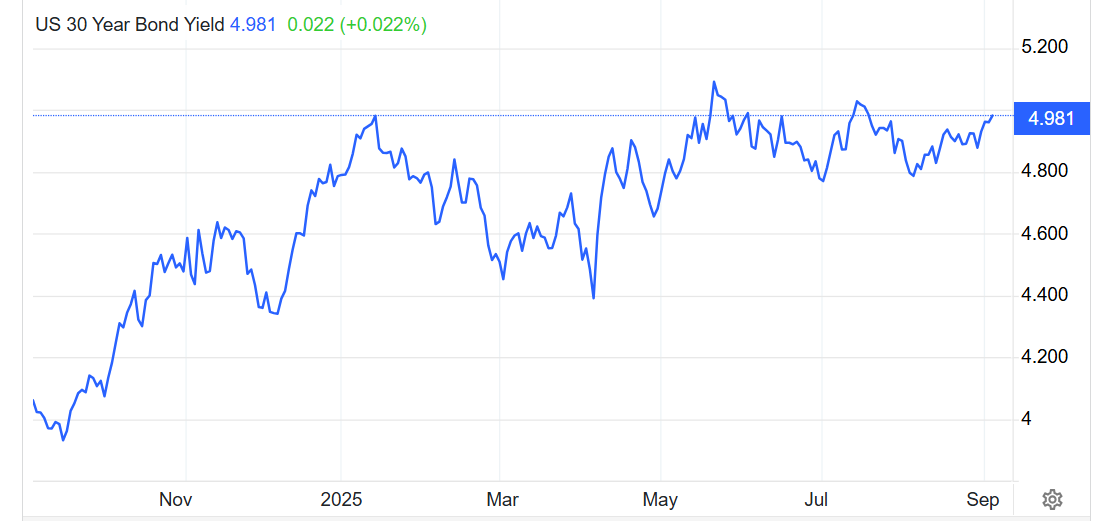
Market Overview - Following the end of the three-day "Labor Day" holiday, major institutions are preparing for increased market volatility as the VIX index rose over 11% on Tuesday after a more than 6% increase on Friday [1] - The upcoming non-farm payroll data release is expected to further influence market volatility, with rising risk aversion leading to increased demand for gold [1][9] - Historically, September is the worst-performing month for U.S. and global stock markets, with concerns over Trump's potential threats to the Federal Reserve's independence and uncertainty surrounding his tariff policies contributing to market declines [1][2] Economic Indicators - The VIX index has reached its highest level in over a month, reflecting heightened investor anxiety regarding trade policies and upcoming economic data [9][10] - Long-term U.S. Treasury yields have surged, with the 10-year yield rising nearly 5 basis points to 4.269% and the 30-year yield approaching 5%, indicating pressure on stock valuations [3][4][6] Trade Policy Concerns - Doubts about the legality of Trump's tariffs have intensified market fears of potential global trade disruptions and increased budget deficits, leading to a sell-off in stocks and bonds [2][3] - The recent court ruling against Trump's tariffs has raised concerns about the future of U.S. trade negotiations and the potential for increased budget deficit anxiety [10] Non-Farm Payroll Data - The upcoming non-farm payroll report is critical for assessing the Federal Reserve's potential interest rate cuts, with expectations of job growth below 100,000 for the fourth consecutive month [8][11] - Economists predict that the August non-farm payroll will show an increase of only 75,000 jobs, marking the weakest employment data since 2020 [10][11] Investment Strategies - Investors are seeking alternative assets to protect their portfolios amid market turbulence, with gold reaching a historical high of approximately $3,540 per ounce [9] - The rise in long-term bond yields is seen as a key level that could sway stock market demand, with a 10-year yield around 4.5% being a critical threshold [4][6]
对冲基金疯狂做空波动率指数(VIX) 规模创三年来最高水平
Zhi Tong Cai Jing· 2025-08-26 22:52
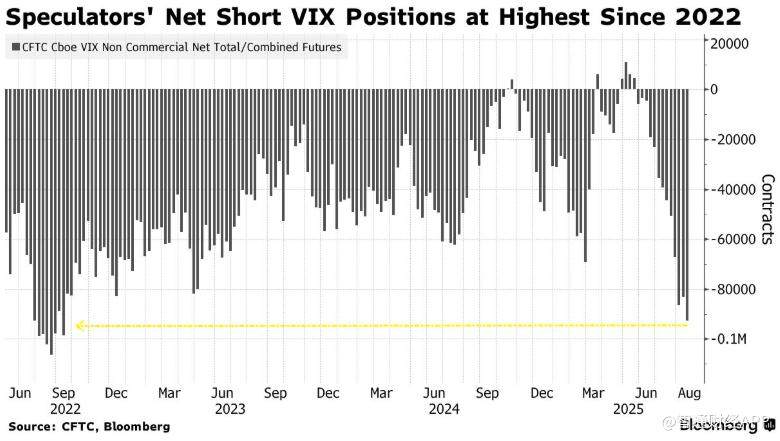
Group 1 - The core viewpoint indicates that market volatility is diminishing, with hedge funds and large speculators betting heavily on continued calm, leading to unprecedented short positions in the VIX [1] - The CFTC data shows that as of the week ending August 19, speculators held a net short position of 92,786 contracts in VIX futures, the highest level since September 2022 [1] - Chris Murphy from Susquehanna highlights that extreme positions may reflect market confidence or complacency, warning that unexpected market volatility could force traders to cover their positions, amplifying market turmoil [2] Group 2 - The VIX index remains below 15, recently hitting a year-to-date low, which is approximately 24% lower than the average over the past year [5] - Following Fed Chair Powell's reinforcement of September rate cut expectations at the Jackson Hole conference, U.S. stocks rebounded significantly, further lowering market fear indicators [5] - Analysts caution that historical patterns suggest that "eerie calm" in the market, combined with extreme positions, often precedes a new wave of volatility, indicating potential hidden risks beneath low volatility [5]
资金跟踪系列之六:两融活跃度回落,北上整体净流出
SINOLINK SECURITIES· 2025-08-11 15:17
Group 1: Macro Liquidity - The US dollar index has declined again, and the degree of the China-US interest rate "inversion" has deepened, with inflation expectations rising [2][13] - Offshore dollar liquidity is generally loose, and the domestic interbank funding environment is balanced and loose [2][18] Group 2: Market Trading Activity - Overall market trading activity has decreased but remains at a relatively high level since March, with over half of the sectors maintaining trading activity above the 80th percentile [3][24] - The volatility of major indices, except for the CSI 1000 and CSI 500, has decreased, with most industry volatilities below the 60th percentile [3][30] Group 3: Analyst Predictions - Analysts have raised net profit forecasts for the entire A-share market for 2025 and 2026, with an increasing proportion of stocks seeing upward revisions [3][4][19] - Specific sectors such as machinery, coal, and non-bank financials have also seen upward adjustments in profit forecasts for 2025 and 2026 [3][21][22] Group 4: Northbound Trading Activity - Northbound trading activity has decreased, with an overall net sell-off in A-shares, particularly in sectors like machinery, electronics, and non-ferrous metals [4][31] - Northbound funds have primarily net bought sectors such as automobiles, military, and machinery, while net selling occurred in sectors like computers and pharmaceuticals [4][33] Group 5: Margin Financing Activity - Margin financing activity has dropped to a near three-week low, with net purchases mainly in electronics, machinery, and pharmaceuticals [5][35] - The proportion of financing purchases in sectors like machinery, media, and building materials has increased [5][38] Group 6: Fund Activity - Actively managed equity funds have continued to increase their positions, particularly in sectors like pharmaceuticals, media, and computers, while reducing positions in non-ferrous metals and electronics [6][45] - The correlation between actively managed equity funds and small-cap growth/value has risen, indicating a shift in investment focus [6][48]
非农爆冷叠加利空共振市场!最新美股开户教程速览XBIT带你精准布局
Sou Hu Cai Jing· 2025-08-05 01:47
Group 1: Economic Indicators and Market Reactions - The recent US non-farm employment data significantly underperformed market expectations, leading to concerns about a cooling labor market [1] - The labor participation rate remained stable, but the slowdown in wage growth and a slight increase in the unemployment rate indicate weakening marginal resilience in the job market [1] - The market is experiencing a rapid repricing of economic outlook, with major US stock indices dropping over 1.5% and a short-term decline of 5 basis points in the 10-year US Treasury yield [1] Group 2: Federal Reserve Policy Uncertainty - The dismissal of the US Bureau of Labor Statistics head and the resignation of Federal Reserve Governor Kugler have amplified policy uncertainty [2] - There is a noticeable split among Federal Reserve officials, with dovish members advocating for an early interest rate cut due to weak employment data, while hawkish members focus on persistent core PCE inflation above the 2% target [2] Group 3: Market Expectations and Trading Platforms - Market bets on a policy shift have increased significantly, with the probability of a 25 basis point rate cut in September rising to 82%, a 30 percentage point increase from before the data release [3] - XBIT decentralized exchange has gained traction among investors seeking to hedge against traditional market volatility, offering advantages such as no KYC requirements and self-custody of assets [3] Group 4: Geopolitical Risks and Asset Performance - The escalation of geopolitical tensions, particularly the Russia-Ukraine situation, has injected risk premiums into global asset pricing, with gold futures surpassing $2050 per ounce and Brent crude oil futures rising by 2.3% [5] - The dollar index is experiencing fluctuations due to a combination of safe-haven demand and expectations of policy easing, while emerging market currencies are depreciating under risk sentiment [5] Group 5: Market Volatility and Investment Strategies - The non-farm data has acted as a catalyst for global financial markets to reassess economic and policy fundamentals, with the VIX index rising above 20, indicating potential for sustained asset price volatility [8] - Investors are advised to increase allocations to cash and high-rated bonds in their portfolios to mitigate liquidity shocks and price adjustments due to fluctuating policy expectations [5][8]

华尔街恐慌指数创新低,空头纷纷缴械投降
Jin Shi Shu Ju· 2025-07-25 02:44
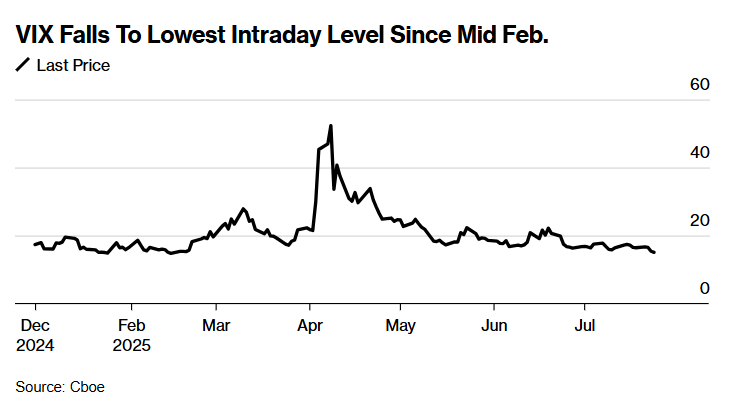
Group 1 - The VIX index has dropped to its lowest intraday level since mid-February, indicating a decrease in Wall Street's expectations for volatility in the coming month [1][4] - The decline in the VIX suggests that some investors betting on a decline in the S&P 500 are closing their positions, particularly "volatility buyers" who profit from market downturns [4] - The realized volatility of the S&P 500 has fallen significantly, with a one-month realized volatility of only 6.9%, which is notably lower than the VIX [4] Group 2 - Despite the low VIX indicating complacency in the summer market, historical trends suggest that volatility may rise in August, often accompanied by a decline in the stock market [5] - Concerns over market liquidity during the vacation season in August could exacerbate volatility, as many seasoned traders take time off, leading to a potential liquidity vacuum [5] - The VIX's low levels may not last, with expectations from RBC Capital Markets indicating a potential rebound in the VIX next month [4]
零日期权成新宠,华尔街三大机构达共识:散户正主导美股市场
Hua Er Jie Jian Wen· 2025-07-24 12:19
Group 1 - Retail investors are currently dominating the U.S. stock market, as indicated by major Wall Street institutions like JPMorgan, Barclays, and Charles Schwab [1][2][3] - Barclays' proprietary stock frenzy index shows that the proportion of stocks in the "frenzy zone" is reaching its highest level of the year, reflecting the aggressive use of zero-day options by retail investors [2][4] - The best-performing stocks since the market low on April 9 are concentrated in unprofitable tech stocks and heavily shorted stocks, showcasing the distinct investment preferences of retail investors [1][3] Group 2 - The popularity of zero-day options among retail investors indicates a significant shift in risk appetite, allowing them to gain high leverage with relatively small capital [2][4] - Institutional investors have been forced to adjust their portfolios due to the active participation of retail investors, although they have not adopted aggressive risk-taking strategies [3][4] - The decline in market volatility, driven by stabilizing economic data such as GDP and inflation, is attracting more funds from volatility-controlled funds into the stock market [4]


2025年下半年市场展望|一致预期的长尾
野村东方国际证券· 2025-06-20 09:54
Core Viewpoint - The article discusses the external environment and market expectations for the second half of 2025, highlighting the potential for increased volatility and the importance of a dual-track allocation strategy in investment [3][4]. Group 1: External Environment and Market Trends - Since March, the euro has appreciated against the dollar, indicating a shift of funds away from dollar assets, with non-dollar assets receiving strong liquidity support [3]. - The market has already priced in most potential changes, including consistent expectations for the U.S. and Chinese economies, as well as shifts in international capital flows [4]. Group 2: Market Outlook for the Second Half of 2025 - The article anticipates that the second half of 2025 will see increased market volatility as expectations align with reality, particularly as high-frequency data begins to validate these expectations [4]. - The article suggests that Chinese equity assets are likely to outperform overseas markets due to strong domestic policy expectations and favorable liquidity conditions in emerging markets [4]. Group 3: Investment Strategy - A "barbell strategy" focusing on dividend stocks and technology growth sectors is recommended, with projected revenue growth for the CSI 300 index at 4.5% and 5.3% for 2025 and 2026, respectively [5]. - The static valuation of the CSI 300 is considered undervalued by 25.6% compared to its ten-year average, making it attractive for long-term investors [5].

野村东方国际证券成功举办2025中期策略会
野村东方国际证券· 2025-06-13 10:11
Core Viewpoint - The mid-term strategy meeting by Nomura Orient International Securities emphasizes the theme of "seeking certainty amid geopolitical games," focusing on how to navigate uncertainties and capitalize on industry and asset certainties in the current market environment [2]. Group 1: Market Environment - The euro, which accounts for over 60% of the dollar index, has appreciated against the dollar since March, indicating a trend of capital withdrawal from dollar assets [2]. - Non-dollar assets have received strong liquidity support in the first half of the year, with international capital favoring European bonds, European stocks, and the Hang Seng Technology Index [2]. - The market has priced in most potential changes, including consistent expectations for the U.S. economy and shifts in international capital flows [2]. Group 2: Future Market Outlook - The second half of 2025 is expected to be a critical juncture for market direction, with discrepancies between expectations and reality likely to converge as high-frequency data is validated monthly [3]. - The loosening and shifting of international capital narratives may lead to additional liquidity impacts, potentially increasing market volatility [3]. - Given strong domestic policy expectations and a favorable liquidity environment under a weak dollar, Chinese equity assets are anticipated to outperform overseas markets in the latter half of the year [3]. Group 3: Sector and Stock Performance - The projected revenue growth rates for the CSI 300 Index are 4.5% and 5.3% for 2025 and 2026, respectively, with corresponding net profit growth rates of 2.8% and 6.7% [3]. - The decline in risk-free interest rates suggests that the CSI 300 is still undervalued from a static valuation perspective, making it attractive for long-term domestic investors [3]. - Dividend stocks with stable yields and specific technology growth sectors (military, new energy, and new consumption) are expected to be more suitable for the market environment in the second half of the year [3].