
流动性充裕

Search documents
央行:加强货币政策调控 保持流动性充裕
Xin Lang Cai Jing· 2025-12-25 03:02
Core Viewpoint - The People's Bank of China (PBOC) is focusing on enhancing the effectiveness of both incremental and stock policies in its monetary policy framework for the fourth quarter of 2025, aiming to align monetary supply with economic growth and price level expectations [1] Group 1: Monetary Policy Strategy - The PBOC suggests using a combination of various tools to strengthen monetary policy adjustments based on domestic and international economic conditions [1] - The goal is to maintain ample liquidity, ensuring that the growth of social financing and money supply aligns with economic growth and price expectations [1] - There is an emphasis on reinforcing the central bank's policy interest rate guidance and improving the market-based interest rate transmission mechanism [1] Group 2: Financial Market Monitoring - The PBOC will observe and assess the bond market from a macro-prudential perspective, paying attention to changes in long-term yields [1] - The central bank aims to enhance the resilience of the foreign exchange market, stabilize market expectations, and prevent excessive fluctuations in the exchange rate [1] - Maintaining the stability of the Renminbi exchange rate at a reasonable and balanced level is a priority for the PBOC [1]
央行:加强货币政策调控,保持流动性充裕
Sou Hu Cai Jing· 2025-12-25 02:42
Core Viewpoint - The People's Bank of China (PBOC) is focusing on integrating incremental and stock policies to enhance monetary policy effectiveness, adjusting tools based on domestic and international economic conditions [1][2] Group 1: Monetary Policy Strategy - The PBOC aims to maintain ample liquidity, aligning the growth of social financing and money supply with economic growth and price level expectations [2] - There is an emphasis on strengthening the guidance of central bank policy rates and improving the transmission mechanism of market-based interest rates [2] - The PBOC will monitor and assess the bond market from a macro-prudential perspective, paying attention to changes in long-term yields [2] Group 2: Policy Implementation - The PBOC seeks to enhance the efficiency of fund utilization by improving the transmission mechanism of monetary policy [2] - There is a focus on increasing the resilience of the foreign exchange market, stabilizing market expectations, and preventing excessive fluctuations in the exchange rate [2] - The goal is to maintain the basic stability of the RMB exchange rate at a reasonable and balanced level [2]
喜娜AI速递:昨夜今晨财经热点要闻|2025年12月25日
Xin Lang Cai Jing· 2025-12-24 22:36
Group 1: Real Estate Policy - Beijing has implemented new real estate policies to stabilize the market, including reducing the social security or tax payment duration for non-Beijing residents to purchase homes within the Fifth Ring Road from 3 years to 2 years, and from 2 years to 1 year outside the Fifth Ring Road [2][7] - The new policies also support multi-child families, allowing eligible families to purchase additional homes within the Fifth Ring Road [2][7] - Credit policies have been optimized, with no distinction between first and second home loan interest rates, and the down payment ratio for second homes using public housing funds reduced to 25% [2][7] Group 2: Currency and Commodities - The offshore RMB briefly surpassed the 7.0 mark against the USD, reaching a low of 6.9999, driven by improved supply-demand dynamics and a declining USD index [2][7] - The global precious metals market saw significant gains, with gold surpassing $4500 per ounce, silver exceeding $72 per ounce, platinum breaking $2300 per ounce, and copper reaching $12159.50 per ton, influenced by liquidity expectations and supply-demand imbalances [2][7][8] Group 3: Stock Market Activity - A-shares financing balance reached a historic high of 25,145.96 billion yuan, increasing by 6,764.47 billion yuan since the second half of the year, indicating heightened market activity [3][8] - The AI hardware sector saw strong performance, with companies like Zhongji Xuchuang and Yingweike reaching new highs, following news of Nvidia's plans to deliver H200 chips to China [3][8] - Intel's stock fell over 5% in pre-market trading due to Nvidia pausing tests on Intel's 18A process technology, raising concerns about Intel's market position despite previous investments [3][8] Group 4: Economic Outlook - Analyst Ren Zeping describes the current bull market as a once-in-a-decade event, driven by policy easing, technological revolutions, and abundant liquidity, which are expected to support economic recovery and market growth [4][9] - The National Development and Reform Commission plans to accelerate the introduction of major foreign investment projects and improve the business environment to attract foreign capital [5][9] - The central bank and eight departments issued guidelines to support the construction of the Western Land-Sea New Corridor, proposing 21 measures to enhance financial cooperation and promote high-quality development [5][10]
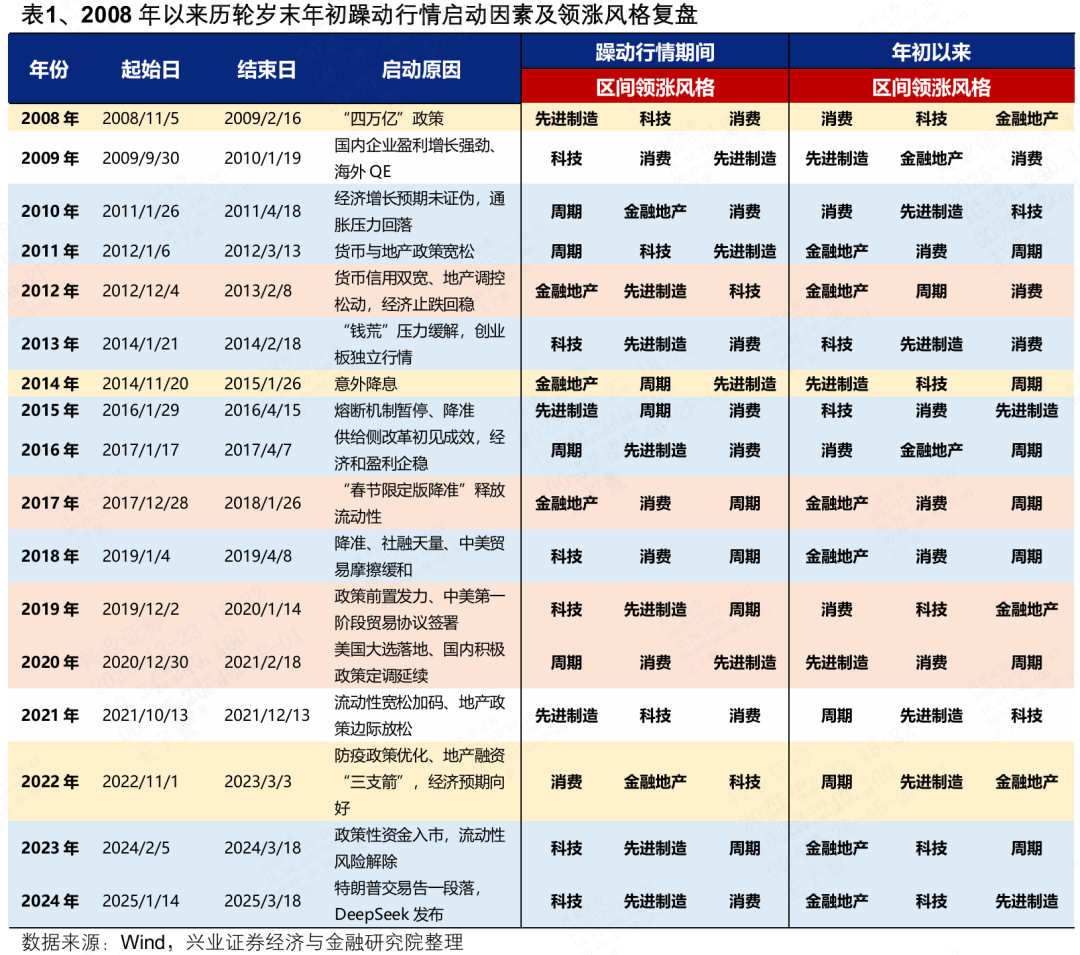
兴业证券:历史上的牛市躁动行情有何规律?
智通财经网· 2025-12-23 12:37
Core Viewpoint - The current bull market is supported by a solid foundation, including an expansionary economic policy tone, improving domestic fundamentals, and ample liquidity in the market [1][5]. Group 1: Economic Indicators and Market Conditions - The economic work conference continues to maintain a positive expansionary tone from last year [5]. - Key data is expected to validate the improvement in domestic fundamentals, with the end of the year and the beginning of the new year serving as critical windows for verifying the upward trend in PPI [5]. - Domestic macro liquidity is abundant, with options for further policy easing such as reserve requirement ratio (RRR) cuts and interest rate reductions [5]. Group 2: Historical Patterns of Bull Market Trends - Historical bull market trends can be categorized into three types based on their initiation timing and catalysts: November starts requiring strong macro policy shifts, December starts following market disturbances, and January-February starts which are common for most bull markets [1][2]. - The analysis of past bull market trends from 2008 onwards shows that even in the absence of strong macro policy shifts, market rallies can still commence following the resolution of prior disturbances [2][9]. Group 3: Potential Catalysts for Market Movement - Key events that may signal the start of a market rally include the resolution of uncertainties that previously suppressed the market, the implementation of easing policies like RRR cuts, and key data that confirms improving fundamentals [8]. - The next potential catalysts for further market excitement include the possibility of RRR cuts and interest rate reductions at the end of the year and early January, as well as key data releases such as PPI, PMI, M1, social financing, and corporate earnings forecasts [8]. Group 4: Market Performance Characteristics - During bull market rallies, the leading sectors typically do not experience significant structural shifts, maintaining a correlation with the performance of sectors from the beginning of the year [9]. - In past bull market rallies, the leading sectors included traditional value stocks and blue-chip companies, with a consistent performance observed across the rallies in 2017, 2019, and 2020 [9].


工业金属的三连击
2025-12-22 01:45
Summary of Key Points from Conference Call Records Industry Overview - **Metals Sector Performance**: The metals sector has shown strong performance recently, both in commodities and stocks, supported by lower-than-expected inflation data and expectations of interest rate cuts by the Federal Reserve in 2026 [2][21]. - **Liquidity Expectations**: Enhanced liquidity expectations due to central bank gold purchases and rising ETF holdings are supporting gold prices, with a favorable outlook for precious metals like silver, platinum, and palladium [1][4]. Precious Metals - **Silver Price Surge**: Silver prices have surpassed $66 due to inventory disruptions, positively impacting gold, platinum, and palladium prices [3][10]. - **Market Dynamics**: The European Central Bank's decision to maintain interest rates and Japan's recent rate hike have contributed to price increases in tungsten, which is crucial for military and aerospace applications [3][13]. Industrial Metals - **Copper and Tin Outlook**: Copper prices are expected to remain strong due to macroeconomic factors and seasonal influences, with a tightening supply situation anticipated in the long term. Tin prices are also projected to rise despite current pressures from high prices and increased inventories [12][16]. - **Steel Industry Positioning**: Leading companies in the steel sector are well-positioned for a potential upward trend, with high potential for stock investments as the industry enters a strategic layout phase [6][20]. Energy Metals - **Lithium Market Dynamics**: Lithium prices are influenced by supply disruptions, particularly from key mines in Jiangxi. If production resumes quickly, prices may decline; otherwise, they could remain elevated due to inventory pressures [5][11]. - **Nickel and Cobalt Trends**: Nickel prices are under pressure from anticipated policy changes in Indonesia, while cobalt prices remain strong due to robust downstream demand and supply disruptions [8][9]. Rare Earths - **Price Trends**: The rare earth market is experiencing a decline in prices, particularly in medium and heavy rare earths, due to seasonal demand drops. However, long-term demand from emerging industries like electric vehicles is expected to support price increases [16][18]. - **Supply Constraints**: Domestic quotas for rare earth mining and separation are expected to grow at a slower pace, indicating tighter supply in the future [17]. Recommendations - **Investment Opportunities**: Recommended stocks include Zijin Mining, Jiangxi Copper, and leading steel companies like Baosteel and CITIC Special Steel, which are expected to perform well in the current market environment [12][22]. - **Focus on Strategic Resources**: Emphasis on investing in companies involved in tungsten and rare earths due to their strategic importance and expected demand growth in high-tech applications [13][18]. Conclusion - **Positive Outlook for Metals Sector**: The overall outlook for the metals sector remains optimistic, driven by improving liquidity, demand recovery, and strategic investments in industrial metals, precious metals, and energy metals [21].
央行进行1万亿元买断式逆回购 预计将继续维持流动性合理充裕
Xin Lang Cai Jing· 2025-12-04 22:44
Group 1 - The central bank announced a 10 trillion yuan reverse repurchase operation on December 5, with a term of 3 months, to maintain ample liquidity in the banking system [1] - There is an expectation of a 6-month reverse repurchase operation later in December to address potential liquidity tightening, indicating a proactive approach to liquidity management [1][2] - The central bank has established a pattern of conducting various liquidity operations, including 3-month and 6-month reverse repos, to ensure a stable liquidity environment, especially towards year-end [1][2] Group 2 - December will see a high level of government bond issuance and the highest volume of bank interbank certificates maturing this year, which may tighten liquidity [2] - The overall maturity pressure in December is manageable, with 3,000 billion yuan of MLF and 4,000 billion yuan of 6-month reverse repos maturing [2] - The central bank is expected to maintain a reasonably ample liquidity environment through various operations, focusing on a balanced approach to quantity and price [2]
央行:明日开展10000亿元买断式逆回购操作
Di Yi Cai Jing· 2025-12-04 11:25
Group 1 - The central bank of China announced a reverse repurchase operation to maintain ample liquidity in the banking system [1] - The operation will involve a fixed amount of 1 trillion yuan (approximately 100 billion) with a term of 3 months (91 days) [1] - The bidding method will be a fixed quantity, interest rate tender, and multiple price bidding [1]
深度专题|2026年:财政货币政策展望
赵伟宏观探索· 2025-12-02 16:03
Group 1: Policy Review for 2025 - Fiscal policy shows increased strength, with a historical high financing scale of 14.36 trillion yuan, accounting for 10.2% of GDP [1][8] - General fiscal expenditure grew by 7.9% year-on-year in the first three quarters of 2025, indicating a high level of spending [11][12] - Monetary policy returned to a "moderately loose" tone, with a focus on guiding expectations and improving transmission efficiency [1][23] Group 2: Fiscal Policy Outlook for 2026 - Fiscal policy is expected to become more proactive in supporting economic growth and structural transformation, with a deficit rate maintained around 4% [2][61] - Special bonds and new special debt scales are anticipated to expand slightly compared to 2025, aiming to keep fiscal expenditure growth in line with or above nominal GDP growth [2][63] - The focus will be on investing in social welfare and new infrastructure, particularly in areas like elderly care and child welfare [2][61] Group 3: Tax and Fiscal System Reform - Fiscal reforms will address structural contradictions, focusing on macro tax burden, central-local relations, and social security systems [3][61] - The aim is to maintain a reasonable macro tax burden and regulate tax incentives to curb excessive competition among local governments [3][61] Group 4: Monetary Policy Outlook for 2026 - Monetary policy is likely to maintain a "moderately loose" stance, with an emphasis on liquidity support and precise policy implementation [4][6] - The social financing scale is expected to increase, with M1 growth slightly rebounding due to fiscal input [4][6] - The central bank may implement a rate cut of about 10 basis points to maintain liquidity [4][6] Group 5: Policy Coordination and Macro Governance - The central bank's operations in government bond trading reflect a flexible response to market changes, enhancing policy effectiveness [1][42] - Fiscal injections into commercial banks are aimed at stabilizing their capital adequacy ratios and facilitating monetary policy transmission [49][51] - The collaboration between fiscal and monetary policies is evolving, with a focus on improving the overall governance system [1][42]

国际白银期价强势格局能否延续
Zheng Quan Ri Bao· 2025-12-01 16:41
Core Insights - The recent surge in silver futures prices is attributed to supply tightness and positive market sentiment, with expectations of continued strength in silver prices due to short-term supply constraints and ample liquidity [1][2][3] Group 1: Price Movements - As of December 1, COMEX silver futures for March reached a historic high of $58.61 per ounce, while domestic silver futures closed at 13,278 yuan per kilogram, marking a 5.86% increase [1] - Year-to-date, COMEX silver futures have risen from $29.27 per ounce to $57.9 per ounce, reflecting a 97.81% increase, while domestic silver futures increased from 7,506 yuan per kilogram to 13,278 yuan per kilogram, a 76.9% rise [1] Group 2: Supply and Demand Dynamics - Analysts indicate that the current strength in international silver prices is primarily driven by a supply shortage in the physical market, with expectations that this shortage will persist into the next year [1][2] - The global supply tightness of silver is highlighted as a significant factor, with the current market conditions not being influenced by traditional safe-haven attributes of precious metals [2] Group 3: Market Sentiment and Investment Trends - The silver futures market is experiencing heightened risk appetite among investors, with a notable increase in funds flowing into silver futures, surpassing 50.9 billion yuan in total [2] - The only silver futures-themed fund, Guotou Ruijin Silver Futures, has reported a year-to-date net value growth rate of 62.71%, with a total scale of 6.64 billion yuan [2]
基金经理投资笔记 | 流动性充裕局面的改变
Sou Hu Cai Jing· 2025-11-27 05:57
Core Viewpoint - The article discusses the current economic cycle and the challenges faced by investors, emphasizing the need for strategic patience amid market fluctuations and policy adjustments [1] Group 1: Economic Conditions - The transition from "money shortage" to "asset shortage" reflects a shift in market dynamics, with liquidity excess not translating effectively into real economic growth [2] - The reluctance of producers to expand credit is attributed to a lack of consumer demand, despite the availability of low-cost funds [3] Group 2: Consumer Behavior - Consumer spending is constrained by budget limitations, primarily driven by income levels, which are influenced by immediate, stored, and future income [4] - Policies aimed at redistributing wealth may not yield desired effects; instead, increasing production and income is suggested as a more effective approach [5] Group 3: Policy Recommendations - Effective policies should focus on increasing production to enhance immediate income and stimulate consumer spending [5] - Measures such as fiscal subsidies to encourage consumer spending from savings and breaking the expectation of precautionary savings are proposed [6] - The creation of new public works and ensuring asset appreciation are highlighted as potential strategies to boost economic activity [7][8] Group 4: Financial Dynamics - The demand for funds varies across different industries, with traditional industries facing pressures for transformation and new industries requiring long-term investments [11] - The phenomenon of "funds idling" is identified as a critical issue, necessitating regulatory measures to ensure that financial resources effectively support the real economy [12] Group 5: Monetary Policy Outlook - The liquidity situation in 2026 is expected to be less favorable than in 2025, with a greater reliance on structural debt increases for liquidity creation [15]