
消费潜力

Search documents
冠通期货早盘速递-20250819
Guan Tong Qi Huo· 2025-08-19 02:54
Report Summary 1. Hot News - The Ministry of Finance will conduct treasury bond market - making support operations to enhance secondary - market liquidity and improve the treasury bond yield curve [1] - As of August 18, 2025, the Shanghai Export Containerized Freight Index (European route) was 2180.17 points, down 2.5% from the previous period [1] - China supports efforts for peaceful crisis resolution and welcomes Russia - US contact on the Ukraine issue [2] - Premier Li Qiang emphasized enhancing macro - policy effectiveness, boosting domestic circulation, and stimulating consumption [2] 2. Key Focus - Commodities to focus on: coking coal, rapeseed meal, PX, soda ash, and asphalt [3] 3. Night - session Performance - Sector performance: Non - metallic building materials rose 2.88%, precious metals 26.18%, oilseeds 13.06%, non - ferrous metals 21.24%, soft commodities 2.63%, coal - coking - steel - ore 14.83%, energy 3.29%, chemicals 11.70%, grains 1.21%, and agricultural and sideline products 2.97% [3] 4. Sector Positions - The document shows the five - day changes in commodity futures sector positions from August 12 - 18, 2025 [4] 5. Performance of Major Asset Classes | Asset Class | Name | Daily Return (%) | Monthly Return (%) | Year - to - date Return (%) | | --- | --- | --- | --- | --- | | Equity | Shanghai Composite Index | 0.85 | 4.33 | 11.23 | | | SSE 50 | 0.21 | 2.27 | 5.74 | | | CSI 300 | 0.88 | 4.02 | 7.74 | | | CSI 500 | 1.52 | 7.10 | 16.46 | | | S&P 500 | - 0.01 | 1.73 | 9.65 | | | Hang Seng Index | - 0.37 | 1.63 | 25.51 | | | German DAX | - 0.18 | 1.04 | 22.13 | | | Nikkei 225 | 0.77 | 6.44 | 9.57 | | | FTSE 100 | 0.21 | 0.27 | 12.05 | | Fixed - income | 10 - year Treasury futures | - 0.29 | - 0.43 | - 0.84 | | | 5 - year Treasury futures | - 0.21 | - 0.26 | - 1.02 | | | 2 - year Treasury futures | - 0.04 | - 0.05 | - 0.65 | | Commodity | CRB Commodity Index | 0.16 | - 1.25 | - 0.24 | | | WTI crude oil | 0.88 | - 8.48 | - 11.92 | | | London spot gold | - 0.10 | 1.28 | 26.97 | | | LME copper | - 0.41 | 1.31 | 10.84 | | | Wind Commodity Index | - 0.11 | - 0.40 | 15.15 | | Others | US Dollar Index | 0.31 | - 1.89 | - 9.52 | | | CBOE Volatility Index | 0.00 | - 9.75 | - 13.03 | [5] 6. Trends of Major Commodities - The document presents trends of various commodities such as the Baltic Dry Index, CRB Spot Index, WTI crude oil, London spot gold, LME copper, CBOT soybeans, and CBOT corn, as well as risk premiums of related stock indices [6]
广发早知道:汇总版-20250819
Guang Fa Qi Huo· 2025-08-19 02:47
1. Report Industry Investment Ratings - Not provided in the given content 2. Core Views of the Report - Overall, the report presents a comprehensive analysis of various financial and commodity markets, including stock index futures, treasury bond futures, precious metals, container shipping futures, non - ferrous metals, black metals, and agricultural products. Different markets show diverse trends and are influenced by a variety of factors such as policy, supply - demand relationships, and international events. For example, the stock index futures market is boosted by TMT sectors and policy expectations; the treasury bond futures market is under pressure due to multiple negative factors; the precious metals market fluctuates with geopolitical events; and various commodity markets are affected by their own supply - demand fundamentals [2][5][8] 3. Summaries According to Relevant Catalogs Financial Derivatives Financial Futures - **Stock Index Futures**: A - share major indices rose significantly on Monday, with TMT sectors leading the gain. The four major stock index futures contracts also increased, and their basis was further repaired. Policy expectations and market sentiment are positive, but near the interim report performance period, profit improvement needs data verification. It is recommended to sell put options on MO2509 at the strike price of around 6600 with a mild bullish view [2][3][4] - **Treasury Bond Futures**: Treasury bond futures closed down across the board, and bond yields rose significantly. Affected by multiple negative factors such as the central bank's monetary policy report, the rising stock market, and tax - period capital convergence, the bond market sentiment weakened. It is recommended to stay on the sidelines in the short term and focus on market sentiment and key interest rate support levels [5][7] Precious Metals - Gold and silver prices fluctuated. The meeting of leaders from the US, Ukraine, and Europe brought hope for easing the Russia - Ukraine conflict, increasing risk appetite. Gold prices closed slightly down, and silver prices closed slightly up. It is recommended to build a bullish spread strategy through gold call options when the price corrects, and maintain a low - buying strategy for silver or build a bullish spread option strategy [8][9][10] Container Shipping Futures (EC) - The spot prices of major shipping companies vary, and the container shipping index shows a mixed trend. The market is in a weak - shock state. Due to high container growth and weak European demand, it is expected that the price of the October off - season contract will be lower than last year. It is recommended to hold short positions in the 10 - contract [11][12] Commodity Futures Non - Ferrous Metals - **Copper**: The spot price of copper is high, suppressing downstream procurement. The short - term trading focus is on interest - rate cut expectations. The supply of copper concentrate is slightly relaxed, and domestic electrolytic copper production is expected to decline slightly in August. The inventory shows a mixed trend. It is expected that the copper price will fluctuate in the short term, and the main contract is expected to trade between 78000 - 79500 [13][15][16] - **Alumina**: The spot price shows a north - south differentiation. The production capacity is expected to increase slightly in August. The inventory of ports decreases, and the registered warehouse receipts increase. It is expected that the price will fluctuate widely between 3000 - 3300 in the short term, and it is recommended to short at high prices in the medium term [17][18] - **Aluminum**: The spot price of aluminum decreases. The production capacity is stable, and the proportion of molten aluminum decreases, leading to an increase in inventory. Affected by the expansion of US import tariffs, the price is under pressure. It is expected that the price will be under high - level pressure in the short term, and the main contract is expected to trade between 20000 - 21000 [20][21] - **Aluminum Alloy**: In the off - season, terminal consumption is weak, and the social inventory in major consumption areas is close to full. The supply is affected by the shortage of scrap aluminum, and the demand is suppressed by the off - season. It is expected that the price will fluctuate widely, and the main contract is expected to trade between 19600 - 20400 [22][23] - **Zinc**: The spot price of zinc decreases. The supply of zinc ore is in a loose cycle, and the production of refined zinc increases. The demand is in the off - season, and the inventory shows a mixed trend. It is expected that the zinc price will fluctuate, and the main contract is expected to trade between 22000 - 23000 [23][24][26] - **Tin**: The spot price of tin decreases. The supply of tin ore is tight, and the import volume is low. The demand is weak after the end of the photovoltaic installation rush and the entry of the electronics off - season. It is recommended to wait and see, and the price is expected to fluctuate widely. Pay attention to the import situation of Burmese tin ore [27][28][29] - **Nickel**: The spot price of nickel increases slightly. The production of refined nickel is at a high level, and the demand is generally stable. The overseas inventory is high, and the domestic inventory increases slightly. It is expected that the price will fluctuate in the short term, and the main contract is expected to trade between 118000 - 126000 [29][30][31] - **Stainless Steel**: The spot price of stainless steel increases slightly. The cost is supported, but the demand is weak. The production is expected to increase in August, and the inventory is slowly decreasing. It is expected that the price will fluctuate strongly in the short term, and the main contract is expected to trade between 12800 - 13500 [32][33][35] - **Lithium Carbonate**: The spot price of lithium carbonate increases. The supply is affected by disturbances, and the demand is optimistic. The inventory decreases slightly. It is expected that the price will be strong in the short term, and the main contract is expected to trade between 86000 - 92000. It is recommended to wait and see cautiously and try to go long lightly at low prices [36][37][39] Black Metals - **Steel**: The steel futures price fell, and the basis strengthened. The cost increased, and the steel mill's profit improved. The supply increased, and the demand decreased, with inventory accumulating mainly in traders. Considering the expected production restrictions in the middle and late August, it is expected that the price will remain high and fluctuate, and the support levels for hot - rolled coils and rebar are around 3400 and 3150 respectively [40][41][42] - **Iron Ore**: The spot price of iron ore decreased slightly. The global shipment increased, and the port arrival volume decreased. The demand from steel mills was high, and the inventory increased slightly. Considering the production restrictions of Hebei steel mills in the late period, it is recommended to short at high prices [43][44] - **Coking Coal**: The coking coal futures price fell. The supply from domestic mines decreased slightly, and the import of Mongolian coal was stable. The demand from downstream industries was high but slowed down. The inventory was at a medium level. It is recommended to short at high prices for speculation and conduct a 9 - 1 reverse spread for arbitrage [45][47][48] - **Coke**: The sixth round of price increase for coke was implemented, and the seventh round was initiated. The supply increased slightly, and the demand was still resilient. The inventory decreased. It is recommended to short at high prices for the 2601 contract and conduct a 9 - 1 positive spread for arbitrage [49][50] Agricultural Products - **Meal (Soybean Meal and Rapeseed Meal)**: The spot price of soybean meal increased slightly, and the trading volume increased. The开机 rate of oil mills decreased slightly. The fundamental news shows that the US soybean crushing volume increased, and the EU's oilseed import decreased. The USDA report supported the US soybean price, but there was still upward pressure. It is recommended to take long - term long positions at low prices [51][52][53] - **Pigs**: The spot price of pigs fluctuated at a low level. The profit of pig farming varied, and the average weight of pigs increased slightly. With the expected increase in group - farmed pig sales in August and the need for small - scale farmers to sell large - weight pigs, the future pig price is not optimistic. It is not recommended to short blindly for far - month contracts [54][55] - **Corn**: The spot price of corn was mixed. The supply pressure was obvious, and the demand was weak. The inventory in Guangzhou ports decreased. It is expected that the corn price will be weak and fluctuate, and attention should be paid to the growth of new - season corn [56][57][58] - **Sugar**: The international raw sugar price oscillated at the bottom, and the domestic sugar price oscillated at a high level. The Brazilian sugar production increased, and the Indian sugar production was expected to increase. The domestic sugar import in July was expected to be much higher than last year. It is recommended to maintain a short - on - rebound strategy [59] - **Cotton**: After the cotton price stabilized in early August, the industrial downstream improved slightly. The inventory of cotton yarn decreased slightly, and the spinning mill's operation rate remained stable. The cotton price has support at low levels, and it is expected to oscillate, paying attention to the traditional peak - season demand [60]
申万期货品种策略日报:国债-20250819
Shen Yin Wan Guo Qi Huo· 2025-08-19 02:27
Report Industry Investment Rating - No information provided Core View of the Report - On August 18, the central bank conducted 2665 billion yuan of 7 - day reverse repurchase operations, with a net investment of 1545 billion yuan. The central bank's monetary policy implementation report continues the loose monetary policy idea, which has some support for short - term Treasury bond futures prices. However, the seesaw effect between bonds and equity and commodity markets will continue. Bond funds and household and corporate deposits may continue to flow to the non - banking sector with higher returns, suppressing bond market sentiment. Treasury bond futures prices may continue to weaken, and the price differentiation between new and old bonds and between short - and long - term bonds will intensify, and the inter - period and inter - variety spreads may also widen [3] Summary According to Relevant Catalogs Futures Market - **Price and Volume**: On the previous trading day, Treasury bond futures prices generally declined. For example, the T2509 contract fell 0.26%. The trading volume and open interest of different contracts changed. For instance, the open interest of the T2509 contract increased, while that of the T2512 contract decreased [2] - **Arbitrage Opportunity**: The IRR of the CTD bonds corresponding to Treasury bond futures contracts was relatively high, indicating certain arbitrage opportunities [2] Spot Market - **Domestic Bond Yields**: On the previous trading day, yields of key - term Chinese Treasury bonds generally increased. The 10Y Treasury bond yield rose 4.75bp to 1.79%, and the long - short (10 - 2) Treasury bond yield spread was 35.06bp [2] - **Overseas Bond Yields**: On the previous trading day, the 10Y Treasury bond yields of the US, Germany, and Japan increased by 1bp, 2bp, and 1bp respectively [2] Macro News - **Central Bank Operations**: On August 18, the central bank carried out 2665 billion yuan of 7 - day reverse repurchase operations at a fixed - rate and quantity - tendered method, with an operating rate of 1.40%. The net investment was 1545 billion yuan after 1120 billion yuan of reverse repurchases matured. The Ministry of Finance and the central bank conducted the bidding for the 2025 central treasury cash management commercial bank time deposits (eighth issue), with a winning total of 1200 billion yuan and a winning rate of 1.78% [3] - **Policy Stance**: Premier Li Qiang emphasized improving the effectiveness of macro - policies, stabilizing market expectations, stimulating consumption potential, expanding effective investment, and consolidating the stabilization of the real estate market [3] - **Market Supervision**: The National Association of Financial Market Institutional Investors launched a self - regulatory investigation into relevant institutions due to the misappropriation of debt financing tool funds by some issuing enterprises and the ineffective performance of supervision duties by relevant funds supervision banks [3] - **International Events**: The global financial market is waiting for the Jackson Hole Global Central Bank Annual Conference. Different institutions have different expectations for Fed Chairman Powell's speech. Trump met with Zelensky, and they discussed possible trilateral talks and US military participation in peace - keeping in Ukraine. India plans to reform the goods and services tax in response to Trump's tariff threat [3] Industry Information - **Interest Rate Movements**: On August 18, most money market interest rates increased. Yields of most US Treasury bonds rose [3] - **Market Situation**: The 10 - year Treasury bond active bond yield increased. The central bank's net investment, the rise of Shibor short - term varieties, the seesaw effect between stocks and bonds, and the inflow of funds into the non - banking sector led to a convergence of the money supply. The US economic data affected the expectations of interest rate cuts, and the domestic real estate market was still in adjustment, but the social financing stock growth rate continued to rise [3]
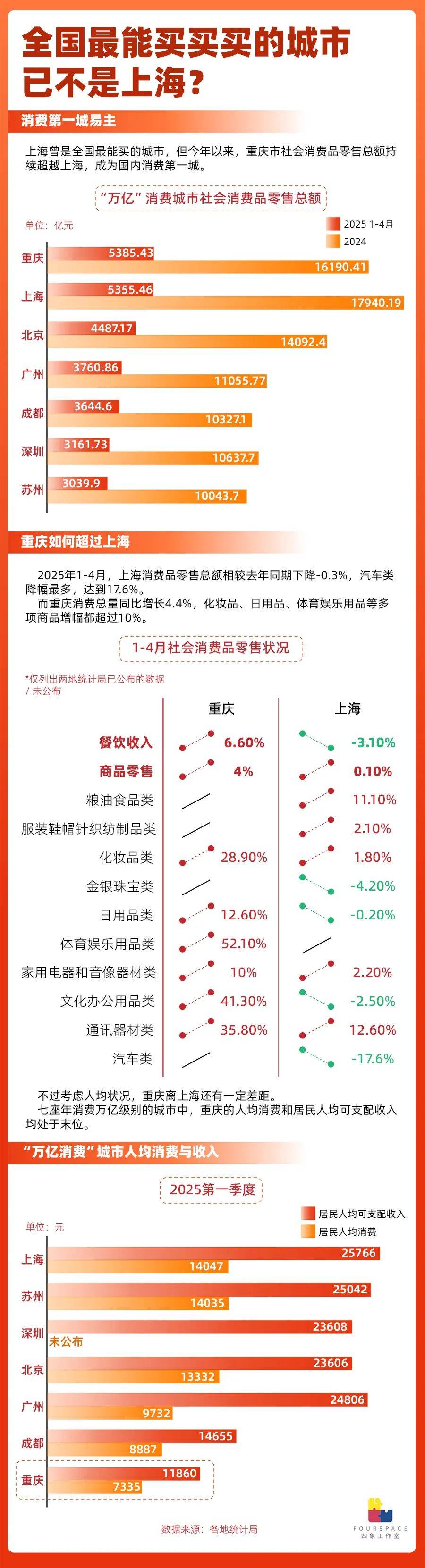
重庆消费比上海高?全国“最能买”背后钱花哪了
Sou Hu Cai Jing· 2025-07-05 05:33
Core Viewpoint - Chongqing has surpassed Shanghai to become the top city in China for consumer spending, marking a significant shift in the retail landscape [1][9]. Retail Performance Comparison - In the first four months of 2025, Shanghai's retail sales decreased by 0.3% year-on-year, with the automotive sector experiencing the largest decline of 17.6% [3][6]. - Conversely, Chongqing's total consumption increased by 4.4%, with several categories such as cosmetics, daily necessities, and sports entertainment goods seeing growth rates exceeding 10% [3][6]. Historical Context - Prior to 2020, Chongqing consistently ranked behind major cities like Beijing, Shanghai, and Guangzhou in terms of retail sales. However, it surpassed Guangzhou in 2020 to become the third city to achieve over 1 trillion yuan in consumption [9]. - The trend of Chongqing's rising consumption was evident in 2024, where it recorded a growth rate of 3.6%, while Shanghai and Beijing faced declines of 2.5% and 3.1%, respectively [9]. Factors Influencing Consumption - The decline in consumption in major cities like Shanghai and Beijing is attributed to high living costs, limited statistical coverage of consumption indicators, and other factors such as online shopping and service consumption not being included [9]. - Chongqing's growth is supported by policies that stimulate consumption, including the rise of county-level commerce and the development of first-store economies [9]. Demographic Considerations - Despite its current consumer spending leadership, Chongqing still lags behind Shanghai in per capita consumption and disposable income, ranking last among the seven cities with over 1 trillion yuan in consumption [7][10]. - As of the end of 2024, Chongqing's resident population reached approximately 31.9 million, compared to Shanghai's 24.8 million, indicating a significant demographic advantage for Chongqing [10].

波士顿咨询高管看好中国市场消费潜力 希望国补政策延续
news flash· 2025-07-03 14:47
Group 1 - The Chinese consumer market is currently in a process of recovery and stimulation, with trade-in programs for old products playing a significant role [1] - Trade-in initiatives are primarily encouraging low-frequency purchases, such as electronics, home appliances, and furniture [1] - There is a call for policies to promote high-frequency consumption and the development of the service industry, as well as support measures for families with children, low-income groups, and university students to further unleash consumption potential [1] Group 2 - The outlook for consumer potential in China remains optimistic if favorable policies are introduced in the second half of the year [1]
盛松成:消费需求对供给的促进更有效、更直接
Di Yi Cai Jing· 2025-07-03 03:04
Group 1 - The core viewpoint emphasizes the need to boost consumption and improve investment efficiency to expand domestic demand, marking a significant shift in macroeconomic policy [1] - China's consumption potential is closely linked to economic growth and income distribution, with current per capita GDP at approximately $13,000, indicating substantial room for growth compared to developed countries [2] - The consumption rate in China is currently around 56%, significantly lower than the 70%-80% typical in developed nations, suggesting that factors such as income distribution systems are limiting consumption potential [2] Group 2 - Consumption is expected to play a larger role in economic growth this year, as external trade uncertainties and diminishing returns on traditional investments highlight the need for domestic demand stimulation [3] - The relationship between consumption and investment is not mutually exclusive; rather, they can mutually reinforce each other, with consumption driving production, employment, and further investment [3] - The current economic challenges necessitate a focus on enhancing consumption to stabilize demand and promote growth, as ineffective investment is a key issue facing the economy [3] Group 3 - The disposable income to GDP ratio in China is 60.8%, significantly lower than the 70%-85% seen in developed countries, indicating structural issues in income distribution and consumer spending tendencies [4] - Policies aimed at boosting consumption have shown positive results, with retail sales growing by 5.0% year-on-year from January to May, aided by initiatives like "trade-in" programs and consumption vouchers [4] - Improving the income distribution system is crucial for increasing consumer spending and addressing the structural contradictions between policy incentives and consumer willingness [5] Group 4 - The service sector in China faces a significant deficit in high-quality supply, particularly in travel and healthcare, with high-income groups seeking services abroad due to insufficient domestic offerings [7][8] - Learning from past manufacturing sector reforms, opening up the service industry to foreign investment could enhance competition, improve service quality, and stimulate domestic consumption [8] - It is essential to create a favorable environment for foreign enterprises to invest long-term in China, which includes optimizing the business environment and providing policy support [9] Group 5 - Consumption is a fundamental driver of economic growth, with demand directly influencing production and investment, particularly in the service sector where consumption and production occur simultaneously [10] - Current policies focus on promoting consumption while improving investment efficiency to enhance the quality of supply, with high-tech investments showing significant growth [10] - Local governments play a crucial role in stimulating consumption, and there are suggestions to incorporate consumption metrics into their performance evaluations [11] Group 6 - Optimizing the value-added tax distribution mechanism could enhance local governments' motivation to promote consumption, thereby directly stimulating local economic growth [12] - Establishing a compensation mechanism for consumption-based tax distribution could encourage local governments to implement more proactive consumption policies [12]
寻找消费潜力群体——5月经济数据点评
一瑜中的· 2025-06-17 03:10
Core Viewpoint - The article emphasizes the need to revise the GDP growth forecast for the second quarter, projecting it to be between 5.2% and 5.4% due to strong performance in industrial and service sectors, alongside a notable rebound in consumer spending [2][5]. Economic Overview - In May, industrial production growth was recorded at 5.8%, while the service sector's production index grew by 6.2%. Consumer spending showed a year-on-year increase of 6.4%, up from 5.1% in April [20][25]. - Investment growth has slowed, with fixed asset investment growth at 2.7% in May, down from 3.5% in April. Real estate investment continued to decline, with a year-on-year drop of 12.0% [20][38]. Consumer Spending Insights - The article identifies several factors contributing to the unexpected rise in consumer spending, including accelerated "trade-in" programs, early promotional activities for the 618 shopping festival, and an increase in holidays compared to the previous year [6][10]. - Specific categories such as home appliances saw a significant increase in sales, with a 53% growth in May. Online shopping also surged, with an 8.2% increase compared to the previous year [27][28]. Consumer Potential Analysis - The article highlights five groups with increasing consumer potential: retirees, individuals with dividend income from listed companies, urban operators, rural wage earners, and those engaging in preventive savings [3][7]. - However, it also notes that certain groups, such as borrowers and urban private sector employees, require additional support to enhance their consumption potential [17][18]. Detailed Economic Data - The report provides a detailed analysis of May's economic data, indicating that the consumer price index (CPI) remained stable at -0.1%, while the producer price index (PPI) decreased by 3.3% [21][22]. - The unemployment rate in urban areas decreased to 5.0%, reflecting a slight improvement in the job market [22]. Investment Trends - Fixed asset investment growth has been primarily driven by sectors such as infrastructure and manufacturing, with manufacturing investment growth at 8.5% for the first five months of the year [38][40]. - The report also notes a decline in real estate investment, with new construction area down by 19.3% year-on-year in May [29][30].
以需求增量撬动发展增量(评论员观察)
Ren Min Ri Bao· 2025-04-22 21:52
Economic Growth - China's GDP grew by 5.4% year-on-year in Q1 2025, indicating a positive start for the year amid external uncertainties [1] - The continuous release of policy effects has contributed to high-quality development and economic recovery [1] Consumer Trends - Retail sales of consumer goods increased by 4.6% year-on-year in Q1, accelerating by 1.1 percentage points compared to the previous year [2] - Emerging consumption trends such as ice and snow economy, low-altitude economy, and silver economy are driving demand and attracting investment [2][3] Demand-Side Management - Effective demand management is crucial for economic recovery, with a focus on enhancing domestic consumption as a driving force [3] - The government has implemented policies to stimulate consumption, particularly targeting the shortfalls in effective demand [3][4] Investment Opportunities - The government is promoting effective investment to boost short-term economic growth and long-term stability [4] - Successful case studies, such as the transformation of a failed project into a biopharmaceutical park, highlight the potential for effective investment to enhance resource utilization [4] Export Growth - China's exports grew by 6.9% in Q1, reflecting the competitiveness of "Made in China" products in the global market [4] - The diverse demands of the global market are being met by Chinese enterprises, showcasing the adaptability and strength of the manufacturing sector [4] Market Potential - The Chinese market offers significant opportunities due to its large population and stable growth, fostering a positive interaction between supply and demand [5] - The ongoing development trends indicate a robust economic foundation, with potential for further growth and innovation [5]