
算力国产化

Search documents
电光科技:公司已投建的千卡级智算集群采用了业界领先的高性能算力芯片
Zheng Quan Ri Bao Wang· 2025-12-10 12:12
Core Viewpoint - The company has established a high-performance computing cluster utilizing industry-leading chips and is actively planning for domestic chip technology testing and cluster development in response to market demand [1] Group 1 - The company has built a thousand-level intelligent computing cluster [1] - The cluster employs leading high-performance computing chips [1] - The company is closely monitoring the trend of domestic chip localization [1] Group 2 - The company is proactively planning and advancing technology testing based on domestic chips [1] - The development of clusters will be aligned with market demand [1]

瑞银证券熊玮:现阶段中国出现“AI泡沫”可能性不大
Xin Hua Cai Jing· 2025-12-05 11:27
Core Viewpoint - UBS Securities analyst Xiong Wei believes that by 2026, the application cases of AI in China will become more abundant and the monetization pace will accelerate, indicating a low likelihood of an "AI bubble" in the current stage [1]. Group 1: AI Development in China - By 2025, investor interest and recognition of AI development in China are expected to increase due to advancements in large model technology, computing infrastructure, and the widespread adoption by enterprises and consumers [1]. - In 2026, domestic large model capabilities are anticipated to rapidly iterate, catching up with their American counterparts, while both China and the U.S. will follow similar monetization paths in AI applications, particularly in cloud services and advertising [1]. - The localization of computing power is expected to continue, with breakthroughs in chip performance, leading to supernodes taking a larger share of inference and training workloads [1]. Group 2: Factors Mitigating AI Bubble Risks - The limited cycle of financing is a key reason for the low likelihood of an "AI bubble," as leading AI model developers are funded by internal cash flows from parent companies rather than third-party financing [1]. - Major Chinese internet companies are adopting a pragmatic approach to AI investments, focusing on return on investment and operational efficiency rather than excessive initial spending [1]. - The stability of the Internet Data Center (IDC) deployment rate and regulatory control over new supply, including strict management of electricity quotas by the National Development and Reform Commission, help prevent overbuilding [1]. Group 3: AI Disruption in Vertical Industries - The discussion around AI's potential to disrupt vertical industries is increasing among investors, but the pace of disruption in China may remain slow due to a more fragmented landscape of AI chatbots compared to the dominance of ChatGPT and Gemini in the U.S. [2]. - Vertical industry companies are actively integrating AI and intelligent agents into their applications, but the high entry barriers in sectors like online travel agencies (OTA) and online music content and user operations make it difficult for AI to easily replace existing capabilities [2].
中国银河证券:AI价值重心向应用端转移 聚焦元件等新机遇
智通财经网· 2025-11-26 02:30
Core Viewpoint - The electronic industry is undergoing a critical transition driven by AI, shifting from computing infrastructure to application implementation by 2026, with overall valuations being high and investment logic needing to shift from valuation expansion to profit realization [1][2] Semiconductor Sector - The semiconductor industry is expected to continue its rapid growth into 2026, with key trends including the push for domestic computing power and a significant cycle in storage [3] - The demand for AI and high-bandwidth memory (HBM) is expected to drive a new growth cycle in semiconductor manufacturing, with a focus on domestic semiconductor equipment and materials [3] Consumer Electronics - The consumer electronics sector is anticipated to see accelerated development in AI applications, particularly in mobile devices and smart imaging equipment, leading to significant revenue growth [4] - Investment opportunities are emerging from the rapid penetration of AI in small-end devices and upgrades in large-end devices, including foldable screens and enhanced imaging functions [4] Components and Devices - The demand for printed circuit boards (PCBs) is expected to remain high due to AI, with leading manufacturers expanding production to meet growing downstream needs [5] - The storage industry's upward cycle is driving demand for packaging substrates, while passive components like chip inductors and tantalum capacitors are also areas of focus [5] - The optical components market is benefiting from the upgrade of smart phone optics and the proliferation of new consumer electronic products [5]

禾盛新材(002290):首次覆盖报告:主业行稳致远,布局AI拓展业务边界
Haitong Securities International· 2025-11-24 08:12
Investment Rating - The report initiates coverage with an "Outperform" rating for the company [4]. Core Insights - The company is a leader in the home appliance composite materials sector, maintaining stable operations while strategically expanding into AI chips and servers, capitalizing on the domestic computing power wave, indicating significant future growth potential [4][10]. - Revenue projections for 2025-2027 are estimated at 30.06 billion, 35.22 billion, and 40.87 billion RMB, with corresponding EPS of 0.83, 1.19, and 1.68 RMB [10][14]. Financial Summary - Total revenue for 2023 is projected at 2,340 million RMB, with a year-on-year growth of 9.7%. This is expected to grow to 2,526 million RMB in 2024, 3,006 million RMB in 2025, 3,522 million RMB in 2026, and 4,087 million RMB in 2027, reflecting growth rates of 7.9%, 19.0%, 17.2%, and 16.0% respectively [3][10]. - Net profit attributable to the parent company is forecasted to be 83 million RMB in 2023, increasing to 98 million RMB in 2024, 207 million RMB in 2025, 296 million RMB in 2026, and 417 million RMB in 2027, with growth rates of 25.5%, 18.3%, 111.2%, 43.1%, and 41.0% respectively [3][10]. Business Overview - The company has over 20 years of experience in the home appliance composite materials sector, focusing on PCM (pre-coated metal sheets) and VCM (film-coated metal sheets) used in various home appliances [19][20]. - The company has established a subsidiary, Haixi Technology, to advance its AI transformation, focusing on AI servers and intelligent computing centers, which have already begun to generate significant orders and profits [4][9]. AI Business Expansion - The AI business is expected to see rapid growth, with revenue projections of 300 million RMB in 2025, 600 million RMB in 2026, and 960 million RMB in 2027, reflecting growth rates of 100% and 60% for the latter two years [9][11]. - The company is actively building a diversified product matrix in the AI sector, including hardware, software, and industry-specific solutions, to enhance its market presence [39][44]. Valuation Analysis - The report employs both PE and PS valuation methods, estimating a reasonable valuation of 147.90 billion RMB based on a 50x PE for 2026, corresponding to a target price of 59.61 RMB per share [4][16]. - The average PE of comparable companies is around 43.54x for 2026, indicating a strong growth trajectory for the company [14][15].

A股午评 | 三大指数弱势震荡 军工板块逆势上扬 贵金属板块跌幅居前
智通财经网· 2025-11-17 03:57
Core Viewpoint - The market is experiencing a weak and volatile trend, with significant movements in various sectors, particularly in defense, lithium, AI, and storage chips, while facing declines in gold and certain pharmaceutical stocks [1][2][3][4][5]. Group 1: Market Performance - The three major indices closed lower, with the Shanghai Composite Index down 0.43%, Shenzhen Component Index down 0.35%, and ChiNext Index down 0.80% [1]. - The market continues to show a trend of adjustment, with strong performances in sectors such as defense, lithium resources, AI applications, and storage chips [1][2]. Group 2: Sector Highlights - **Defense and Military Industry**: The defense sector saw a strong performance, with stocks like Changcheng Military Industry and Jianglong Shipbuilding hitting the daily limit. Increased geopolitical tensions are expected to boost investment in national defense [3]. - **Lithium Sector**: The lithium sector rebounded, with companies like Shengxin Lithium Energy and Rongjie Shares reaching the daily limit. The price surge in lithium materials and ongoing demand in the supply chain are driving this growth [4]. - **AI Sector**: Huawei's computing concept stocks surged, with companies like Huasheng Tiancheng and Dongfang Guoxin seeing significant gains. Huawei is set to release breakthrough AI technology, enhancing resource management for AI training [5]. Group 3: Institutional Insights - **Market Sentiment**: The A-share sentiment index is declining, while the Hong Kong stock sentiment index is rising. Institutions are focusing on sectors like basic chemicals, defense, and non-bank financials [6][7]. - **Investment Opportunities**: The current market environment suggests a rotation towards sectors with earnings support, including energy storage, batteries, and military industries [8][9].





政策与产业共振,科技突破迎来“加速度”
Mei Ri Jing Ji Xin Wen· 2025-10-28 01:29
Core Insights - The capital market policies have increasingly favored the technology sector over the past two years, focusing on "supporting the development of new productive forces" [1] - The escalation of the US-China tech rivalry has acted as a catalyst for domestic innovation, with companies like Huawei and BYD making significant advancements [1] - A positive feedback loop has formed, characterized by "policy benefits → technological breakthroughs → market expansion" [1] - The ongoing domestic advancements in computing power, AI applications, and robotics are expected to enhance the competitiveness and valuation of Chinese tech companies against US counterparts [1] - The Federal Reserve's interest rate cuts have alleviated global dollar liquidity pressures, benefiting the valuation recovery of Hong Kong tech stocks [1] Industry Summary - The technology sector is experiencing a shift from being a "follower" to a "leader" in innovation, with significant breakthroughs in areas such as AI and robotics [1] - Companies like iFlytek have surpassed international counterparts in core capabilities, while the smart car industry has established a presence in the global market [1] - The influx of resources into the tech sector is supported by favorable policies, which are expected to continue driving growth and expansion [1] - The low interest rate environment is enhancing the attractiveness of Hong Kong tech stocks as high-growth assets, supported by increased foreign investment in emerging markets [1] ETF Overview - The Hong Kong Stock Connect Technology ETF (159101) covers the entire technology industry chain [2] - The Hang Seng Internet ETF (513330) focuses on leading internet companies [2]
算力狂飙带飞光模块
2 1 Shi Ji Jing Ji Bao Dao· 2025-10-24 23:08
Core Insights - The domestic computing power industry in China is entering a period of explosive growth by 2025, driven by high capital expenditure from major companies and a consensus on domestic computing power [1][2] - The industry is transitioning from the first phase of scale expansion to the second phase, which focuses on deep integration with the real economy and value creation [1] - The light module sector is expected to benefit significantly from this computing power revolution [1] Demand Side - Major companies are maintaining high growth in capital expenditure, contributing to the consensus on domestic computing power [2] - By 2025, China's intelligent computing power scale is projected to reach 1037.3 EFLOPS, with a compound annual growth rate of 46.2% from 2023 to 2028 [3] - The global AI computing power market is expected to reach $1.2 trillion by 2025, with China accounting for 38% of this market [3] Supply Side - Breakthroughs in advanced processes and innovations from companies like Cambrian and Moore Threads are leading to revenue growth [2] - The domestic computing power industry is gradually forming a self-controlled supply chain, supported by significant R&D investments [4] - Companies like Zhongji Xuchuang and NewEase have shown strong financial performance, with Zhongji Xuchuang achieving a revenue of 14.789 billion yuan in the first half of 2025, a year-on-year increase of 36.95% [4] Market Dynamics - The light module market is experiencing a surge in demand, particularly for high-speed products, with Zhongji Xuchuang's gross margin reaching 39.96% [4][5] - The competition landscape shows that Chinese manufacturers dominate the global midstream market, with Zhongji Xuchuang and NewEase ranking among the top three globally [6] - The growth of GPU servers and the increasing penetration of silicon photonic modules are expected to drive further demand for light modules [7] Future Outlook - The capital expenditure of four major overseas cloud companies is expected to increase by 50% to $333.8 billion in 2025 [8] - The demand for light modules is anticipated to continue growing due to advancements in AI and deep learning applications [7][8] - Companies are focusing on high-quality delivery capabilities and supply chain management to maintain competitive advantages in the market [9]


数字经济ETF(560800)盘中涨超1%,英伟达千亿合作催化算力国产化浪潮
Xin Lang Cai Jing· 2025-09-24 02:40
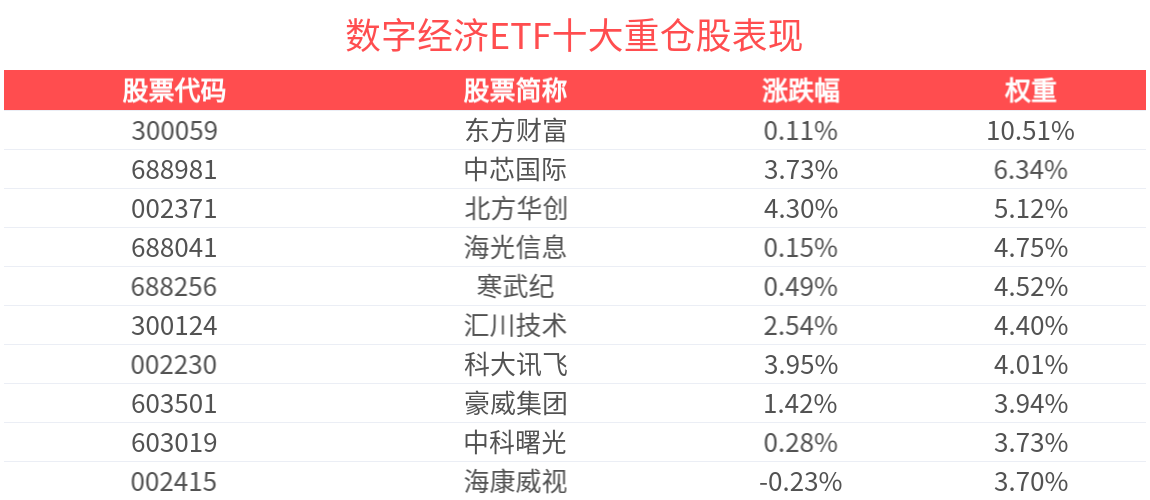
Core Insights - The digital economy theme index (931582) has shown a strong increase of 1.11%, with notable gains in constituent stocks such as Shengmei Shanghai (688082) up by 8.32% and Zhongkong Technology (688777) up by 6.46% [1] - NVIDIA and OpenAI have announced a partnership to deploy at least 10 gigawatts of NVIDIA systems for OpenAI's next-generation AI infrastructure, with an investment of up to $100 billion (approximately 71 billion RMB) from NVIDIA [1] - The Chinese intelligent computing power is projected to reach 725.3 exaFLOPS in 2024, a year-on-year growth of 74.1%, and is expected to reach 1,037.3 exaFLOPS in 2025, indicating a significant increase in demand for GPU and other chips [2] Digital Economy ETF Performance - The digital economy ETF (560800) has increased by 1.26%, with a trading volume of 8.0542 million RMB and a turnover rate of 1.15% [1] - Over the past month, the average daily trading volume of the digital economy ETF was 36.94 million RMB, ranking it first among comparable funds [1] Key Constituents of the Index - As of August 29, 2025, the top ten weighted stocks in the digital economy theme index account for 53.36% of the index, including Dongfang Caifu (300059), Cambricon (688256), and SMIC (688981) [3] - The weightings of the top stocks are as follows: Dongfang Caifu (10.51%), SMIC (6.34%), and Northern Huachuang (5.12%) [5]


牛市急刹车?寒武纪领跌超13%,后市怎么看?科创人工智能ETF重挫5%,资金积极抢筹589520!
Xin Lang Ji Jin· 2025-09-04 05:51
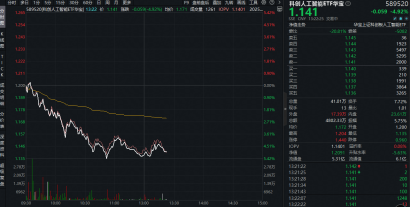
Core Viewpoint - The technology sector, particularly the domestic AI industry chain, is experiencing a pullback, with the Sci-Tech Innovation Artificial Intelligence ETF (589520) seeing a nearly 5% drop in price, despite significant capital inflow over recent weeks [1][3]. Group 1: Market Performance - The Sci-Tech Innovation Artificial Intelligence ETF (589520) has seen a cumulative increase of 58.60% since its recent low on April 8, outperforming other indices such as the Sci-Tech 50 (41.37%) and the Sci-Tech Composite Index (50.51%) [3][4]. - In the last five days, the ETF attracted 73.78 million yuan, and over the past 60 days, it has garnered 286 million yuan [1]. Group 2: Component Stocks - Among the ETF's component stocks, Qi Anxin and New Point Software showed gains, while 28 other stocks declined, with notable drops in stocks like Cambrian (over 13%) and Lingyun Light (over 13%) [1]. - Cambrian, as a leading AI chip company, has seen its weight in the Sci-Tech 50 index exceed 15%, raising concerns about potential sell-offs due to index adjustments [5]. Group 3: Future Outlook - Analysts suggest that the current rally in the semiconductor sector is a response to overseas market trends, with significant opportunities expected towards the end of the year and into next year as AI applications develop [5][6]. - The domestic AI sector is anticipated to continue growing, with projections indicating a doubling of market capacity by 2025 due to increasing demand for domestic computing power [6]. Group 4: Investment Highlights - The Sci-Tech Innovation Artificial Intelligence ETF (589520) is positioned to benefit from policy support and the trend of domestic substitution in technology, making it an attractive investment option [7]. - The ETF's structure allows for lower entry barriers and higher efficiency during market surges, with a significant concentration in semiconductor stocks [7][8].

海光信息(688041):业绩持续高增,构建算力全产业链布局
Tai Ping Yang Zheng Quan· 2025-09-03 15:27
Investment Rating - The report maintains a "Buy" rating for the company, with a target price based on the last closing price of 201.89 [1][6]. Core Insights - The company has demonstrated sustained high growth, with a focus on building a comprehensive computing power industry chain [6][12]. - In H1 2025, the company achieved operating revenue of 5.464 billion, a year-on-year increase of 45.21%, and a net profit attributable to shareholders of 1.201 billion, up 40.78% [4][5]. - The company is expected to benefit from the trend of domestic computing power localization and the rapid growth of AI technology, with predictions indicating that China's intelligent computing power scale will reach 2,781.9 EFLOPS by 2028, with a compound annual growth rate of 46.2% [6][8]. - The merger with Zhongke Shuguang aims to create a vertically integrated capability from chip design to server manufacturing and cloud computing services, enhancing competitiveness against international leaders [6][8]. Financial Performance - In Q2 2025, the company reported revenue of 3.064 billion, a year-on-year increase of 41.15%, and a net profit of 696 million, up 23.14% [5]. - The gross margin for Q2 was 59.33%, reflecting a decrease of 4.5 percentage points due to product mix adjustments and increased material costs [5]. - The company’s operating cash flow reached 2.177 billion in H1 2025, compared to a negative 113 million in the same period last year, indicating strong cash generation [5][6]. Revenue and Profit Forecast - The company is projected to achieve operating revenues of 13.949 billion, 19.906 billion, and 26.938 billion for 2025, 2026, and 2027 respectively, with net profits of 3.028 billion, 4.509 billion, and 6.324 billion [6][8]. - The expected revenue growth rates are 52.25% for 2025, 42.70% for 2026, and 35.33% for 2027 [8][14].
