
自动驾驶

Search documents
汽车巨头变身AI大厂?63亿美元砸向AI,建数据中心和机器人工厂
Hua Er Jie Jian Wen· 2026-02-27 06:42
Core Viewpoint - Hyundai Motor's announcement of a $6.3 billion investment in South Korea aims to accelerate the development of AI and robotics technologies, creating 71,000 jobs and positively impacting the Korean stock market [1][4][8]. Group 1: Investment Details - The investment plan includes the construction of an AI data center, a robotics factory, and green hydrogen facilities, with completion expected by the end of 2029 [4][5]. - The AI data center will receive 5.8 trillion KRW, equipped with 50,000 GPUs to support autonomous vehicle development and deep learning for robots [5]. - A budget of 400 billion KRW is allocated for the first robotics factory in Korea, focusing on mass production of wearable robots and other industrial models [5]. Group 2: Renewable Energy and Technology Partnerships - The investment also includes 1 trillion KRW for a water electrolysis facility capable of producing 80 tons of green hydrogen daily, and 1.3 trillion KRW for solar power plants to support AI and hydrogen projects [6]. - Hyundai is deepening collaborations with top global tech companies, including a partnership with NVIDIA to develop a national-level physical AI cluster [6]. Group 3: Economic Impact and Strategic Response - This large-scale investment is a strategic response to external pressures faced by Hyundai's core automotive business, including potential tariffs in the U.S. and competition from Chinese manufacturers [8]. - The project aligns with the South Korean government's economic vision, aiming to create more jobs and shift economic focus from major cities to regional areas [8].


蔚来芯片子公司获超22亿元融资,成立8个月估值超百亿
Huan Qiu Lao Hu Cai Jing· 2026-02-27 03:41
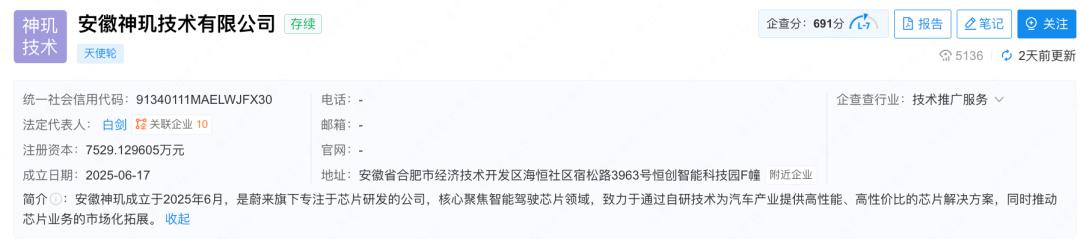
Core Insights - NIO's subsidiary, Anhui Shenqi Technology Co., Ltd., has completed its first round of equity financing, raising over 2.2 billion yuan, with a post-financing valuation nearing 10 billion yuan [1] - The financing attracted several industry capital and leading institutions, including Hefei Guotou, Hefei Haiheng, IDG Capital, and others [1] - The funds will support the continuous research and promotion of high-end, competitive chip products, aiding NIO's long-term strategies in autonomous driving and embodied intelligence [1] Financing Details - After the financing, NIO retains a 62.7% stake in Anhui Shenqi, maintaining absolute control, while external investors hold a combined 27.3% [1] - The remaining 10% is held by entities involved in a management equity incentive plan [1] Company Operations - Anhui Shenqi is the first company in China to develop 5nm automotive-grade chips and achieve large-scale commercialization, with core products covering smart driving, vehicle computing, and vehicle networking [2] - Since its production began in 2024, the company has shipped over 150,000 units, successfully deploying them across NIO's entire vehicle lineup [2] Leadership and Expertise - The legal representative of Anhui Shenqi is Bai Jian, NIO's Senior Vice President and head of smart hardware, who has extensive experience in hardware and chip industries [2] - Bai Jian previously held significant roles at OPPO and Xiaomi before joining NIO in 2020 [2] - Zhang Danyu, a co-founder and director, has a strong background in SoC chip and processor design, having worked at Huawei HiSilicon before joining NIO [2]

开源证券:伯特利拟收购豫北转向 汽车行业整合迎线控变革时代
Zhi Tong Cai Jing· 2026-02-27 03:01
Core Viewpoint - Berteli (603596.SH), a leading player in the braking system industry, plans to acquire a 50.97% stake in Yubei Steering to achieve control, enhancing its chassis layout and benefiting from the rise of autonomous driving and steer-by-wire technology [1][3]. Group 1: Acquisition Details - Berteli announced on February 25 that it intends to use its own funds to acquire a 50.97% stake in Yubei Steering from shareholders Junhong Industrial, Hefei Huaxin, and Hefei Chanchuang, making it the controlling shareholder post-acquisition [1]. - The valuation of the transaction is capped at 2.2 billion yuan, with the purchase price not exceeding 1.12 billion yuan, pending regulatory approvals [1]. Group 2: Yubei Steering's Market Position - Established in 1969, Yubei Steering specializes in mechanical, electronic, and hydraulic steering systems, achieving a sales volume of over 5 million steering devices in 2021, with a market share of 20% [2]. - The company is set to generate revenues of 3.03 billion yuan and 3.18 billion yuan in 2024 and 2025, respectively, with net profits of 120 million yuan and 160 million yuan [2]. Group 3: Strategic Benefits of the Acquisition - The acquisition is expected to enhance Berteli's comprehensive layout in the chassis sector, facilitating better synergy across customers, products, and supply chains [3]. - Berteli's existing product range includes brake calipers, electronic parking brake systems, and steer-by-wire systems, with the acquisition allowing for improved development capabilities in key components like ball screws and motor controls [3]. Group 4: Industry Trends and Opportunities - The trend towards autonomous driving presents a significant opportunity for steer-by-wire technology, which is well-suited for autonomous vehicles due to its variable steering ratio and enhanced safety features [4]. - As autonomous driving becomes mainstream, steer-by-wire systems are expected to become standard in vehicles, benefiting industry players [4].

开源证券:伯特利(603596.SH)拟收购豫北转向 汽车行业整合迎线控变革时代
智通财经网· 2026-02-27 02:58
Group 1 - Berteli plans to acquire 50.97% stake in Yubei Steering to achieve control, with the transaction value not exceeding 1.12 billion yuan and the total valuation of the target not exceeding 2.2 billion yuan [2] - Yubei Steering is a leading player in the steering system industry, projected to achieve revenues of 3.18 billion yuan in 2025, with a market share of 20% in steering gear sales [3] - The acquisition is expected to enhance Berteli's layout in the chassis sector, creating synergies in customers, products, and supply chains [4] Group 2 - The rise of autonomous driving presents a historical opportunity for steer-by-wire technology, which is well-suited for autonomous vehicles due to its advantages such as variable steering ratio and enhanced safety [5] - The investment landscape includes beneficiaries such as Berteli, Asia-Pacific Holdings, and others, as the industry shifts towards autonomous driving and steer-by-wire systems [5]
谷歌新模型Nano Banana 2来了;手机厂商或集中涨价
2 1 Shi Ji Jing Ji Bao Dao· 2026-02-27 02:34
Group 1: Technology Developments - Google launched the next-generation image generation model Nano Banana 2, featuring improvements in subject consistency, instruction adherence, and the ability to produce high-quality materials across various resolutions from 512 pixels to 4K [2] - Anthropic acquired Seattle-based AI startup Vercept to enhance its AI model Claude with visual capabilities, allowing it to perform complex tasks by interacting with computer interfaces [4] - Huawei Cloud released the public beta of its CodeArts code AI, integrating large code models and supporting various coding processes to improve developer efficiency [5] Group 2: Market Trends - In February 2026, China's AI model API usage surged by 127%, surpassing the US for the first time, with four out of the top five models globally coming from Chinese companies, contributing to 85.7% of the total usage [6] - Major smartphone manufacturers are planning to raise prices due to an over 80% increase in storage chip procurement costs compared to the previous year, marking the largest collective price adjustment in five years [11] Group 3: Corporate Actions - Shanghai AI startup Jieyue Xingchen is reportedly planning an IPO in Hong Kong, aiming to raise approximately $500 million, with a potential filing timeline in the first half of the year [12] - NIO's chip subsidiary, Anhui Shenji Technology, completed its first round of financing exceeding 2.2 billion yuan, which will support its long-term plans in autonomous driving and intelligent systems [12] - Ruixin Technology plans to acquire a 51% stake in Deheng Equipment through a combination of stock issuance and cash payment, focusing on automotive parts and intelligent equipment solutions [13]
驶向 2030:自动驾驶的商业化浪潮与规则重构
3 6 Ke· 2026-02-27 02:33
Group 1 - The core viewpoint of the articles revolves around the transformative impact of AI on the autonomous driving industry, predicting a significant shift towards widespread adoption by 2030, driven by advancements in technology and regulatory frameworks [2][14][41] - The United Nations' global regulations for autonomous driving systems are set to be implemented in February 2026, paving the way for legal operation of autonomous vehicles on public roads [1][14] - The market for Robotaxi and Robobus is expected to grow significantly, with Robotaxi operating costs projected to decrease by over 60% by 2030, making it a mainstream transportation option [15][18] Group 2 - The development of autonomous driving is characterized by a transition from Level 2 to Level 4 automation, with AI capabilities evolving from perception assistance to decision-making and autonomous evolution [3][4] - The integration of AI models and Agent intelligence is enhancing the decision-making capabilities of autonomous vehicles, allowing for real-time data processing and improved safety [7][9] - The cost of essential hardware components, such as LiDAR, is decreasing significantly, enabling broader access to autonomous driving technology [6][29] Group 3 - The employment landscape is expected to undergo a major transformation, with millions of professional drivers facing job displacement due to the rise of autonomous vehicles [26][27] - Traditional transportation industries, including automotive manufacturing and logistics, are predicted to face structural collapse, necessitating a reevaluation of market valuations [28][29] - The financial markets are likely to experience ripple effects from the shift to autonomous driving, with increased default rates on loans related to traditional transportation businesses [30][31] Group 4 - The articles emphasize the need for a restructured legal and regulatory framework to accommodate the unique challenges posed by autonomous driving technology [33][34] - A collaborative regulatory approach is essential to address the cross-industry and cross-regional nature of autonomous driving, requiring the integration of various governmental departments [36][37] - The societal implications of autonomous driving necessitate a proactive adaptation in urban planning, employment training, and income distribution to ensure equitable access to the benefits of this technology [39][40][42]

融资22亿,安徽冲出一家AI芯片独角兽,蔚来李斌是背后老板
3 6 Ke· 2026-02-27 02:29
Core Viewpoint - NIO's chip subsidiary, Anhui Shenji, has completed its first round of equity financing, raising over 2.2 billion yuan, with a post-financing valuation nearing 10 billion yuan, supported by various investors [1]. Group 1: Financing and Valuation - Anhui Shenji's first round of financing exceeded 2.2 billion yuan, with a post-financing valuation close to 10 billion yuan [1]. - Investors in this round include Hefei Guotou, Hefei Haiheng, IDG Capital, and others [1]. Group 2: Company Overview - Anhui Shenji, established in June 2025, is the first company in China to develop 5nm automotive-grade chips and achieve large-scale commercialization [1][2]. - The company focuses on high-performance, cost-effective chip solutions for the automotive industry, particularly in smart driving [2]. Group 3: Leadership and Expertise - Key personnel include Chairman Li Bin, General Manager Bai Jian, and Chip Design Head Zhang Danyu, all of whom have significant experience in the tech and automotive sectors [3]. - Li Bin is the founder and CEO of NIO, while Bai Jian has a background in hardware management at OPPO and Xiaomi [3]. Group 4: Product Development - The self-developed smart driving chip, Shenji NX9031, has successfully completed its tape-out and is based on 5nm technology, featuring over 50 billion transistors and a 32-core CPU [5]. - Since its production in 2024, over 150,000 units of the NX9031 chip have been shipped and deployed across NIO's entire vehicle lineup [6]. Group 5: Future Plans - Following this financing, Anhui Shenji plans to launch next-generation high-performance chips and expand into emerging fields such as embodied robotics and AGI solutions [6].
营收下滑3%,百度却拿出50亿美元
Sou Hu Cai Jing· 2026-02-27 01:19
Core Viewpoint - The financial report released by Baidu is not a routine disclosure but a proactive valuation reconstruction, indicating a shift in the company's strategy towards capital management and asset valuation amidst declining traditional revenue streams [2]. Financial Performance - In Q4 2025, Baidu reported total revenue of 32.74 billion RMB, slightly exceeding market expectations, with core AI business revenue surpassing 11 billion RMB, accounting for 43% of general business revenue [2]. - For the entire year of 2025, Baidu's total revenue was 129.1 billion RMB, a year-on-year decrease of 3% [2]. - The company faced a significant increase in sales costs, which rose by 10% to 72.4 billion RMB, while sales and management expenses increased by 9% to 25.8 billion RMB [3]. Capital Management Actions - Baidu announced a share buyback plan with an authorization limit of 5 billion USD, equivalent to approximately 35 billion RMB, representing nearly 10% of its total market capitalization [3]. - The company also approved a dividend policy for the first time, with the first dividend expected to be paid by the end of 2026 [2]. Asset Valuation Strategy - Baidu's management is attempting to shift investor focus from traditional advertising revenue models to a new valuation logic through financial maneuvers, including the planned spin-off of its core AI chip business, Kunlun Chip, which has submitted a listing application in Hong Kong [2][10]. - The valuation of Kunlun Chip is reported to be around 21 billion RMB, indicating a strategic move to separate heavy asset investments from the core business [10]. Cash Flow and Financial Discipline - Baidu's operating cash flow was under pressure, with a net cash flow from operating activities of negative 3 billion RMB and free cash flow at negative 15.1 billion RMB after capital expenditures [8]. - The company is using non-operating income from asset disposals to support its dividend payments, reflecting a significant shift in its financial strategy [6][8]. Market Response and Future Outlook - Investment institutions have responded positively to Baidu's strategic moves, with Barclays including Kunlun Chip in its valuation framework and raising its target price to 147 USD [13]. - The sustainability of the company's buyback and dividend strategy will depend on the recovery of positive cash flow from its core business rather than relying on one-time asset disposals [13][14].


中原证券晨会聚焦-20260227
Zhongyuan Securities· 2026-02-27 00:22
Core Insights - The report highlights the strong performance of the communication and electronic sectors, indicating a bullish trend in the A-share market with a focus on long-term investment opportunities [5][9][10] - The report notes a significant decline in the Chinese automotive market, with a 32.1% month-on-month drop in sales for January 2026, reflecting ongoing challenges in the sector [4][21] - The report emphasizes the impact of macroeconomic factors, including the appreciation of the RMB against the USD, which is expected to enhance the attractiveness of Chinese assets for global investors [4][9] Domestic Market Performance - The Shanghai Composite Index closed at 4,146.63 with a slight decline of -0.01%, while the Shenzhen Component Index rose by 0.19% to 14,503.79 [3] - The average P/E ratios for the Shanghai Composite and ChiNext indices are 17.04 and 53.74, respectively, indicating a favorable long-term investment environment [8][9] Industry Analysis - The report discusses the strong performance of the power and utilities sector, with the index rising by 2.05% in February, outperforming the broader market [14][15] - The report highlights the significant drop in box office revenues during the 2026 Spring Festival, with total box office earnings of 5.697 billion yuan, a decrease of 40.09% year-on-year [17][18] - The automotive sector is experiencing a shift, with a notable increase in commercial vehicle sales, while passenger vehicle sales are declining [21][22] Investment Recommendations - The report suggests maintaining a "stronger than market" investment rating for the power and utilities sector, focusing on stable, high-dividend companies and emerging opportunities in virtual power plants and controlled nuclear fusion [16] - In the automotive sector, the report recommends focusing on intelligent driving technologies and the transition to electric vehicles, as well as companies involved in robotics and liquid cooling technologies [23] - The report advises investors to pay attention to companies with strong content creation capabilities and efficient cinema operations in the film industry, as they are expected to benefit from the evolving market dynamics [20]

估值近百亿元!蔚来芯片子公司完成22亿元首轮融资
Zhong Guo Zheng Quan Bao· 2026-02-26 23:59
Group 1 - NIO's subsidiary, Anhui Shenqi Technology Co., Ltd., completed its first round of equity financing, raising over 2.2 billion yuan, with a post-investment valuation nearing 10 billion yuan [1] - After the financing, NIO will retain a 62.7% stake in Anhui Shenqi, while investors will hold a combined 27.3%, and the remaining 10% will be held by management incentive plan entities [1] - The financing will support Anhui Shenqi's ongoing research and development of high-end, competitive chip products, aiding NIO's long-term strategy in autonomous driving and embodied intelligence [1] Group 2 - The automotive chip is referred to as the "digital heart" and "smart brain" of vehicles, directly influencing driving intelligence levels, cabin fluidity, safety response speed, and electrification efficiency [2] - NIO decided to develop its own intelligent driving chips in 2021, aiming to achieve full self-research of core technologies from NPU to SoC [2] Group 3 - Since its production in 2024, the "Shenqi NX9031" chip has shipped over 150,000 units, all installed in NIO's own brand vehicles [3] - The cost of chips is increasingly becoming a significant portion of the overall vehicle cost, potentially becoming a core profit area [3] - Other leading automakers, including BYD, XPeng, and Li Auto, are also developing their own chips, indicating a competitive landscape in the self-research of automotive chips [3] - Following this financing, Anhui Shenqi plans to launch high-performance chips for the next generation of intelligent driving and expand into emerging businesses such as embodied robotics and agent reasoning [3]