
量化宽松

Search documents
金荣中国:美联储12月利率分歧加剧,金价扩大回落维持偏空震荡
Sou Hu Cai Jing· 2025-11-18 01:51
行情回顾: 国际黄金周一(11月17日)再度收跌,开盘价4086.20美元/盎司,最高价4106.68美元/盎司,最低价4049.65美 元/盎司,收盘价4064.11美元/盎司。 消息面: 纽约联储周一表示,11月全州制造业商业状况指数上升8点,至18.7,反映出经济活动加速扩张。 评论称,尽管制造业的乐观情绪有所减弱,但随着信号显示需求改善,美国纽约州的制造业活动本月意外加快 步伐。这是过去5个月来第四次出现正面读数。该行表示,新订单和发货量大幅增加,而交货时间略有延长, 供应可及性有所减弱。纽约联储经济研究顾问Richard Deitz表示,"纽约州制造业活动稳步增长,就业水平和工 作时间都小幅上升。"不过,他补充称,尽管企业预期情况会改善,但对未来的乐观情绪却有所下降。该行表 示,尽管投入和销售价格的增速放缓,但仍处于高位。报告指出,劳动力市场指标有所改善,就业人数小幅增 加,平均每周工作时间延长。由于政府关门导致经济数据缺乏,物价和就业市场的发展可能会受到更密切的关 注。本次调查是在11月3日至11月10日期间收集的。 美联储理事沃勒表示,他支持在12月的会议上再次降息,因为他越来越担心劳动力市场和 ...


美联储沃勒:假如自己是美联储主席更早就会停止QE
Sou Hu Cai Jing· 2025-11-17 22:55
Core Viewpoint - Federal Reserve Governor Christopher Waller suggests that if he were the Fed Chair, he would have halted quantitative easing (QE) earlier, indicating that the current state of the Fed's balance sheet is quite ideal [1] Group 1: Federal Reserve's Balance Sheet - Waller believes that the Fed's balance sheet will not remain static, as natural reserve demand will drive its expansion, with potential growth occurring within a month or a few months [1] - He anticipates no significant changes in fiscal stimulus measures next year [1] Group 2: Market Interest Rates - Waller notes that market interest rates are gradually rising, indicating that the Fed is nearing a state of reserve scarcity, while the neutral level of interest rates remains unclear [1] - The Fed cannot simply refrain from cutting rates due to inflation being above target for five consecutive years; more substantial justification is required [1] - If the job market shows signs of recovery, the necessity for "insurance rate cuts" will diminish [1]
宏观金融类:文字早评2025-11-17-20251117
Wu Kuang Qi Huo· 2025-11-17 03:23
Report Industry Investment Rating No relevant content provided. Core Views of the Report - For the stock index, after a previous continuous rise, recent hot sectors have rotated rapidly, with technology growth remaining the market's main line. Policy support for the capital market remains unchanged, and the medium - to - long - term strategy is mainly to go long on dips [4]. - Regarding treasury bonds, the economic data in October showed weakness in both supply and demand, and the overall situation declined compared to the third quarter. The social financing growth rate may remain weak at the end of the year. The bond market is expected to oscillate and recover [6][7]. - For precious metals, the upward drivers of gold and silver prices remain unchanged. The Fed is about to enter the balance - sheet easing cycle. It is recommended to go long on silver after the price pullback stabilizes [8][9]. - In the non - ferrous metals sector, different metals have different trends. For example, copper prices are expected to continue to oscillate strongly; aluminum prices may strengthen further after consolidation; zinc and lead prices are expected to be weak in the short term; nickel prices may have limited downside space; tin prices are expected to oscillate strongly; and the price trends of other non - ferrous metals also vary according to their fundamentals [11][13][15][16][18][20][21]. - In the black building materials sector, steel demand has entered the off - season, and prices are expected to continue to oscillate weakly in the short term but may recover in the future. Iron ore prices will operate within an oscillating range. Glass and soda ash prices are expected to remain weak, and manganese - silicon and silicon - iron prices are recommended to pay attention to the inflection point of market sentiment [33][36][38][40][43]. - For energy and chemical products, different products have different trends. For example, rubber is recommended for short - term trading; crude oil is recommended for short - term observation; methanol, urea, and other products have different price trends based on their supply - demand and cost situations [56][58][59]. - In the agricultural products sector, for pigs, the strategy is to first conduct reverse arbitrage and then short after a rebound. For eggs, the short - term is expected to oscillate, and the medium - term is to short after a rebound. The prices of other agricultural products also vary according to their fundamentals [80][82]. Summary by Relevant Catalogs Macro Financial Stock Index - **Market Information**: Important articles by General Secretary Xi Jinping were published in Qiushi Journal; the State Council executive meeting was held to promote consumption; many airlines announced free ticket refunds and exchanges; and the price of lithium carbonate may break through 150,000 yuan/ton if demand growth exceeds 30% next year [2]. - **Strategy View**: After a previous continuous rise, recent hot sectors have rotated rapidly, with technology growth remaining the main line. The long - term strategy is to go long on dips [4]. Treasury Bond - **Market Information**: On Friday, the prices of treasury bond futures contracts had different changes. The central bank will conduct a 6 - month 800 - billion - yuan repurchase operation, and China's industrial added value in October increased by 4.9% year - on - year [5]. - **Strategy View**: The economic data in October showed weakness in both supply and demand, and the social financing growth rate may remain weak at the end of the year. The bond market is expected to oscillate and recover [6][7]. Precious Metals - **Market Information**: Gold and silver prices fell. The Fed's balance - sheet expansion cycle is in the early stage, and gold and silver prices are not expected to peak [8]. - **Strategy View**: The upward drivers of gold and silver prices remain unchanged. It is recommended to go long on silver after the price pullback stabilizes [9]. Non - Ferrous Metals Copper - **Market Information**: Copper prices declined and then rebounded. LME copper inventory decreased, and domestic spot premiums increased [11]. - **Strategy View**: Copper prices are expected to continue to oscillate strongly, with the Shanghai copper main contract operating in the range of 85,800 - 87,400 yuan/ton [13]. Aluminum - **Market Information**: Aluminum prices declined. Domestic and overseas aluminum inventories had different changes, and the market trading was not good [14]. - **Strategy View**: Aluminum prices may strengthen further after consolidation, with the Shanghai aluminum main contract operating in the range of 21,650 - 22,000 yuan/ton [15]. Zinc - **Market Information**: Zinc prices declined. Zinc ore inventory increased slightly, and LME zinc inventory increased [16]. - **Strategy View**: Zinc prices are expected to be weak in the short term [16]. Lead - **Market Information**: Lead prices declined. Lead ore inventory increased slightly, and domestic lead inventory increased [17]. - **Strategy View**: Lead prices are expected to slow down their rise and enter an oscillating state [18]. Nickel - **Market Information**: Nickel prices fell sharply. Refined nickel inventory increased, and nickel - iron prices decreased [19]. - **Strategy View**: Nickel prices may have limited downside space, and it is recommended to wait and see in the short term [20]. Tin - **Market Information**: Tin prices fell. Tin ore supply was tight, and demand in emerging fields provided support [21]. - **Strategy View**: Tin prices are expected to oscillate strongly, and it is recommended to go long on dips [21]. Carbonate Lithium - **Market Information**: Carbonate lithium prices declined. The price of lithium concentrate increased, and the inventory of lithium carbonate was at a low level [23]. - **Strategy View**: The market contradiction is concentrated on the demand side. It is recommended to pay attention to the changes in lithium - battery materials and battery production schedules [24]. Alumina - **Market Information**: Alumina prices fell. The basis was positive, and the inventory was stable [25]. - **Strategy View**: It is recommended to wait and see in the short term, with the main contract operating in the range of 2,600 - 2,900 yuan/ton [26]. Stainless Steel - **Market Information**: Stainless steel prices fell. The market supply was in excess, and the inventory decreased [27]. - **Strategy View**: Stainless steel prices are expected to continue to decline [28]. Cast Aluminum Alloy - **Market Information**: Cast aluminum alloy prices fell. The trading volume decreased, and the inventory increased [29]. - **Strategy View**: Cast aluminum alloy prices are expected to follow the trend of aluminum prices [30]. Black Building Materials Steel - **Market Information**: Steel prices had different changes. The inventory of rebar decreased, and the inventory of hot - rolled coils increased [32]. - **Strategy View**: Steel demand has entered the off - season, and prices are expected to continue to oscillate weakly in the short term but may recover in the future [33]. Iron Ore - **Market Information**: Iron ore prices were unchanged. The overseas shipment volume decreased, and the demand increased slightly [34][36]. - **Strategy View**: Iron ore prices will operate within an oscillating range, with the lower limit at 750 - 760 yuan/ton [36]. Glass and Soda Ash - **Market Information**: Glass prices fell, and soda ash prices also fell. The inventory of glass increased, and the inventory of soda ash decreased slightly [37][39]. - **Strategy View**: Glass prices are expected to be weak, and soda ash prices are expected to oscillate at a low level [38][40]. Manganese Silicon and Silicon Iron - **Market Information**: Manganese silicon and silicon iron prices declined slightly. The prices were in an oscillating range [41][42]. - **Strategy View**: It is recommended to pay attention to the inflection point of market sentiment and beware of overseas sentiment fluctuations [43]. Industrial Silicon and Polysilicon - **Market Information**: Industrial silicon prices fell, and polysilicon prices also fell. The supply of industrial silicon decreased, and the demand for polysilicon decreased [45][48]. - **Strategy View**: Industrial silicon is expected to be in a situation of weak supply and demand and oscillate weakly. Polysilicon prices are expected to oscillate widely, and it is necessary to pay attention to relevant news [47][49]. Energy and Chemical Rubber - **Market Information**: Rubber prices oscillated and declined. The opening rate of tire factories was neutral, and the inventory increased slightly [51][54]. - **Strategy View**: It is recommended for short - term trading and partial hedging [56]. Crude Oil - **Market Information**: Crude oil and refined product prices rose. The inventory of refined products had different changes [57]. - **Strategy View**: It is recommended for short - term observation and to wait for the verification of OPEC's export behavior [58]. Methanol - **Market Information**: Methanol prices fell. The port inventory was high, and the supply pressure was still there [59]. - **Strategy View**: It is recommended to wait and see [59]. Urea - **Market Information**: Urea prices fell slightly. The market was affected by news, and the inventory decreased [61]. - **Strategy View**: Urea prices are expected to oscillate and build a bottom [61]. Pure Benzene and Styrene - **Market Information**: Pure benzene prices were unchanged, and styrene prices rose. The supply and demand of both had different changes [62]. - **Strategy View**: Styrene prices may stop falling temporarily [63]. PVC - **Market Information**: PVC prices rose. The supply was in excess, and the demand was weak [64]. - **Strategy View**: It is recommended to short on rallies in the medium term [65]. Ethylene Glycol - **Market Information**: Ethylene glycol prices rose. The supply decreased slightly, and the demand decreased slightly. The inventory increased [66]. - **Strategy View**: It is recommended to short on rallies [67]. PTA - **Market Information**: PTA prices were unchanged. The supply was expected to increase, and the demand was expected to be weak. The inventory increased [68]. - **Strategy View**: It is necessary to pay attention to the opportunity of PTA strengthening driven by PXN in the medium term [69]. Para - Xylene - **Market Information**: PX prices fell. The load was high, and the inventory was expected to increase slightly [70]. - **Strategy View**: It is necessary to pay attention to the opportunity of valuation increase in the medium term [72]. Polyethylene (PE) - **Market Information**: PE prices rose. The upstream opening rate increased, and the inventory had different changes [73]. - **Strategy View**: PE prices are expected to oscillate at a low level [74]. Polypropylene (PP) - **Market Information**: PP prices fell. The supply pressure was high, and the demand increased slightly [75]. - **Strategy View**: PP prices are expected to be affected by cost changes in the first quarter of 2026 [76]. Agricultural Products Pigs - **Market Information**: Pig prices were expected to be stable in the south and decline in the north [78][79]. - **Strategy View**: First conduct reverse arbitrage and then short after a rebound [80]. Eggs - **Market Information**: Egg prices were stable. The inventory was high, and the demand was recovering [81]. - **Strategy View**: The short - term is expected to oscillate, and the medium - term is to short after a rebound [82]. Soybean and Rapeseed Meal - **Market Information**: CBOT soybean prices fell. The global soybean supply decreased slightly, and the domestic soybean and meal inventory was large [83]. - **Strategy View**: Soybean meal prices are expected to oscillate [84]. Oils and Fats - **Market Information**: Palm oil export decreased, and production had different changes. Domestic oil prices oscillated [85][86]. - **Strategy View**: Observe the production trend of palm oil and adjust the strategy accordingly [87]. Sugar - **Market Information**: Sugar prices fell. Brazilian sugar production increased, and India allowed sugar exports [88]. - **Strategy View**: Wait for a rebound and then short [89]. Cotton - **Market Information**: Cotton prices oscillated. The downstream demand was weak, and the domestic production was high [90][91]. - **Strategy View**: Cotton prices are expected to oscillate in the short term [92].
格林大华期货早盘提示:全球经济-20251117
Ge Lin Qi Huo· 2025-11-17 01:48
Morning session notice 早盘提示 更多精彩内容请关注格林大华期货官方微信 本报告中的信息均源于公开资料,格林大华期货研究院对信息的准确性及完备性不作任何保 证,也不保证所包含的信息和建议不会发生任何变更。我们力求报告内容的客观、公正,但 文中的观点、结论和建议仅供参考,报告中的信息和意见并不构成所述期货合约的买卖出价 和征价,投资者据此作出的任何投资决策与本公司和作者无关,格林大华期货有限公司不承 担因根据本报告操作而导致的损失,敬请投资者注意可能存在的交易风险。本报告版权仅为 格林大华期货研究院所有 任何机构和个人不得以任何形式翻版 如引用、转载、刊发,须注明出处为格林大华期货有限公司。 格林大华期货研究院 证监许可【2011】1288 号 2025 年 11 月 17 日 星期一 研究员: 于军礼 从业资格: F0247894 交易咨询资格:Z0000112 | 勋称:中国将赢得人工智能竞赛,他将中国的潜在胜利归功于更有利的监管环境和 | | --- | | 更低的能源成本。华为公布"十大发明"成果,Scale-up 超节点算力平台、新一代超 | | 高容量 SSD 存储、短距光互联 ...
格林大华期货早盘提示-20251117
Ge Lin Qi Huo· 2025-11-17 01:32
Morning session notice 早盘提示 更多精彩内容请关注格林大华期货官方微信 格林大华期货研究院 证监许可【2011】1288 号 2025 年 11 月 17 日 星期一 | 板块 | 品种 | 多(空) | 推荐理由 【行情复盘】 | | --- | --- | --- | --- | | | | | 受外部市场下跌影响,周五两市主要指数低开走弱,油气板块走强。两市成交额 1.95 万亿元,稍有缩量。沪深 300 指数收 4628,跌 73 点,跌幅-1.57%;上证 50 指数收 | | | | | 3038 点,跌 35 点,跌幅-1.15%;中证 500 指数收 7235 点,跌 119 点,跌幅-1.63%; | | | | | 中证 1000 指数收 7502 点,跌 87 点,跌幅-1.16%。行业与主题 ETF 中涨幅居前的 | | | | | 是油气资源 ETF、科创板新能源 ETF、石油天然气 ETF、中药 ETF、石油 ETF,跌幅 | | | | | 居前的是中韩半导体 ETF、创业板人工智能 ETF 国泰、信创 ETF 易方达。两市板块 | | | | | 指数中 ...

美银Hartnett:2026年“最佳交易”是“做空云大厂债券”,明年5月前市场不太可能“停止做多股市”
Hua Er Jie Jian Wen· 2025-11-17 01:08
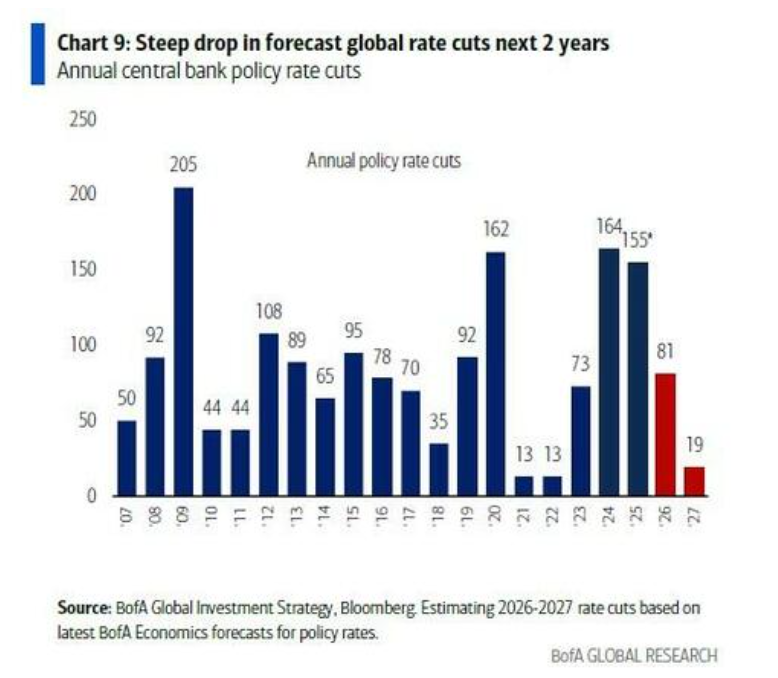
Core Viewpoint - The report by Bank of America strategist Michael Hartnett predicts that the best trade entering 2026 will be shorting the bonds of hyperscaler companies heavily invested in AI, as debt pressures from AI will become a significant vulnerability for these tech giants [1][2]. Group 1: Financial Conditions and Debt Risks - Hartnett's bearish logic is based on the changing financial conditions, noting that the past year saw 167 rate cuts by global central banks, but this momentum is expected to decrease to 81 cuts in the next year [2][4]. - The tightening of liquidity is leading to increased concerns about credit market strains and the financing of capital expenditures for AI, which have exceeded cash flow capabilities, resulting in widening bond spreads and credit default swaps (CDS) [4][6]. Group 2: Economic Disparities and Borrowing Costs - Hartnett highlights a core contradiction in the U.S. economy, where financial conditions have led to prosperity for Wall Street, but borrowing costs for Main Street remain "unaffordable," with various interest rates significantly higher than government borrowing costs [6][7]. - The disparity in borrowing costs is illustrated by the following rates: U.S. government borrowing at 4%, investment-grade companies at 5%, and credit card APRs reaching 20% [6][7]. Group 3: Market Sentiment and Future Outlook - Despite credit concerns, Hartnett believes that the macro narrative supporting the market remains strong, characterized by a "Goldilocks" scenario of lower rates and higher profits, with expectations of continued stock market preference until May 2026 [8]. - The date of May 15, 2026, is significant as it marks the appointment of a new Federal Reserve chair, with expectations of a more dovish stance, which may support stock preferences until then [8]. Group 4: Macro Trading Opportunities - Hartnett identifies macro trading opportunities, suggesting that tax cuts, interest rate reductions, and U.S. industrial policies will drive the Purchasing Managers' Index (PMI) towards an expansionary range [9][11]. - He expresses optimism for commodities and U.S. small-cap stocks, which are currently undervalued compared to the S&P 500 index, indicating potential for a rebound [11][13]. Group 5: Inflation and Long-term Bonds - Hartnett proposes a "reverse trade" regarding inflation, suggesting that if the U.S. core Consumer Price Index (CPI) falls to 2%, it would benefit long-term U.S. Treasuries [15]. - He anticipates that the government may intervene directly in pricing to control costs in key sectors, which could negatively impact profit margins but create further upside for long-term bonds [15].
宏观:香港路演见闻
2025-11-16 15:36
Summary of Conference Call Notes Industry Overview - **Macroeconomic Outlook**: The market anticipates a continuation of loose monetary policy into 2026, despite recent hawkish signals from the Federal Reserve. Most investors expect a rate cut in December, driven by economic downturn pressures from government shutdowns [1][4]. - **Trade Policy Uncertainty**: There is significant division regarding Trump's trade policies, with some expecting renewed tariff conflicts while others view it as a risk event rather than a baseline assumption [5][6]. - **Fiscal Policy**: Net fiscal easing for 2025 and 2026 is projected to be nearly zero, necessitating additional fiscal measures for true easing, such as direct payments to impoverished families [7]. Key Points and Arguments - **Economic Projections for 2026**: The overall outlook for the U.S. economy in 2026 is optimistic, relying on both fiscal and monetary easing. However, without further easing measures, credit pressures on households will increase, particularly in auto loans and credit cards [8]. - **Market Sentiment on AI and Commodities**: There is continued optimism for gold and AI sectors despite bubble concerns, with expectations for further price increases. The market also holds a positive view on commodities like copper due to anticipated dual easing [9]. - **Risks in the Macroeconomic Environment**: Potential risks include oil price volatility, which could trigger inflation and lead to rate hikes by the Fed, impacting overall economic stability. The AI sector's growing macro exposure is also a concern [10]. Additional Insights - **Shifts in Equity Market Styles**: Recent shifts from growth tech to defensive sectors are attributed to year-end positioning by investors seeking to secure gains, alongside concerns about potential market corrections in November and December [3]. - **Employment Trends**: Large companies continue to hire, while small businesses face layoffs, particularly in the leisure and service sectors, reflecting structural economic challenges [16]. - **AI's Economic Impact**: The application of AI technology has resulted in a K-shaped impact on the economy, benefiting high-income groups while increasing employment pressures on low-income groups [20][21]. - **Investment Focus**: Investors are advised to prioritize established tech companies like Alphabet and Microsoft, which show stable performance and significant progress in AI applications, over newer firms like OpenAI that have yet to meet expectations [23]. Market Dynamics - **Liquidity Conditions**: Current liquidity is not in crisis but presents structural issues. Recent declines in SOFA rates have alleviated some concerns, but the market remains cautious about potential increases in demand for funds [24]. - **Future Rate Cut Expectations**: There is a divided market sentiment regarding a potential rate cut in December, with a near 50:50 probability. However, indications suggest that a cut may occur, contingent on forthcoming data [28]. - **Investment Strategy for 2026**: Investors are encouraged to avoid speculative plays and focus on companies with solid products and financial performance, while preparing for potential market pressures from AI stagnation or hawkish Fed policies [32].
中美发债背后:一个37万亿,一个300%GDP,谁更扛得住?
Sou Hu Cai Jing· 2025-11-15 02:09
Group 1 - The article contrasts the debt management strategies of the United States and China, highlighting that while the US can attract global capital through its bond market, China's debt is primarily directed towards domestic projects like infrastructure and employment stabilization [1][4] - As of August 2025, the US public debt is projected to exceed $37 trillion, with interest payments expected to rise to over $1.4 trillion by 2033, supported by the Federal Reserve's monetary policies [3] - In contrast, China's total debt is approaching 300% of GDP, with government debt at approximately 88%, but the funds are largely invested in tangible projects, allowing for a stable growth rate of around 5% [1][4] Group 2 - The US dollar maintains its dominance in global trade, accounting for 88% of transactions and 58% of foreign reserves, making US Treasury bonds highly sought after [6] - China's bond market is still developing, with a focus on domestic consumption and growth, as evidenced by a 32.36% year-on-year increase in government debt in the first half of 2025 [4][8] - The article notes that while the US faces significant fiscal challenges, including a $2 trillion annual deficit and potential government shutdowns, China is exploring innovative debt instruments like green and digital bonds [10]
自11月10日起,人民币将正式退出伦敦金属交易所的期货合约交易。单看这一事件或许波澜不惊,但结合美国 12 月即将启动的量化宽松政策,以及刚组建的十国关键矿产联盟来看,这本质是一场针对人民币定价权的精准狙击,且时间节点的把控堪称刻意。大宗商品的“定价权”是什么?它并非一个单一的权力,而...
Sou Hu Cai Jing· 2025-11-15 01:58
Core Viewpoint - The decision by the London Metal Exchange (LME) to remove Renminbi (RMB) from futures trading is a strategic move aimed at undermining RMB's pricing power, coinciding with the upcoming U.S. quantitative easing policy and the formation of a key minerals alliance among ten countries [1][2]. Group 1: Pricing Power Dynamics - Pricing power in commodities is a tripartite structure involving trading rules, currency liquidity, and physical control [2]. - The LME's announcement to suspend all non-U.S. dollar-denominated metal options trading from November 10, 2025, significantly impacts RMB's role in international trading, effectively removing a key tool for risk hedging [2]. - The official reason of "insufficient liquidity" for this decision is questioned given the nearly threefold increase in average daily trading volume of RMB copper futures over the past three years [2]. Group 2: U.S. Monetary Policy and Global Impact - The Federal Reserve's upcoming quantitative easing, which includes lowering the federal funds rate and reinvesting up to $35 billion monthly in mortgage-backed securities, is expected to increase global dollar liquidity [3]. - This influx of liquidity may lead to significant price volatility in global commodity markets, compelling producers and consumers to rely more on the U.S. dollar for pricing [3]. - The removal of RMB tools from the LME will force global market participants to accept the pricing risks associated with the U.S. dollar, enhancing its influence over global resources [3]. Group 3: Strategic Resource Control - The formation of the "Ten Country Key Minerals Alliance," led by the U.S., aims to establish a supply chain for critical minerals like rare earths and lithium that does not depend on China by 2030 [4]. - This initiative targets China's reliance on imports for key resources, coinciding with the EU's policies to secure supply chains from mining to trade [4]. - China's recent discoveries of significant lithium resources and a 30% increase in domestic lithium production are efforts to enhance its supply chain autonomy amid this geopolitical struggle [4]. Group 4: Long-term Implications - The changes in LME rules, U.S. monetary policy, and the establishment of the minerals alliance collectively represent a systemic defense against the current pricing power structure [5]. - This silent competition will reshape the depth and breadth of RMB internationalization and alter global resource distribution and trade order over the coming decades [5].

债市专题研究:日本股债回顾与启示
ZHESHANG SECURITIES· 2025-11-13 10:36
Group 1: Report's Investment Rating - No investment rating information for the industry is provided in the report. Group 2: Core Views of the Report - After the Japanese bond yield broke below 2%, it remained in a long - term low - level oscillation. The weak economic reality restricted the upward movement of the yield, but there were still significant obstacles to further decline. The Japanese stock market, on the other hand, experienced a long - bull market due to factors such as positive macro - economic expectations, improved corporate micro - profitability, and the support from the Bank of Japan [1]. Group 3: Summary Based on the Directory 1. Japan's Stock and Bond Review and Insights ➢ Japanese Bonds: Long - term Oscillation after Breaking below 2% - **1990 - 2018 Phases**: From 1990 to 1998, the 10 - year Japanese bond yield was in a downward period, dropping from over 8% to 0.77%. From 1999 to 2008, it was in an oscillation period, fluctuating around a 1.5% central level. From 2008 to 2018, under continuous and substantial monetary policy easing, the yield steadily declined and remained in a low - level oscillation. Since 2018, as Japanese monetary policy gradually normalized, the bond's elasticity increased, and the yield moved from a long - term zero - interest state to positive interest [10]. - **1998 - 1999**: Fiscal adjustment and the Asian financial crisis led to a significant deterioration of the Japanese economy. The Bank of Japan cut interest rates, causing the 10 - year Japanese bond yield to break below 2% in October 1997 and reach a low of 0.77% in October 1998. Subsequently, due to the imbalance between the supply and demand of national bonds (the government's large - scale fiscal expansion increased bond issuance, while the main buyer, the Ministry of Finance's Fund Management Bureau, suspended bond purchases), the yield quickly rebounded to 2.43% [13][14][19]. - **2002 - 2003**: The Japanese government adopted fiscal austerity while the central bank implemented loose monetary policies. The 10 - year Japanese bond yield started a new downward trend in February 2002 and reached a low of 0.43% in June 2003. After 2002, the global economic recovery improved Japan's economic outlook, and the yield rebounded. The sell - off by commercial banks using the VAR model accelerated the bond market's adjustment, with the yield rising by nearly 120BP from June to September 2003 [20][22][23]. ➢ Japanese Stocks: Long - Bull Trend after 2013 - After hitting a historical high in 1989, the Japanese stock market entered a long - term correction. In 2013, it started a new long - bull market, reaching a new high in February 2024. As of the end of October 2025, the Nikkei 225 index was at 52,411.34 points, a cumulative increase of 512.27% compared to the beginning of 2012 [28]. - Abenomics was an important catalyst for the rise of the Japanese stock market. In 2013, the Abe cabinet launched a 20.2 - trillion - yen economic stimulus package, the Bank of Japan introduced the QQE policy, and the government launched the "Japan Revitalization Strategy". Multiple factors such as positive macro - economic expectations, the development of high - tech industries, and the support from the central bank led to a double - whammy of improved corporate profitability and valuation, driving the long - bull market [31][32].