
太空算力

Search documents
航天发展、中国卫星盘中逼近跌停!航空航天ETF天弘(159241)逆市获1300万份净申购
2 1 Shi Ji Jing Ji Bao Dao· 2026-01-20 07:01
Core Viewpoint - The aerospace and defense sector in China is experiencing significant fluctuations, with a notable decline in major indices and specific stocks, while the aerospace ETF shows positive net inflows and growth potential in the commercial space sector by 2026 [1][2]. Group 1: Market Performance - On January 20, the three major indices collectively declined, with the Shanghai Composite Index down 0.31%, the Shenzhen Component down 1.47%, and the ChiNext Index down 2.36% [1]. - The CN5082 Aerospace and Defense Industry Index fell by 3.86%, with significant declines in stocks such as Aerospace Development and China Satellite approaching their daily limit down [1]. Group 2: ETF Activity - The Tianhong Aerospace ETF (159241) had a trading volume of 132 million yuan, with a net subscription of 13 million shares during the session [1]. - The ETF saw a net inflow of over 21 million yuan on the previous trading day (January 19), with a current circulation of 531 million shares and a total market size of 814 million yuan [1]. Group 3: Industry Outlook - The Tianhong Aerospace ETF closely tracks the CN5082 index, which encompasses various sectors including aerospace equipment, military electronics, and emerging technologies like satellite internet and low-altitude economy [1]. - According to Open Source Securities, the domestic commercial space sector is expected to experience a "triple resonance" of policy, technology, and capital by 2026, highlighting the importance of the rocket and satellite industry chains [1]. - Guotai Junan Securities noted that the China Aerospace Science and Technology Corporation has announced plans to focus on reusable rocket technology and the development of commercial space by 2026, indicating a significant acceleration in the commercial space sector [2].




申万宏源:商业航天进入规模部署与能力升级新阶段 为太空光伏带来新增需求
智通财经网· 2026-01-20 03:13
Group 1 - China's submission of over 200,000 satellite constellation applications marks a significant expansion in the commercial space market, indicating a new phase of large-scale deployment [2][3] - The largest two constellations, CTC-1 and CTC-2, each consist of 96,714 satellites, suggesting a substantial increase in demand across satellite manufacturing and rocket launching sectors [2] - The commercial space sector is transitioning to a new stage characterized by large-scale deployment and capability upgrades, leading to a surge in demand for space photovoltaics [3] Group 2 - The demand for space photovoltaics is expected to grow significantly as the construction of low-orbit constellations moves from the "thousands" scale to "hundreds of thousands" and potentially "millions" in the coming decade [3] - Current mature technology includes gallium arsenide (GaAs) multi-junction batteries, which are high-performance but extremely costly, while silicon-based HJT batteries are seen as a key transitional solution for large-scale deployment [4] - Future potential technologies include perovskite and tandem batteries, which could achieve breakthroughs in efficiency and cost, although they currently face challenges in long-term stability [4] Group 3 - Key equipment suppliers in the space photovoltaic sector include Maiwei Co. (HJT production line equipment), High Measurement Co. (slicing machines), and Aotwei (module string welding equipment) [5] - Battery component manufacturers such as Yunda Co. and Trina Solar are actively developing next-generation space energy products, including collaborations on perovskite technology [5]

新一代AI基础设施,全球科技力量争相布局太空算力
Jin Rong Jie· 2026-01-19 23:43
Core Insights - The Space AI Center represents a new generation of AI infrastructure characterized by AI computing power deployment in space, aimed at overcoming energy, environmental, and spatial bottlenecks for AI development [1] - Global tech companies are actively investing in the construction of Space AI Centers, leading to rapid advancements in related technologies and applications [1] Group 1: Developments in Space Computing - Space computing is transitioning from concept validation to operational systems, with notable advancements from companies like NVIDIA, SpaceX, Google, and Starcloud [1] - NVIDIA has completed in-orbit testing of its H100 GPU, while SpaceX plans to deploy 100GW of space data centers annually within four years [1] - Google aims to launch a TPU prototype satellite by 2027, and Starcloud is working on establishing a 40MW data center [1] Group 2: China's Progress in Space AI - China has successfully established the world's first commercial AI satellite network, marking significant progress in space data centers [1] - In May 2025, China Guoxing Aerospace and Zhijiang Laboratory launched the first batch of 12 intelligent computing satellites equipped with AI chips and models, achieving a total computing power of 5 POPS [1] Group 3: Energy Solutions for Space Computing - CITIC Securities suggests that the energy supply for space computing will heavily rely on photovoltaic technology [1] - Perovskite, as a next-generation photovoltaic technology with high efficiency and low cost, is expected to become a crucial energy solution for space [1] - Since 2025, the industrialization of perovskite has accelerated, with breakthroughs in efficiency and stability, and multiple GW-level production lines have been launched [1]


【早报】事关经济!两场重要发布会今日举行;最高检:从严惩治财务造假、操纵市场等证券犯罪
财联社· 2026-01-19 23:11
Industry News - China successfully launched 19 low-orbit satellite internet satellites using the Long March 12 rocket on January 19, marking a successful mission [4] - Micron Technology reported a worsening shortage of memory chips in the past quarter, reiterating that supply constraints will persist due to surging demand for high-end semiconductors driven by AI infrastructure [4] Company News - ST Aowei is set to be the first company to be delisted due to market capitalization issues by 2026 [7] - Shuijingfang announced an expected net profit of 392 million yuan for 2025, a 71% decrease compared to the previous year [8] - Yidian Tianxia announced the end of its suspension for verification and will resume trading [8] - Trina Solar expects a net loss of 6.5 billion to 7.5 billion yuan for 2025 [8] - Jianghua Microelectronics announced a change in its actual controller to the Shanghai State-owned Assets Supervision and Administration Commission, and its stock will resume trading [9] - Tianjian Technology forecasts a net loss of 176 million to 250 million yuan for 2025, which may lead to a risk warning for delisting [10] - Chengdu Huamei expects a net profit increase of 74% to 109% for 2025, with Q4 net profit projected to grow by 458% to 614% [11] - Hualing Cable terminated its acquisition of Xingxin Aerospace's controlling stake, which provides components for Shenzhou spacecraft and Chang'e probes [12] - Hunan Youneng anticipates a net profit increase of 94% to 136% for 2025, driven by a rebound in lithium carbonate prices [12] - Xianglu Tungsten Industry forecasts a net profit of 125 million to 180 million yuan for 2025, with continuous price increases in tungsten raw materials [12] - Dingtong Technology expects a net profit increase of 120% for 2025, driven by significant growth in its high-speed communication products [13] - Yingfang Micro plans to acquire 100% of Shanghai Xiaokeli and Fujide China, which is expected to constitute a major asset restructuring [14] - Jiangxi Copper plans to register and issue debt financing tools not exceeding 25 billion yuan [15] - Pingzhi Information announced a successful bid for an intelligent computing service project worth approximately 489 million yuan [16] - ST Lifang's stock may face mandatory delisting due to trading violations and major legal issues [16] Investment Opportunities - UBTECH has signed a humanoid robot service agreement with Airbus, marking a significant step in the humanoid robot industry [20] - The space AI center is emerging as a new generation of AI infrastructure, with global tech companies investing in space computing capabilities [21] - The development of perovskite technology is accelerating, presenting investment opportunities in the solar energy sector, particularly for space applications [21]


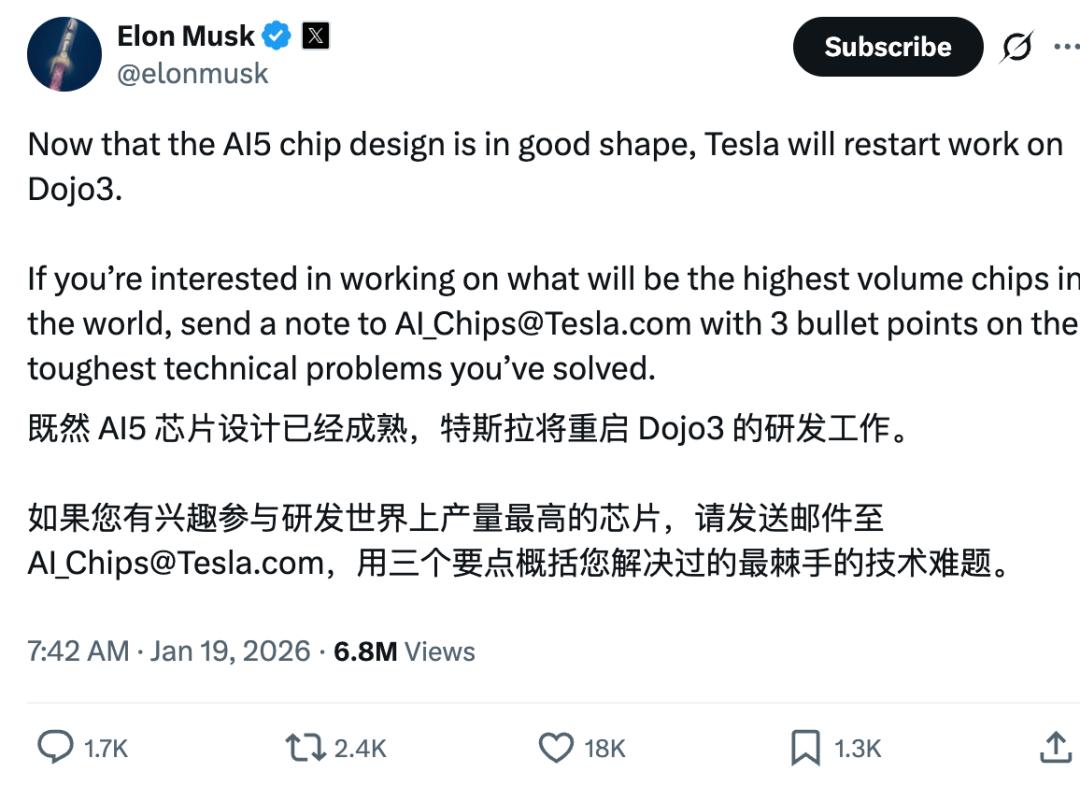
马斯克剧透3代芯片:AI5研发顺利,太空部署Dojo,“迭代周期9个月”
3 6 Ke· 2026-01-19 10:37
Core Insights - The article discusses the future iterations of AI chips by Tesla, highlighting Elon Musk's recent announcements regarding the development of the AI5, AI6, and AI7 chips, which aim to enhance the capabilities of Tesla's vehicles and robots [1][3][10]. Group 1: AI Chip Development - Tesla's AI5 chip is nearing completion, designed for advanced driver assistance systems, with a performance increase of up to 50 times compared to the previous AI4 chip, expected to enter mass production next year [3][10]. - The AI5 chip will feature two versions based on manufacturing processes, utilizing both 2nm and 3nm technologies, which will significantly enhance its performance [3][6]. - The AI5 chip's single-chip computing power is projected to exceed 2000 TOPS, which is double that of the current leading chip, Thor-X [10]. Group 2: AI6 and AI7 Chips - The AI6 chip is designed for dual purposes, supporting both inference for Tesla's robots and training algorithms in data centers, marking a significant step in chip versatility [10][11]. - The AI7 chip, previously known as Dojo3, is being revived to focus on space computing, indicating a shift in its application towards commercial space endeavors [12][15]. Group 3: Industry Implications - The rapid development cycle of Tesla's chips, with a target design cycle of nine months for future iterations (AI8 and AI9), is expected to accelerate the overall chip update cycle in the automotive industry [18]. - The article notes that the synchronization of chip iteration cycles with vehicle model updates is crucial, as discrepancies can lead to outdated technology in newly purchased vehicles [19]. - Tesla's recent patent for a method to enhance low-precision chip performance by processing data in chunks offers a potential solution for older vehicle models to utilize advanced algorithms, addressing concerns of existing customers [20][21].

焦点复盘创业板指冲高回落跌0.7%,AI软硬件双双低迷,贵金属板块再度爆发
Sou Hu Cai Jing· 2026-01-19 09:39
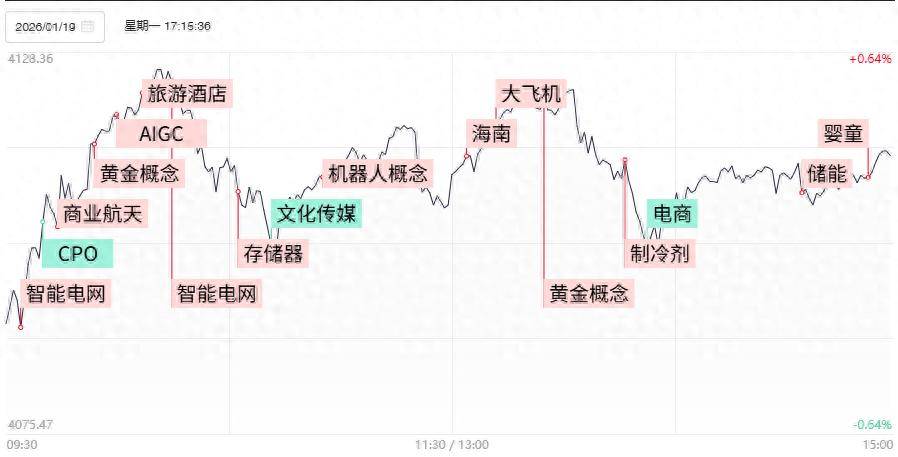
Market Overview - A total of 88 stocks hit the daily limit up, while 20 stocks faced limit down, resulting in a sealing rate of 60% [1] - The Shanghai Composite Index rose by 0.29%, and the Shenzhen Component Index increased by 0.09%, while the ChiNext Index fell by 0.7% [1] - The total trading volume in the Shanghai and Shenzhen markets was 2.71 trillion yuan, a decrease of 317.9 billion yuan compared to the previous trading day [1] Stock Performance - Fenglong Co. achieved a 14-day consecutive limit up, while Xinhua Department Store reached a 4-day consecutive limit up [1] - Jia Mei Packaging and Victory Energy had 15 limit ups in 22 days, and Youbang Ceiling achieved 9 limit ups in 13 days [1] - The market saw over 3,500 stocks rise, with leading sectors including power grid equipment, military industry, robotics, and precious metals [1] Sector Analysis - The power grid equipment sector continued its strong performance, with significant projects announced by the State Grid, including the construction of 42 ultra-high voltage projects by the end of 2025 [5] - The robotics sector remained strong, driven by favorable industry news, including the appointment of a former Tesla executive [6] - The commercial aerospace sector showed signs of recovery, with several companies initiating IPO processes, leading to a rebound in related stocks [7] - Precious metals prices reached historical highs, with gold surpassing $4,690 and silver exceeding $94 per ounce, positively impacting the sector [8] Future Outlook - The market exhibited mixed performance, with the Shanghai Composite Index recovering from a four-day decline, while the ChiNext Index faced pressure from AI hardware and software [9] - Despite over 3,500 stocks rising, there were still over 20 non-ST stocks hitting the limit down, indicating that bearish momentum has not fully dissipated [9] - The Shanghai Composite Index is currently facing resistance from the 5-day moving average, suggesting that short-term adjustment trends may continue [9]

星载激光通信专题-星间链路标配-商业星座刚需
2026-01-19 02:29
Summary of Key Points from the Conference Call Industry Overview - The conference focuses on the satellite laser communication industry, highlighting the development of "Tianshu Tiansuan" and "Dishu Tiansuan" to address the bottleneck in satellite data transmission, driven by increasing data demands [1][2]. Core Insights and Arguments - Laser communication is gaining importance due to its high bandwidth (100THz) and speed (400Gbps), especially as satellite constellations expand. Compared to microwave communication, laser communication offers stronger directionality and interference resistance [1][4]. - Starlink has achieved laser communication speeds of 100-200Gbps with daily link times of 1-10 hours, with over 9,000 terminals in orbit. China's experimental satellite, 0,102, has validated speeds of 400Gbps [1][6]. - The market for laser communication terminals is substantial, with a projected demand of 78 billion RMB during the national grid construction phase and a market space of 1.2 trillion RMB by the end of 2025 [1][9]. Key Developments in the Industry - The domestic aerospace industry, particularly the Fifth Academy of Aerospace Science and Technology, has made significant advancements in laser communication, establishing China's first internationally advanced laser inter-satellite link [3][11]. - Companies like Haige Communication have developed a comprehensive supply chain in low Earth orbit satellite internet, including chips, modules, and terminals, demonstrating the capability to produce satellite broadband laser communication terminals [3][16]. - The development history of laser communication includes milestones from Japan's first successful satellite-ground laser communication in 1995 to China's rapid advancements in recent years [5]. Market Dynamics - The laser communication terminal market is expected to grow significantly, with companies like York Space Systems and Lockheed Martin purchasing terminals at approximately 3.5 million RMB each. The cost-effective production of terminals is crucial for low Earth orbit constellations [9]. - The wireless communication business experienced a revenue decline from 2.5 billion RMB in 2021 to 1.582 billion RMB in 2024, but there are expectations for recovery driven by satellite internet demand [17]. Notable Companies and Their Contributions - Companies with laser communication terminal production capabilities include the Fifth Academy of Aerospace Science and Technology, Aerospace Technology Institute, and private firms like Nanjing Guangyu and Haige Communication [10][12]. - Nanjing Guangyu has achieved significant product upgrades, reducing weight and increasing speed, with a production capacity of over 1,000 units annually [12]. - Chang Zheng Rocket Technology Co., a subsidiary of Aerospace Electronics, has seen rapid revenue growth despite a projected decline in 2024 due to industry factors [13]. Emerging Technologies and Future Prospects - The conference highlighted the importance of high-quality optical systems and advanced mechanical structures in laser communication terminals, which are essential for meeting the demands of space applications [8]. - Companies like Longxin Technology and Jiuzhi Sheep are developing critical components for satellite communication, contributing to the overall advancement of the industry [20][23]. Conclusion - The satellite laser communication industry is poised for significant growth, driven by technological advancements and increasing demand for data transmission capabilities in space. The collaboration between state-owned enterprises and private companies is crucial for the development and production of laser communication technologies.
银河证券:卫星互联网应用落地加速 三条主线勾勒产业新图景
智通财经网· 2026-01-19 00:18
Core Viewpoint - The report from Galaxy Securities highlights the long-term growth potential of satellite internet across various industries, recommending attention to three main lines in the satellite internet industry chain: potential operators of space computing power, satellite communication equipment providers, and satellite application service providers [1] Group 1: Strategic Cooperation - PuTian Technology and Changsha Nonferrous Institute have signed a strategic cooperation framework agreement to combine PuTian's technological advantages in 5G, satellite internet, data elements, and artificial intelligence with Changsha's expertise in mining and metallurgy [2] - This collaboration aims to provide advanced and comprehensive digital solutions for industry clients, serving as a practical model for upgrading traditional industries by integrating new communication technologies with specific industry know-how [2] Group 2: Accelerated Application Deployment - The new generation of communication technology, represented by satellite internet, is rapidly penetrating various industries, with a focus on three main lines of application [3] - The first line involves the acceleration of direct satellite connections for consumer and automotive sectors, with approximately 40 direct satellite phones expected to be launched by China Telecom and partners by the end of 2025, and an estimated cumulative shipment of over 25 million units [3] - The second line is the nationwide commercial trial of satellite IoT, initiated by the Ministry of Industry and Information Technology, which aims to establish a foundation for large-scale applications through phased, multi-scenario trials [3] - The third line emphasizes the evolution of space computing power, transitioning satellites from mere connectivity to also providing computational capabilities, which can alleviate bandwidth bottlenecks and create value for time-sensitive industries [4] Group 3: Key Developments in Space Computing - The "Three-Body Computing Constellation," in which PuTian Technology is deeply involved, has entered the networking phase, with plans for a launch of "one rocket, twelve satellites" by May 2025, featuring a single satellite computing power of up to 744 TOPS and inter-satellite laser communication rates of 100 Gbps [4] - This constellation aims to serve as an application accelerator by providing on-orbit computing and instant response capabilities, exploring business models such as inter-satellite link leasing and computing power leasing for various industries [4]

长城基金基金经理尤国梁:商业航天的远期空间与短期估值
Shang Hai Zheng Quan Bao· 2026-01-18 18:39
Core Viewpoint - The commercial aerospace sector has experienced a significant surge, but a market correction has occurred following this rise. The current adjustment is viewed as a potential phase of consolidation rather than a long-term downturn, given the upward industrial trend in the domestic commercial aerospace sector [1]. Group 1: Industry Trends - The commercial aerospace boom is attributed to multiple factors, including a notable increase in rocket launch frequency in the second half of 2025 and the successful orbiting of reusable rockets, which alleviated the domestic capacity bottleneck and laid the groundwork for commercialization [2]. - The "14th Five-Year Plan" emphasizes the goal of becoming a "space power," indicating the government's strategic focus on the aerospace sector [2]. - The commercial aerospace industry is seen as having substantial growth potential, with low-orbit satellite internet already connecting numerous users and the overseas "Starlink" business proving the viability of its business model [2]. Group 2: Market Dynamics - Concerns regarding the valuation of the commercial aerospace sector exist, as the overall industry valuation was already high before the 2025 market surge. The sector is currently at the early stage of an industrial inflection point, where anticipated increases in rocket and satellite launches may not immediately reflect in financial statements [3]. - The market's focus and rotation of funds align with the future development rhythm of the industry, initially concentrating on the rocket sector, which has seen the most significant changes and breakthroughs recently [3]. - Future market dynamics are expected to depend on which sector experiences major catalysts or industrial advancements, with ongoing performance across various directions including satellite manufacturing and operational services [3].
计算机行业周报:太空光伏能源迎来拐点时刻-20260118
HUAXI Securities· 2026-01-18 12:30
Investment Rating - Industry Rating: Recommended [6] Core Insights - Space photovoltaic energy is reaching a turning point, becoming a strategic solution for commercial space and high-end applications [1][2] - Photovoltaic technology is the only viable solution for energy in space, outperforming traditional fossil fuels and nuclear energy due to its sustainability, stability, and lightweight characteristics [2][15] - The demand for space photovoltaic energy is driven by the increasing number of satellites and the expansion of power requirements for individual satellites, leading to exponential growth in space photovoltaic needs [20][21] Summary by Sections 1. Space Photovoltaic Energy Reaches a Turning Point - Space photovoltaic energy is defined as utilizing solar photovoltaic technology in outer space to generate and supply energy, which is crucial for powering satellites and space stations [1] - The transition from traditional energy sources to photovoltaic technology is essential due to the high risks and complexities associated with fossil fuels and nuclear energy in space [2][15] 2. Photovoltaic Becomes the Only Solution for Space Energy - The cost of traditional energy sources in space is prohibitively high, with gallium arsenide solar panels costing around 200,000 to 300,000 yuan per square meter [12] - SpaceX has adopted the P-type HJT battery technology as the main route for large-scale production of space solar cells, with over 10,000 units tested since 2023 [2][26] - Perovskite tandem batteries are expected to become the mainstream technology for future space photovoltaics, with China leading in production capacity [12][29] 3. Space Computing Strongly Relies on Space Photovoltaic Power Generation - Space photovoltaic energy is identified as the primary energy source for space computing data centers, significantly reducing operational costs compared to ground-based systems [3][38] - The total cost of a space data center over ten years is projected to be approximately $8.2 million, compared to $167 million for a terrestrial equivalent [40] - The coupling of computing power and energy generation in space is expected to drive exponential growth in the space photovoltaic industry [39] 4. Investment Recommendations - Beneficiary companies in the solar photovoltaic sector include: JunDa Co., Maiwei Co., Yujing Co., Dongfang Risheng, Jiejia Weichuang, Gaoce Co., Aotewei, Qianzhao Optoelectronics, and Shanghai Port [4][41]