
电动化

Search documents
上汽集团:公司在电动化和智能化领域累计投入超过1500亿元
Zheng Quan Ri Bao Wang· 2025-12-19 15:41
Core Viewpoint - The company has invested over 150 billion yuan in electrification and intelligence, achieving significant technological advancements in the automotive sector [1] Group 1: Investment and Technological Development - The company has cumulatively invested more than 150 billion yuan in the fields of electrification and intelligence [1] - The company has developed nearly 26,000 effective patents covering three major vehicle platforms: pure electric, hybrid, and hydrogen energy [1] - The company has established seven major technological foundations, including battery, electric drive, super hybrid systems, and full-stack intelligent vehicle solutions [1] Group 2: Industry Leadership and Innovations - The company has achieved mass production of industry-leading technologies such as the first-generation solid-state battery and the "Galaxy" full-stack intelligent vehicle solution [1] - The company is advancing the collaborative development of "algorithm + software + chips" and the application of new technologies like AI large models in vehicles [1] - The company encourages attention to new vehicle releases from various automakers in the upcoming year [1]

华尔街见闻早餐FM-Radio | 2025年12月19日
Hua Er Jie Jian Wen· 2025-12-18 23:24
Market Overview - The US CPI unexpectedly cooled, strengthening rate cut trades, and combined with Micron's earnings report, the S&P 500 rose nearly 0.8%, ending a four-day decline [2] - Major tech stocks led the gains, with Tesla up 3.45% and Micron soaring approximately 12% [2] - The US dollar initially fell but ended slightly higher, while the Chinese yuan strengthened again, approaching 7.03 after the CPI report [3] Economic Indicators - The US initial jobless claims fell to 224,000, reversing the previous surge trend [8] - The November core CPI rose 2.6% year-on-year, marking the lowest since 2021, although economists expressed concerns about potential data distortions due to government shutdowns [7][23] Central Bank Actions - The European Central Bank (ECB) maintained its interest rates for the fourth consecutive time, reiterating that inflation will return to the 2% target in the medium term, with no clear easing guidance [9] - The Bank of England adopted a hawkish stance, cutting rates by 25 basis points with a close 5-4 vote, indicating that further easing will be more challenging [10][25] Corporate Developments - Micron's CEO stated that the company has sold out its HBM capacity for 2026 and is signing unprecedented long-term contracts, indicating a structural shortage in the industry [34] - OpenAI released GPT-5.2-Codex, claiming significant improvements in software engineering and cybersecurity capabilities, and is exploring new financing options up to $100 billion [26] - Trump's media group surged over 40% after announcing plans to acquire a fusion energy company, TAE Technologies, with a valuation exceeding $6 billion [27] Industry Trends - The virtual digital human sector in China has established its first national standard, which is expected to drive significant growth in the market, projected to reach 480.6 billion yuan by 2025 [37] - The Ministry of Industry and Information Technology announced plans to strengthen capacity regulation in the photovoltaic industry, aiming for a dynamic balance of production capacity by 2026 [30] - The AI healthcare sector in China is expected to grow from 97.3 billion yuan in 2023 to 159.8 billion yuan by 2028, with significant growth in AI medical imaging and AI pharmaceuticals [41]






四度追投武汉,安波福武汉新项目明年投产
Chang Jiang Ri Bao· 2025-12-18 13:43
Core Insights - The core message of the news is that Aptiv is significantly expanding its investment in Wuhan, China, with the construction of a new electrical distribution system manufacturing plant and R&D center, expected to be operational in the second half of 2026 [1][2]. Group 1: Company Expansion - Aptiv's new manufacturing plant and R&D center in Wuhan is the fourth investment in the region, highlighting the company's commitment to the local automotive industry [1]. - The new project will focus on the research, production, and sales of high-voltage and low-voltage wiring harnesses, enhancing service to local automotive manufacturers [1]. Group 2: Industry Impact - The expansion is expected to drive collaborative development within the upstream and downstream supply chains, promoting the transformation and upgrading of the automotive industry in Wuhan [1]. - Aptiv's continued investment reflects confidence in the strategic location, strong automotive industry foundation, and favorable business environment in Wuhan [2]. Group 3: Future Outlook - Aptiv plans to increase its investment in the Chinese automotive market, emphasizing local R&D and new product development to provide better services to Chinese automotive companies [2].

2026年职教本科新增多个汽车智能化相关专业,有何利好?
Zhong Guo Qi Che Bao Wang· 2025-12-18 09:34
A e the state of the state of the station of the station of the state of the station of the station of the station of 10 汽车芯片与软件工程、车联网通信、低空智联网……近日,教育部发布《关于做好2026年职业教育拟招生专业设置管理工作的通知》及附件 《2025年职业教育专业目录增补清单》。清单显示,此次新增57个职业教育专业。其中,中职专业3个、高职专科专业31个、职业本科专业23个。其 中有多个与汽车智能化、电动化以及汽车工业智能制造相关的专业,也覆盖了汽车业正在发力的低空经济、具身智能等前沿领域。 人才培养"千年大计" 有关行业人士认为,这不仅为职业教育注入新活力,更为汽车业的人才培养与产业升级带来深远影响。 新增本科专业中,汽车芯片与软件工程技术是其中之一。行业专家认为,汽车行业正经历电动化、智能化的深刻变革,芯片与软件成为核心竞争力之 一。然而,近年来全球不断出现的芯片供应链风险,暴露了汽车业在关键技术领域的韧性不足的问题。此次增设的汽车芯片与软件工程技术专业,旨在培养 既懂芯片设计 ...

张兴海:问界用“五高”标准打造高端汽车
Zhong Guo Zheng Quan Bao· 2025-12-18 08:41
Core Viewpoint - The discussion highlights the growth journey of the AITO brand, emphasizing high standards in safety, reliability, performance, quality, and value as key pillars of the brand's philosophy [1] Group 1: Company Achievements - AITO has achieved cumulative deliveries exceeding 900,000 units, with over 50,000 units delivered in November alone, setting a new monthly delivery record [2] - The average transaction price for the entire AITO lineup is 400,000 yuan, with the AITO M9 model alone surpassing 260,000 cumulative deliveries and being recognized as the sales champion in the 500,000-unit category for 20 consecutive months [2] - AITO is the first and only domestic brand to exceed traditional luxury brands in both monthly sales and average transaction price [2] Group 2: Customer Engagement and Innovation - AITO has introduced a unique delivery model called "user approval before vehicle delivery," allowing customers to participate in the testing and acceptance of new vehicles [2] - The company emphasizes a customer-centric approach, gathering user feedback to enhance research and development, ensuring that vehicles meet customer expectations [2] - The founder has actively engaged with users across multiple cities to listen to their suggestions, reinforcing the brand's commitment to customer satisfaction and trust [2] Group 3: Industry Context - By 2025, it is projected that the sales share of new energy vehicles in China will exceed 50%, marking a significant turning point in the automotive industry [1] - The transformation towards digitalization, electrification, and green initiatives is reshaping the automotive landscape, with AITO positioning itself as a leader in this evolution [1] - The company aims to build a globally influential high-end brand, contributing to China's goal of becoming a strong automotive nation [1]

最后15天:明年起购置税退坡,20万元档车辆或多付1万元
Xin Lang Cai Jing· 2025-12-18 07:20
文|IT时报 毛宇 编辑|郝俊慧 孙妍 岁末,车市正上演一场政策与市场交织的悬疑大戏:2026年新能源购置税从全免缩至减半,20万元级车 辆成本或增近万元。政策"倒计时"的警报已然拉响。 中央经济工作会议明确延续的"以旧换新"政策,却因细则未明蒙上迷雾,上海等地补贴需摇号申领,中 签率低迷让这份红利打了折扣。 近日,《IT时报》记者走访上海多家新能源门店发现,政策跷跷板下,车企阵营迅速分化:理想、蔚 来、极氪、小米等超20家品牌紧急推出购置税兜底政策,最高补贴达1.5万元,但其中暗藏"贷款需20日 前办结"等附加条件;特斯拉则借着长期销量领跑的底气,拒绝兜底反成异类。 更添变数的是技术与地方政策的博弈:广汽等企业宣布全固态电池中试突破,却仍难解量产瓶颈,让消 费者陷入"赶末班车"与"等技术"的纠结中;上海绿牌虽暂未官宣取消,却已浮现收紧预期,"现在需要 居住证,并且3年以上社保,才有绿牌资格。"一位新能源销售告诉记者。 热闹背后是数据的"降温"。12月前7天新能源零售同比下滑17%,这场车企、消费者、政策的三方角 力,正将年底车市推向悬念顶点。 购置税、国补暗藏玄机 根据财政部等3部门2023年公布的《关于延 ...
航天智造(300446):双轮驱动打造航天七院优质上市平台
Xin Lang Cai Jing· 2025-12-18 00:35
Core Viewpoint - The company is initiating coverage on Aerospace Intelligent Manufacturing with a "Buy" rating and a target price of 26.00 yuan, based on a 20x PE valuation for 2026, driven by "technological barriers + policy dividends" for growth [1] Group 1: Company Overview - Aerospace Intelligent Manufacturing has undergone a significant asset restructuring, becoming the core listed platform of the Aerospace Seventh Academy by acquiring 100% stakes in Aerospace Energy and Aerospace Molding [1] - The company is expected to achieve revenues of 58.60 billion yuan and 77.81 billion yuan in 2023 and 2024, respectively, representing year-on-year growth of 20.10% and 32.78% [1] - The net profit attributable to shareholders is projected to be 4.23 billion yuan and 7.92 billion yuan for 2023 and 2024, with year-on-year increases of 61.36% and 87.02% [1] Group 2: Automotive Components Business - Aerospace Molding, established in 2000, focuses on the development and production of automotive interior and exterior parts, smart cockpit components, and lightweight engine parts [2] - The company provided components for 10.95 million vehicles in 2023, accounting for 42% of the total passenger car sales in China [2] - The new energy vehicle segment is expected to contribute 72% of new products in 2024, surpassing industry penetration rates, with successful entries into the supply chains of new car manufacturers like NIO and AITO [2] - Revenue for the automotive components business is projected to grow at a CAGR of 20.96% from 2025 to 2027 [2] Group 3: Oil and Gas Equipment Business - Aerospace Energy, founded in 2013, specializes in the research and manufacturing of perforating tools and high-end completion equipment for the oil and gas sector [3] - The company holds over 60% market share in unconventional oil and gas extraction and approximately 35% in conventional oil and gas extraction as of 2021 [3] - The business is expected to benefit from increasing domestic oil and gas production and the development of deep-sea and deep-earth resources, with a projected revenue CAGR of 17.94% from 2025 to 2027 [3] Group 4: Market Perspective - The market underestimates the company's long-term growth potential, particularly in the automotive components sector, which benefits from the electrification, connectivity, and intelligence transformation of downstream customers [4] - The oil and gas equipment business is expected to gain from policy support for deep-sea and deep-earth technologies, leading to increased demand for perforating tools and completion equipment [4] Group 5: Profit Forecast and Valuation - The company is expected to achieve net profits of 9.48 billion yuan, 11.02 billion yuan, and 12.76 billion yuan from 2025 to 2027 [5] - Comparable companies in the automotive and oil and gas sectors have an average PE of 30x for 2026, while Aerospace Intelligent Manufacturing is assigned a target PE of 20x, leading to a target price of 26.00 yuan [5]

欧盟撤回2035年燃油车禁令?
Xin Lang Cai Jing· 2025-12-17 23:14
Core Viewpoint - The European Commission announced a proposal to abandon the effective ban on new internal combustion engine vehicles by 2035, marking the biggest retreat in green policy in recent years due to pressure from the automotive industry [2][10]. Group 1: Proposal Details - The proposal allows the continued legal registration and sale of vehicles using biofuels or synthetic fuels after 2035, pending approval from EU member states and the European Parliament [2][10]. - The emissions target will be adjusted to a 90% reduction in carbon dioxide emissions from 2021 levels, rather than achieving zero emissions for all new cars and vans by 2035 [14]. - Manufacturers will need to offset remaining emissions by using low-carbon steel, synthetic fuels, or non-food biofuels [14]. Group 2: Industry Reactions - German Chancellor Friedrich Merz's recent letter urging the EU to relax the ban may have influenced this change, as major automakers like BMW and Toyota opposed strict regulations [5][12]. - The European Automobile Manufacturers Association (ACEA) described the current situation as a "decisive moment" for the industry, highlighting the need for more flexible compliance systems [6][13]. - Several EU member states, including Germany and Italy, have pressured the EU for more "technologically neutral" policies, representing nearly half of the EU's total population [6][13]. Group 3: Market Context - The proposal follows Ford's announcement of a $19.5 billion asset write-down and the cancellation of several electric vehicle models due to weak demand in the U.S. market [5][12]. - The automotive industry is entering a reset phase, with manufacturers calling for relaxed emissions targets and reduced penalties for non-compliance [6][13].

泰晶科技:车规级产品已开发2000余款料号
Zheng Quan Ri Bao· 2025-12-17 14:20
Core Insights - The company has developed over 2,000 automotive-grade product models, accelerating market introduction across various domains including body, intelligent driving, cockpit, power, and chassis [2] Group 1: Product Development - The company is focusing on the development of automotive-grade products, with over 2,000 models already created [2] - The products are being introduced in multiple scenarios, indicating a comprehensive approach to market penetration [2] Group 2: Market Trends - As the level of intelligence and electrification in automobiles increases, the demand for crystal oscillators is expected to rise significantly [2]

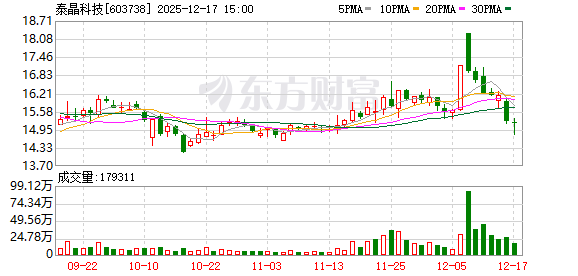
泰晶科技:公司车规级产品已开发2000余款料号
Mei Ri Jing Ji Xin Wen· 2025-12-17 10:23
泰晶科技(603738.SH)12月17日在投资者互动平台表示,公司车规级产品已开发2000余款料号,在车 身域、智驾域、座舱域、动力域和底盘域等多场景全方位加快市场导入。汽车智能化、电动化程度越 高,晶振的使用量越多。 (文章来源:每日经济新闻) 每经AI快讯,有投资者在投资者互动平台提问:请问L3落地是否对公司形成实质性利好?谢谢! ...