通胀数据

Search documents
通胀数据点评:PPI同比低点已过?
Tianfeng Securities· 2025-09-11 01:13
1. Report Industry Investment Rating Not provided in the report. 2. Core View of the Report - The inflation data in August showed a differentiated feature of "weak CPI and stable PPI". The year-on-year growth rate of CPI was lower than market expectations, mainly dragged down by a significant decline in food prices. The year-on-year decline of PPI narrowed, which was attributed to the initial effect of the "anti-involution" policy [1][6]. - For the bond market, the continuous recovery of core CPI for four months indicates that domestic demand is still moderately recovering, and the narrowing decline of PPI reflects that the "anti-involution" policy and the improvement of supply-demand relationship are taking effect. The ultimate impact of the "anti-involution" policy on the bond market depends on whether the price increase expectation it brings can be supported by real demand [1][6]. - Negative inflation means a passive increase in real interest rates. Compared with the weak economic fundamentals and low investment returns, the current level of real interest rates is relatively high, so the central bank may still have the demand to "reduce the financing cost of the real economy" [2][6]. 3. Summary According to Relevant Catalogs 3.1 8 - Month CPI: Food Prices Significantly Drag, Core CPI Continuously Improves - The year-on-year turn of CPI negative in this month was mainly due to two factors: the high-base effect, with the carry-over effect of last year's price changes on this month's CPI year-on-year being about -0.9 percentage points, and the pull-down effect expanding by 0.4 percentage points compared with last month; food prices were weaker than seasonal, with the month-on-month increase of food prices being 0.5%, about 1.1 percentage points lower than the seasonal level, and the price changes of pork, eggs, and fresh fruits all being weaker than seasonal [2][7]. - Although the overall performance of CPI was weak, core CPI showed resilience. The year-on-year increase of core CPI (excluding food and energy prices) was 0.9%, with the increase expanding for the fourth consecutive month. The year-on-year increase of industrial consumer goods prices excluding energy was 1.5%, with the increase expanding by 0.3 percentage points compared with last month, and the year-on-year increase of gold and platinum jewelry prices may be related to the rise in international gold prices; the year-on-year increase of service prices was 0.6%, with the increase expanding by 0.1 percentage points compared with last month [2][7]. 3.2 8 - Month PPI: Year-on-Year Decline Narrows, the First Narrowing Since March This Year - PPI decreased by 2.9% year-on-year, with the decline narrowing by 0.7 percentage points compared with last month, the first narrowing since March this year. This was affected by the lower comparison base in the same period last year and the implementation of active and effective macro - policies in China [3][8]. - Consistent with the "purchase price of major raw materials" in the manufacturing PMI in August being in the expansion range, price transmission started from "upstream to mid - stream", but the downstream consumer goods end still lacked bargaining power. - The optimization of market competition order drove the narrowing of year-on-year price declines in related industries. The year-on-year price declines of coal processing, ferrous metal smelting and rolling processing, coal mining and washing, photovoltaic equipment and component manufacturing, and new energy vehicle manufacturing narrowed by 10.3, 6.0, 3.2, 2.8, and 0.6 percentage points respectively compared with last month, reducing the pull - down effect on PPI year-on-year by about 0.50 percentage points compared with last month, which was the main reason for the narrowing of the PPI year-on-year decline [3][8]. - The new driving force of industry development drove the year-on-year price recovery of related industries. The prices of integrated circuit packaging and testing series increased by 1.1%, the prices of ship and related device manufacturing increased by 0.9%, the prices of communication system equipment manufacturing increased by 0.3%, and the prices of solid waste treatment equipment increased by 0.3% [3][8].
通胀数据点评:为何大宗涨价拉不起PPI?
Shenwan Hongyuan Securities· 2025-09-10 13:13
Group 1: Inflation Data Overview - In August, the CPI decreased by 0.4% year-on-year, compared to a previous value of 0% and an expectation of -0.2%[7] - The PPI recorded a year-on-year decline of 2.9%, improving from -3.6% previously, aligning with market expectations[7] - The overall PPI month-on-month remained at 0%, primarily due to low capacity utilization in downstream sectors, which hindered price transmission from upstream[2] Group 2: Price Transmission and Sector Analysis - Upstream price increases contributed positively to PPI month-on-month, with a calculated impact of 0.3% from commodity prices[1] - Downstream sectors, particularly in food and automotive industries, saw PPI declines of 0.3% each, reflecting significant price drops[2] - The core CPI for core goods rose by 0.1 percentage points to 0.9%, driven by high gold prices and demand from trade-in programs[3] Group 3: Future Outlook - Commodity prices are expected to continue rising, but excess supply in downstream sectors may limit the transmission of upstream price increases, keeping inflation weak throughout the year[4] - By year-end, PPI is projected to recover to a maximum of -2.1% year-on-year, while CPI may remain negative in Q3 but could turn positive in Q4[4] - Risks include potential tightening in food and energy supplies, which could further impact CPI dynamics[5]
8月通胀数据点评:关注PPI回升的持续性
Changjiang Securities· 2025-09-10 10:11
中国经济丨点评报告 丨证券研究报告丨 [Table_Title] 关注 PPI 回升的持续性 %% %% %% %% research.95579.com ——8 月通胀数据点评 报告要点 [Table_Summary] 8 月物价有积极变化,核心 CPI 同比涨幅连续 4 个月扩大,PPI 同比降幅收窄。但值得注意的 是,CPI 同比连续 30 个月在 1%以下震荡,PPI 同比连续 35 个月为负,指向国内需求仍较疲 弱,国际贸易环境不确定、部分行业产能过剩仍待优化。往前看:1)CPI 同比再度转负,强化 社会保障、多措并举提高居民收入是提振消费的关键。2)8 月 PPI 同环比数据均有改善,除了 基数影响,也得益于"反内卷"的有序推进,关注 PPI 同比改善的持续性和幅度。短期稳物价、 稳预期仍待需求侧政策的提振,地产领域已有积极调控政策推出,货币、财政或亦将有加码。 分析师及联系人 [Table_Author] 于博 宋筱筱 SAC:S0490520090001 SAC:S0490520080011 SFC:BUX667 SFC:BVZ974 请阅读最后评级说明和重要声明 1 [Table_Title ...
债市日报:9月10日
Xin Hua Cai Jing· 2025-09-10 09:59
Core Viewpoint - The bond market continues to experience a downturn, with government bond futures showing a significant decline and a tightening liquidity environment affecting market sentiment [1][2][5]. Market Performance - Government bond futures closed lower across the board, with the 30-year main contract down 0.86% to 114.76, marking the lowest close since March 19 [2]. - The yield on the 10-year government bond increased by 2.75 basis points to 1.822%, while the yield on the 30-year bond rose by 2.5 basis points to 2.096% [2]. - The China Convertible Bond Index fell by 0.63% to 474.4 points, with a trading volume of 724.47 billion [2]. Overseas Market Trends - In North America, U.S. Treasury yields rose collectively, with the 2-year yield increasing by 7.41 basis points to 3.560% [3]. - Asian markets saw most bond yields rise, with the 5-year and 10-year yields increasing by 1.5 basis points and 0.4 basis points, respectively [3]. - In the Eurozone, most bond yields also increased, with the UK 10-year yield rising by 1.7 basis points to 4.621% [3]. Primary Market - The weighted average yield for the 91-day Treasury bond was 1.2745%, with a bid-to-cover ratio of 3.04 [4]. - The 5-year fixed-rate bond had a weighted average yield of 1.5973% and a bid-to-cover ratio of 3.24 [4]. - The 50-year special treasury bond had a yield of 2.2227% with a bid-to-cover ratio of 4.18 [4]. Liquidity Conditions - The central bank conducted a 7-day reverse repurchase operation with a total of 3,040 billion at an interest rate of 1.40%, resulting in a net injection of 749 billion for the day [5]. - Short-term Shibor rates mostly increased, with the overnight rate rising by 0.6 basis points to 1.425% [5]. Economic Indicators - August CPI decreased by 0.4% year-on-year, while PPI fell by 2.9%, indicating a narrowing decline compared to the previous month [7]. - The core CPI has shown an expanding growth rate for four consecutive months, reflecting the effectiveness of policies aimed at boosting domestic demand [7]. Institutional Insights - Long-term liquidity is expected to remain stable, with the central bank likely to continue providing support for government bond issuance [8]. - The new regulations on public fund sales fees are anticipated to enhance the stability of public bond funds, potentially leading to increased inflows into bond ETFs [8].
宽松环境或延续,继续关注美国8月PPI、CPI数据
Xin Lang Ji Jin· 2025-09-10 08:52
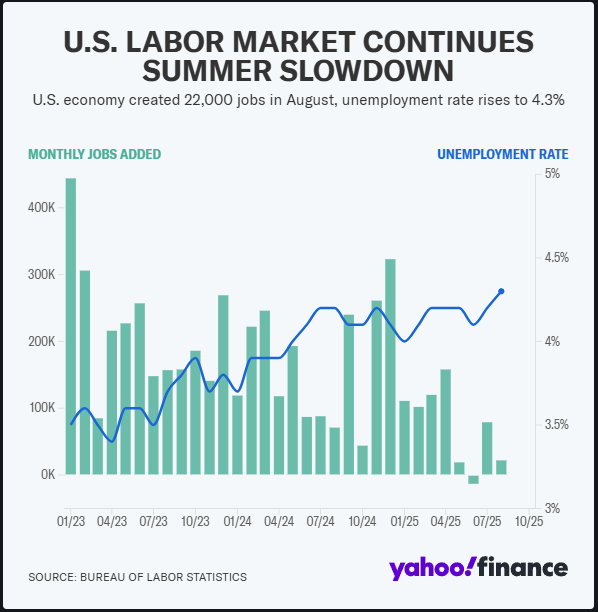
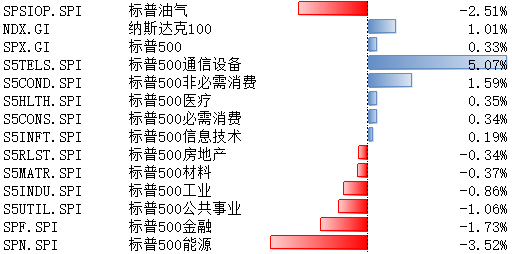
Macroeconomic Overview - In August 2025, the U.S. non-farm payrolls added only 22,000 jobs, significantly below the expected 75,000, with the previous month's figure revised up to 79,000 [1] - The labor force participation rate increased by 0.1 percentage points to 62.3%, while the unemployment rate remained steady at 4.3% [1] - Hourly wage growth slowed to 3.7% year-on-year, with a month-on-month increase of 0.3% [1] - The U.S. manufacturing and services sectors continue to show divergent trends, with manufacturing contracting and services expanding [1] - The ISM manufacturing index for August recorded 48.7, below the expected 49, while the ISM non-manufacturing index was at 52, exceeding both expectations and the previous value [1] - The ADP employment data for August showed a significant decline, with only 54,000 jobs added, falling short of the expected 68,000 and the previous 104,000 [1] Index Performance - For the week of September 1-5, the S&P Oil & Gas Index fell by 2.51%, while the Nasdaq 100 Index rose by 1.01% and the S&P 500 Index increased by 0.33% [2][3] - Among the 11 sectors covered by the S&P 500, five sectors saw gains, with communication equipment leading at 5.07%, while energy was the worst performer, declining by 3.52% [2][3] Investment Direction - The disappointing non-farm payroll data has led to increased expectations for interest rate cuts, resulting in a surge in gold prices and volatility in U.S. equities [4] - Market expectations for rate cuts have significantly risen, with projections indicating a potential cut starting in September [4] - The upcoming U.S. PPI and CPI data will be closely monitored as inflationary pressures remain concentrated in the fourth quarter [4] - The Bosera S&P 500 ETF (513500) is highlighted as a cost-effective investment tool for domestic investors to capture U.S. equity growth [4] - The S&P 500 Index is recognized as a benchmark for U.S. equities, covering over 500 representative companies across 11 sectors, accounting for approximately 80% of the total market capitalization [4] Nasdaq 100 ETF - The Bosera Nasdaq 100 ETF (513390) tracks the Nasdaq 100 Index, with a significant allocation of 57.87% in the information technology sector [5] - The index includes high-quality technology companies, providing exposure to various sectors such as consumer services, consumer goods, and healthcare [5]

万亿市场,午后突发
Zheng Quan Shi Bao· 2025-09-10 08:34
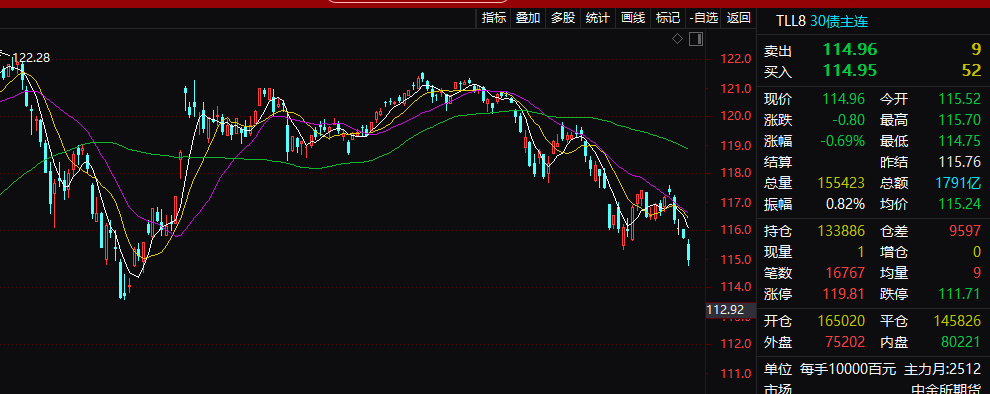
Core Viewpoint - The bond market is experiencing a significant sell-off, with rising yields on government bonds attributed to recent inflation data and a strong equity market [1][3]. Group 1: Market Performance - On September 10, the yield on the 10-year government bond rose by 1.5 basis points to 1.81%, marking a return above 1.8% for the first time in five months [1]. - The 30-year government bond yield increased by over 2 basis points, reaching a new high since its issuance [1][3]. - The 30-year bond futures saw a decline of 0.82%, hitting a new low since March 24 [1]. Group 2: Influencing Factors - The decline in bond prices is linked to the August Producer Price Index (PPI), which fell by 2.9% year-on-year, the first contraction since March [3]. - The strong performance of the equity market, particularly since early July, has shifted investor preference from bonds to stocks, contributing to the sell-off in government bonds [3]. Group 3: Future Outlook - The bond market is expected to remain volatile, influenced by policy expectations, liquidity, and macroeconomic data [4]. - There is speculation that the central bank may resume government bond trading operations to stabilize prices and manage interest rates, especially in the current environment where equities are performing well and bonds are under pressure [5]. - Analysts suggest that improved coordination between fiscal and monetary policies could mitigate the impact of increased government bond supply on the bond market [5].
万亿市场,午后突发!
券商中国· 2025-09-10 08:15
Core Viewpoint - The bond market is experiencing a significant sell-off, with yields on government bonds rising sharply due to inflation data and a strong equity market [1][3]. Group 1: Market Performance - On September 10, the yield on the 10-year government bond rose by 1.5 basis points to 1.81%, marking a return above 1.8% for the first time in five months [1]. - The 30-year government bond yield increased by over 2 basis points, reaching a new high since its issuance, while the 30-year futures contract fell by 0.82%, hitting a low not seen since March 24 [1][3]. Group 2: Influencing Factors - The decline in bond prices is attributed to two main factors: the recent inflation data showing an 8-month low in PPI, which decreased by 2.9% year-on-year, and the strong performance of the equity market since early July [3]. - The strong equity market has led to a shift in investor sentiment, with funds moving from bonds to stocks as market risk appetite increases [3]. Group 3: Future Outlook - The bond futures market is showing a downward trend, influenced by policy expectations, liquidity, and macroeconomic data [4]. - There is speculation that the central bank may restart government bond trading operations to stabilize bond prices and manage interest rate curves, especially in the context of increasing government bond supply [5]. - Analysts suggest that improved market supply-demand dynamics could create conditions for the resumption of government bond trading operations [5].

黄金ETF持仓量报告解读(2025-9-10)美债收益反弹 金价冲高回落
Sou Hu Cai Jing· 2025-09-10 06:27
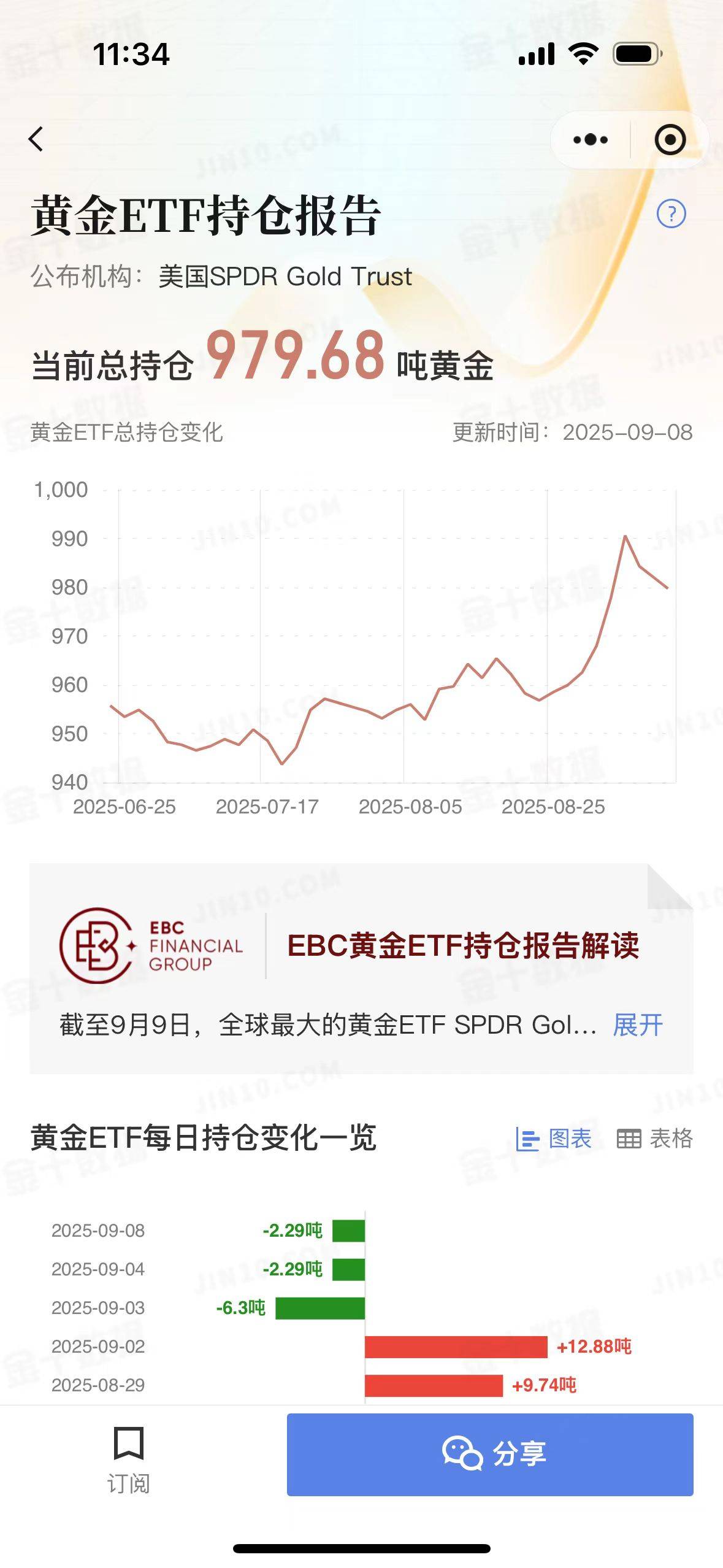
Group 1 - The current total holdings of the world's largest gold ETF, SPDR Gold Trust, stand at 979.68 tons, unchanged from the previous trading day [5] - On September 9, spot gold prices peaked at $3675.01 per ounce, marking a new historical high, before closing at $3626 per ounce, down $9.7 or 0.27% [5] - Geopolitical tensions, particularly involving Israel and Hamas, influenced gold prices, which initially surged before retreating due to rising U.S. Treasury yields [5] Group 2 - Recent economic data revealed a downward revision of 911,000 in U.S. non-farm payrolls, equivalent to a 0.6% decrease, marking the worst performance on record [5] - Analysts suggest that the downward revision of employment data strengthens the case for a Federal Reserve rate cut, with traders currently pricing in an 89.4% probability of a 25 basis point cut in September [6] - Technical analysis indicates that gold may face a correction, with potential support levels at $3600 and $3578, while resistance levels are seen at $3700 and $3750 [6]
Stock market today: Nasdaq hits record, Dow, S&P 500 rise with inflation data set to test rate-cut trade
Yahoo Finance· 2025-09-08 20:02
US stocks moved higher on Monday as investors set their sights on inflation data later this week to provide a reality check on the chances of a jumbo interest-rate cut next week. The S&P 500 (^GSPC) moved up around 0.2%, while the Nasdaq Composite (^IXIC) closed at a record high, up around 0.5% on the day. Meanwhile, the Dow Jones Industrial Average (^DJI) climbed 0.2%. The moves come after stocks finished last week on a down note. Wall Street is already looking ahead to key inflation reports later this ...
疲软非农点燃降息预期 本周通胀数据成美联储下一步行动关键
智通财经网· 2025-09-07 23:24
Economic Overview - The U.S. stock market closed lower last Friday due to a weak non-farm payroll report for August, indicating a significant cooling in the job market and raising concerns about the U.S. economy [1] - Following the release of the August non-farm payroll report, the market now anticipates a 100% probability of a rate cut by the Federal Reserve in September [1] Employment Market - The August non-farm payroll report showed only 22,000 new jobs added, marking the weakest job market since the pandemic began [2] - Excluding healthcare, the total employment has seen negative growth for the first time in 25 years, except during recession periods [4] - The healthcare sector has been the primary source of job growth in recent months, but it is now also experiencing a noticeable decline [4] Inflation and Federal Reserve Policy - Economists expect the August Consumer Price Index (CPI) to rise by 2.9% year-over-year and 0.3% month-over-month, indicating limited progress in curbing inflation [2] - The core CPI, excluding volatile items like food and energy, is projected to increase by 3.1% year-over-year, remaining consistent with July's levels [2] - The Federal Reserve's dual mandate of achieving full employment and maintaining a 2% inflation rate is under pressure due to the current economic conditions [2] Consumer Sentiment - The upcoming Michigan University Consumer Sentiment Index for September will provide insights into consumer psychology amid a slowing job market and uncertain inflation outlook [1] - Despite a relatively low unemployment rate of 4.32%, there is growing concern among workers about future job losses, which negatively impacts consumer confidence [4]