
新型政策性金融工具

Search documents
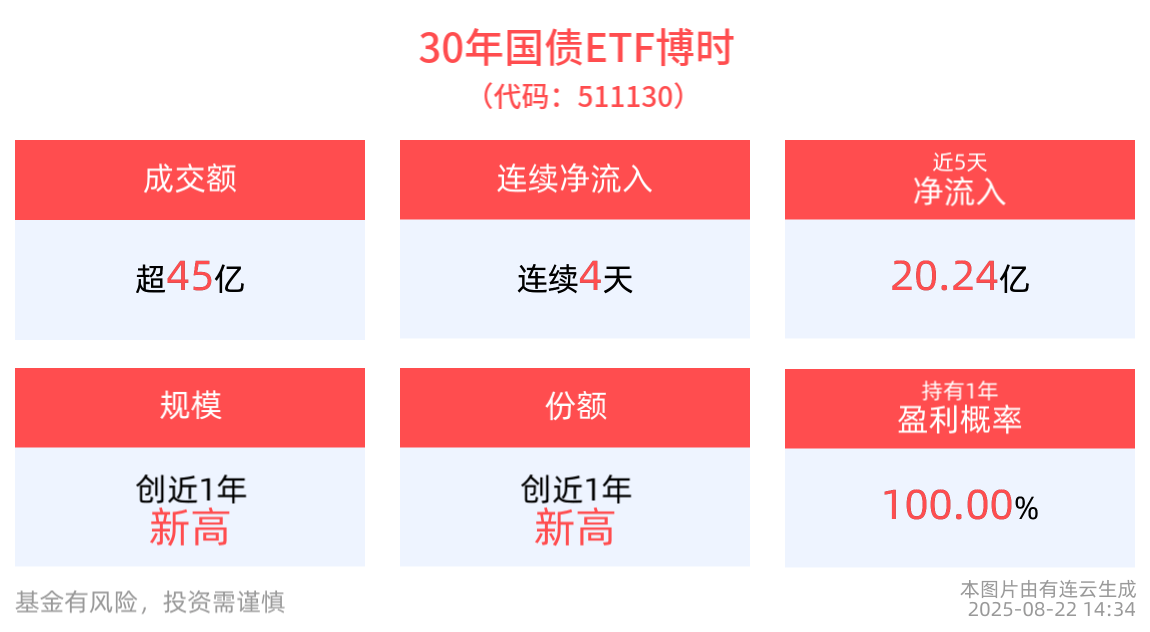
30年国债ETF博时(511130)连续4天净流入,合计“吸金”超20亿元,最新规模再创新高
Sou Hu Cai Jing· 2025-08-22 07:00
Core Viewpoint - The 30-year government bond ETF from Bosera has shown a significant performance with a recent price of 108.18 yuan, reflecting a 6.87% increase over the past year, indicating strong market activity and investor interest [3]. Group 1: Market Performance - As of August 21, 2025, the 30-year government bond ETF has achieved a net value increase of 6.99% over the past year, ranking 12th out of 421 index bond funds, placing it in the top 2.85% [5]. - The ETF's latest scale reached 17.695 billion yuan, marking a new high in nearly a year [4]. - The ETF has seen a continuous net inflow of funds over the past four days, with a peak single-day net inflow of 1.504 billion yuan, totaling 2.086 billion yuan in net inflows [4]. Group 2: Fund Characteristics - The ETF has a management fee rate of 0.15% and a custody fee rate of 0.05% [5]. - The tracking error for the ETF over the past three months is 0.053%, indicating a close alignment with the underlying index [5]. - The ETF closely tracks the Shanghai Stock Exchange 30-year government bond index, which reflects the overall performance of government bonds with a 30-year maturity [5]. Group 3: Economic Context - The bond market is expected to decouple slowly from the stock market, driven by economic fundamentals, with several supportive factors including continued monetary easing and low funding rates [4]. - The new policy financial tools being introduced have a funding scale of 500 billion yuan, focusing on emerging industries and infrastructure, which may further influence the bond market [3].

更加积极财政政策陆续落地
第一财经· 2025-08-22 05:04
Core Viewpoint - The article emphasizes the implementation of a more proactive fiscal policy in China, which is expected to support stable economic growth amid various challenges [3][4]. Fiscal Revenue and Expenditure - In the first seven months of this year, the total revenue from broad fiscal sources was approximately 15.9 trillion yuan, remaining stable compared to the same period last year [3]. - Broad fiscal expenditure reached about 21.5 trillion yuan, showing a year-on-year increase of approximately 9.3%, significantly outpacing the economic growth rate of 5.3% in the first half of the year [3][4]. - The fiscal deficit, which exceeded revenue by about 5.6 trillion yuan, marked a year-on-year increase of 47% [3]. Tax Revenue Trends - Tax revenue saw a decline of 3.5% in the first quarter, but subsequent months showed growth, leading to a reduction in the decline to just 0.3% over the first seven months [4]. - Stable growth in VAT and a surge in securities transaction stamp duty contributed to the recovery in tax revenue, reflecting an overall improvement in economic conditions [4]. Land Transfer Revenue - The revenue from land transfers amounted to approximately 1.7 trillion yuan, with a year-on-year decline of 4.6%, although the rate of decline has been narrowing [6]. Government Debt and Financing - Net financing from government bonds reached 8.9 trillion yuan in the first seven months, an increase of 4.88 trillion yuan year-on-year [8]. - The government is accelerating bond issuance to maintain fiscal expenditure levels, particularly in key areas such as social welfare, education, and healthcare [8]. Policy Outlook - The Central Political Bureau meeting in late July emphasized the need for continued macroeconomic policy support, including more proactive fiscal measures and moderately loose monetary policies [8]. - Despite concerns about potential reductions in fiscal spending in the second half of the year, estimates suggest that the adjusted fiscal expenditure growth rate could remain between 4.1% and 6.7%, aligning with economic growth targets of 4.7% to 4.8% [9]. Future Fiscal Strategy - The Ministry of Finance has indicated that there are sufficient reserve tools and policy space to respond to uncertainties in the economic environment [10]. - The focus will remain on stabilizing employment, businesses, and market expectations to ensure economic development and social stability [10].

8月22日证券之星午间消息汇总:海外突发!美联储释放鹰派信号
Sou Hu Cai Jing· 2025-08-22 03:52
Macro News - The Ministry of Commerce spokesperson stated that despite increased risks and challenges in international trade, China's foreign trade has shown steady growth, with a cumulative import and export growth of 3.5% in the first seven months of the year [1] - New policy financial tools with a funding scale of 500 billion yuan are being developed, focusing on emerging industries and infrastructure, including digital economy, artificial intelligence, and green low-carbon sectors [1] - The global focus is on the Jackson Hole central bank conference, where the Federal Reserve Chairman Powell is expected to deliver a key speech regarding future monetary policy [2] Industry News - The National Medical Products Administration announced comprehensive measures to ensure drug safety, including 100% coverage of inspections for selected products in national procurement [3] - A national hydrogen energy vehicle industry measurement testing center is being established to enhance the competitiveness of the hydrogen energy vehicle industry [3] - Titanium dioxide companies are announcing price increases, with Longbai Group raising prices by 500 yuan per ton for domestic customers and 70 USD per ton for international customers starting August 18, 2025 [3][4] Sector Insights - CITIC Securities reports that the market for high-frequency and high-speed resins for AI servers is projected to reach 2.28 billion yuan by 2026, with a CAGR of 85% from 2024 to 2026, indicating significant demand growth [5] - Guojin Securities highlights the rising demand for liquid cooling solutions in AI servers, suggesting opportunities in upstream materials such as fluorinated refrigerants and electronic fluorinated liquids [6] - Huatai Securities notes that the liquor sector is stabilizing, with strong fundamentals among leading companies, suggesting a favorable environment for bottom-fishing investments [6]
苏州市委常委会召开会议
Su Zhou Ri Bao· 2025-08-22 00:29
Group 1 - The meeting emphasized the importance of gathering public opinions for the "14th Five-Year Plan" to enhance its scientific, strategic, and operational aspects [1] - The meeting highlighted the need for effective flood prevention measures and risk management to ensure public safety following recent disasters [1] - The meeting discussed the necessity of improving urban living conditions and promoting technological and industrial innovation to better align with national development goals [1] Group 2 - The meeting focused on addressing corruption and misconduct in areas of public concern, particularly in educational materials and school uniforms [2] - The meeting called for strengthening supervision and accountability among party members to enhance public welfare and development [2] Group 3 - The meeting reviewed the current economic situation and stressed the need for extraordinary measures to stabilize businesses, employment, and market expectations [3] - The meeting outlined strategies to boost consumer spending and support key demographics such as graduates and veterans in finding employment [3] - The meeting emphasized the importance of risk prevention and maintaining a focus on public welfare amidst economic challenges [3]
规范PPP存量项目指导意见发布,重视企业报表改善与稳增长持续加码
Changjiang Securities· 2025-08-21 08:42
Investment Rating - The investment rating for the industry is "Positive" and maintained [8] Core Viewpoints - The State Council has issued a notice regarding the "Guiding Opinions on Regulating the Construction and Operation of Existing PPP Projects," which has received approval from the State Council, marking the arrival of regulatory guidance for existing PPP projects [2][6] - The report emphasizes the importance of ensuring the smooth progress of projects, with government debt clearly designated for the payment of existing projects [11] - The report highlights the need for mid-term focus on sustained growth, with fiscal efforts and major projects as two key drivers [11] Summary by Relevant Sections - **Regulatory Guidance**: The issuance of regulatory guidance for existing PPP projects aims to optimize credit approval processes and ensure the stability of credit funds, which will enhance the government's payment capacity for these projects [11] - **Asset Quality Improvement**: If the implementation of PPP projects is secured, it is expected to solidify the asset quality of construction companies, potentially leading to a recovery in price-to-book ratios [11] - **Fiscal and Project Initiatives**: The report outlines that the urgency for stabilizing growth has increased, with expectations for new policy financial tools and significant project investments to support infrastructure development [11] - **Investment Opportunities**: The report suggests focusing on state-owned enterprises with low price-to-book ratios and ecological landscape companies, particularly those benefiting directly from PPP projects and major regional developments [11]
招商宏观:重点关注基建相关财政支出增速的回补效应
Sou Hu Cai Jing· 2025-08-21 00:50
Core Viewpoint - The report emphasizes the importance of infrastructure-related fiscal spending recovery in supporting the currently weak infrastructure investment growth, which is also a crucial part of the upstream "anti-involution" demand-side policy [1] Group 1: Infrastructure Spending - The acceleration of infrastructure spending is necessary to meet the annual budget, with cumulative year-on-year growth in public budget infrastructure spending from January to July being -5%, but expected to rebound to over 7% from August to December [1] - The local debt resolution for the year is likely nearing completion, with future efforts focusing on advancing special bond projects. As of August 20, the issuance scale of special refinancing bonds for the year reached 1.94 trillion, with the actual allocation of the originally planned 800 billion for new special bonds exceeding 940 billion [1] Group 2: Long-term Bonds and Financial Tools - The issuance progress of ultra-long-term special government bonds is nearing 80%, with an increase in the issuance scale of policy financial bonds from June to August, potentially preparing for new policy financial tools. As of August 20, the issuance progress of ultra-long-term special government bonds is close to 80%, compared to less than 60% in the same period last year [1] - The project initiation and funding collection progress for ultra-long-term special government bonds are both ahead of last year, indicating that the implementation situation is likely to be significantly better than last year [1]
下半年“财政退坡”值得担心吗?——7月财政数据点评
一瑜中的· 2025-08-20 14:33
Group 1 - The core viewpoint of the article discusses the potential concerns regarding "fiscal retreat" in the second half of the year, highlighting the implications for economic performance and the need for extraordinary policy measures to counteract any downturn [3][4][5]. - "Fiscal retreat" refers to a significant drop in fiscal expenditure growth in the latter half of the year compared to the first half, particularly in years where the fiscal budget is not adjusted post-implementation [3][12]. - There is a possibility of a fiscal retreat this year, with projections indicating a potential decline in fiscal expenditure growth to between -0.4% and 2.1%, marking the lowest growth rate since 2022 [4][13]. Group 2 - Despite the potential for fiscal retreat, the actual risk of it negatively impacting the economy may be limited, as adjusted fiscal expenditure growth is estimated to remain robust, between 4.1% and 6.7% [5][15]. - The article emphasizes that even without extraordinary policy measures, the fiscal support for the economy in the second half may not be less than that in the first half, aligning with economic growth targets of approximately 4.7% to 4.8% [5][15]. - The analysis includes a breakdown of fiscal expenditure adjustments, excluding non-economic driving components and incorporating new policy financial tools to enhance fiscal capacity [16][19]. Group 3 - The July fiscal data indicates a significant rebound in public fiscal revenue, with a year-on-year increase of 2.6%, marking the highest monthly growth rate of the year [20][21]. - Tax revenue has shown consistent positive growth for four consecutive months, with notable increases in sectors such as equipment manufacturing, where tax revenue grew by over 33% [20][21]. - On the expenditure side, public fiscal spending increased by 3% in July, ending a two-month decline, with a notable focus on social welfare and infrastructure spending [33][34]. Group 4 - The article notes a narrowing of land sales revenue growth, which has implications for broader fiscal revenue, while special bonds and new special debts have supported high growth in fiscal expenditure [42][43]. - Government fund income growth has slowed to 8.9% in July, primarily due to reduced land sales revenue growth of 7.2% [42][43]. - The article highlights the importance of monitoring future policies aimed at stabilizing the real estate market, which could impact fiscal revenue positively [42][43].

7月财政数据点评:下半年“财政退坡”值得担心吗?
Huachuang Securities· 2025-08-20 08:06
Group 1: Fiscal Performance Overview - In July, the broad fiscal revenue increased by 3.6% year-on-year, compared to 2.8% in June[1] - Broad fiscal expenditure in July rose by 12.1% year-on-year, down from 17.6% in June[1] - The public fiscal revenue in July marked the highest monthly growth of the year, with tax revenue showing positive growth for four consecutive months[15] Group 2: Concerns about Fiscal Decline - "Fiscal decline" refers to a significant drop in expenditure growth in the second half of the year if no budget adjustments are made[2] - There is a risk of fiscal decline this year, with potential expenditure growth ranging from -0.4% to 2.1% in the second half, marking the lowest since 2022[9] - The gap between the first and second half of the fiscal expenditure growth could reach 6.8% to 9.3%, the largest since 2022[9] Group 3: Economic Impact and Adjusted Expenditure - Even without extraordinary fiscal policies, the adjusted fiscal expenditure growth in the second half is estimated to be between 4.1% and 6.7%, comparable to the first half's 4.5%[10] - The adjusted fiscal expenditure growth aligns with the economic growth target of approximately 4.7% to 4.8% for the second half[10] - The analysis suggests that the actual economic support from fiscal measures may not be significantly lower than in the first half[10] Group 4: Sector-Specific Insights - Tax revenue from the manufacturing sector, including railways and aerospace, saw significant monthly growth rates of over 33%, 10%, and 8% respectively[18] - Social welfare expenditures contributed 3.5 percentage points to the expenditure growth in July, while infrastructure spending had a negative impact of 0.7 percentage points[33] - Government fund income growth slowed to 8.9% in July, primarily due to a decrease in land sale revenue growth to 7.2%[45]
华泰宏观:预计3季度末至4季度初或将通过增发特别国债、上调赤字等方式多管齐下稳定增长预期
Sou Hu Cai Jing· 2025-08-19 23:37
Group 1 - The core viewpoint of the report indicates that after a proactive fiscal approach in the first half of the year, there may be a need for timely reinforcement in the second half, with a focus on the sustainability of broad fiscal policies and the comprehensive impact of external demand fluctuations [1] - The sustainability of fiscal stimulus may face certain uncertainties, contrasting with last year's delayed government bond issuance, where only a net issuance of 4 trillion yuan occurred in the first seven months, while 7.3 trillion yuan was issued from August to December [1] - It is anticipated that from late Q3 to early Q4, measures such as issuing special government bonds and increasing the deficit will be employed to stabilize growth expectations, with a particular emphasis on the effective impact of new policy financial tools on investment [1] Group 2 - If new policy financial tools are accelerated and even expanded in Q3, they will play a crucial role in supporting the expansion of "quasi-fiscal" efforts [1]
华泰证券:财政政策持续有效发力是稳内需、稳信心的关键
Zheng Quan Shi Bao Wang· 2025-08-16 01:36
Core Viewpoint - The report from Huatai Securities indicates that while external demand uncertainty is decreasing due to the reduction of U.S. tariff policy disruptions, the impact of a potential slowdown in global trade activities after the "export grabbing" trend subsides still needs to be observed [1] Group 1: Economic Indicators - From January to June, the broad fiscal expenditure, including general public budgets and government funds, increased by 8.9% year-on-year, a significant improvement compared to a decline of 2.8% in the same period last year, contributing positively to economic growth in the first half of the year [1] - The implementation of "reciprocal tariffs" in early August may significantly raise the U.S. weighted average import tariff level, introducing uncertainty to external demand trends [1] Group 2: Policy Implications - Continuous effective fiscal policy is crucial for stabilizing domestic demand and confidence [1] - The need for timely reinforcement of domestic fiscal measures after initial efforts, as well as the effectiveness of new policy financial tools in boosting investment, are areas of concern [1]
