人民币升值

Search documents
每日投行/机构观点梳理(2025-12-26)
Jin Shi Shu Ju· 2025-12-26 12:32
Group 1 - UBS Wealth Management predicts that the Chinese stock market will continue to have upward potential through 2026, driven by advanced manufacturing and technology as new growth engines [1] - The technology sector, which accounts for about half of the MSCI China Index, is becoming increasingly resilient to external shocks and U.S. economic cycles [1] - The Hang Seng Tech Index is expected to see a 37% growth in earnings per share by 2026, with approximately 7 trillion RMB in excess household savings likely to flow into the stock market [1] Group 2 - Barclays anticipates that the Bank of Japan will raise interest rates in July and December of 2026, influenced by the spring wage negotiation cycle [2] - The report emphasizes the importance of wage negotiations as a key factor in the Bank of Japan's monetary policy and its response to the risk of yen depreciation [2] Group 3 - OANDA reports that multiple factors are driving a historic surge in precious metals, with gold potentially reaching $5,000 per ounce and silver $90 per ounce in the coming year [3] - The report attributes the rise to speculative trading, low liquidity at year-end, expectations of long-term Fed rate cuts, a weaker dollar, and increased geopolitical risks [3] - Platinum and palladium prices have surged due to supply constraints and strong industrial demand, with platinum up approximately 165% and palladium over 90% year-to-date [3] Group 4 - CICC suggests focusing on asset trend changes rather than specific gold price predictions, as current gold prices are above short-term valuation models, indicating potential bubbles [4] - The report anticipates that the gold bull market may not end soon, but volatility is expected to increase as prices deviate from fundamental indicators [4] - CICC maintains an optimistic outlook on Chinese assets, emphasizing the benefits of the AI technology wave and ample liquidity, while suggesting a focus on technology growth in the short term [5][6] Group 5 - CITIC Securities highlights the importance of maintaining macro liquidity stability through tools like reserve requirement ratio cuts and interest rate reductions [6] - The report predicts a 5%-10% increase in the overall A-share market in 2026, with Hong Kong stocks expected to experience a rebound in performance [6] - The outlook for commodities includes expectations for gold to challenge $5,000 per ounce and copper prices to rise to $12,000 per ton due to supply constraints and demand drivers [6] Group 6 - CITIC Securities notes a trend of diminishing focus on quantitative targets by the People's Bank of China, with an emphasis on long-term structural reforms [7] - The report indicates that the central bank's policy may shift towards addressing supply-side issues and reducing financing costs [7] Group 7 - Huatai Securities states that the current appreciation of the RMB is likely to enhance foreign interest in RMB-denominated assets, creating a positive feedback loop for capital inflows [8] - The report suggests that the strengthening of the RMB will continue to support the valuation of both onshore and offshore RMB assets [8] Group 8 - CITIC Jin Investment reports that rising storage costs have begun to impact consumer electronics prices, with several manufacturers increasing product prices by 100-200 RMB [9] - The report indicates that the cost pressures from rising storage prices are likely to lead to a temporary decline in consumer electronics sales [9] Group 9 - Galaxy Securities notes that leading liquor companies are adjusting their strategies for 2026, focusing on maintaining price stability and channel profitability amid cyclical pressures [10] - The report emphasizes the importance of developing new consumer segments and adapting to new consumption trends as part of long-term transformation efforts [10]
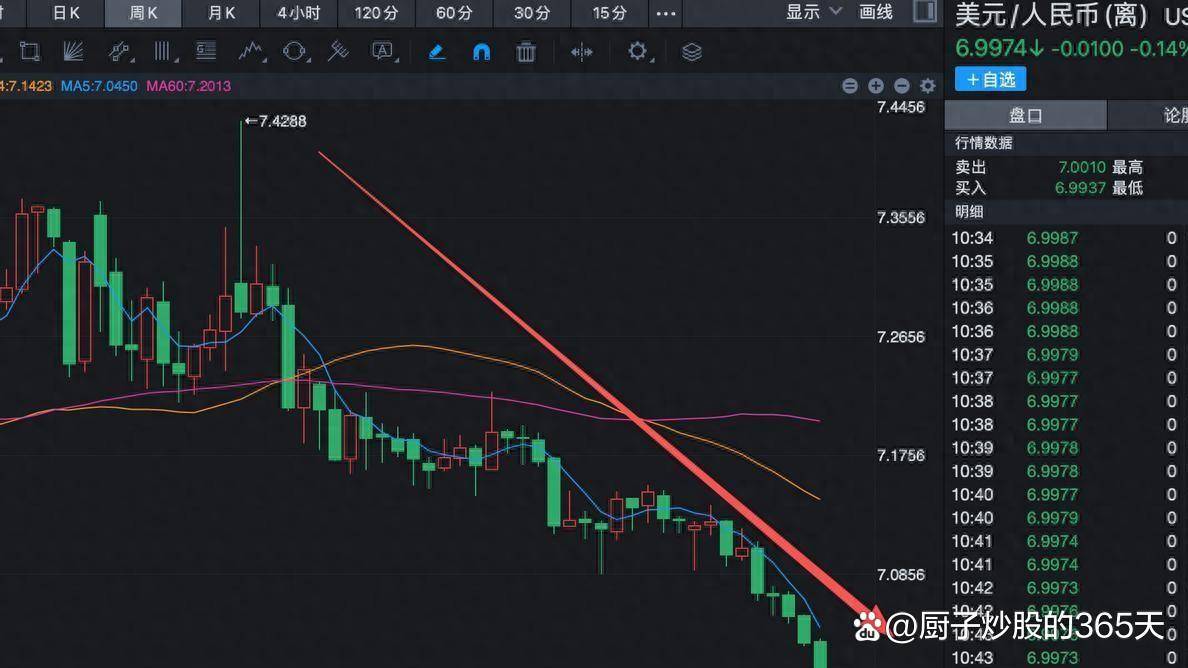
人民币汇率破7!接下来股市、楼市和你手里的资产都会怎么走?
Sou Hu Cai Jing· 2025-12-26 11:43
Core Viewpoint - The recent appreciation of the RMB against the USD, crossing the 7.0 mark, signals a significant shift in market dynamics, impacting various sectors and consumer behavior [1][3]. Exchange Rate Dynamics - The RMB has experienced a steady rise since hitting a low of 7.3498 in April, culminating in a peak of 6.9965 on December 25, marking a 14-month high [1][3]. - The decline of the USD index, dropping over 8% this year, has diminished the attractiveness of USD-denominated assets, prompting capital to seek new opportunities [3][5]. Capital Flows and Market Reactions - Export companies are accelerating their currency conversion ahead of the year-end, contributing to increased demand for RMB as they prepare for the new year [5]. - There is a noticeable trend of foreign capital returning to the A-share market, particularly in technology, consumer, and financial sectors, with blue-chip stocks gaining favor due to their liquidity and reasonable valuations [5][10]. Stock Market Implications - The appreciation of the RMB is expected to benefit the stock market, with estimates suggesting that a 1% increase in the RMB could enhance A-share returns by approximately 3% [8]. - However, not all sectors will benefit equally; foreign capital is favoring core assets and blue-chip stocks, while industries reliant on imported materials, such as aviation and paper manufacturing, are experiencing cost reductions and improved financial performance [10][12]. Real Estate Market Impact - The direct impact of RMB appreciation on the real estate market is limited, as foreign investment faces regulatory hurdles and the overall market is influenced more by policy and demographic factors [14][16]. - While RMB appreciation may enhance the attractiveness of RMB-denominated assets, it does not directly drive up property prices, which remain under pressure in major cities [16][17]. Consumer Behavior and Purchasing Power - The appreciation of the RMB enhances purchasing power for consumers, making overseas education, travel, and imported goods more affordable [19][21]. - However, individuals holding USD-denominated assets may face challenges, as currency fluctuations can offset interest earnings, highlighting the importance of considering broader trends in investment decisions [21][23]. Strategic Investment Considerations - Investors are encouraged to diversify their asset allocations rather than concentrating on a single currency or asset type, as this approach mitigates risks associated with currency fluctuations [25]. - The recent RMB appreciation reflects a broader reassessment of risks and opportunities in the global market, indicating a potential shift in capital flows towards Chinese assets [25][27].


沪指8连阳 短线情绪回暖明显
Sou Hu Cai Jing· 2025-12-26 11:25
长沙晚报掌上长沙12月26日讯(全媒体记者 周丛笑)今天市场冲高回落,沪指放量微涨0.1%,录得8连 阳。截至收盘,沪指涨0.1%,深成指涨0.54%,创业板指涨0.14%。沪深两市成交额2.16万亿元,较上一 个交易日放量2357亿元。 消息面,《广州市扶持游戏电竞产业发展的十八条措施》发布,单个企业每年获得本政策所涉及的财政 扶持资金最高不超过1000万元。四家头部硅片企业联合大幅上调报价,业内普遍反馈,本次硅片涨价主 要是上游硅料涨幅较大所致。国投白银LOF公告,将于12月26日开市起至当日10:30停牌;限制A类基金 份额定期定额投资金额为100元。 行情上,昨天市场延续反弹,三大指数全线飘红,短线情绪持续活跃,全市场再度逾百股涨停或涨超 10%。指数上,沪指迎8连阳,深成指、创业板指探底回升。盘面上,商业航天在连续两日的放量拉升 后,成为当前市场最为核心的热点题材,此外算力硬件方向也始终与指数高度共振。这两大热点核心个 股的资金反馈或对短线情绪起到风向标意义,若能始终维持震荡向上趋势行情,各短线题材仍有望在轮 动中反复活跃。观点仅供参考,投资有风险,入市需谨慎。 长江证券资深投资顾问刘浪表示,25日 ...
和讯投顾卢明昊:中午为何突然跳水,继续看好后市行情
Sou Hu Cai Jing· 2025-12-26 11:25
同时呢在长端掉期进行了回笼美元,以应对结汇的压力,所以啊也就间接影响到我们大a跳水了。而这 一个动作其实啊也只是起到了放缓人民币的涨势,而不是从根本上改变它原有的趋势,所以反映到我们 盘面上也就是突然跳下水,然后慢慢的再收起来了。至于之后的行情啊我依旧比较看好,不会因为今天 盘中的那么一跳而改变自己的观点。板块方面短期还是看商业航天和人形机器人,中期依旧看好AI、 算力、半导体、有色等方向。 今天中午发生了什么事,大盘突然跳水了,而午后又逐步收了上去。另外之后的行情大家又怎么看呢? 和讯投顾卢明昊分析,今天早盘市场依旧延续着最近小幅攀升的节奏,就在以为还是老剧本重演的时 候,突然之间大盘直线跳水,由于跳水来的太快,可能有些朋友啊还没有反应过来,等到中午吃饭的时 候啊才看到,那到底是发生了什么事呢?原来啊是因为最近人民币升值过快短短一个月时间里,离岸人 民币对美元将近升值了1.5%左右,从而可能触发了机构交易市场重新购买美元的条件。 ...
每日机构分析:12月26日
Zhong Guo Jin Rong Xin Xi Wang· 2025-12-26 10:38
Group 1: Asset Environment and Economic Outlook - CITIC Securities predicts that the asset environment in 2026 may exhibit characteristics of marginal liquidity easing and moderate economic recovery, with the 10-year China bond yield expected to fluctuate between 1.5% and 1.8% and the 10-year US Treasury yield maintaining a range of 3.9% to 4.3% [1] - The report anticipates that Brent crude oil will oscillate between $58 and $70 per barrel, while gold prices may continue to be strong, potentially reaching $5,000 per ounce, supported by liquidity easing and geopolitical risks [1] - Copper prices are expected to rise to an average of $12,000 per ton due to supply constraints and electricity demand [1] Group 2: Currency and Foreign Investment - Huatai Securities indicates that the current appreciation of the RMB is likely to enhance foreign investors' interest in RMB-denominated assets, creating a positive cycle for capital inflows and easing financial conditions [2] - The report notes that despite seasonal declines in capital flows and risk appetite towards the end of the year, the strengthening of the RMB will continue to boost the valuation of both onshore and offshore RMB assets [2] Group 3: Silver Market Dynamics - Silver prices have surged nearly 150% this year, driven by strong industrial demand, low global inventories, and its inclusion in key mineral lists [2] - Analysts suggest that silver is breaking away from its traditional role as a "by-product" of gold, with its independent investment logic being re-evaluated by the market [2] - Predictions indicate that silver prices could reach $100 per ounce by 2026, especially if monetary instability increases [2] Group 4: Japanese Economic Indicators - Tokyo's inflation rate has shown a greater-than-expected decline, with the CPI rising 2.3% year-on-year in December, down from 2.8% the previous month, primarily due to easing food price increases and lower energy costs [3] - Despite the slowdown, inflation remains above the Bank of Japan's 2% target, suggesting continued tightening of monetary policy [3] - The Japanese economy is expected to rebound from a contraction in Q3, with forecasts indicating production growth of 1.2% and 1.8% in December and January 2026, respectively [3] Group 5: Japanese Government Bond Issuance - The Japanese Finance Ministry plans to reduce the issuance of ultra-long government bonds to the lowest level in 17 years, cutting nearly 20% from the previous fiscal year to approximately 17.4 trillion yen [4] - The total issuance of Japanese government bonds for the next fiscal year is projected to be 180.7 trillion yen, a decrease of nearly 5% from the current fiscal year [4] Group 6: South Korean Currency Intervention - The South Korean won has strengthened against the US dollar due to verbal interventions and measures from authorities, with the government expressing a firm commitment to alleviate pressure on the currency [4] - Recent measures may lead to a dollar sell-off of up to $23 billion, although there are risks that the outcomes may not meet expectations [4]
铅周度总结:供应刚性与需求弹性共振 跨年行情将延续涨势?
Xin Lang Cai Jing· 2025-12-26 09:52
Core Viewpoint - The lead price in the Changjiang spot market has shown a healthy upward trend, closing at 17,350 CNY/ton, marking a cumulative increase of 400 CNY/ton over the week, with an average price of 17,190 CNY/ton, up 80 CNY from the previous week, driven by macroeconomic factors and fundamental support [4][5]. Macroeconomic Factors - The strong rise in lead prices is attributed to four macroeconomic drivers: 1. Strengthened expectations for Federal Reserve interest rate cuts, reducing the opportunity cost of holding non-yielding assets like metals [5]. 2. Significant appreciation of the RMB, lowering import costs for raw materials and enhancing domestic investors' preference for RMB-denominated assets [5]. 3. Continuous supportive policies from the government, including signals of monetary easing and initiatives to boost consumption, which have bolstered confidence in economic recovery and industrial demand [5]. 4. Improvement in initial jobless claims data in the U.S., alleviating concerns about a deep global economic recession and increasing risk appetite [5]. Supply and Demand Dynamics - The lead market is currently in a "weak balance" state, characterized by rigid supply and elastic demand: - Supply constraints are due to structural shortages in lead concentrate and challenges in recycling during winter, leading to insufficient supply elasticity and low social inventory, which supports prices [6]. - Demand shows a mixed picture, with traditional sectors like electric bicycles and automotive batteries remaining stable, while new energy vehicles pose long-term replacement pressure on lead-acid batteries. Emerging sectors like energy storage are expected to provide incremental space but have not yet significantly impacted the overall demand [6]. - The industry's profit is shifting towards upstream mining, while midstream and downstream sectors face challenges balancing cost pressures and end prices [6]. Market Outlook - Looking ahead, the market will navigate through the interplay of policy, liquidity, and reality: - The focus will be on the Federal Reserve's December FOMC meeting minutes to validate the interest rate cut path for 2026, with any dovish signals likely to reinforce the narrative of a weak dollar and ample liquidity [7]. - Domestic policies under the "14th Five-Year Plan" are expected to drive growth, with a dual focus on "new productive forces" and expanding domestic demand, serving as key engines for the market [7]. - The lead market is anticipated to remain in a typical "weak balance" state, with supply constraints and low social inventory supporting price floors, while demand lacks explosive drivers. The lead price is expected to fluctuate within the range of 17,500 to 17,900 CNY/ton, exhibiting characteristics of "top and bottom" [7]. Investment Strategy - For investors, this period represents a critical window for positioning in 2026: - A "barbell strategy" is recommended, focusing on offensive investments in sectors aligned with "new productive forces" such as AI and commercial aerospace, while defensive allocations should include high-dividend blue-chip stocks to mitigate volatility [8]. - The trading logic is shifting from mere expectation-based speculation to a deeper validation of policy effectiveness and fundamental data, emphasizing the need for sensitivity to reality while embracing trends to seize opportunities in the year-end market [8].

刚刚!惊魂大逆转,背后原因是什么?
中国基金报· 2025-12-26 07:58
Market Overview - On December 26, A-shares experienced a significant intraday drop but managed to recover, with the three major indices closing slightly higher. The Shanghai Composite Index rose by 0.1%, the Shenzhen Component Index increased by 0.54%, and the ChiNext Index gained 0.14% [2]. Market Performance - A total of 1,866 stocks rose, with 92 hitting the daily limit up, while 3,414 stocks remained unchanged or fell [3][4]. - The total trading volume reached 21,811.04 billion, with a total turnover of 130,586.97 million shares [4]. Sector Highlights - The commercial aerospace sector continued to show strength, with companies like Shenjian Co. achieving a seven-day limit up. Other stocks such as China Satellite and China Satcom also hit the daily limit up [4]. - The Hainan Free Trade Zone remained active, with Hainan Mining and Hainan Airlines hitting the daily limit up [5]. - The lithium battery sector saw a surge, with stocks like Fengyuan Co. and Yongxing Materials reaching the daily limit up. This was influenced by a recent article from the National Development and Reform Commission emphasizing the importance of regulating competition in the new energy sectors [5]. Market Dynamics - The sudden drop in the market around 11 AM was attributed to two main factors: 1. The adjustment of the RMB to USD exchange rate, which was set at 7.0358, significantly lower than market expectations, indicating a potential strategy to manage the pace of RMB appreciation [12][13]. 2. The circulation of a commentary regarding the A500 ETF, which caused market disturbances [14]. Analyst Insights - Analysts from Huatai Research noted that the current environment of RMB appreciation could enhance foreign investment interest in RMB-denominated assets, potentially leading to a positive cycle of capital inflow and increased asset valuations [14]. - Industrial analysts from Industrial Securities suggested that the RMB appreciation might just be the beginning, with expectations of returning capital that had previously flowed out of China, further boosting market risk appetite [14].

人民币上涨4300点破7!四大行业直接受益,明年A股主线全揭秘
Sou Hu Cai Jing· 2025-12-26 07:24
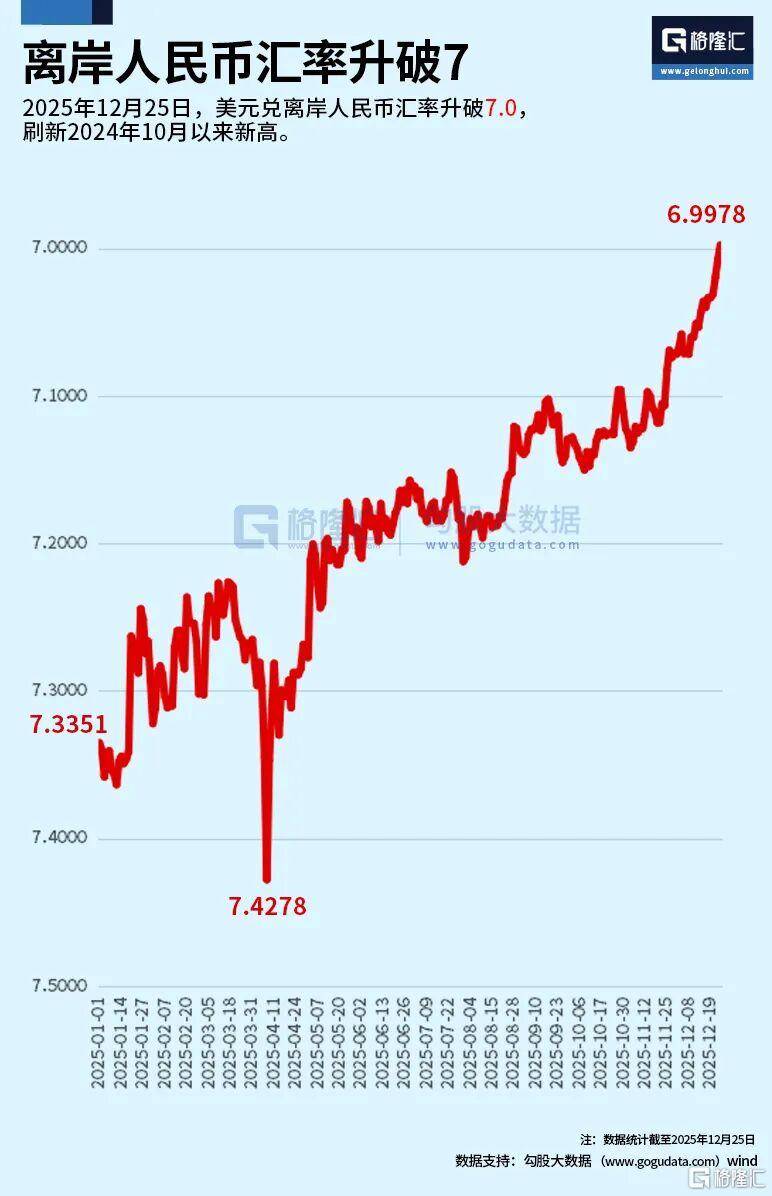
Core Viewpoint - The Chinese yuan has experienced a significant appreciation against the US dollar, rising from 7.43 to 6.99 in just over six months, breaking the key psychological barrier of 7.0, contrary to previous pessimistic market sentiments [1][3]. Group 1: Currency Appreciation Dynamics - The yuan began its appreciation in April 2023, with the onshore yuan recently surpassing the 7.07 mark, reaching a midpoint of 7.0759 in early December, marking a new high in over a year [3][4]. - The US dollar index has fallen from a high of 109 to below 100, with an annual decline exceeding 8%, influenced by the Federal Reserve's interest rate cuts [4]. - China's economic resilience is a fundamental support for the yuan's strength, with a bank settlement surplus of $80.9 billion in the first ten months and a GDP growth of 5.3% in Q3, surpassing market expectations [4]. Group 2: Impact on Industries - The aviation sector benefits significantly from the yuan's appreciation, with a 1% increase in the yuan potentially boosting the net profit of leading airlines by 5% [6]. - The paper industry also stands to gain, as over 70% of its raw materials are imported, leading to a 2-3 percentage point increase in gross margins due to lower procurement costs [7]. - The financial sector is seeing increased foreign investment, with foreign holdings of Chinese government bonds exceeding 3.2 trillion yuan, creating a favorable environment for core financial assets [6][7]. Group 3: Market Sentiment and Investment Strategies - Analysts suggest that a classic "cross-year-spring" market trend is developing, with a focus on cyclical sectors such as industrial metals, non-bank financials, and the hotel and aviation industries [9]. - Investment strategies are being adjusted, with a focus on consumer services, food and beverage sectors, and traditional industries like basic chemicals and machinery [9][12]. - The ongoing appreciation of the yuan is expected to influence market dynamics, with a potential shift towards value-driven investments as investor sentiment stabilizes [12][13].
悄悄破了。。意味着什么?
Sou Hu Cai Jing· 2025-12-26 07:11
Group 1 - The recent appreciation of the Renminbi (RMB) against the US dollar, breaking the 7 mark, is seen as a psychological barrier rather than just a numerical threshold, indicating a shift in market sentiment towards potential RMB strength [1][34] - China's trade surplus exceeded $1 trillion for the first time in the first 11 months of the year, reflecting strong global demand for Chinese goods despite ongoing trade tensions [3] - The RMB's appreciation is linked to a self-reinforcing cycle where expectations of further appreciation lead to increased demand for RMB, thus strengthening its value [5][6] Group 2 - The external environment, including the weakening of the US dollar and changes in global investment patterns, has contributed to the RMB's strength, with significant net inflows into Chinese assets [12] - Historical trends show that RMB appreciation often correlates with positive stock market performance, suggesting potential benefits for investors in Chinese equities [14][20] - Industries that benefit from RMB appreciation include aviation, paper manufacturing, semiconductor production, and certain steel and petrochemical sectors, as their costs are often denominated in foreign currencies [24][25][26][27] Group 3 - Conversely, industries that rely heavily on exports and operate on thin margins may face challenges as their products become more expensive in international markets due to RMB appreciation [29] - The appreciation of the RMB may force companies to innovate and enhance their value propositions, leading to a structural upgrade in the industry [30][31] - The impact of currency fluctuations on savings and investments, particularly in the context of previously popular US dollar deposits, highlights the real effects of exchange rate changes on financial decisions [32]
沪铜再创新高!多重催化下有色板块持续表现亮眼,工业有色指数涨超3.5%
Sou Hu Cai Jing· 2025-12-26 06:02
Group 1 - The core viewpoint of the articles highlights the strong performance of the non-ferrous metal sector, particularly copper and precious metals, driven by favorable macroeconomic conditions and supply-demand dynamics [1][2] - On December 26, 2025, copper futures prices surged past 98,000 yuan/ton, reaching a historical high, with the Zhongzheng Industrial Non-Ferrous Metals Theme Index rising by 3.54% [1] - The National Development and Reform Commission emphasized the importance of optimizing traditional industries like alumina and copper smelting, which are crucial for the national economy and defense [1] Group 2 - Citic Securities noted that the U.S. November CPI unexpectedly cooled, leading to market adjustments for the Federal Reserve's interest rate cuts in 2026, which, along with abundant liquidity and supply constraints, pushed non-ferrous metal prices to new highs [2] - The strong performance of non-ferrous metals is attributed to a combination of macroeconomic financial policies and structural changes in supply and demand, including the onset of a global rate-cutting cycle and a weakening dollar [2] - The Tianhong Zhongzheng Industrial Non-Ferrous Metals Theme Index closely tracks the performance of 30 major listed companies involved in copper, aluminum, lead, zinc, and rare earth metals, reflecting the overall performance of the sector [2]