
成长风格

Search documents
[6月19日]指数估值数据(港股下跌,港股科技重回低估;月薪宝的收益来源是什么;红利估值表更新;指数日报更新)
银行螺丝钉· 2025-06-19 12:47
Market Overview - The overall market experienced a decline today, closing at a 5-star rating [1] - Large-cap stocks saw less decline compared to small and mid-cap stocks, with value and dividend indices showing smaller fluctuations [2] - Growth style stocks faced more significant declines during market volatility [2] Hong Kong Stock Market - The Hong Kong stock market exhibited considerable volatility today [3] - After a significant drop in early April, the market rebounded strongly, with 8 out of 9 weeks showing gains, outperforming A-shares by 20% since the Lunar New Year [4] - The Hang Seng Index has seen three waves of increases and three waves of corrections over the past year [6] - The index's performance ranged from 16,000-17,000 points at a 5.9-star rating last year to 18,000-19,000 points at the beginning of this year, and 19,000-20,000 points after the April drop [7] - Earnings for Hong Kong stocks grew by 16% year-on-year in Q1, contributing to the market's gradual rise [8] - Future increases are expected to be accompanied by corrections of 10%-20%, similar to previous bull markets [9] Investment Products - The monthly salary product has shown relative stability, with minor fluctuations during market corrections [11] - The product typically follows a pattern of advancing three times and retreating once, with each correction leading to a gradual increase in the market's bottom [12] - A decline in deposit rates has led to an increase in income-generating assets, with products like dividends, REITs, and monthly salary products performing better in 2024 compared to previous years [13][14] Monthly Salary Product Composition - The monthly salary product consists of 40% stocks and 60% bonds, with a focus on value style for the stock portion [16][17] - Value style characteristics include lower volatility during bear markets and higher dividend yields, providing stable income regardless of market fluctuations [19][20] - The bond portion is primarily focused on short to medium-term bonds, with current interest rates around 1.6%-1.7% [21] - Rebalancing strategies have been employed to capitalize on market fluctuations, with the last adjustment occurring in early 2024 during a market dip [22][23] Future Expectations - The monthly salary product reached a historical high in Q2, surpassing previous stock purchase levels [23] - A rebalancing strategy is anticipated post-Q2, likely reducing stock exposure back to 40% and reallocating funds to bonds [26] - This rebalancing aims to create additional returns through low-buy high-sell opportunities, although such chances are not frequent [27] Dividend Indices and Funds - A summary of dividend indices and high-dividend funds' valuations has been provided for reference [30] - Various indices, such as the Hang Seng Dividend Index, have been analyzed for their earnings yield, dividend yield, and other financial metrics [31]


2025年股指期货半年度行情展望:N型下半场,认准方向,无惧颠簸
Guo Tai Jun An Qi Huo· 2025-06-18 11:42
2025 年 6 月 18 日 N 型下半场,认准方向,无惧颠簸 ---2025 年股指期货半年度行情展望 毛磊 投资咨询从业资格号:Z0011222 maolei@gtht.com 报告导读: 货 研 究 所 我们的观点:我们 2025 年年报中 N 字型走势的判断,目前看主要的调整阶段已经出现。下半年,N 字型后半段将持续演绎。 当然,后半段并非单边反弹,内外宏观因素的反复与利多的脉冲式效应,将带来行情走出蛇年"蛇型"的震荡上行走势。但 即使面对重重扰动,方向已明,无惧颠簸。 国 泰 君 安 期 二 我们的逻辑:今年,外部扰动一度带来了宏观预期与股指悲观情绪的大幅宣泄,但外生性的扰动犹如压力测试,给出了小概 率黑天鹅事件下中国经济的下限以及股指的下限。后期出现更大程度黑天鹅的难度无疑更为困难,反而提升了最悲观投资者 的入市信心。后期来看,经济与贸易博弈的反复性,宏观预期仍会出现波动,对股市的传导仍不可避免。但基本面环境的不 确定性强化政策托底与稳市场,也带来看空资金翻多的潜在空间。利率下行环境下,结合资本市场制度优化均提升股市配置 价值,有望持续带来增量资金。最终股指或依靠估值抬升,震荡上行。风格方面,成 ...
[6月17日]指数估值数据(螺丝钉定投实盘第369期发车;个人养老金定投实盘第19期;养老指数估值表更新;618购书福利)
银行螺丝钉· 2025-06-17 12:51
Market Overview - The market opened lower today but the decline narrowed by the close, indicating low volatility and maintaining a five-star rating [1] - Large, mid, and small-cap stocks exhibited similar volatility [2] - Value stocks showed little fluctuation, with the 300 Value index slightly up, demonstrating resilience during market volatility [3] - Growth style stocks experienced a slight decline [4] Hong Kong Market Insights - The Hong Kong stock market also saw a decline during the day, but the drop significantly reduced by the close, resulting in a slight decrease [5] - Technology stocks in Hong Kong remained relatively stable with low volatility [6] - Recent weeks have seen Hong Kong tech stocks return to a normal low valuation, with current valuations not far from being undervalued [7] - The performance growth rate of tech stocks in Q1 was strong, and if this trend continues into Q2, there is potential for further upward movement in tech stocks [8] Investment Strategies - The article promotes a limited-time discount on investment books as part of a promotional event [9][10][12] - A systematic investment plan is introduced, with specific amounts allocated for different investment strategies, such as the Index Enhanced Advisory Portfolio and Active Selection Advisory Portfolio [14] - The systematic investment strategy follows a "regular but variable" approach, investing more when valuations are lower [18] - Two methods for following investment strategies are outlined: manual and automatic [20][22] Pension Fund Investment - A personal pension fund investment plan is detailed, including specific funds and their current prices [23] - A valuation table for personal pension index funds is provided, offering insights into various indices and their financial metrics [29] Bond Market Insights - A bond valuation table is included, showing various bond indices and their respective metrics such as yield and duration [38] - The article indicates that the bond market is being monitored for valuation updates and insights [41]

红利风格配置价值备受关注,国企红利ETF(159515)盘中上涨,兴业银行涨近2%
Sou Hu Cai Jing· 2025-06-16 03:54
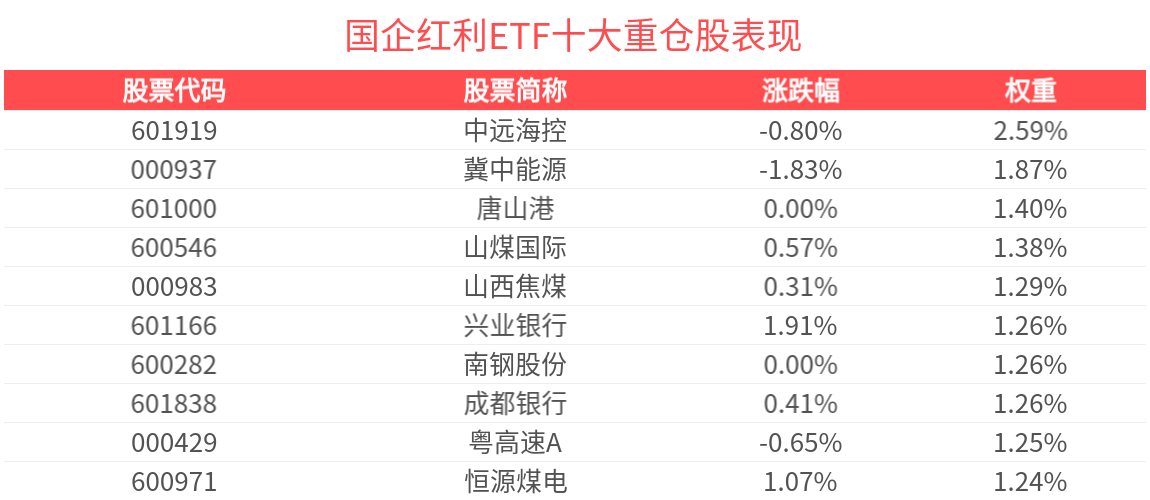
Group 1 - The core viewpoint of the news is that the China Securities State-Owned Enterprises Dividend Index (000824) has shown a slight increase, indicating a positive trend in state-owned enterprises' stock performance, particularly in dividend-paying stocks [1][2] - The top ten weighted stocks in the China Securities State-Owned Enterprises Dividend Index account for 15.83% of the index, highlighting the concentration of investment in a few key companies [2] - The report from Xinda Securities suggests that if significant monetary and fiscal policies are implemented, there could be improvements in M2 and M1-M2 differential, which may positively impact market conditions [1] Group 2 - The China Securities State-Owned Enterprises Dividend ETF (159515) closely tracks the performance of the China Securities State-Owned Enterprises Dividend Index, which includes 100 listed companies with high and stable cash dividend yields [2] - As of May 30, 2025, the top weighted stocks include COSCO Shipping Holdings (601919), Jizhong Energy (000937), and Chengdu Bank (601838), among others, indicating a diverse portfolio within the index [2][4] - The report indicates that the absolute and relative price-to-earnings (PE) ratios are high, but the trading volume has decreased since early April, suggesting a potential for future market adjustments [1]



后市怎么投?最新研判来了
Zhong Guo Ji Jin Bao· 2025-06-15 14:02
Core Viewpoint - The A-share market is expected to experience a structural upward trend in the second half of 2025, driven by economic recovery and policy support, with a focus on sectors like AI, high-end manufacturing, and innovative pharmaceuticals [1][15][20]. Market Outlook - The overall market is anticipated to continue favoring undervalued domestic equity assets with higher certainty, while also emphasizing the hedging value of gold against market volatility [4][17]. - Domestic economic indicators show a positive trend, with credit cycles in the early stages of recovery, contrasting with developed countries facing peak credit cycles [6][16]. - A-shares are seen as having better cost-performance ratios, making them suitable for medium to long-term investments [8][20]. Investment Strategies - Investment strategies should focus on structural opportunities in the stock market, particularly in technology growth and consumer sectors, while maintaining a balanced approach to equity and bond allocations [12][21]. - The preference for growth-oriented assets is highlighted, with an emphasis on actively managed equity funds that can capitalize on emerging trends [24][25]. - Gold is recommended for its dual role as a hedge against geopolitical risks and inflation, with expectations of continued price appreciation [27][28]. Asset Allocation - The allocation strategy should include a mix of high-quality growth stocks, dividend-paying blue-chip stocks, and value-oriented funds, with a focus on sectors benefiting from policy support [22][24]. - Fixed-income investments should prioritize high-grade credit bonds, while maintaining a core position in pure bond funds to stabilize portfolio volatility [26][30]. - The overall asset allocation should remain flexible to adapt to changing market conditions, with a focus on risk management and dynamic rebalancing [30][31]. Global Economic Factors - Global economic uncertainties, particularly related to U.S. trade policies and geopolitical tensions, are expected to influence market dynamics and investment strategies [29][30]. - The potential for U.S. interest rate cuts and ongoing geopolitical conflicts may create volatility in commodity prices, particularly in oil and gold [28][30].

风格轮动策略周报:当下价值/成长的赔率和胜率几何?-20250615
CMS· 2025-06-15 08:56
Group 1 - The report introduces a quantitative model solution for addressing the issue of value and growth style rotation based on odds and win rates [1][8] - The recent performance of the growth style portfolio was -0.01%, while the value style portfolio returned -0.14% [8] Group 2 - The estimated odds for the growth style is 1.10, while the value style is estimated at 1.08, indicating a negative correlation between relative valuation levels and expected odds [2][14] - The current win rates indicate that 3 out of 7 indicators favor growth, resulting in a win rate of 68.88% for growth and 31.12% for value [3][16] Group 3 - The latest investment expectation for the growth style is calculated at 0.44, while the value style has an investment expectation of -0.35, leading to a recommendation for the growth style [4][18] - Since 2013, the annualized return of the style rotation model based on investment expectations is 27.10%, with a Sharpe ratio of 0.98 [4][19]
创业板50ETF嘉实(159373)午后上涨1.47%,机构:6月市场风格可能整体偏大盘风格
Xin Lang Cai Jing· 2025-06-11 07:00
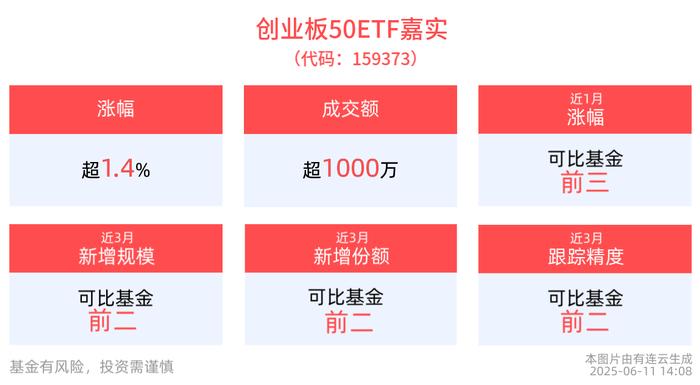
Group 1 - The ChiNext 50 Index has shown a strong increase of 1.43%, with notable gains from constituent stocks such as Guide Infrared (up 4.14%), CATL (up 3.23%), and Yangjie Technology (up 3.17%) [1][4] - The ChiNext 50 ETF managed by Harvest has seen a trading volume of 14.55 million yuan, with a turnover rate of 3.89% [4] - Over the past three months, the ChiNext 50 ETF has experienced a significant growth in scale, increasing by 254 million yuan, ranking among the top two in comparable funds [4] Group 2 - The latest price-to-book ratio (PB) for the ChiNext 50 Index is 4.2 times, which is lower than 81.33% of the time over the past five years, indicating a favorable valuation [4] - The top ten weighted stocks in the ChiNext 50 Index account for 65.6% of the index, with major players including CATL, Dongfang Wealth, and Mindray [4] - The market has shown a strong performance in June, with leading sectors including telecommunications, electronics, and non-ferrous metals, reflecting a recovery in market sentiment driven by growth styles [4][5] Group 3 - The market style in June is expected to lean towards large-cap stocks, with a balanced approach between growth and value [5] - Investment opportunities are suggested to focus on traditional capacity clearance, the rise of new consumption, and sectors with high industry prosperity [5] - Investors are encouraged to consider the ChiNext 50 ETF linked fund to capitalize on these investment opportunities [5]

创业板指大幅拉升,创业板ETF富国(159971)早盘大涨近2%!
Mei Ri Jing Ji Xin Wen· 2025-06-11 04:46
Core Viewpoint - The A-share market opened strong with significant gains across major indices, indicating a positive market sentiment and potential recovery in the A-share landscape [1] Market Performance - The Shanghai Composite Index surpassed the 3400-point mark, while the Shenzhen Component Index rose nearly 1% and the ChiNext Index increased by approximately 1.4% [1] - Nearly 4000 stocks in the two markets experienced an increase, showcasing broad market participation [1] Sector Highlights - The automotive parts sector showed collective strength, and the energy metals sector also saw a rise, with the IP economy concept becoming active again [1] - The ChiNext-listed companies performed strongly, with related funds experiencing significant gains [1] Fund Performance - The ChiNext ETF by Guotai Junan (159371) demonstrated strong leadership, with an intraday increase of over 2% [1] - Other related ETFs, such as the ChiNext ETF (159971) and the ChiNext Enhanced ETF (159676), saw intraday increases of 1.91% and 1.67%, respectively, and closed up 1.42% and 1.11% [1] Market Trends - The market achieved a "good start" in June, with the ChiNext Index showing impressive gains, particularly in the communication, electronics, and non-ferrous metals sectors, indicating a return to growth style that is boosting market sentiment [1] - Various sectors, including computing power, digital currency, rare earths, sports, and 6G, exhibited varying degrees of performance [1] Investment Opportunities - The ChiNext Index, composed of the 100 most representative ChiNext-listed companies, reflects the operational status of the ChiNext market, characterized by a high proportion of emerging industries and high-tech enterprises [1] - As one of the most representative growth stock indices in A-shares, the ChiNext Index is seen as a "leader" during upward phases, suggesting that investors may consider forward-looking investments through the ChiNext ETF (159971) and its linked funds (Class A 161022/Class C 013277) to capitalize on the A-share recovery opportunities [1]
风格轮动策略周报:当下价值、成长的赔率和胜率几何?-20250608
CMS· 2025-06-08 12:48
Group 1 - The report introduces a quantitative model solution for addressing the issue of value and growth style switching, based on the combination of odds and win rates [1][8] - Last week's market performance showed a growth style portfolio return of 3.01%, while the value style portfolio return was 1.51% [1][8] Group 2 - The estimated odds for the current growth style is 1.10, while the value style is estimated at 1.08, indicating a negative correlation between relative valuation levels and expected odds [2][14] - The current win rates indicate that 58.26% favor the growth style, while 41.74% favor the value style, based on seven win rate indicators [3][16] Group 3 - The latest investment expectation for the growth style is calculated at 0.22, while the value style's investment expectation is -0.13, leading to a recommendation for the growth style [4][18] - Since 2013, the annualized return for the style rotation model based on investment expectations has been 27.12%, with a Sharpe ratio of 0.99 [4][19]
资产配置月报:六月配置视点:今年业绩领先的基金有何特征?-20250605
Minsheng Securities· 2025-06-05 07:26
1. Report Industry Investment Rating No industry investment rating information is provided in the report. 2. Core Viewpoints of the Report - This year, public - offering equity funds have outperformed the market. Leading equity active funds are a mix of focused, rotational, and gambling types in terms of industries, with mid - growth and mid - high valuation styles. Their returns mainly come from stock - picking and trading abilities, and they are more concentrated in the consumer sector. Leading equity quantitative funds may deviate towards large - cap and value, with less under - allocation of finance and less over - allocation of machinery and electronics compared to other public - offering quantitative funds [1][14][33]. - In June 2025, the equity market's sentiment will continue to recover, and investors should take advantage of trading opportunities; the 10Y Treasury bond rate may decline by 9BP to 1.60%; gold should be continuously allocated; the real - estate supply - side pressure will rise; foreign capital will continue to flow in slightly, and the Indian equity market will have a phased rebound, but its current allocation value is relatively limited [2][35]. - In terms of market style, it is recommended to focus on the expected growth style, and the institutional attention to small - cap stocks is accelerating [4][91]. - For industry allocation, the high - probability and high - odds strategy recommends non - ferrous metals, electronics, power equipment and new energy, computers, machinery, and agriculture, forestry, animal husbandry and fishery; the industry clearance and reversal strategy recommends non - ferrous metals, electronics, and communications [5][107]. 3. Summary by Relevant Catalogs 3.1 This Year's Characteristics of Leading - Performance Funds 3.1.1 Equity Active Funds - As of May 30, 2025, public - offering equity active funds have achieved good results. The average absolute return is 2.51%, the median is 1.13%, and the proportion of positive absolute returns is 57.30%. The average excess return relative to their respective benchmarks is 2.45%, the median is 1.49%, and the proportion of positive excess returns is 61.19%. The average information ratio is 2.67%, and the average information ratio of the top 20 is 26.1% [10][12]. - The top 20 equity active funds with an information ratio and established for more than one year are a mix of focused, rotational, and gambling types in industries, mainly with mid - growth and mid - high valuation styles, and their scale is generally below 1 billion. There are three main models: focused on consumption - mid - growth and high - valuation, industry rotation - mid - growth and mid - valuation, and industry gambling - mid - growth and high - valuation [14][15]. - The returns of these three models mainly come from stock - picking and trading contributions. Style and industry returns contribute relatively little to the total return. The leading - performance equity active funds' returns mainly come from stock - picking and trading abilities [19]. - In terms of industry distribution, these funds are mainly concentrated in the consumer sector. Focused funds are concentrated in medicine and food and beverage; rotational funds are relatively diversified, mainly in consumer and manufacturing sectors; gambling funds are concentrated in food and beverage, basic chemicals, and commerce and retail [21]. 3.1.2 Equity Quantitative Funds - In terms of style exposure relative to the benchmark, the top 20 public - offering quantitative funds in terms of information ratio may deviate towards large - cap and value. They have less deviation in small - cap and greater deviation in non - linear small - cap, indicating an increase in large - cap stocks. They also have higher exposure to undervaluation factors, showing a preference for value, and obvious deviations in low - liquidity and low - volatility [29]. - In terms of industry exposure, these top 20 funds have less under - allocation of finance and less over - allocation of machinery and electronics compared to other public - offering quantitative funds. They also have over - allocation in construction and food and beverage [31]. 3.1.3 Summary This year, public - offering equity funds have outperformed the market. Leading equity active funds are a mix of different types in industries, with mid - growth and mid - high valuation styles, and their returns mainly come from stock - picking and trading abilities, and are concentrated in the consumer sector. Leading equity quantitative funds may deviate towards large - cap and value, with different industry exposure characteristics [33]. 3.2 Quantitative Views on Major Asset Classes 3.2.1 Equity: Sentiment Continues to Recover, Seize Trading Opportunities in June - In May, the overall sentiment recovered, with a slight decline in the financial sector and a steady recovery in the industrial sector. The full - A net profit in Q2 may further improve [39]. - Credit expansion has weakened, and the structure still needs improvement. It is estimated that the new social financing in May 2025 will be about 2.33 trillion yuan, an increase of 0.27 trillion yuan year - on - year. Government bonds will continue to support the growth of social financing [45]. - The market will remain in a volatile pattern in June. Investors can increase excess returns by seizing trading opportunities. The market is in a volatile pattern, and the overall market center may gradually rise, but the pace may be slow. The Shanghai and Shenzhen 300 Index has a healthy microstructure, and investors can buy low and sell high [48]. 3.2.2 Interest Rates: The 10Y Treasury Bond Rate May Decline by 9BP to 1.60% in June - Since 2023, the out - of - sample direction prediction of the 10Y Treasury bond rate has been correct for 20 months, with a winning rate of 69%. - Economic growth, inflation, and short - term interest rate factors are declining, while the debt - leverage factor has slightly increased. Overall, the 10Y Treasury bond rate may continue to decline in June [35]. 3.2.3 Gold: Continue to Allocate - Since 2023, the out - of - sample direction prediction of gold has been correct for 22 months, with a winning rate of 76%. - Various factors jointly drive the continued rise of gold. The US economic factor is declining, the fiscal factor is rising but at a slower pace, the employment factor is recovering, and the external debt factor is increasing [62]. - The slowdown in the upward rate of the fiscal factor is due to the reduction in defense spending, while overall consumption and investment expenditures have not declined [67]. 3.2.4 Real Estate: Supply - Side Pressure Rises - As of May 31, 2025, the three - month moving average of the real - estate industry pressure index is 0.569, indicating an increase in overall industry pressure. The supply - side pressure has increased due to the weak performance at the start - up end, while the demand - side pressure is basically the same as last month [72]. 3.2.5 Overseas: Foreign Capital Continues to Flow in Slightly, and Indian Equity Has a Phased Rebound - In May, there was a small inflow of foreign capital into the Indian equity market, with a net FPI inflow of $2.344 billion. The NIFTY 50 index rose 1.71% in May. - India is currently in a stage of foreign - capital outflow and valuation downward - adjustment due to lower - than - expected profit growth, and its current allocation value is relatively limited [80][88]. 3.3 Quantitative Views on Binary Styles 3.3.1 Comprehensive View on Styles: Recommend Focusing on the Expected Growth Style - The advantage gap of actual - growth assets continues to recover, and it is recommended to maintain the allocation of actual - growth strategies. The advantage gap of expected - growth assets continues to recover, and it is recommended to increase the allocation of expected - growth strategies. - The ROE advantage gap is declining marginally, with low crowding, and the profitability strategy is not recommended although it has short - term performance. The crowding of high - dividend assets remains high, and there is a crowding risk for pure dividend assets. - Currently, both Δg and Δgf are expanding, and the expected growth sector is more worthy of attention. It is recommended to focus on the growth style in June [91]. 3.3.2 Supplementary Observation on Styles: Institutional Attention to Small - Cap Stocks is Accelerating - The downward trend of the US Treasury bond rate is unlikely to reverse. Although there may still be short - term opportunities for dividends, it is expected to have reached an inflection point in the long run. - In May, the institutional attention to small - cap stocks relative to large - cap stocks continued to accelerate. The crowding of the small - cap style increased slightly in May and remains at a high level. There is no significant difference between large - cap and small - cap stocks in June based on the seasonal effect since 2010 [95][100][105]. 3.4 Quantitative Views on Industry Allocation 3.4.1 Industry Recommendation: High - Probability and High - Odds Strategy - This strategy recommends non - ferrous metals, electronics, power equipment and new energy, computers, machinery, and agriculture, forestry, animal husbandry and fishery. Since 2024, the absolute return is 12.59%, and the excess return relative to the equal - weighted benchmark of CITIC first - level industries is 0.97% [5][110][114]. 3.4.2 Industry Recommendation: Industry Clearance and Reversal Strategy - This strategy recommends non - ferrous metals, electronics, and communications. It defines the state where both industry demand and supply are declining as the industry clearance state, and the state where the demand side recovers after clearance, the supply side has not turned around, and the concentration declines as the end - of - clearance reversal state [116][124].