以旧换新政策

Search documents
8月社会零售品消费数据点评:8月社零同比+3.4%,线上零售及金银强劲增长
Shenwan Hongyuan Securities· 2025-09-15 14:35
Investment Rating - The industry investment rating is "Overweight," indicating a positive outlook for the sector compared to the overall market performance [5]. Core Insights - In August 2025, the total retail sales in China grew by 3.4% year-on-year, slightly below market expectations. The total retail sales reached 4.0 trillion yuan, with a month-on-month decline of 0.3 percentage points [5]. - Online retail sales continued to show strong growth, with a year-to-date increase of 9.6% and an online penetration rate of 25.6% in August, up from 24.8% in the same month last year [5]. - The government has introduced several policies to boost consumption, including personal consumption loans and interest subsidies for service industry loans, which are expected to support consumer spending [5]. Summary by Sections Retail Sales Performance - August retail sales reached 3.5 trillion yuan, with a year-on-year growth of 3.6%. The service sector's production index increased by 5.6% year-on-year [5]. - The retail sales of essential goods such as daily necessities and food maintained strong growth, with categories like furniture and gold showing double-digit increases [5]. E-commerce and Online Retail - Online retail sales in August amounted to 1,017.4 billion yuan, with a year-on-year growth of 7.1%. The online retail penetration rate increased significantly, indicating a solidified consumer mindset towards online shopping [5]. Investment Recommendations - The report suggests a positive outlook for sectors benefiting from consumption recovery, including e-commerce, travel, and premium consumer goods. Specific companies highlighted include Alibaba, JD.com, Meituan, and various jewelry brands [5][6].
崔东树:1-8月汽车生产同比增11% 新能源汽车生产同比增31% 渗透率45%
Zhi Tong Cai Jing· 2025-09-15 12:46
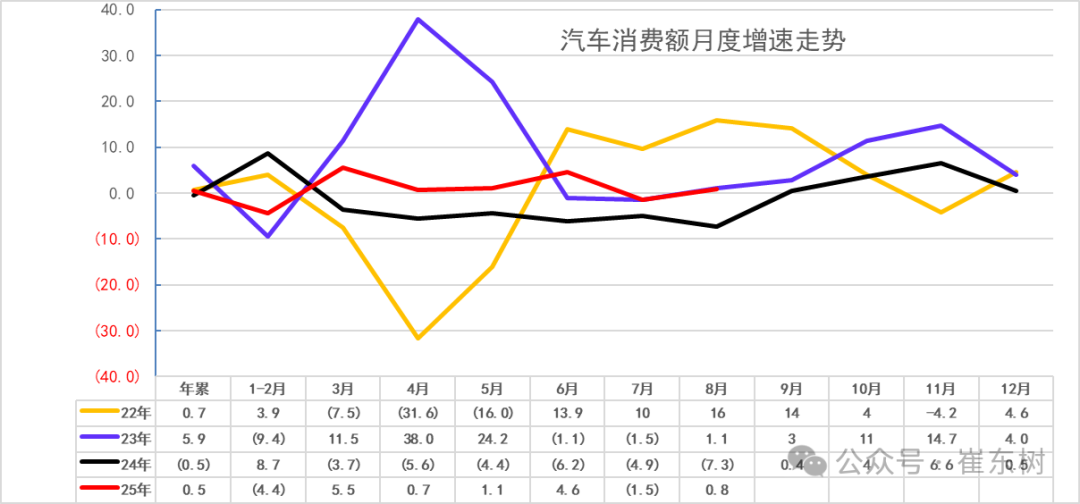
Core Insights - The automotive industry in China is experiencing significant growth, particularly in the production and sales of new energy vehicles (NEVs), driven by government policies and changing consumer preferences [1][2][20]. Group 1: Automotive Production and Sales - In August 2025, automotive production reached 2.75 million units, an 11% year-on-year increase, with NEVs accounting for 1.33 million units produced, up 23% [1][18]. - For the first eight months of 2025, total automotive production was 20.83 million units, also reflecting an 11% increase year-on-year, with NEVs at 938,000 units, a 31% increase [1][18]. - The penetration rate of NEVs in the automotive market reached 48% in August 2025, indicating a strong shift towards electric vehicles [1][18]. Group 2: Consumer Spending and Economic Impact - The total retail sales of consumer goods in August 2025 amounted to 39,668 billion yuan, with automotive consumption contributing 4,093 billion yuan, a 1% increase year-on-year [1][27]. - The overall retail sales for the first eight months of 2025 were 323,906 billion yuan, growing by 4.6%, with automotive consumption at 31,263 billion yuan, reflecting a modest 0.5% increase [1][27]. - The decline in the real estate market since 2021 has positively impacted automotive consumption, which rose from 3.94 trillion yuan in 2020 to an expected 5.03 trillion yuan in 2024 [4][22]. Group 3: Investment Trends - Fixed asset investment in the automotive sector grew by 20.2% in the first eight months of 2025, significantly outpacing overall manufacturing investment [20][21]. - The automotive investment growth is attributed to the rising demand for NEVs, indicating a recovery in the sector after previous downturns [20][21]. Group 4: Industry Challenges and Future Outlook - The automotive industry faces challenges from a complex external environment, including unilateralism and protectionism, which threaten supply chain stability [2]. - Despite a strong performance in the first half of 2025, the industry anticipates a slowdown in growth rates in the latter half of the year, necessitating supportive policies to sustain consumer demand [2][8].

2025年8月宏观数据点评:8月经济增长动能延续稳中见弱势头
Dong Fang Jin Cheng· 2025-09-15 07:02
Economic Growth Overview - In August, the industrial added value increased by 5.2% year-on-year, down from 5.7% in July, with a cumulative growth of 6.2% from January to August[1] - Retail sales of consumer goods grew by 3.4% year-on-year in August, a decrease from 3.7% in July, with a cumulative growth of 4.6% from January to August[1] - Fixed asset investment saw a cumulative year-on-year growth of 0.5% from January to August, down from 1.6% in July[1] Industrial Production Insights - The slowdown in industrial production is attributed to weakened external demand and insufficient domestic demand, with August's industrial added value growth down by 0.5 percentage points[3][4] - Manufacturing output growth was 5.7% in August, a decline of 0.5 percentage points from the previous month, primarily impacting overall industrial growth[4] - Export delivery value for industrial enterprises fell by 0.4% year-on-year in August, marking the first negative growth since 2024[4] Consumer Spending Trends - The slowdown in retail sales is influenced by last year's consumption policies and declining food prices, with August's retail sales growth at 3.6%, down 0.4 percentage points from July[6] - Optional consumer goods retail sales showed improvement, likely due to the wealth effect from rising stock markets, with categories like clothing and cosmetics seeing increased sales growth[8] Investment Dynamics - Fixed asset investment growth for the first eight months was 0.5%, reflecting a decline of 1.1 percentage points from previous values, with all major investment sectors experiencing downturns[9][12] - Manufacturing investment growth was 5.1%, down 1.1 percentage points, while high-tech manufacturing sectors like computer and aerospace equipment saw significant growth rates of 12.6% and 28.0% respectively[10][11] Future Economic Outlook - Economic growth momentum is expected to remain weak in September, with industrial and retail growth potentially declining further, while investment growth may stabilize[2][15] - Anticipated macroeconomic policies in Q4 may include increased fiscal measures and interest rate cuts to counteract external demand slowdowns and support the real estate market[15]
以旧换新政策:品类扩容、补贴优化,3000亿资金助力
Sou Hu Cai Jing· 2025-09-15 03:58
Core Insights - Recent adjustments to the "trade-in for new" policy across multiple regions aim to enhance consumer spending and stimulate economic growth [1] Group 1: Policy Adjustments - The policy has expanded its categories beyond traditional appliances and automobiles to include senior-friendly modifications, such as subsidies for smart toilets [1] - New subsidy standards have been implemented to improve fund allocation efficiency, utilizing methods like lotteries and qualification vouchers to ensure fair distribution [1] - Financial support mechanisms have been established, with 690 billion yuan in special long-term bonds already allocated and an additional 690 billion yuan set to be disbursed in October, contributing to a total annual plan of 3000 billion yuan [1] Group 2: Consumer Impact - The adjustments are designed to provide consumers with discounts, thereby boosting market sales and encouraging companies to innovate and transform [1] - The integration of various policy tools is expected to create a synergistic effect, enhancing the effective implementation of the trade-in policy [1]
以旧换新政策:品类补贴调整,全年3000亿资金保障
Sou Hu Cai Jing· 2025-09-15 03:41
Core Viewpoint - Recent adjustments to the "trade-in for new" policy across multiple regions focus on enhancing quality and efficiency to stimulate consumer spending [1] Group 1: Policy Adjustments - The scope of trade-in categories has expanded beyond traditional appliances and automobiles to include senior-friendly modifications, such as subsidies for smart toilets designed for the elderly, addressing real consumer needs and unlocking policy benefits [1] - Subsidty standards have been modified, with many regions implementing mechanisms like "lottery," qualification vouchers, and first-come-first-served approaches to improve distribution efficiency and fairness, ensuring that funds are available throughout the entire cycle [1] - The government has initiated financial support measures, including the distribution of 690 billion yuan in long-term special bonds and the implementation of personal consumption loan interest subsidy policies, aimed at alleviating consumer financial pressure and boosting participation [1] Group 2: Overall Impact - The core adjustment of the trade-in policy is centered on enhancing quality and efficiency, benefiting consumers by providing discounts based on demand, stimulating product sales in the market, and encouraging companies to transform [1] - The adjustments are expected to release consumer potential and contribute to economic recovery and growth [1]
以旧换新政策:品类扩容,全年3000亿资金保障
Sou Hu Cai Jing· 2025-09-15 00:50
Core Insights - Recent adjustments to the trade-in policy across multiple regions aim to enhance consumer spending and stimulate market development [1] Group 1: Policy Adjustments - The trade-in policy has expanded its categories, now including items like smart elderly-friendly toilets, addressing consumer needs and maximizing policy benefits [1] - Subsidy standards have been modified to improve fund allocation efficiency, utilizing methods such as lottery systems and first-come-first-served approaches [1] - The government has allocated significant financial resources, with 690 billion yuan in special bonds already distributed and an additional 690 billion yuan set for October, contributing to a total annual plan of 300 billion yuan [1] Group 2: Market Impact - The adjustments are designed to enhance the quality and effectiveness of the trade-in policy, ensuring that consumers with replacement needs can access discounts [1] - The policy is expected to drive sales of green and smart products, prompting companies to adapt and transform [1] - Overall, these changes are anticipated to unleash consumer potential and support economic recovery [1]
以旧换新政策细化调整释放更强消费动能
Zheng Quan Ri Bao· 2025-09-14 16:13
Core Viewpoint - The recent adjustments to the trade-in policy focus on enhancing consumer experience and ensuring that policy benefits are more tangible and accessible, reflecting a commitment to meet real consumer needs [1][2][3] Group 1: Policy Adjustments - The expansion of categories under the trade-in policy includes new items such as smart toilets for the elderly, indicating a shift towards addressing specific consumer demands rather than merely adding categories [1] - The adjustment of subsidy standards aims to improve allocation efficiency and fairness, utilizing methods like lottery systems and first-come-first-served to ensure that limited funds are directed towards genuine replacement needs [1][2] Group 2: Financial Support - The government has allocated a total of 690 billion yuan in special bonds for the third batch of trade-in support, with plans for an additional 690 billion yuan in October, ensuring robust financial backing for the policy [2] - The introduction of a nationwide personal consumption loan subsidy policy has alleviated immediate financial pressure on consumers, encouraging greater participation in the trade-in program [2] Group 3: Overall Impact - The refined trade-in policy is designed to enhance quality and efficiency, ensuring that consumers can easily access subsidies for their desired replacements, while also promoting the sale of green and smart products [3] - The cumulative effect of these policies is expected to stimulate consumer spending, contributing positively to economic recovery [3]
铸造铝合金产业链周报-20250914
Guo Tai Jun An Qi Huo· 2025-09-14 06:53
1. Report Industry Investment Rating No relevant content provided. 2. Core Viewpoints of the Report - The price of cast aluminum alloy is oscillating at a high level due to the continuous shortage of scrap aluminum supply, and the ADC12 - A00 spread has converged significantly [2][4]. - In the short term, driven by the gradually recovering demand in the peak season and cost - side support, the price of cast aluminum alloy may continue to oscillate at a high level. Although the downstream demand has slightly improved in the "Golden September and Silver October" season, the increase in enterprise orders is limited, and the performance of the peak season needs further observation. The supply - side start - up rate has slightly increased, but the market is waiting and seeing due to the uncertainty of the tax - refund cancellation policy. Some enterprises are purchasing at high prices across regions to ensure order delivery, and the raw material supply remains tight [6]. - The inventory of aluminum alloy ingots has increased. As of September 12, the combined factory and social inventory of aluminum alloy ingot factories increased by 14,400 tons to 131,300 tons compared with the previous week, and the inventory accumulation rate has increased. The supply shortage of raw materials has intensified due to the tight circulation of domestic and foreign scrap aluminum and increased demand. The domestic automobile sales in the last week of September decreased, but the "trade - in" policy is expected to boost automobile consumption, and the automobile sales are expected to improve month - on - month [6]. 3. Summary by Directory 3.1 Transaction End - Volume and Price - The report presents data on trading volume, open interest, price spreads between different contracts (such as AD00 - 01, AD01 - 02, AD02 - 03), and capital precipitation in the cast aluminum alloy market [9]. 3.2 Transaction End - Arbitrage 3.2.1 Inter - period Positive Arbitrage Cost Calculation - The cost of inter - period positive arbitrage for cast aluminum alloy is calculated. For the AD2511 and AD2512 contracts on September 12, 2025, the fixed cost is 5.28 yuan/ton, mainly including value - added tax on the spread and trading fees. The floating cost is 70.92 yuan/ton, including storage fees, capital costs for holding warehouse receipts, and futures capital costs. The total cost is 76 yuan/ton [12]. 3.2.2 Spot - Futures Arbitrage Cost Calculation - The cost of spot - futures arbitrage is calculated. Based on the reference price of Baotai Group, considering storage fees, capital costs, warehousing fees, inspection fees, trading fees, etc., the warehouse receipt cost is 20,815.9 yuan/ton [14]. 3.3 Supply End - Scrap Aluminum - The production of scrap aluminum is at a high level, and the social inventory is at a medium - high level in history. The import of scrap aluminum is also at a high level, with a relatively fast year - on - year growth rate. The price spread between refined and scrap aluminum has shown a downward trend [16][21][25]. 3.4 Supply End - Recycled Aluminum - The price of Baotai ADC12 has increased, and the spread between recycled and primary aluminum has converged significantly. The regional price spread of cast aluminum alloy has strengthened and shows certain seasonal patterns. The weekly start - up rate of recycled aluminum has rebounded, while the monthly start - up rate has slightly decreased. The production of recycled aluminum alloy has certain regional distribution characteristics. The cost of ADC12 is mainly composed of scrap aluminum, and it is currently estimated to be above the break - even line. The factory inventory of cast aluminum alloy has decreased, while the social inventory accumulation rate has increased. The import window of cast aluminum alloy is currently closed [33][38][43][48][53][58]. - The production and inventory of recycled aluminum rods are also presented. The production and factory inventory of recycled aluminum rods have certain regional distribution characteristics [60][62]. 3.5 Demand End - Terminal Consumption - The production of fuel - powered vehicles has declined, which has affected the die - casting consumption. Data on the production of new energy vehicles, motorcycles, and small household appliances are also provided, as well as the PPI of auto parts manufacturing and the automobile inventory warning index [66][67].
中金:物价的三个关注点——2025年8月通胀数据点评
中金点睛· 2025-09-12 00:07
Core Viewpoint - The August CPI turned negative at -0.4% year-on-year, primarily driven by a decline in food prices, influenced by high base effects from the previous year [2][3] - Core CPI continues to improve, reaching 0.9% year-on-year, supported by rising prices of gold and platinum jewelry, as well as services [4][5] CPI Analysis - The food price index fell by 4.3% year-on-year, with fresh vegetables, fruits, and pork contributing significantly to the decline [3][4] - The drop in vegetable and pork prices may not be sustained due to high base effects from last year, where prices surged due to extreme weather conditions [3][4] - The core CPI's increase is attributed to a 37.1% rise in gold jewelry prices and a 27.3% rise in platinum jewelry prices, contributing 0.31 percentage points to the core CPI [5][6] PPI Analysis - The PPI ended its downward trend, remaining flat month-on-month, with a year-on-year decline of 2.9%, a narrowing of the drop by 0.7 percentage points from the previous month [8][9] - The "anti-involution" effect is beginning to show, but its impact on prices is limited, with various industries experiencing reduced price declines [8][9] - Predictions indicate that the PPI may have reached its bottom in July, with future declines expected to narrow, although a positive trend in the next year remains challenging [9][10] Consumer Goods and Services - Prices of durable goods are showing improvement, with household appliances increasing by 4.6% year-on-year and communication tools by 0.8% [6][7] - The automotive sector is experiencing a reduction in price declines due to improved competition management, with fuel vehicle prices decreasing by 2.3% year-on-year [6][7] - Despite the rise in consumer prices for certain goods, the PPI for related industries has not improved, indicating a potential slowdown in demand [6][7]

家电行业2025年中报总结:家电收入利润延续增长关税扰动逐渐明晰
Shenwan Hongyuan Securities· 2025-09-11 09:23
Investment Rating - The report maintains a positive investment outlook for the home appliance industry, highlighting three main investment themes: white goods, export opportunities, and core components [4][5][6]. Core Insights - The home appliance industry experienced a revenue growth of 7.34% year-on-year in Q2 2025, with total revenue reaching 482.5 billion yuan. Net profit increased by 3.14% to 37.41 billion yuan [4][15][18]. - The report identifies a divergence in performance among sub-sectors, with white goods showing steady growth, while kitchen appliances faced declines in both revenue and profit [4][38][43]. Summary by Sections 1. Industry Performance Overview - The home appliance sector underperformed the market, with a decline of 5.3% from April to June 2025, lagging behind the 1.3% increase in the CSI 300 index [10][11]. 2. Q2 2025 Revenue and Profit Trends - The home appliance industry saw a total revenue of 482.5 billion yuan, marking a 7.34% increase year-on-year. The net profit for the same period was 37.41 billion yuan, reflecting a 3.14% growth [4][15][18]. 3. Sub-sector Performance 3.1 White Goods - White goods revenue reached 300.21 billion yuan, growing by 5.81% year-on-year, while net profit was 30.38 billion yuan, with a growth rate of 5.86% [38][39]. 3.2 Kitchen Appliances - Kitchen appliance revenue fell by 8.36% to 7.944 billion yuan, with net profit declining by 13.80% to 0.813 billion yuan [43][44]. 3.3 Small Appliances - Small appliances achieved a revenue increase of 14.10% to 37.23 billion yuan, but net profit decreased by 14.68% to 2.599 billion yuan [49][50]. 3.4 Black Goods - Black goods revenue grew by 8.23% to 100.34 billion yuan, with net profit increasing by 13.93% to 1.342 billion yuan [53][55]. 3.5 Components - The components sector reported a revenue increase of 15.74% to 36.739 billion yuan, with net profit rising by 14.38% to 2.278 billion yuan [58][61]. 4. Key Investment Targets - The report recommends focusing on leading companies in the white goods sector, export-oriented firms, and key component manufacturers, highlighting their potential for growth amid favorable market conditions [4][5][6].