
两新政策

Search documents
我国投资潜力依然巨大
Jing Ji Ri Bao· 2025-07-17 22:06
Core Viewpoint - The balance between investment and consumption is crucial for economic development, with both elements complementing and promoting each other in the economic cycle [1][3] Investment Growth - In the first half of the year, China's fixed asset investment (excluding rural households) reached 24.8654 trillion yuan, a year-on-year increase of 2.8%, and a real growth of 5.3% after adjusting for price factors [1] - There is a significant differentiation in investment growth: manufacturing investment and high-tech service investment grew by 7.5% and 8.6% respectively, outpacing overall investment growth by 4.7 and 5.8 percentage points [1] - Infrastructure investment increased by 4.6%, exceeding the overall investment growth rate by 1.8 percentage points, while real estate investment faced pressure, declining by 11.2% year-on-year [1] Transition to High-Quality Development - The current investment slowdown reflects a structural and quality adjustment, indicating a shift from high-speed growth to high-quality development [2] - The focus of investment is shifting from traditional sectors like real estate and infrastructure to new growth areas, with manufacturing investment now accounting for 25.2% of total investment [2] - Investment in new energy and high-tech sectors is accelerating, showing a transition of funds from inefficient to efficient areas [2] Investment Potential - Despite the slowdown, China's investment potential remains significant, supported by factors such as low per capita infrastructure capital stock compared to developed countries and ongoing urbanization of nearly 300 million rural migrants [2] - There are still many weak links in public services like education, healthcare, and environmental protection that require effective investment [2] Policy Focus - Economic policies are increasingly aimed at improving livelihoods and promoting consumption, but investment remains a key component [3] - The "Two New" policy connects supply and demand, transforming development potential into tangible growth, with significant retail growth in household appliances and automobiles observed [3] Investment Structure Optimization - To promote sustainable investment growth, it is essential to balance supply and demand, new and old sectors, and the roles of government and market [4] - Funds should be directed towards advanced manufacturing and modern service industries, enhancing both short-term demand and long-term growth potential [4] - There is a need to prevent low-level repeated construction and improve investment efficiency while fostering private investment in more sectors [4]
第一创业晨会纪要-20250717
First Capital Securities· 2025-07-17 06:25
Macroeconomic Group - The June CPI in the US showed a year-on-year increase of 2.7%, the highest level since February, with a month-on-month increase of 0.3%, marking a new high since January [2] - The core CPI for June was 2.9% year-on-year, slightly below the expected 3.0%, while the month-on-month core CPI was 0.2% [2] - The PPI for June increased by 2.3% year-on-year, the lowest since October 2024, with a month-on-month change of 0.0% [3] Advanced Manufacturing Group - Among 12 car manufacturers, 7 achieved over 40% of their annual sales targets, indicating significant market differentiation [7] - BYD faced a rare decline in both year-on-year and month-on-month sales, highlighting intense market competition [7] - The "Two New" policy and new product launches are expected to be crucial for the second half of the year [8] Consumer Group - The company "匠心家居" anticipates a net profit of 410-460 million yuan for the first half of 2025, representing a year-on-year growth of 43.7%-61.2% [10] - The growth is attributed to the expansion in overseas markets and optimization of product structure, with net profit margins increasing from 11.6% in 2017 to 26.8% in 2024 [10] - The successful launch of the high-end brand MotoMotion in the US market has been a significant driver of performance [10]
热轧卷板底部或已现,但下半年仍有二次探底风险
Qi Huo Ri Bao· 2025-07-17 00:46
Group 1 - The core viewpoint of the article is that the recent rebound in steel prices, particularly hot-rolled coil prices, is driven by improved macroeconomic expectations, better-than-expected supply-demand dynamics, and strong performance in raw material prices [1][2][8] - As of July 11, the price of hot-rolled coil main contract reached 3273 yuan/ton, an increase of 221 yuan/ton or 7.24% from the low point in early June [1] - The rebound in steel prices is supported by a positive outlook on macroeconomic conditions, including easing trade tensions between China and the U.S. and expectations for policy support in urban renewal [2][3] Group 2 - The supply-demand dynamics for hot-rolled coils have improved, with significant growth in the automotive and machinery sectors, leading to a positive consumption trend for hot-rolled coils [2] - The prices of coking coal and iron ore have remained strong, providing cost support for steel prices [2] - The manufacturing and export sectors, which are key consumers of hot-rolled coils, may face marginal weakening risks in the second half of the year, potentially impacting demand [4][6] Group 3 - The article highlights that the macroeconomic outlook is expected to continue improving, with potential for synchronized monetary easing between China and the U.S. [3][8] - The manufacturing sector's investment resilience is supported by policies promoting equipment upgrades, although the effectiveness of these policies may diminish in the second half of the year [5][6] - The price gap between cold-rolled and hot-rolled coils has narrowed, indicating weakening downstream demand [6] Group 4 - The current rebound in steel prices is characterized by strong speculative expectations, with the hot-rolled coil main contract price aligning closely with spot prices, creating arbitrage opportunities for traders [7] - There is a risk of a second price dip in late August to September due to potential policy impacts and weaker-than-expected demand recovery [8]
2025年6月宏观数据解读:6月经济:名义GDP增速边际放缓,关注股债双牛兑现
ZHESHANG SECURITIES· 2025-07-15 14:03
Economic Overview - In June, the actual GDP growth for Q2 was 5.2%, aligning with market expectations, while nominal GDP growth slowed by 0.7 percentage points to approximately 3.9%[1] - The industrial added value for June increased by 6.8% year-on-year, exceeding market expectations, with a month-on-month growth of 0.5%[3] - The capacity utilization rate for large-scale industries in Q2 was 74.0%, down 0.1 percentage points from the previous quarter and 0.9 percentage points from the same period last year, indicating potential overcapacity[3][23] Investment Trends - Fixed asset investment (excluding rural households) in the first half of 2025 was 248,654 billion yuan, growing by 2.8%, which was below market expectations of 3.8%[5] - Infrastructure investment grew by 4.6%, while manufacturing investment increased by 7.5%, and real estate development investment fell by 11.2%[7][39] - The marginal slowdown in investment demand is attributed to concerns over medium- to long-term uncertainties following tariff adjustments[5][39] Consumer Behavior - The total retail sales of consumer goods in June rose by 4.8% year-on-year, down from 6.4% in May, reflecting a 1.6 percentage point decline[4][31] - The "618" shopping festival significantly supported retail sales, with e-commerce sales reaching 8,556 billion yuan, a 15.2% increase year-on-year[33] - Automotive sales showed robust growth, with June retail sales increasing by 4.6% year-on-year, despite price promotions impacting overall retail revenue[36] Market Outlook - The second half of 2025 is expected to see a dual bull market in stocks and bonds, driven by a potential easing of Sino-US trade relations and risk-averse funds supporting market sentiment[2][21] - The 10-year government bond yield is projected to decline to around 1.5% amid low expectations for large-scale domestic demand stimulus[2][21]
瀛通通讯:预计2025年上半年营收同比增长10%
Zheng Quan Ri Bao Wang· 2025-07-14 14:13
Core Viewpoint - Yingtong Communications is expected to see a revenue increase of approximately 10% year-on-year for the first half of 2025, but is also projecting a net loss of between 22 million to 30 million yuan [1] Group 1: Financial Performance - For Q2 2025, Yingtong Communications anticipates a revenue increase of about 17% compared to the same period last year [1] - The company expects a net loss of 22 million to 30 million yuan and a non-recurring net profit loss of 27 million to 35 million yuan for the first half of 2025 [1] Group 2: Operational Strategy - Yingtong Communications has focused on establishing and continuously improving a scientific customer identification standard and tracking management mechanism to strengthen long-term strategic partnerships with quality clients [1] - The company has been expanding new projects and has seen gradual improvements in production efficiency as new projects reach capacity [1] Group 3: Market Conditions and Future Outlook - Analysts suggest that despite the current performance pressures, Yingtong Communications is well-positioned for stable development due to the gradual recovery of the consumer electronics industry and the ongoing expansion of the global healthcare market [2] - The company is recognized as a leading player in the acoustic products and data transmission cable sector and has established itself as a core supplier for internationally renowned consumer electronics brands [2] - Looking ahead, Yingtong Communications aims to deepen its focus on the "big acoustics, big transmission, big health" sectors, leveraging innovation and technology to optimize its product line and enhance market share [2]

经济半年报即将发布,二季度GDP增速有望实现5%以上
第一财经· 2025-07-14 05:43
Core Viewpoint - The economic growth rate in the second quarter is expected to slow slightly compared to the first quarter but is still projected to exceed 5% due to various supportive policies and resilient domestic demand [1][2]. Economic Growth - The average forecast for GDP growth in the second quarter is 5.07%, with expectations of a slight decline from the first quarter [1][3]. - High-frequency data indicates continued improvement in industrial production, consumption, and investment, supporting the overall economic outlook [1][3][4]. Industrial Production - Industrial production is expected to maintain stability, with a predicted year-on-year growth rate of 5.6% in June, slightly down from 5.8% in May [6][7]. - The manufacturing PMI for June is reported at 49.7, indicating a slight recovery in manufacturing activity [6][7]. Consumption Trends - Retail sales growth is anticipated to slow to 5.66% in June, down from 6.4% in May, influenced by the end of holiday demand and the tapering effects of promotional activities [8][9]. - The "trade-in" policy has significantly boosted the retail sales of major appliances, with a year-on-year increase of 28% in the second quarter [9]. Investment Dynamics - Fixed asset investment growth is projected to be around 3.65% in June, slightly lower than the previous month, with challenges in real estate and manufacturing sectors impacting overall investment sentiment [10][11]. - Infrastructure investment is expected to rebound in the second half of the year, supported by the issuance of special bonds and government funding for key projects [12][13].

经济半年报即将发布,二季度GDP增速有望实现5%以上
Di Yi Cai Jing· 2025-07-14 01:58
Economic Growth Outlook - The second quarter GDP growth is expected to slow slightly compared to the first quarter but is still projected to exceed 5% [1][2] - The average forecast for GDP growth in the second quarter is around 5.3% to 5.2%, supported by policies and resilient exports [2][3] Industrial Production - Industrial production growth is predicted to remain stable, with June's industrial added value year-on-year growth forecasted at 5.7%, slightly down from 5.8% in May [4][5] - The manufacturing PMI for June is reported at 49.7%, indicating a slight improvement in manufacturing sentiment [4] Consumer Spending - Consumer retail sales growth is expected to slow in June, with a forecasted year-on-year increase of 5.66%, down from 6.4% in May [6][7] - The "trade-in" policy has significantly boosted consumer activity, particularly in the home appliance sector, with online retail sales for major appliances rising by 28% in the second quarter [7] Investment Trends - Fixed asset investment growth is anticipated to slightly decline, with a forecasted growth rate of 3.65% for June [8] - Infrastructure investment is expected to rebound in the second half of the year, supported by government initiatives and project approvals [9]
中汽协:新能源汽车延续快速增长态势,市场份额持续提升
news flash· 2025-07-10 03:04
Core Insights - The Chinese automotive market is experiencing significant improvement, with a year-on-year growth rate exceeding 10%, driven by the effectiveness of the vehicle replacement policy [1] - The rapid growth of the new energy vehicle (NEV) sector continues, with an increasing market share that is leading the industry towards accelerated transformation and upgrading [1] - Looking ahead to the second half of the year, the implementation of the "two new" policies, along with a continuous supply of new products from companies, is expected to further stimulate sustained growth in automotive consumption, ensuring the healthy and stable operation of the automotive industry [1]
“两新”政策强势拉动,上半年车市销量增长超一成
Bei Jing Shang Bao· 2025-07-08 12:31
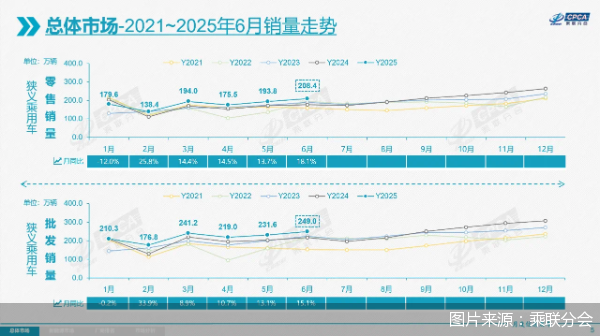
Core Viewpoint - The Chinese passenger car market has shown significant growth in the first half of the year, driven by government policies and the increasing popularity of new energy vehicles (NEVs) [1][3][5]. Group 1: Market Performance - In the first half of the year, retail sales of passenger cars reached 10.9 million units, a year-on-year increase of 10.8% [3]. - In June alone, retail sales were 2.084 million units, marking an 18.1% year-on-year increase and a 7.6% month-on-month increase [4]. - The "Two New" policies (trade-in and replacement) have significantly boosted market demand, with nearly 70% of private car buyers benefiting from these policies [3][4]. Group 2: New Energy Vehicles - NEV retail sales reached 5.468 million units in the first half of the year, representing a growth of 33.3% [5]. - The penetration rate of NEVs in June reached 53.3%, indicating strong market acceptance [5]. - Domestic brands dominate the NEV market, with a retail share of 71% in June, led by BYD, Geely, and Chery [6]. Group 3: Industry Challenges - Despite increased sales, the automotive industry faces profitability challenges, with profits declining by 11.9% year-on-year in the first five months of the year [8]. - The average price reduction for new cars in the first half of the year was 21,000 yuan, with a reduction rate of 11.4% [8][9]. - The ongoing price war among car manufacturers has raised concerns about the long-term health of the industry, with calls for a shift towards value-based competition rather than price competition [9].

前五月我国钢铁行业效益提升 供需状况改善 生产成本下降
Ren Min Ri Bao· 2025-07-07 21:55
Core Viewpoint - The Chinese steel industry has experienced a slight decline in crude steel production in the first five months of the year, but profitability has improved significantly due to better supply-demand dynamics and lower raw material costs [1][2]. Group 1: Production and Profitability - From January to May, the national crude steel output was 432 million tons, a year-on-year decrease of 1.7% [1]. - The black metal smelting and rolling industry achieved a total profit of 31.69 billion yuan, surpassing the full-year profit of 29.19 billion yuan in 2024 [1]. - The steel industry's operational stability and improved economic benefits are attributed to enhanced supply-demand conditions [1]. Group 2: Supply-Side Dynamics - Since 2025, the steel industry has increased self-discipline in production control, leading to a decrease in crude steel output and alleviating supply-demand conflicts [1]. - The reduction in inventory pressure has provided support for steel prices and improved the overall operating environment of the industry [1]. - The self-discipline in production has ensured that inventory levels remain low, which has helped maintain a balance in market supply and stabilize steel prices [2]. Group 3: Demand-Side Factors - The "two new" policies have positively impacted steel consumption, with automobile production and sales increasing by over 10% year-on-year, and retail sales of home appliances and audio-visual equipment rising by 30.2% [1]. - Steel exports have also shown significant growth, with cumulative exports reaching 48.469 million tons, a year-on-year increase of 8.5%, providing further support for steel demand [1]. Group 4: Cost Factors - Prices of key raw materials such as iron ore, coking coal, and coke have significantly decreased compared to last year's highs, effectively lowering production costs for steel mills [2]. - The decline in raw material prices has created more room for profitability in steel production [2]. - The industry is advised to continue self-discipline in production and inventory management to avoid excessive competition [2].