
反内卷政策

Search documents
关注现金流ETF(159399)投资机会,市场聚焦科技+出海盈利主线
Sou Hu Cai Jing· 2025-12-18 03:14
Group 1 - The core viewpoint is that A-share overall profit growth is expected to increase from 6% year-on-year this year to 8% year-on-year by 2026, driven by accelerated nominal GDP growth, narrowing PPI contraction, supportive policies, and ongoing anti-involution actions that boost profit margins [1] - The anti-involution policies are anticipated to enhance capacity utilization, alleviate price competition, and promote profit recovery in overly competitive industries such as photovoltaics, batteries, chemicals, and cement [1] - The market is increasingly focused on profitability and shareholder returns rather than short-term earnings elasticity, indicating a qualitative leap in profit momentum [1] Group 2 - Investors are encouraged to pay attention to the cash flow ETF (159399), which has outperformed the CSI Dividend Index and the CSI 300 Index for nine consecutive years from 2016 to 2024 [1] - The underlying index of the cash flow ETF focuses on large and mid-cap stocks, with a higher proportion of central state-owned enterprises compared to similar cash flow indices, allowing for monthly dividend assessments [1]
大摩闭门会:金融、原材料、交运行业更新 _纪要
2025-12-17 15:50
Summary of Key Points from Conference Call Records Industry Overview - The conference call primarily discusses the **financial, raw materials, and transportation industries** [1][3][4]. Core Insights and Arguments Financial Industry - Current low interest rates may lead to financial mismatches, prompting central banks and banks to shift towards reasonable interest rate pricing [1][3]. - Social financing and M2 no longer have quantitative guidance, with loan growth stabilizing around **6%** [1][3]. - Personal loan growth is not significantly impacted by previous bad asset digestion [1][3]. - As of November, medium to long-term loans show signs of stabilization, while manufacturing investment has slowed to **1.7%**, below overall demand growth of **4%** [1][3]. - A balanced supply-demand relationship is expected to alleviate financial system risk concerns and industrial product price pressures, with a potential rebound in PPI by **2027** [1][3]. - Loan interest rates are stabilizing, which may gradually improve interest margins, and insurance yields are performing well [1][4]. - The financial sector is expected to benefit from government bond rates slightly rising, supporting fiscal policies to stabilize and enhance financial returns [1][4]. Manufacturing and Credit Demand - In **2026**, manufacturing credit demand is anticipated to weaken, while consumer loan growth is expected to decline due to high-interest consumer loan clean-up [5]. - The initiation of the "14th Five-Year Plan" and increased local special bonds will support infrastructure loan demand, stabilizing overall financing needs [5]. - Strict management of hidden debts and real estate risks will continue, leading to a reduction in overall financial risks [5]. Insurance Industry - The insurance sector has significant growth potential, with household financial assets growing at **12%** [6]. - Insurance products are competitive, providing guaranteed rates along with retirement and health services, with growth expected to exceed household financial asset growth [6]. - China Ping An anticipates its BNB growth to exceed **20%**, indicating substantial upside potential [6]. - The insurance sector is viewed as an important investment target due to its long-term double-digit growth potential and the increasing interest from U.S. investors in the Chinese insurance market [6]. Raw Materials Industry - The macro environment for **2026** suggests a weak dollar in the first half, potentially rebounding in the second half, with ample liquidity in both China and the U.S. supporting commodity prices [7]. - Strong demand for energy storage and supply disruptions are expected to drive prices of copper, aluminum, and cobalt higher [7]. - Significant mining accidents have led to a tight supply situation for copper, with global copper supply expected to remain flat [7]. - Recommended stocks include those related to aluminum, copper, gold, lithium, and cobalt, such as Zijin Mining and China Aluminum [7]. Aluminum Supply and Demand - Global aluminum supply is projected to decrease by **700,000 tons** due to factory shutdowns, while new supply is expected to be **1.4 million tons** [2][8]. - Overall demand is forecasted to grow by over **2%**, but demand in the photovoltaic sector is expected to decline by **30%** [9]. Congo Fund's New Quota System - The new quota system from the Congo Fund has led to a significant reduction in supply, with expected output only **40%** of previous levels, resulting in market tightness [10]. Anti-Overcapacity Policies - Recent government meetings have emphasized anti-overcapacity policies, potentially limiting new capacity in coal, steel, and cement industries [11]. Other Important Insights - The Thai market for J&T Express has shown significant success, becoming the largest express company in Thailand, with a market share exceeding that of the second to fourth competitors combined [12]. - The competitive landscape in Thailand's express delivery market is intense, with low costs due to favorable geographic conditions and balanced regional economic development [14]. - Long-term growth potential for J&T Express is viewed positively, but uncertainties in Southeast Asia's e-commerce landscape may affect valuation [15]. - The aviation industry has shown positive performance, with significant growth in passenger traffic and improved pricing power for airlines [16].



2026年国债期货展望:政策导向与通胀预期扰动实际利率定价,把握债市逆风下结构性机遇
Guo Tai Jun An Qi Huo· 2025-12-17 13:00
Report Industry Investment Rating - The report maintains a view that the overall situation of treasury bond futures will be fluctuating with a downward bias, indicating a relatively cautious investment attitude towards the bond market [4]. Core Viewpoints of the Report - The current interest rate is supported by the central bank and capped by the fundamentals. The restraint of the central bank's monetary policy, the disappointment in bond - buying, the redistribution of new funds between the equity and fixed - income markets due to the entry of long - term funds, and the unfalsifiable "14th Five - Year Plan" policies in the next year limit the significant decline in long - term interest rates. The trend of commodities and inflation expectations may make the bond market face more headwinds [3]. - The report maintains the view that the overall situation of treasury bond futures will be fluctuating with a downward bias. In addition to short - selling hedging at high prices and long - position substitution at low prices under the high - selling and low - buying framework, strategies such as positive spreads trading and long positions in inter - delivery spreads under the timing framework are also recommended [4]. Summary According to the Table of Contents 1. Anti - involution Policy Consolidates the Inflation Floor 1.1 Inflation Floor Consolidation Disturbs the Pricing of Real Interest Rates - In 2025, the overall operation of treasury bond futures was tortuous. The market showed a high - level shock in the first half of the year and a fluctuating downward trend except in October. The 30Y - 10Y spread widened from about 10bp at the beginning of the year to over 30bp [7]. - The macro - economy remained in the bottom - shock pattern. Exports were affected by the Sino - US trade war in the first half of the year, and domestic demand recovery was not significant. In the second half of the year, the policy intensity declined, and the GDP growth rate slowed down in the third and fourth quarters due to weak downstream demand [7]. - The "asset shortage" of RMB assets still exists, but the structure has changed. The net long - position in treasury bond futures has decreased, and the market's expectations for the bond market have diverged. After the anti - involution policy, the bond market showed a fluctuating downward trend [9]. - The capital market reform policies have increased the importance of the equity market, and the "slow - bull" of the equity market has become the "political correctness" of the capital market. If the Fed cuts interest rates further and domestic policies are arranged beyond expectations next year, the equity market will continue to recover, and the bond market will only have structural opportunities [9]. 1.2 Monetary Policy Orientation and Micro - analysis of Treasury Bond Futures - The statements in the Q1 monetary policy implementation report indicated that the central bank's next - stage focus was to increase inflation, promote growth, and reduce costs. However, the bond market's recovery did not exceed the high at the beginning of the year. After the introduction of policies such as anti - involution and the resumption of the collection of value - added tax on bond interest, the market's inflation expectations and the central bank's orientation changed rapidly, and the market showed a fluctuating downward trend from the middle of the year [20]. - The Q2 report emphasized the importance of structure, and the Q3 report aimed to maintain a relatively loose liquidity environment. The central bank's bond - buying, interest - rate cuts, and reserve - requirement ratio cuts at the end of the year were less than expected. In the framework of the unfalsifiable "14th Five - Year Plan" policies and the relatively restrained monetary policy next year, treasury bond futures may continue to fluctuate within a range with a downward bias [20]. - In terms of market characteristics, the trading volume of the 12 - contract is limited, and the short - term inter - delivery spread may be positively correlated with the market. The basis has converged during the repair process since early June, and there is a demand for profit - taking in positive hedging. The curve structure has limited factors to support long - term steepening, and the steepening space may be reversed [21]. 2. Maintain the Judgment of Fluctuating and Downward - biased Interest Rates 2.1 Interest Rates are Supported by the Central Bank and Capped by the Fundamentals - Since 2015, China's interest rates have generally shown a downward trend, with three upward trends lasting more than a quarter. The duration and amplitude of these upward trends have gradually decreased, and the economic significance behind them has changed from fundamental and inflation - driven to short - term expectation and policy - driven [30]. - China has been in the passive de - stocking phase for nearly 34 months, longer than the 21 - month period in 1998. The GDP deflator has not turned positive. The second growth curve based on globalization and the real - estate model has encountered difficulties, and the future growth path depends on internal stimulus and external cooperation [30]. - Since the "9.24" in 2024, the policy bottom of the new economic cycle has been clear. The policy orientation of the financial sector is to guide long - term funds into the equity market. Although the fundamental recovery is still insufficient, the policy orientation makes it difficult for the market to break through the previous low of interest rates in the short term. Meanwhile, the limited elasticity of fundamentals and inflation restricts the upward space of interest rates, resulting in a fluctuating market where interest rates are supported by the central bank and capped by the fundamentals. In the long run, the inflow of funds into the equity market may lead to a fluctuating and downward - biased trend in treasury bond futures [31]. 2.2 Market Outlook for 2026 - The report maintains the view that the bond market will be fluctuating with a downward bias since the middle of the year. In addition to short - selling hedging at high prices and long - position substitution at low prices, strategies such as positive spreads trading and long positions in inter - delivery spreads under the timing framework are recommended [38].
长城证券“烽火杯”火热进行中 《烽火论剑》栏目解码2026资产配置主线
Zhong Zheng Wang· 2025-12-17 11:37
Group 1 - The "Fenghuo Cup" private equity selection event organized by Changcheng Securities has attracted over 600 private equity institutions and more than 1,600 products since its launch in October 2025, covering seven core strategies including stock, index enhancement, neutral, arbitrage, CTA, bond, and combination strategies [1] - The event aims to provide ample time for participating institutions to showcase their investment capabilities, with registration open until June 2026 [1] - The initiative is part of Changcheng Securities' effort to create a supportive ecosystem for quality private equity growth, offering diverse resources and platforms for trading execution, investment support, and financing solutions [1] Group 2 - In the macroeconomic context, the current economic cycle is perceived to be in a relatively early stage, with policies aimed at supply-side reform generating positive expectations, although actual progress remains to be verified [2] - The consensus among fund managers is that there are still reasonably valued targets in the market, such as the food and beverage index's price-to-earnings ratio and the Hang Seng Index's price-to-book ratio, both at historical lows [2] - Investment opportunities in the technology sector are highlighted, particularly in AI, with a focus on hardware that has reasonable valuations and is part of new major industry chains [2] Group 3 - Looking ahead to 2026, it is anticipated that more aggressive monetary and fiscal policies will be implemented, with potential further declines in risk-free interest rates and an increase in the value of credit bond allocations [3] - The stock market outlook favors relatively undervalued sectors such as banking, food and beverage, and consumer electronics, alongside technology leaders in AI chips, semiconductor equipment, and computing power [3] - The difficulty of stock selection and timing is expected to increase, making industry ETFs a more cost-effective option for investment [3]

A股,放量上攻!多股尾盘直线涨停!
Xin Lang Cai Jing· 2025-12-17 09:55
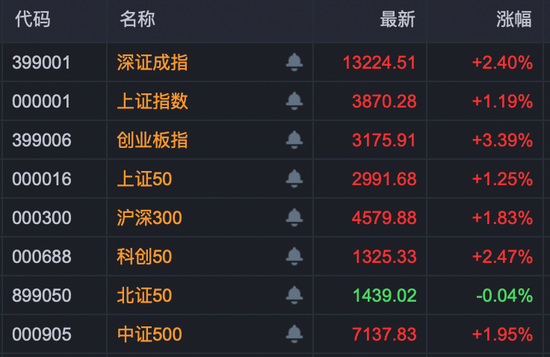
炒股就看金麒麟分析师研报,权威,专业,及时,全面,助您挖掘潜力主题机会! 今日(12月17日)午后,A股放量大幅上攻,创业板指大涨3.39%,创近2个月来最大单日涨幅,深证成 指、科创50也均涨逾2%,上证指数、沪深300、上证50等亦涨超1%,市场成交温和放大至1.83亿元。 万和证券认为,市场将震荡上行,"反内卷"政策有效推动市场竞争持续优化,扩内需、保民生等政策落 地带来供需关系的改善,建议关注消费行业的投资机会。此外,高技术制造业继续位于扩张区间,且明 显高于制造业总体水平,行业支撑作用持续显现,建议关注受益于政策和业绩驱动的集成电路、商业航 天板块。 市场热点方面,大金融午后集体异动拉升成为市场上涨主要动力。券商股在13:30左右开始放量,板块 指数约40分钟就由绿盘转为大涨近3%。华泰证券盘中一度冲击涨停,股价创2015年6月以来10年半新高 (复权,下同),收盘涨幅收窄至6.09%;兴业证券、广发证券等涨幅居前。 同一时段,保险板块指数也放量拉升,一度涨近4%,创历史新高。板块内所有个股上涨,中国太保、 新华保险逼近历史最高点,中国人寿、中国平安创年内新高。 银行板块指数午后也一度涨逾1%,多元 ...



A股市场集体上涨,成长ETF涨5.28%,创业板成长ETF涨4.94%
Ge Long Hui· 2025-12-17 08:13
Core Viewpoint - The A-share market experienced a collective rebound, with significant increases in major indices, driven by expectations of monetary easing following disappointing U.S. employment data [1][3]. Market Performance - The Shanghai Composite Index rose over 1%, while the ChiNext Index increased by more than 3% [1]. - The total trading volume in the Shanghai and Shenzhen markets reached 1.81 trillion, an increase of 87 billion compared to the previous trading day [1]. Growth ETFs - The Growth ETF surged by 5.28%, and the ChiNext Growth ETF rose by 4.94%, with the E Fund ChiNext Growth ETF increasing by 3.81% [3]. - The National Growth 100 Index, which the Growth ETF tracks, employs a unique compilation method that focuses on multiple profit growth indicators to identify genuine growth stocks [3]. Institutional Outlook - Major institutions like UBS, JPMorgan, and Fidelity believe that Chinese assets have a solid foundation for continued rebound due to profit growth, accelerated innovation, and attractive valuations [3]. - The consensus among international institutions is that the core driver for Chinese assets will shift from "valuation repair" to "profit growth" by 2026 [4]. Profit Growth Drivers - JPMorgan identified corporate earnings as a key variable for the next phase of asset appreciation in China, while Goldman Sachs noted a transition from valuation-driven to profit-driven market dynamics [4]. - The expected recovery in corporate earnings is supported by factors such as anti-involution policies, global demand for AI, and growth opportunities from companies expanding overseas [4]. Future Projections - Goldman Sachs anticipates that the Chinese stock market could reach historical highs by 2027, driven by a significant increase in earnings per share (EPS) growth, projected to rise to approximately 12% in 2026 [5]. - This EPS growth is expected to surpass historical averages from 2015-2020 (6%) and 2020-2024 (8%), indicating a qualitative leap in profit momentum [5]. - Key indices are projected to achieve a 30%-40% increase by the end of 2027, marking a potential historical peak [5]. Long-term Trends - Although these dynamics may not immediately reflect in stock prices, they are gradually being incorporated into long-term funding pricing models [6].

双焦:反内卷政策延续,盘面维持区间震荡
Hong Ye Qi Huo· 2025-12-17 06:37
1. Report Industry Investment Rating - Not provided in the content 2. Core Viewpoints of the Report - In 2025, the coking coal and coke markets showed a pattern of weak operation in the first half and a rebound in the second half. The overall supply - demand situation was loose, and it is expected that the supply - demand pattern in the second half of 2025 will continue in 2026. The prices of coking coal and coke will fluctuate within a range, and attention should be paid to the implementation of the anti - involution policy, the supply of imported coal, and terminal consumption [2][15][79] 3. Summary According to the Table of Contents I. Review of Futures Market Trends and Spot Price Tracking - In 2025, the coking coal and coke markets continued the weak pattern of 2024 in the first half, with prices falling due to high inventory, weak downstream demand, and other factors. In the second half, due to the anti - involution policy, coal production decreased, and the supply - demand pattern improved, leading to a price rebound. However, in November, the prices declined due to the off - season of terminal demand [8][9] - Spot prices of coking coal first fell and then rose, while coke prices experienced multiple rounds of price cuts in the first half and price increases in the second half, with a complex price adjustment process throughout the year [12][13] II. Coking Coal Supply Analysis 1. Slight Increase in Domestic Coking Coal Production, with Output Contraction in the Second Half - In 2025, the overall supply of domestic coking coal was loose. From January to October, the cumulative output of raw coal was 397,319 million tons, a year - on - year increase of 1.5%. The output of raw coal in Shanxi had a significant driving effect, with a cumulative output of 108,486 million tons from January to October, a year - on - year increase of 3.0% [17] - The operating rate and daily output of mines and coal washing plants increased after the Spring Festival, but decreased from May to June due to safety and environmental protection inspections. In the second half, due to the anti - involution policy, the operating rate and output remained low [16][18] - The coal washing process showed a contraction trend, with the operating rate of 314 sample coal washing plants lower than the previous year. The daily output of clean coal remained low and fluctuated little [21] - It is expected that the growth rate of raw coal output will slow down in 2026, and the supply will remain at a low level, mainly for energy supply security. Attention should be paid to the raw coal production in Shanxi, Xinjiang and other regions [24] 2. Year - on - Year Contraction of Imported Coking Coal, with Mongolian and Russian Coal Dominating - From January to October 2025, the cumulative import of coking coal was 94.16 million tons, a year - on - year decrease of 4.8%. Mongolia and Russia were the top two import sources, accounting for nearly 80% [26] - Mongolian coal imports from January to October were 47.71 million tons, ranking first. Although there was a slight year - on - year decrease, the volume was still at a relatively high level in recent five years. After the second half of the year, imports increased due to the price difference, but decreased in October due to political instability and then recovered [29][31] - Russian coal imports from January to October were 26.48 million tons, a year - on - year increase of 4.46%. Although there was a decline in May, the long - term contract volume was relatively stable. Russia may increase its coal exports to China in the future [32] - US coal imports were severely hit, and imports basically stopped from May, with a cumulative import of only 2.91 million tons from January to October, a year - on - year decrease of 65.7% [32] - It is expected that in 2026, with stricter domestic coal production control, the increase in coking coal supply will mainly come from overseas imports, and the main sources will still be Mongolia and Russia [37] III. Coke Supply Analysis - Coke supply showed a self - regulating trend affected by corporate profitability and operating pressure, but the overall supply was still loose. In 2025, the average profit per ton of coke for independent coking enterprises hovered around the break - even point, but production willingness was not greatly affected [38] - The production capacity utilization rate of independent coking enterprises was stable at around 70% - 75%, and the daily output of coke fluctuated in the range of 62 - 670,000 tons. The production capacity utilization rate of steel mills' self - owned coking plants decreased in the second half of the year, and the daily output also declined significantly [40] - It is expected that if steel demand continues to weaken in 2026, coke over - capacity will face pressure. Due to the large base of coking production capacity, the possibility of large - scale production cuts is low, and coke supply will remain rigid and relatively loose [46] IV. Double - Coking Demand Analysis 1. International Demand: Tense International Trade Situation Affects Coke Exports - In 2025, coke exports continued to decline. From January to October, the cumulative export volume was about 6.22 million tons, a year - on - year decrease of 14.0%. The main export market was Southeast Asia, accounting for 56% [48] - If overseas steel demand does not improve significantly in 2026 and competition in Southeast Asian markets intensifies, China's coke exports will still be under pressure [52] 2. Domestic Demand: Good Resilience of Downstream Rigid Demand, Weak Terminal Real Estate Demand - In 2025, the blast furnace operating rate and daily molten iron output of 247 steel mills in the country were generally high. Although terminal demand was weak in the second half of the year, molten iron output still had resilience. However, from January to October, the cumulative output of pig iron and crude steel decreased slightly year - on - year [53][57] - Terminal demand was weak, mainly affected by weak domestic demand and the continuous downturn of the real estate market. From January to October, real estate development investment, new construction area, and completion area all decreased significantly year - on - year [61] - In 2026, the risk of loose supply and demand will continue. Steel mills may face phased production contraction pressure, and attention should be paid to policy support for the real estate market and the implementation of the crude steel reduction system [62][65] V. Double - Coking Inventory Analysis 1. Coking Coal: Mine - End Inventory Declined from High Levels, and Downstream Maintained Low Inventory - In the first half of 2025, the coking coal inventory structure was characterized by high mine - end inventory, stable mid - stream inventory, and low terminal inventory, which suppressed prices. In the second half, mine - end inventory decreased significantly, and the inventory structure improved [66] - The clean coal inventory of sample mines decreased in the second half of the year after reaching a high level in the first half. The inventory of sample coal washing plants was relatively stable in the second half after being gradually depleted in the first half. The inventory of downstream independent coking plants and steel mills was relatively stable in the second half after being in a state of depletion or low - level fluctuation in the first half [66][67] - Coking coal port inventory decreased in the first half and remained stable in the second half, at a medium - level in the past five years [69] 2. Coke: Coking Plant Inventory Depleted, and Steel Mill and Port Inventory Remained High - In the first half of 2025, coke inventory pressure was significant, with coking enterprise inventory reaching a high level before the Spring Festival and remaining high throughout the first half. In the second half, coking plant inventory decreased rapidly but began to accumulate in November [73] - Currently, coking plant inventory is at a medium - low level in the same period of previous years but is accumulating. Steel mill coke inventory is at a high level in the past four years, and port coke inventory is at a high level overall [75] VI. Outlook - In terms of supply in 2026, domestic coking coal supply growth is limited due to policy influence, and the increase mainly comes from imports, with Mongolian and Russian coal accounting for about 80% [79] - In terms of demand, domestic steel demand is under pressure, mainly relying on the export market for growth. The overall supply - demand pressure of coking coal and coke still exists, and prices will fluctuate within a range. Attention should be paid to the implementation of the anti - involution policy [79]
新产能持续释放 烧碱重心将逐步下移
Qi Huo Ri Bao· 2025-12-17 00:18
Core Viewpoint - The caustic soda market is expected to face a structural oversupply in 2026, with supply growth outpacing demand growth, leading to a continued downward pressure on prices [1][5][6] Supply and Demand Dynamics - In 2025, the price of caustic soda fell from a peak of 3332 CNY/ton to 2098 CNY/ton, a decrease of 1234 CNY/ton, primarily due to an imbalance between capacity expansion and demand growth [1] - Domestic caustic soda production capacity increased by 210 million tons in 2025, contributing to a long-term oversupply situation [1] - The aluminum oxide industry, which accounts for 30%-40% of caustic soda demand, is expected to add approximately 11 million tons of capacity in 2025, theoretically increasing caustic soda demand by 1.2 million tons, but actual production is limited by bauxite supply constraints [1][2] - In 2026, the planned new capacity for caustic soda is about 2.19 million tons, with total domestic production expected to reach 43.86 million tons [2] - The overall demand growth for caustic soda in 2026 is projected to slow down compared to 2025 [3] Inventory and Market Pressure - By the end of 2025, caustic soda inventories exceeded 3 million tons, indicating a persistent oversupply [1] - In 2026, inventory pressure is expected to increase significantly, with most companies maintaining inventories above 450,000 tons [2] Cost Factors - The cost support for caustic soda prices is weak, with electricity and raw salt being the main cost components, accounting for 50%-60% and 25% respectively [4] - The price of liquid chlorine, which is produced alongside caustic soda, fluctuated between -650 to 275 CNY/ton in 2025, affecting the pricing dynamics of caustic soda [4] Policy Implications - The "anti-involution" policy proposed by the Ministry of Industry and Information Technology aims to eliminate outdated capacity, potentially impacting caustic soda supply if effectively implemented [5][6] - The actual execution and impact of this policy remain uncertain, and its development will be crucial for the market in 2026 [5][6]
2026年宏观对冲策略年报:2026年宏观对冲策略年度行情展望
Guo Tai Jun An Qi Huo· 2025-12-16 13:10
Report Industry Investment Rating No relevant content provided. Core Viewpoints of the Report - In the second half of 2025, the uncertainty of domestic and foreign policies improved. With the improvement of global liquidity and the stabilization of the domestic economy, the diversification effect among stocks, bonds, and commodities significantly recovered since mid - year, and the effectiveness of asset allocation increased. The overseas policy path became clearer, the Fed entered the interest - rate cut cycle, and major economies increased fiscal expansion, driving the global economy to show signs of mild recovery and supporting emerging market demand. In this context, market risk appetite recovered, and the resonance risk of assets decreased. The external environment for macro - hedging strategies improved significantly compared to the beginning of the year, and profits were achieved in the second half of the year [2]. - In 2026, the allocation cost - performance of macro - hedging strategies will increase. Risk - parity strategies have more bottom - position value in an environment where asset correlations decline, which can balance return acquisition and drawdown control. However, the market may still experience periodic fluctuations, so it is necessary to pay attention to whether the manager has a perfect tail - risk protection mechanism. In the pattern where asset differentiation reappears, moderately increasing the allocation of asset - rotation managers with single - asset alpha - capture ability can enhance the portfolio's return elasticity and optimize the risk - return structure [3]. Summary According to the Table of Contents 1. Review of the Performance of Macro - Hedging Strategies in 2025 1.1 Review of the Performance of Risk - Parity and Asset - Rotation Strategies - The "risk - parity" index of domestic macro - hedging managers had a net value of 1.172 as of November 28, 2025. The weekly average return was 0.36%, with an annualized value of 20.29%, and the weekly volatility was 1.41%, with an annualized volatility of 10.15%. The cumulative maximum drawdown was - 4.09%, reaching the bottom in the week after April 11 (Tomb - Sweeping Festival). The "asset - rotation" index had a net value of 1.101. The weekly average return was 0.21%, with an annualized value of 11.72%, and the weekly volatility was 0.93%, with an annualized volatility of 6.67%. The cumulative maximum drawdown was - 3.73%, reaching the bottom on May 23. Overall, the performance of risk - parity strategies was better than that of asset - rotation strategies in 2025, but the volatility was also greater [6][7]. - For risk - parity macro - hedging managers, the average weekly return was positive in 30 weeks and negative in 16 weeks from January 3 to November 28, 2025. The highest single - week return was 5.87%, occurring in the week of May 23, mainly due to the sharp increase in gold prices, and the maximum single - week drawdown was - 2.35%, occurring after the Tomb - Sweeping Festival on April 11. For asset - rotation macro - hedging managers, the weekly return was positive in 25 weeks and negative in 20 weeks. The highest single - week return was 2.57%, also occurring after the Spring Festival in February, and the maximum single - week drawdown was - 2.06%, occurring in the week of November 21, following the stock decline that week [8]. - The performance of macro - hedging strategies was differentiated in the first and second halves of the year, with the second - half performance being significantly better. In the first half, due to high macro - volatility and global macro - uncertainties, the drawdown and volatility of risk - parity managers were greater than those of asset - rotation managers. After the Tomb - Sweeping Festival, the net values of the two strategies diverged significantly. In the second half, the stock - bond bull market and the continuous strengthening of gold after the third quarter led to a significant increase in the returns of macro - hedging strategies. After September, the risk - parity strategies outperformed the asset - rotation strategies due to their passive holding of gold positions, but the overall volatility was also greater [9]. 1.2 Review of the Performance of Subjective and Quantitative Strategies - As of November 28, 2025, the cumulative net value of the quantitative macro - hedging index was 1.128, and that of the subjective macro - hedging index was 1.118. The average weekly return of the quantitative macro - index was 0.27%, with a weekly volatility of 0.98% (annualized volatility of 7.06%). The average weekly return of the subjective macro - index was 0.25%, with a weekly volatility of 1.03% (annualized volatility of 7.46%). The single - week maximum return of the quantitative macro - hedging index was 3.36% on May 23, and the maximum single - week drawdown was - 2.47% after the Tomb - Sweeping Festival on April 11. The maximum single - week return of the subjective macro - hedging index was 3.00% on February 7, and the maximum single - week drawdown was - 2.37% on November 21 [12]. - In terms of return and drawdown, the volatility of the two strategies was similar. In the market in 2025, the return differences between the two strategies were not significant, but the market conditions affecting the returns were slightly different [13]. 2. Review of Macro - Hedging Strategies and Market Conditions in 2025 2.1 Domestic Macro - Hedging Strategies 2.1.1 Analysis of the Correlation between Macro - Hedging Strategies and Major Asset Classes - In 2025, the negative correlation between bonds and equity indices weakened compared to the end of last year. Commodities were positively correlated with stock indices, negatively correlated with bonds, and positively correlated with gold. Gold was negatively correlated with equities and had a higher correlation with bonds compared to the end of last year, indicating its status as a primary safe - haven asset. Overall, asset correlations showed further differentiation in 2025 [18]. - The weekly return of the risk - parity index had the highest correlation with the return of the gold ETF, reaching 0.453, followed by the CSI Commodity Index and the SSE 50 Index, reaching 0.441 and 0.230 respectively. So, the returns of risk - parity strategies mainly relied on gold this year. In contrast, the asset - rotation index had the highest correlation with the CSI 1000 Index, reaching 0.641, and a much higher correlation with the SSE 50 Index than the risk - parity strategies, reaching 0.628. Therefore, the returns of asset - rotation managers were more dependent on their equity exposure. The exposure of both strategies to bonds decreased compared to the first half of the year [19]. 2.1.2 Review of Macro - Hedging Strategies and Equity Assets - In 2025, the asset - rotation strategy was more dependent on stocks for returns than the risk - parity strategy. The A - share market showed a trend of first falling and then rising. As of November 28, 2025, the CSI 1000 Index had a higher increase than the SSE 50 Index, with a net value of 1.304 after normalization at the beginning of the year, while the SSE 50 Index was 1.199. The weekly average return of the SSE 50 Index was 0.40%, with a volatility of 1.66% (annualized volatility of 11.96%), and the weekly average return and volatility increased compared to mid - year. The weekly average return of the CSI 1000 Index was 0.60%, with a volatility of 2.61% (annualized volatility of 18.8%), and the weekly average return increased while the volatility decreased compared to mid - year [21]. - In the first quarter, the stock market fluctuated and differentiated, with risk appetite recovering but volatility also increasing significantly. The market showed an overall upward - fluctuating trend, and the macro - hedging strategies diverged, with the risk - parity index being dragged down by bonds and commodities and performing weakly, while the asset - rotation index benefited from the growth market. In the second quarter, the market was affected by policy disturbances and trade risks, with significant fluctuations. The macro - hedging strategies also showed differentiation. In the third quarter, driven by the "anti - involution" policy, the stock market rose strongly, and the macro - hedging strategies generally benefited. In the fourth quarter, the market adjusted, and the macro - hedging strategies faced drawdowns [22][23][24][25]. 2.1.3 Review of Macro - Hedging Strategies and Treasury Bond Assets - The correlation between the risk - parity strategy and the 10 - year Treasury bond futures was 0.221, while that of the asset - rotation strategy was - 0.068. Many managers believed that the Treasury bond market had entered a bear market, so asset - rotation managers mostly reduced or shorted Treasury bonds, while risk - parity strategies still held bond positions [28]. - In the first quarter, the bond market adjusted at a high level. Most macro - managers actively reduced bond durations, with risk - parity strategies slightly reducing positions and asset - rotation strategies starting to reduce or short bond assets. In the second quarter, the bond market fluctuated at a high level. In May, the risk - parity managers who held Treasury bonds achieved positive returns, while the asset - rotation managers had drawdowns. In the third quarter, the bond market was under pressure, but the macro - hedging managers were not significantly affected. In the fourth quarter, the bond market showed a short - term recovery with limited space. The risk - parity managers obtained some returns from the bond market recovery in October, while the asset - rotation managers had slightly lower returns due to their low bond allocation [28][29][30][31]. 2.1.4 Review of Macro - Hedging Strategies and Commodity Assets - From January 3 to November 28, 2025, the normalized cumulative net value of the CSI Commodity Index was 1.087. The correlation between the risk - parity index and the CSI Commodity Index was 0.441, and that of the asset - rotation strategy was 0.506. Commodities had a greater impact on asset - rotation strategies, but the correlations decreased compared to mid - year [33]. - In the first half of 2025, the commodity index trended weakly with high volatility. The asset - rotation managers with short positions in industrial products performed better. In the third quarter, driven by the "anti - involution" policy, the commodity market rose and then partially corrected, and many macro - hedging strategies obtained some returns. In the fourth quarter, the commodity market consolidated, and the contribution of commodities to macro - hedging strategies was not significant, but there were some drawdowns in November [33][34][35]. 2.1.5 Review of Macro - Hedging Strategies and Gold ETF Assets - In 2025, gold reached new highs and was one of the strongest - performing assets. The cumulative net value of the gold ETF from January 3 to November 28, 2025, was 1.588. The correlation between the risk - parity strategy and the gold ETF was 0.453, while that of the asset - rotation strategy was 0.110. Gold had a much greater impact on risk - parity strategies, and the asset - rotation managers were more willing to participate in the equity market. Compared to mid - year, the correlations of both strategies with the gold ETF decreased, with the asset - rotation strategy showing a larger decrease [37]. - In the first quarter, gold fluctuated strongly. Although it contributed positively to the macro - hedging strategies, the contribution was limited due to low positions. In the second quarter, gold was supported by weak US economic data and geopolitical risks, bringing positive returns to the strategies but being partially offset by the drawdowns of equity and commodity assets. In May, gold entered an adjustment phase, and the risk - parity strategies faced relatively large drawdowns. In the third quarter, gold fluctuated and consolidated, and its contribution to the strategies was limited. In the fourth quarter, gold maintained a strong pattern. In October, the risk - parity strategies benefited significantly from the new high of gold, while the asset - rotation managers had a weaker increase in returns. In November, there were some drawdowns due to the gold price correction [38][39][40][41][42]. 2.2 Overseas Macro - Hedging Strategies 2.2.1 Review of Overseas Macro - Hedging Strategies - As of October 2025, the net value of the "unidentified" macro - hedging index was 1.088, with a monthly average return of 0.86% (annualized to 10.88%), a monthly volatility of 1.44% (annualized volatility of 4.97%), and a maximum monthly drawdown of - 1.10% in April. The net value of the "subjective" macro - hedging index was 1.129, with a monthly average return of 1.23% (annualized to 15.81%), a monthly volatility of 1.41% (annualized volatility of 4.90%), and a maximum drawdown of - 1.68% in March. The net value of the "quantitative" macro - hedging index was 1.159, with a monthly average return of 19.55%, a monthly volatility of 1.54% (annualized volatility of 5.35%), and a maximum drawdown of - 0.77% also in April. Overall, the quantitative macro - hedging strategy performed the best, followed by the subjective strategy, and the overall returns were similar to those in the domestic market [45][46]. 2.2.2 Analysis of the Correlation between Overseas Macro - Hedging Strategies and Major Asset Classes - In 2025, from January to October, the S&P 500 and the GSCI Commodity Index had a positive correlation, while they were negatively correlated with the US Treasury bond index and New York gold. The US Treasury bond index was negatively correlated with the commodity index. The return of gold had a low correlation with stocks, bonds, and commodities, and its correlation with the S&P 500 changed from positive to negative compared to mid - 2025 [49]. - The return of the unidentified macro - hedging index had a more balanced correlation with major asset classes, with a near - zero correlation with New York gold. The subjective macro - hedging index had a high correlation with the S&P 500 (0.792) and a negative correlation with New York gold, indicating that its returns were more dependent on the overall performance of the US stock market. The quantitative macro - hedging index also had a high correlation with the S&P 500 (0.627) and the GSCI (0.300), but a negative correlation with US Treasury bonds and gold, suggesting that its returns were also more related to the US stock market, and overseas macro - hedging managers' returns did not seem to rely much on the gold market this year [50]. 2.2.3 Review of Overseas Macro - Hedging Strategies and US Assets - The S&P 500 was the asset most correlated with the subjective and quantitative macro - hedging strategies. The overseas equity market performed well in 2025, and the S&P 500 index rose by about 16.7% during the year, bringing significant returns to overseas macro - hedging strategies [52][53]. - The US Treasury bond market was mainly traded around interest - rate cut expectations. The short - term interest rates declined, while the long - term interest rates remained relatively high, resulting in a bull market in US Treasury bonds and bringing returns to some overseas macro - hedging strategies [55]. - The GSCI index was more correlated with the unidentified and quantitative macro - hedging indices and negatively correlated with the subjective macro - hedging index. The GSCI index performed weakly and was volatile, and its decline in April affected the net values of some overseas macro - hedging managers [59]. - Only the unidentified macro - hedging strategy had a positive correlation with New York gold, while the subjective and quantitative macro - hedging strategies had negative correlations. The strong performance of gold this year seemed to have a weak correlation with the returns of overseas macro - hedging strategies. Although gold reached new highs in April and October, the increase in April did not offset the losses of overseas macro - hedging strategies [62]. 3. Conclusion and Investment Outlook 3.1 Judgment on Macro - Hedging Strategies in 2026 - Since the transition from mid - year to the fourth quarter, the correlation between assets has decreased significantly compared to mid - year, and the diversification effect among stocks, bonds, and commodities has gradually recovered. With the stabilization of the domestic economy and the improvement of the global liquidity environment, the three major asset classes have shown more differentiated performance, and the effectiveness of asset allocation has increased [64]. - In 2026, the overseas policy path will be clearer, with the Fed entering a continuous interest - rate cut cycle and major economies increasing fiscal expansion, driving the global economy to show signs of mild recovery. The domestic policy will focus on "anti - involution" and structural optimization. Under the improvement of the economy and liquidity, market risk appetite will recover, and the resonance risk between assets will decrease. The external environment for macro - hedging strategies will improve significantly compared to the beginning of the year [64][65]. 3.2 Investment Outlook - In 2026, the allocation value of macro - hedging strategies will increase, and the overall return cost - performance will rise. In the market environment where both gold and equities are at relatively high levels but still have continuous allocation value, macro - hedging strategies can balance return acquisition and drawdown control. Some investors are
方正燕翔:2026增长稳、科技强、内需进,价格回升引盈利修复
2 1 Shi Ji Jing Ji Bao Dao· 2025-12-16 09:21
Group 1 - The core viewpoint is that if the "anti-involution" policy in 2026 successfully promotes re-inflation, corporate profits are expected to recover rapidly, providing strong momentum for the market, similar to the successful logic of supply-side structural reforms in 2016-2017 [1] - The economic outlook for 2026 is analyzed through three dimensions: stable GDP growth, increasing share of the "three new" economy (including automotive and AI industries), and marginal improvement in consumption and investment, with domestic demand becoming the core driving force [1] Group 2 - In the A-share market, there is a strong correlation between A-share profits and PPI, with over 70% of the 5,400 A-share listed companies being manufacturing enterprises, indicating significant price elasticity [2] - As of October 2025, PPI is still at -2.1% year-on-year, and corporate profits are in a bottoming phase. If the "anti-involution" policy leads to a rebound in commodity prices, corporate profits could improve significantly, providing strong support for the market [2] - Concerns regarding the AI bubble in the US stock market are raised, with the S&P 500 index showing significant valuation risks, but the adjustment is expected to be relatively mild compared to the 2000 internet bubble [2] Group 3 - A risk warning is issued regarding the "policy expectation reversal risk," highlighting the potential conflict if both PPI and CPI rise unexpectedly, which could challenge the assumption of continued US interest rate cuts [3] - The year 2026 is seen as crucial for the success of the "anti-involution" policy in promoting re-inflation. If PPI turns positive year-on-year, A-shares could experience a rapid recovery in profits similar to the supply-side structural reform period, making this a key market driver [3]