
两新政策

Search documents
中国行业:分化加剧,破局在途
Hua Tai Qi Huo· 2025-07-06 12:56
Report Summary 1. Investment Rating The provided content does not mention the industry investment rating. 2. Core Viewpoints - In 2025, the core contradiction throughout the upstream, midstream, and downstream industries is the "structural gap during the new - old kinetic energy conversion period." In the first half of the year, the industry was affected by external uncertainties, with intensified internal differentiation, and overall prosperity relied on policy support. In the second half of the year, with the "two new" policies further boosting domestic demand and upgrading the industrial structure, the industry is expected to achieve a systematic leap from "quantity" to "quality" expansion [2][7]. 3. Summary by Directory Market Overview - **Upstream Materials**: In H1 2025, raw material prices were under pressure due to weak demand and Sino - US trade conflicts, showing significant differentiation. In H2, the structural differentiation will continue. Enterprises should focus on capacity elimination, tariff negotiations, and climate risks [8]. - **Midstream Manufacturing**: In H1 2025, it presented a differentiated pattern of "traditional under pressure, high - tech doing well." In H2, policies will support both demand and supply - side reforms, and traditional manufacturing is expected to break through cost dilemmas through intelligent and digital transformation [8]. - **Downstream Consumption**: In H1 2025, it showed a "weak recovery" pattern. In H2, the consumption market will continue to be structurally differentiated, and the recovery highly depends on policy implementation efficiency and business model innovation [9][10]. Upstream: Raw Material Price Fluctuations - **H1 2025 Situation**: Raw material prices were under pressure. Metal mining showed a divergence between black and non - ferrous metals; chemical raw materials had multi - directional fluctuations; energy sources like crude oil and coal were more differentiated; most agricultural products were at near - five - year lows [8][15]. - **H2 2025 Outlook**: The price differentiation will continue. Traditional raw materials' rebound depends on supply - side reforms and policy support, while emerging demand - driven products are more resilient. Enterprises should focus on capacity elimination, tariff reviews, and extreme weather [15][16]. Midstream: Short - term Stabilization, Continued New - Old Kinetic Energy Conversion - **Overall Situation**: In H1 2025, the manufacturing industry was affected by external factors, with traditional manufacturing under pressure and high - tech manufacturing supported by policies. After the tariff war, there was short - term stabilization, and both external and internal demands recovered to some extent [43][53]. - **Traditional Manufacturing**: In H1 2025, profits declined due to over - capacity and weak demand. In H2, policies will expand to more traditional manufacturing sectors, promoting transformation and efficiency improvement [59][75]. - **High - tech Manufacturing**: In H1 2025, it recovered significantly compared to the beginning of the year, benefiting from strong policy support. In H2, it is expected to continue to improve [69][75]. Downstream: Intensified Retail Differentiation, Weak Real Estate Recovery - **Retail Industry**: In H1 2025, online e - commerce grew due to the "trade - in" policy, while traditional physical retail was under pressure. In H2, the differentiation will continue, with emerging formats having growth potential and traditional retail relying on policy and innovation [82][93]. - **Leasing Industry**: In H1 2025, it was in a downturn. In H2, the "price - for - volume" trend will continue, and the de - stocking of commercial land will continue [92][93]. - **Real Estate Industry**: In H1 2025, it achieved "weak stabilization" under policy support. In H2, it is expected to continue to recover slowly with further policy optimization and improved supply - demand balance [99][115].
8000亿“两重”项目清单全部下达,下半年稳投资如何发力
Di Yi Cai Jing· 2025-07-03 13:58
Core Viewpoint - Major projects are playing a stabilizing role in investment growth, with infrastructure investment expected to accelerate due to the expansion of special bond issuance and faster project implementation [1][4][9]. Infrastructure Investment - Infrastructure construction investment growth is projected to expand to 6% for the year, continuing to support economic stability [1][10]. - The National Development and Reform Commission (NDRC) has allocated over 300 billion yuan to support the third batch of "Two Major" construction projects for 2025, completing the annual plan of 800 billion yuan [2][5]. Project Progress and Funding - As of May, fixed asset investment in transportation reached 1.2 trillion yuan, while water conservancy investment was 408.97 billion yuan [4][6]. - The government is implementing fiscal and monetary policies to ensure sufficient funding for major projects, including the early issuance of special bonds and long-term treasury bonds [6][7]. Economic Impact - Major projects are crucial for stabilizing economic operations, optimizing industrial structures, and enhancing public services in urban areas [4][5]. - From January to May, investment in projects with planned total investments of over 100 million yuan grew by 6.5%, outpacing overall investment growth [4][9]. Policy Support - The government is focusing on expanding effective investment through various financial tools and encouraging private investment in high-quality projects [10][11]. - New policy-oriented financial tools are being established to support infrastructure, technology innovation, and consumption [8][9].

【广发宏观贺骁束】高频数据下的6月经济:数量篇
郭磊宏观茶座· 2025-07-03 05:26
Group 1 - The core viewpoint of the article highlights the mixed performance of various sectors in June, with a notable decline in coal-fired power generation and a slight recovery in construction-related activities [1][3][11] - The coal-fired power generation in June decreased by 1.8% year-on-year, contrasting with a 0.4% increase in May, indicating a downward trend in traditional energy sources as renewable energy gains market share [1][8] - Industrial operating rates showed seasonal characteristics, with steel and coking industries experiencing declines, while the automotive and chemical sectors, particularly styrene, showed marginal improvements [2][9][10] Group 2 - Infrastructure-related indicators improved significantly, with the national construction site funding availability rate at 59.1%, a month-on-month increase of 0.2 percentage points [3][11] - Cement dispatch rates rose to 40.8% year-on-year, up 3.1 percentage points compared to the previous year, indicating a positive trend in construction activity [11][12] - The average daily subway ridership in major cities increased by 2.0% year-on-year, reflecting stable social activity despite seasonal weather impacts [13][13] Group 3 - New home sales showed signs of weakening, with the average daily transaction area in 30 major cities down 8.6% year-on-year, compared to a decline of 3.3% in May [4][15][16] - The automotive and home appliance sectors remained bright spots in the economy, with passenger car retail sales increasing by 24% year-on-year in early June [6][17] - The three major home appliances maintained high sales growth rates, with online sales showing significant fluctuations throughout June [18][19][20] Group 4 - Container throughput growth slowed, but the number of container ships sent to the U.S. showed signs of stabilization, with a year-on-year increase of 9.5% in June [6][21][22] - The overall economic picture for June reflects resilience in the automotive and home appliance sectors, while traditional infrastructure projects are gradually gaining momentum [23][23]

★由降转增!一季度规模以上工业企业利润同比增长0.8%
Shang Hai Zheng Quan Bao· 2025-07-03 01:56
Group 1 - In the first quarter, the total profit of industrial enterprises above designated size reached 1509.36 billion yuan, reversing a decline of 3.3% from the previous year to a growth of 0.8% [1] - The profit growth was driven by the continuous release of the "two new" policy effects, rapid profit growth in equipment manufacturing and high-tech manufacturing, and an acceleration in enterprise revenue growth [1][2] - In March, the profit growth of industrial enterprises turned from a decline of 0.3% in January-February to an increase of 2.6% [1] Group 2 - Nearly 60% of industries saw profit growth in the first quarter, with manufacturing showing significant improvement; 24 out of 41 major industrial categories experienced either accelerated profit growth or reduced declines, resulting in a recovery rate of 58.5% [2] - Manufacturing profits increased by 7.6% year-on-year, accelerating by 2.8 percentage points compared to January-February [2] - Equipment manufacturing profits grew by 6.4% year-on-year, contributing 2 percentage points to the overall profit growth of industrial enterprises [2] Group 3 - The "two new" policy continued to show positive effects on industry profits, with specialized equipment and general equipment industries seeing year-on-year profit growth of 14.2% and 9.5%, respectively [3] - The effects of the consumption upgrade policy were evident, with profits in wearable smart device manufacturing, electric vehicle manufacturing, and kitchen appliance manufacturing increasing by 78.8%, 65.8%, and 21.7% year-on-year, respectively [3] - Overall, industrial enterprises' profits showed a sustained recovery trend in the first quarter, supported by macroeconomic policies and a favorable external environment [3]
★国家发展改革委:存量政策加快落地见效 新的储备政策陆续出台实施
Shang Hai Zheng Quan Bao· 2025-07-03 01:55
Group 1 - The National Development and Reform Commission (NDRC) is set to implement multiple economic stabilization measures, including the third batch of funds for consumer goods replacement, which will be issued in July [1][2] - The "Two New" policies are playing a crucial role in stabilizing investment, expanding consumption, and promoting transformation, with sales of related goods exceeding 1.4 trillion yuan this year [2] - In May, the industrial added value increased by 5.8% year-on-year, and the service production index grew by 6.2%, indicating stable economic performance [1][2] Group 2 - The NDRC plans to enhance the management of equipment update projects and accelerate project construction to lower financing costs for businesses [2][3] - There is a significant potential for the development of sports events and cultural tourism industries, as evidenced by the rising popularity of diverse sports events among the public [2][3] - The NDRC aims to expand public fitness spaces and support the development of outdoor sports, targeting the establishment of around 100 high-quality outdoor sports destinations by 2030 [3]
消费市场复苏 吉宏股份上半年归母净利润预增超55%
Zheng Quan Shi Bao Wang· 2025-07-02 14:29
Group 1 - The core viewpoint of the articles highlights the performance fluctuations of Jihong Co., with a significant profit increase in 2025 followed by a substantial decline in 2024 due to various economic factors [1][2] - In the first half of 2025, Jihong Co. expects a net profit attributable to shareholders to grow by 55% to 65%, reaching between 112 million to 119 million yuan, with a further increase in net profit growth to 68% to 79% after excluding non-recurring gains [1] - The growth in 2025 is attributed to the recovery of the consumer market, which has led to increased packaging demand from downstream clients, and the company's strategic partnerships with leading firms in the fast-moving consumer goods sector [1] Group 2 - In 2024, Jihong Co. experienced a decline in net profit by over 47% due to a challenging economic environment, inflation, and fluctuating exchange rates, which resulted in decreased consumer confidence and sales growth in the packaging sector [2] - The company is actively expanding its client base and diversifying its business to enhance revenue, shifting from traditional packaging to higher-margin products such as tobacco and personal care packaging [2] - Jihong Co. is also focusing on international expansion through cross-border e-commerce, utilizing AI algorithms for market analysis and advertising on platforms like Meta and TikTok to sell Chinese products abroad [3] Group 3 - The company has established a strategic partnership with BMJ Industries to accelerate its overseas expansion, planning to invest in packaging production bases and trade platforms in the Middle East [3] - The collaboration aims to produce and sell various packaging products, including tobacco packaging and environmentally friendly materials, targeting markets in the Middle East and Africa [3]

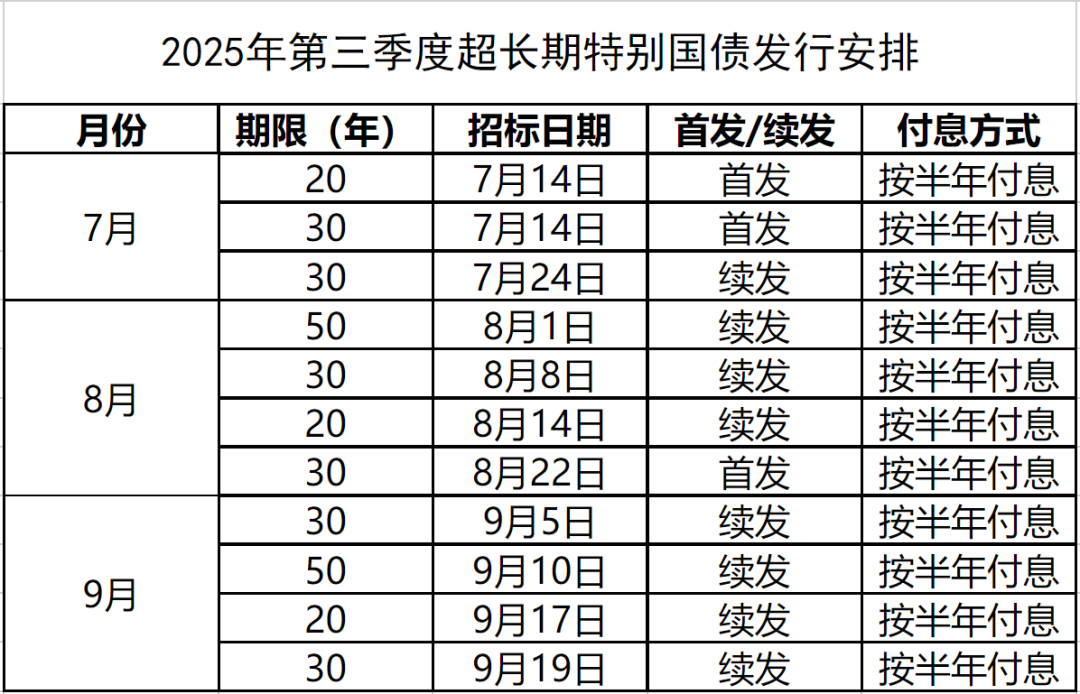
20年、30年、50年!11只超长期特别国债定档→
Jin Rong Shi Bao· 2025-07-02 08:36
Core Viewpoint - The issuance schedule for ultra-long-term special government bonds in the third quarter has been announced, with a total of 11 bonds to be issued, indicating a proactive fiscal policy aimed at boosting market confidence and investment [1][3]. Issuance Schedule - In July, three bonds will be issued, including a 20-year bond on July 14 and a 30-year bond on the same day, both being first issuances [2] - In August, four bonds will be issued, including a 50-year bond on August 1 and a 30-year bond on August 22, with several renewals scheduled [2] - In September, four bonds will be issued, including a 50-year bond on September 10 and a 30-year bond on September 19, all with semi-annual interest payments [2] Issuance Scale - In the first half of the year, 9 ultra-long-term special government bonds were issued, totaling 555 billion yuan, which is 42.69% of the total issuance for the year, significantly higher than the 250 billion yuan in the same period last year [2] - The total issuance scale for the second half of the year is projected to be 745 billion yuan, with a concentration in the third quarter [2] Fiscal Policy Impact - The issuance of ultra-long-term special government bonds is set to increase to 1.3 trillion yuan this year, up by 300 billion yuan from last year, with 800 billion yuan allocated to support "two heavy" projects and 500 billion yuan for "two new" policies [3] - The proactive fiscal policy aims to stimulate market confidence, social investment, and consumption, thereby enhancing market vitality [3][4] Consumption and Investment Support - The funding support for consumption goods replacement is set at 300 billion yuan, with previous allocations exceeding 1.4 trillion yuan in sales for related products this year [4] - The first batch of funding for equipment updates has been allocated to approximately 7,500 projects across 16 sectors, with ongoing project reviews for subsequent funding [4]
【乘联分会论坛】2025年5月乘用车区域市场流向分析
乘联分会· 2025-07-01 08:36
Core Viewpoint - The article highlights the strong growth of the passenger car market in China, driven by favorable government policies and regional disparities, with northern regions showing significant gains compared to southern regions [1][6][11]. Group 1: Passenger Car Market Trends - In 2025, the national retail sales of passenger cars are expected to grow by 9% year-on-year, with a strong performance observed from February to May, maintaining a growth rate of around 13% [4][5]. - In May 2025, retail sales reached 1.932 million units, a year-on-year increase of 13.3% and a month-on-month increase of 10.1%, with cumulative sales for the year at 8.811 million units, up 9.1% year-on-year [5][6]. Group 2: Regional Market Characteristics - The northern car market is showing a clear strength, with market share increasing by 2.8 percentage points year-on-year in May 2025, and by 2.1 percentage points compared to 2019 [7][8]. - The northeastern and northwestern regions are experiencing significant growth, while the southern regions, particularly the eastern and central areas, are lagging behind [6][8]. Group 3: Policy Impact on Market Structure - Government subsidies are favoring the development of low-end and economic vehicles, particularly benefiting A00 and A0 class electric vehicles in northern regions [1][9]. - The article emphasizes the importance of policy fairness in promoting the adoption of small and micro electric vehicles, which is crucial for their widespread acceptance [1][9]. Group 4: New Energy Vehicle Market Analysis - The new energy vehicle market is showing strong performance, particularly in pure electric and plug-in hybrid vehicles, with traditional fuel vehicles still holding a significant share in the northern and midwestern regions [14][15]. - In May 2025, the proportion of new energy vehicles in regions like Hainan and Tianjin reached around 60%, indicating robust growth [14][15].

银河证券晨会报告-20250630
Yin He Zheng Quan· 2025-06-30 05:58
Macro Overview - In the first five months of 2025, the total profit of industrial enterprises above designated size in China decreased by 1.1% year-on-year, with total revenue increasing by 2.7% [7][12] - The monetary policy is expected to remain "moderately loose," with potential interest rate cuts and reserve requirement ratio reductions anticipated in the second half of the year [5][4] - The focus of structural monetary policy tools will be on technology, consumption, foreign trade, real estate, and the stock market [5][4] Industrial Profit Analysis - The profit margin for industrial enterprises recorded a cumulative 4.97% from January to May, showing a year-on-year decline of 0.22 percentage points [8] - The equipment manufacturing sector saw a profit increase of 7.2%, contributing 2.4 percentage points to the overall industrial profit growth [11] - The automotive manufacturing sector experienced a significant profit decline of 11.9% year-on-year, indicating challenges in the consumer goods manufacturing sector [12] Investment Strategy - The report suggests a positive outlook for the equity market, particularly in sectors related to new consumption and high-tech manufacturing, while maintaining a cautious stance on the bond market [13] - The anticipated decline in interest rates may provide a favorable environment for small-cap stocks, especially in the technology sector [18] - The report emphasizes the importance of monitoring policy continuity and the impact of international trade negotiations on domestic industries [12][13] Company-Specific Insights - Ying Shi Innovation, a leader in the panoramic camera market, is projected to achieve revenues of 5.57 billion yuan in 2024, with a compound annual growth rate (CAGR) of 65.3% from 2022 to 2024 [27] - The company holds a 67.2% market share in the global panoramic camera market, indicating strong competitive positioning [29] - The demand for smart imaging devices is diversifying, with applications in outdoor sports and vlogging, which are expected to drive growth in the sector [28]
中国盈利系列十一:工企盈利承压
Hua Tai Qi Huo· 2025-06-30 05:54
1. Report Industry Investment Rating - No relevant information provided 2. Core Views of the Report - **Revenue Pressure Remains**: From January to May 2025, the total profit of industrial enterprises above the designated size was 2.72 trillion yuan, a year - on - year decrease of 1.1% (turning negative from +1.4% in January - April). This was mainly affected by demand - price weakness, short - term base effects, and a sharp decline in single - month growth. Positive signals include a 2.7% year - on - year increase in operating income and a 1.1% growth in gross profit. The equipment manufacturing industry's profit increased by 7.2%, contributing over 40%. However, inventory pressure persisted, with a 3.5% increase in finished - product inventory at the end of May and longer turnover and accounts - receivable collection days [3]. - **Structural Differentiation Intensifies**: In the equipment manufacturing industry, electronics, electrical machinery, and general equipment benefited from "two new" policies, while railway, ship, aerospace equipment was driven by high - end orders. In the consumer goods manufacturing industry, there was significant internal differentiation. Upstream industries were deeply adjusted, and the profit of the automotive manufacturing industry decreased. Private enterprises' profit increased by 3.4%, outperforming state - owned enterprises [4]. 3. Summary by Relevant Catalog 3.1 Overall Profit Situation - From January to May 2025, the total profit of industrial enterprises above the designated size was 27204.3 billion yuan, a year - on - year decrease of 1.1% due to multiple factors such as insufficient demand, falling industrial product prices, and short - term factor fluctuations. The high base of investment income in the same period last year pulled down the profit growth rate by 1.7 percentage points [2][3][29]. - The gross profit and operating income of industrial enterprises increased. The gross profit increased by 1.1% year - on - year, driving the profit growth of all industrial enterprises above the designated size by 3.0 percentage points. The operating income increased by 2.7% year - on - year, creating favorable conditions for future profit recovery [29]. 3.2 Industry Structure - **Equipment Manufacturing Industry**: From January to May, the profit of the equipment manufacturing industry increased by 7.2% year - on - year, driving the profit growth of all industrial enterprises above the designated size by 2.4 percentage points. Seven out of eight industries in equipment manufacturing saw profit growth, with electronics, electrical machinery, and general equipment growing by over 10% [3][30]. - **"Three - Aviation" Industries**: From January to May, the "three - aviation" industries (aerospace, aviation, and navigation) drove the profit of the railway, ship, and aerospace industry to increase by 56.0% year - on - year. Industries such as aircraft manufacturing, spacecraft and launch vehicle manufacturing, and related equipment manufacturing also had significant profit growth [30]. - **Consumer Goods Manufacturing Industry**: There was significant internal differentiation. The profit of the agricultural and sideline food processing industry increased by 38.2%, while the textile and chemical fiber industries were under pressure [4]. - **Upstream Industries**: The profit of coal mining and ferrous metal ore mining decreased significantly, with year - on - year declines of 50.6% and 45.6% respectively [4]. - **Automotive Manufacturing Industry**: The profit decreased by 11.9% year - on - year, and the new - energy transformation could not offset the decline of fuel - powered vehicles [4]. 3.3 Enterprise Types - Private enterprises' profit increased by 3.4% year - on - year, significantly better than state - owned holding enterprises, which had a 7.4% year - on - year decline, highlighting the operational resilience of private enterprises [4]. - Foreign - invested and Hong Kong, Macao, and Taiwan - invested enterprises' profit increased by 0.3% year - on - year, higher than the average level of all industrial enterprises above the designated size [33].