去工业化

Search documents
看到中美达成了共识,德国率先变脸,转向幅度之大,各方错愕
Sou Hu Cai Jing· 2025-11-02 07:46
Group 1 - The recent US-China talks resulted in unexpected outcomes, with both sides providing concessions without escalating tensions, indicating a strategic calculation behind the apparent win-win situation [1][5] - China achieved key results such as tariff extensions, partial reductions, and some sanctions being eased, while the US gained more negotiating space regarding rare earth exports [1][5] - The global implications of the US-China thaw are significant, as countries that previously relied on choosing sides must now navigate their own paths, leading to discomfort for Japan, South Korea, and the EU [5][8] Group 2 - Despite the easing of tensions, there remains an intense underlying competition, with China managing to withstand global tax pressures and maintain stability while others face increasing tax burdens [3][9] - Germany's rapid shift in stance reflects a realization of its precarious position, as it can no longer rely solely on ideological alignments with the US while facing its own industrial challenges [8][9] - The EU, particularly Germany, must reassess its economic relationship with China, focusing on practical cooperation in key industries like electric vehicles, energy, and AI, rather than ideological posturing [9][10] Group 3 - The current geopolitical landscape presents both pressure and opportunity for Europe, as it can no longer depend on US policies for protection and must engage in meaningful economic collaboration to influence global rules [14] - Germany's recent pivot towards realism signifies a shift from being a passive player to actively seeking beneficial partnerships, recognizing that cooperation is essential for economic survival [10][14] - The ongoing US-China détente provides a "repair window" for Europe to propose cooperation in sectors where mutual benefits can be realized, emphasizing the need for action over rhetoric [12][14]

麦肯锡称巴西正在吸引战略领域投资
Shang Wu Bu Wang Zhan· 2025-10-31 16:40
Group 1 - The core viewpoint of the article highlights a significant increase in foreign investment in Brazil's strategic sectors, particularly in natural resources and infrastructure [1] - Foreign investments are primarily concentrated in energy, mining, agriculture, and pulp industries [1] - Brazil faces challenges in advanced industrial competition, particularly in semiconductors and electric vehicles [1] Group 2 - The main driver of Brazil's economic growth in recent years has been population growth rather than productivity improvement [1] - Brazil has been undergoing a "de-industrialization" process, lagging behind larger and more competitive countries like the United States and China [1] - McKinsey suggests that Brazil should increase investments in technology and artificial intelligence to drive productivity leaps [1] Group 3 - Tax reform and regulatory improvements could help Brazil attract more foreign investment [1] - Brazil needs to address issues related to public debt sustainability and security to further enhance its business environment [1]
卢拉、比亚迪与巴西的工业悲歌
虎嗅APP· 2025-10-31 13:50
Core Viewpoint - The article discusses the historical and economic context of Brazil, particularly focusing on the automotive industry and the impact of government policies on industrialization and economic cycles. It highlights the challenges and opportunities faced by Brazil in its quest for sustainable development and industrial growth, especially in the context of electric vehicles and renewable energy [4][22]. Group 1: Historical Context of Brazil's Economy - Brazil's historical wealth has been cyclical, with periods of prosperity followed by decline, often linked to resource exploitation and economic dependency on single commodities [5][6]. - The industrialization policies initiated in the mid-20th century, particularly under President Juscelino Kubitschek, led to significant growth in the automotive sector, with major companies establishing factories in São Paulo [7][10]. - The automotive industry played a crucial role in Brazil's industrial development, with local production and assembly of global car models, such as the Santana, which was produced in multiple countries [9][10]. Group 2: Economic Challenges and Policy Shifts - The 1980s marked a significant downturn for Brazil, characterized by hyperinflation and economic mismanagement, which disrupted industrial growth and led to a decline in manufacturing's share of GDP [11][12]. - The introduction of the Real Plan in 1993 aimed to stabilize the economy, but the subsequent opening of markets exposed local industries to international competition, leading to further challenges for domestic manufacturing [11][12][19]. - The automotive sector faced difficulties as foreign brands dominated the market, and local manufacturers struggled with high costs and low-quality components, resulting in a decline in competitiveness [19][22]. Group 3: Current Developments and Future Prospects - The Brazilian government is now focusing on a new industrial strategy, "Brazil New Industry," which aims to promote sustainable and digital industries, including a significant push for electric vehicles [22][24]. - BYD's establishment of a new factory in Brazil is seen as a pivotal move, providing thousands of jobs and contributing to the local economy while aligning with the government's green energy initiatives [24][22]. - The government's "Mover" plan aims to provide substantial tax incentives for the automotive industry, particularly for electric vehicle infrastructure, indicating a shift towards a more sustainable industrial model [22][24].



全球化工巨头出走德国:本土巨亏数十亿,却在中国复制核心基地
Sou Hu Cai Jing· 2025-10-29 09:36
Core Viewpoint - The article discusses the ongoing deindustrialization in Germany, drawing parallels to the historical Morgenthau Plan, highlighting the struggles of German companies like BASF and the broader implications for the German economy [1][11]. Group 1: BASF's Situation - BASF has been facing significant losses at its Ludwigshafen site, with billions of euros in deficits, while simultaneously investing in its integrated site in Zhanjiang, China, which is set to begin production by the end of 2025 with a total investment of approximately €10 billion [1]. - The new production facility for neopentyl glycol at the Zhanjiang site has an annual capacity of 80,000 tons, increasing BASF's global capacity from 255,000 tons to 335,000 tons [3]. - The integrated production model used in Zhanjiang mirrors the successful approach from Ludwigshafen, focusing on cost reduction and efficiency [3]. Group 2: Economic Challenges in Germany - The rising energy costs, particularly due to the cessation of Russian gas supplies, have significantly impacted German chemical companies, leading to a projected 25% to 30% increase in corporate bankruptcies by 2025 [5]. - A report from Creditreform indicates that the number of bankruptcies in Germany could reach a ten-year high in 2024, with an increase of 24.3%, totaling around 22,400 companies [5]. - The automotive sector is particularly hard-hit, with Volkswagen planning to cut over 700,000 units of production and Bosch announcing a reduction of approximately 22,000 jobs in Germany [7]. Group 3: Factors Driving Companies Abroad - German companies are relocating not just for cost reduction but also due to market factors, as China offers a complete industrial chain and a vast consumer market, significantly lowering logistics costs [9]. - The German government's energy policy failures, high labor costs, bureaucratic challenges, and burdens from the "green transition" have deteriorated the business environment in Germany [9]. - In contrast, China provides stable energy supplies, efficient government services, and robust infrastructure, making it an attractive destination for investment [9]. Group 4: Long-term Implications - BASF's commitment to using 100% renewable energy at its Zhanjiang site by 2025 reflects a long-term strategy in the Chinese market, indicating a shift in investment focus [11]. - The situation in Germany serves as a warning to other countries about the importance of maintaining a strong manufacturing base and stable industrial policies [11][13]. - The global shift in industrial dynamics emphasizes the necessity of complete supply chains, stable energy supplies, and favorable business environments for sustaining manufacturing advantages [13][14].


欧盟做出一个“狠辣”决定,要与俄罗斯天然气彻底“划清界限”
Sou Hu Cai Jing· 2025-10-26 14:40
欧盟最近做出了一个堪称"狠辣"的决定:要与俄罗斯天然气彻底"划清界限"。在我看来,这无疑是一场 以巨额资金为筹码、为政治立场站队的豪赌。 决定详情:彻底"断供"的时间表 从2026年1月1日起,欧盟将不再与俄罗斯签订新的天然气合同。不仅如此,对于现有的合同也设定了严 格的最后期限:短期合同最多只能维持到2026年6月17日,长期合同最晚也必须在2028年1月1日终止。 这意味着,最晚到2028年初,理论上欧盟将不再直接从俄罗斯购买管道气和液化天然气,双方在天然气 贸易上的直接联系将被彻底切断。 代价剖析:经济、工业与民生的三重重创 欧盟做出这一决定,主要基于"不能花钱资助对手"的政治考量。然而,这笔政治账背后,却是巨大的经 济代价。 首先是巨额的经济损失。过去三年,由于拒绝使用价格相对便宜的俄罗斯天然气,欧盟多花了超过5440 亿欧元,这一数字相当于其GDP的相当一部分比例(原文1.3万亿欧元表述或有误,推测为占比类 比)。这笔巨额开支,无疑给欧盟的经济带来了沉重的负担。 其次是工业的衰落。能源成本的高企,使得欧盟工业的竞争力大幅下降,出现了明显的"去工业化"趋 势。以德国化工巨头巴斯夫为例,由于能源成本过高 ...
美国500%关税威胁难撼中国!中俄合作立法告破分化图谋
Sou Hu Cai Jing· 2025-10-19 19:07
Group 1 - The U.S. Treasury Secretary proposed a potential 500% tariff on Chinese purchases of Russian oil, indicating a political strategy to leverage economic measures in the context of the Ukraine crisis [1][6][20] - Economic logic suggests that tariffs above a certain threshold, such as 100%, significantly diminish the profitability of goods, making higher tariffs like 500% or 7000% more symbolic than practical [3][10][20] - The U.S. is using the tariff threat as a negotiating tool ahead of upcoming trade talks with China, reflecting a pattern of linking geopolitical issues with economic leverage [6][17][20] Group 2 - European countries are experiencing rising energy prices and inflation due to the Ukraine conflict, leading to a potential "de-industrialization" as companies relocate to the U.S. for lower energy costs [7][8][17] - Russia has legally formalized its strategic partnership with China, indicating a commitment to mutual cooperation that complicates U.S. efforts to drive a wedge between the two nations [9][18][20] - The interdependence of U.S. and Chinese markets is highlighted by the complexities of trade relationships, where high tariffs can lead to supply chain shifts and market adjustments [10][12][19] Group 3 - The impact of tariffs extends through various supply chain stages, ultimately affecting consumer prices and contributing to inflation, as seen in the U.S. market for Chinese goods [15][16][20] - The U.S. tariff threats have historically faced pushback from domestic businesses and consumers, indicating a limit to how much pressure can be applied without economic repercussions [6][16][20] - The dynamics of global trade are shifting, with China diversifying its market relationships and reducing reliance on the U.S. dollar for transactions, which may mitigate the impact of U.S. sanctions [10][12][19]

德国的世界第一,正在批量阵亡
创业家· 2025-09-19 09:59
Core Viewpoint - The article discusses the phenomenon of "invisible champions" in Germany, highlighting their significance in niche markets and the recent wave of bankruptcies affecting these companies, particularly in the automotive sector [4][12][31]. Group 1: Definition and Characteristics of Invisible Champions - "Invisible champions" are defined as small to medium-sized enterprises that dominate niche markets but remain largely unknown to the general public [12]. - These companies typically have strong technical capabilities, high product value, and are difficult for competitors to imitate [12]. - Key characteristics include being rooted in small towns, having low employee turnover, and focusing on highly specialized products [13]. Group 2: Comparison of Invisible Champions in Germany and China - Germany has nearly 3,000 invisible champions, with about half located in the country, while China has fewer than 100 [14]. - The article emphasizes that Germany's invisible champions are crucial to its economy, contributing significantly to GDP and employment [24]. Group 3: Recent Challenges Faced by Invisible Champions - The automotive industry, a backbone of the German economy, is experiencing significant challenges, leading to the bankruptcy of several invisible champions [31]. - Factors contributing to these bankruptcies include rising costs due to energy price increases and a shortage of skilled labor as the workforce ages [41]. - The emergence of Chinese automotive manufacturers has also reduced demand for products from German invisible champions, further exacerbating their financial struggles [43]. Group 4: Case Studies of Invisible Champions - Wanzl, a company specializing in shopping carts, holds over 50% of the global market share, illustrating the success of invisible champions in niche markets [17]. - Körber, a leader in high-speed cigarette manufacturing machines, showcases the technological prowess of these companies [17]. - Gerhardi, a supplier of automotive parts, recently declared bankruptcy, highlighting the vulnerabilities faced by even established invisible champions [33][40].

德国的世界第一,正在批量阵亡
华尔街见闻· 2025-09-18 10:20
Core Viewpoint - The article discusses the concept of "hidden champions," which are small to medium-sized enterprises that dominate niche markets but remain largely unknown to the general public. These companies are characterized by their strong technological capabilities and high product value, making them difficult to imitate and surpass [7][8][10]. Group 1: Definition and Characteristics of Hidden Champions - The term "hidden champion" was introduced by German scholar Hermann Simon in 1990, referring to companies that hold a leading position in a specific niche market but are not widely recognized [7]. - Hidden champions typically exhibit several unusual traits: they are often rooted in small towns, have low employee turnover, and focus on highly specialized core businesses [9]. - According to Simon's criteria, hidden champions are defined as companies that rank among the top three in their niche globally, have annual revenues not exceeding €5 billion, and are not well-known to the public [10][11]. Group 2: Germany's Dominance in Hidden Champions - Germany is home to nearly half of the world's hidden champions, with around 3,000 such companies globally, while China has fewer than 100 [11][12]. - The strength of Germany's manufacturing sector is attributed to its high-value, technology-intensive production, which has allowed it to maintain a competitive edge in global markets [26][30]. - Small and medium-sized enterprises (SMEs) make up over 99% of German companies and contribute 55% to the GDP, highlighting their crucial role in the economy [30]. Group 3: Challenges Faced by Hidden Champions - Recently, many German hidden champions, particularly in the automotive sector, have faced bankruptcy due to rising costs and increased competition from Chinese manufacturers [42][49]. - The energy crisis exacerbated by geopolitical tensions has led to soaring energy prices, further straining these companies [49]. - The aging workforce in Germany, coupled with a declining birth rate, has resulted in significant labor shortages, with projections indicating a shortfall of up to 7 million jobs by 2035 [49][50]. Group 4: Case Studies of Hidden Champions - Wanzl, a German company founded in 1918, dominates the global market for shopping carts, with a market share exceeding 50% [15]. - Körber, established in 1946, has become the global leader in high-speed cigarette manufacturing machines, showcasing the technological prowess of hidden champions [18][19]. - Flexi, a small company producing retractable dog leashes, has achieved global sales leadership despite having only around 300 employees [37][41].

欧洲经济:危机根源、多维后果与破局路径
Jin Rong Shi Bao· 2025-09-15 01:23
Global Economic Context - The global economy in 2025 is overshadowed by "excess supply" and "excess capacity," leading to a decline in demand and investment, particularly affecting Europe [2][3] - The oil market is experiencing a significant imbalance, with OPEC increasing production despite falling demand, resulting in a sharp drop in oil prices, which impacts energy-exporting countries and exacerbates global economic downturns [2] Current State of the European Economy - The Eurozone GDP growth was 0.3% in Q1 2025 but fell to 0.1% in Q2, indicating a lack of sustainable growth driven by internal economic factors [4] - Germany's GDP is projected to decline by 0.2% in 2025, reflecting structural issues such as energy transition delays and declining industrial competitiveness [4] - The Eurozone unemployment rate dropped to 6.2% in April 2025, but underlying issues indicate a stagnation in job creation and rising hidden unemployment [5] - Industrial production in Europe saw a temporary spike but quickly fell back to low levels, with Germany's industrial output down over 20% compared to a decade ago [6] Inflation Dynamics - The Eurozone inflation rate decreased to 1.9% in May 2025, below the ECB's target, primarily due to falling energy prices [8] - ECB forecasts suggest inflation may drop further to 1.4% in Q1 2026, with wage growth also slowing, indicating potential deflationary risks [8] Economic Conditions of Major European Countries - Germany, Italy, and France, which account for over 50% of the EU's GDP, are facing significant economic challenges, with Germany's GDP growth at 0.7% and Italy's economy stagnating for nearly 20 years [9][10][11] - France's economic model is struggling to adapt to global competition, with low productivity growth and high labor costs hindering investment [11] ECB Monetary Policy - The ECB has implemented a series of interest rate cuts, bringing the deposit rate down to 2% as of June 2025, in response to economic weakness and low inflation [12] - There are indications that the ECB may pause further rate cuts, reflecting a cautious approach to avoid excessive monetary easing [13] Root Causes of the European Economic Crisis - The energy crisis, particularly the reliance on Russian gas, has severely impacted industrial competitiveness, leading to high energy costs and industrial decline [15] - Deindustrialization and a lack of technological sovereignty are evident, with Europe lagging in digital and technological advancements [16] - Geopolitical dependencies and strategic missteps have left Europe vulnerable, particularly in the context of U.S. trade policies and the Ukraine conflict [17] - Social and demographic challenges, including low birth rates and immigration issues, are exacerbating economic pressures [18] Pathways for Economic Recovery - Strategies for recovery include restoring affordable energy supplies, establishing technological sovereignty, and reforming social policies to address demographic challenges [19][20]
德国的“环保主义”,正在摧毁它的工业根基
Hu Xiu· 2025-09-07 06:41
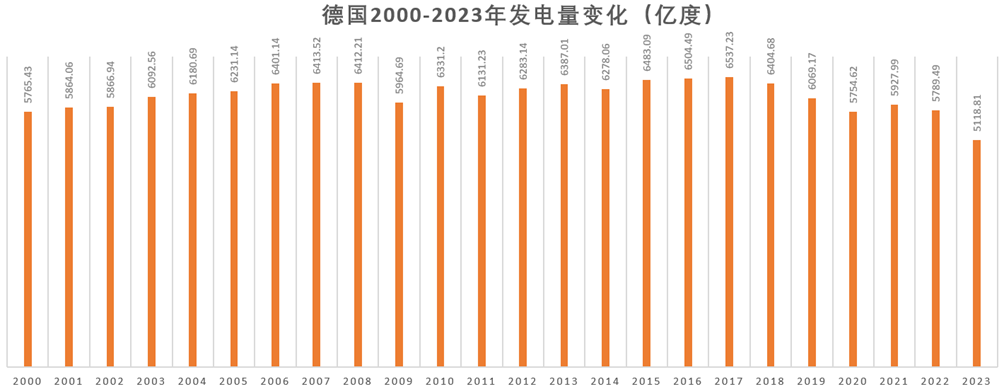
Core Viewpoint - Germany's electricity generation has significantly declined due to a combination of factors, including a drastic reduction in coal-fired power generation and the complete phase-out of nuclear power, leading to concerns about the country's industrial capacity and energy security [6][27][38]. Group 1: Electricity Generation Trends - In 2000, Germany's electricity generation was 576.54 billion kWh, peaking at 653.72 billion kWh in 2017, but has since been on a downward trend [3][8]. - By 2024, Germany's total electricity generation is projected to be 497.29 billion kWh, a year-on-year decrease of 3.0%, ranking it only 10th globally [6][8]. - From 2017 to 2023, Germany's electricity generation decreased by 21.7% [8]. Group 2: Decline in Coal-Fired Power - Coal-fired power generation in Germany dropped from 3,145.55 billion kWh in 2003, accounting for 51.63% of total generation, to only 1,348.92 billion kWh in 2023, representing a decline of 57.12% and only 26.4% of total generation [10][12]. - The German government aims to eliminate coal power by 2038, with some political factions pushing for an even earlier phase-out by 2030 [12][13]. Group 3: Nuclear Power Phase-Out - Germany has completely phased out nuclear power, with the last three nuclear plants shut down in April 2023, which previously contributed about 6% of the country's electricity generation [27][28]. - The anti-nuclear sentiment in Germany has historical roots, stemming from safety concerns and major nuclear accidents, leading to a long-standing opposition to nuclear energy [31][34]. Group 4: Economic Implications - The decline in electricity generation raises concerns about Germany's industrial capacity, as a significant reduction in energy supply could hinder its ability to produce goods competitively [38]. - The high cost of electricity generation, exemplified by the closure of the efficient Moorburg coal power plant due to economic unviability, highlights the challenges faced by the energy sector [26][21].