
消费结构升级

Search documents
内需“双引擎”扩容提质 增长新动能释放新潜力
Zheng Quan Shi Bao· 2025-12-04 17:54
Core Viewpoint - The article emphasizes the importance of domestic demand as a dual engine of consumption and investment in driving China's economic growth, particularly in the context of the 14th Five-Year Plan and the uncertain external environment [1][6]. Group 1: Consumption Trends - Service consumption is expanding and improving, with retail sales of consumer goods increasing by 4.3% year-on-year and service retail sales growing by 5.3% in the first ten months of the year [2]. - The "old-for-new" consumption policy has significantly boosted sales, generating over 2.5 trillion yuan in sales and benefiting more than 360 million people [2]. - The proportion of per capita service consumption expenditure is projected to reach 46.1% in 2024, with a further increase to 46.8% in the first three quarters of this year, indicating a shift towards service consumption as a key growth driver [2]. Group 2: Investment Structure - Fixed asset investment, excluding real estate, grew by 1.7% year-on-year in the first ten months, with manufacturing investment increasing by 2.7% [4]. - High-tech industries, particularly in information services and aerospace, are experiencing rapid investment growth, while overall investment growth is slowing [4]. - The impact of fiscal policies, such as special bonds and long-term loans, is expected to support investment growth, although the immediate effects may not be realized until early next year [5][8]. Group 3: Policy Support - The People's Bank of China has established a 500 billion yuan service consumption and pension refinancing facility, indicating a shift in macro policy focus towards service consumption [3]. - The government is implementing various policies to enhance service consumption, including subsidies and support for sectors like elderly care and cultural tourism [3]. - The upcoming 15th Five-Year Plan aims to significantly increase the role of domestic demand in economic growth, with a focus on improving consumption rates [6][7].
南财快评|推动消费向多元融合生态转型
2 1 Shi Ji Jing Ji Bao Dao· 2025-12-03 14:01
Core Viewpoint - The Ministry of Finance and the Ministry of Commerce have announced a pilot program to support around 50 cities in exploring new consumption models, aiming to enhance domestic demand and respond to the trend of consumption structure upgrading [2][3]. Group 1: Policy Framework - The pilot program emphasizes three dimensions: new business formats, new models, and new scenarios, moving beyond traditional consumption promotion policies [2][3]. - The policy framework includes support for cutting-edge areas such as the "first-release economy," diversified service consumption scenarios, and cross-industry collaborations with well-known IPs [2][3]. - Financial support is designed to be performance-based, with funding distributed in two batches according to city size and linked to performance evaluations [3]. Group 2: City Selection and Strategy - The selection of 50 pilot cities balances leadership and equity, including four direct-controlled municipalities and five separately planned cities, as well as key regional cities [3][4]. - Different levels of cities are encouraged to adopt differentiated strategies based on their unique advantages, avoiding homogeneous competition and fostering a diverse new consumption landscape [4][5]. - Major cities should focus on attracting high-quality consumption resources and enhancing global influence, while provincial capitals and regional centers should develop into regional consumption hubs [4][5]. Group 3: Implementation and Expected Outcomes - Cities rich in cultural and tourism resources should integrate cultural heritage with modern consumption scenarios, enhancing the cultural value of consumption through immersive experiences and night economies [5]. - The pilot program aims to create a collaborative policy system that drives innovation, industry, and regional synergy, with a focus on sustainable development of historical and cultural heritage [5]. - Successful implementation of the pilot can stimulate short-term consumption and explore replicable experiences for expanding domestic demand, contributing to high-quality economic development in China [5].


如何更好发挥超大规模市场优势?权威解读
Yang Shi Wang· 2025-12-03 05:27
Core Viewpoint - Recent policies have been introduced to stimulate consumption in China, which is crucial for economic growth, especially amid increasing external uncertainties. The "14th Five-Year Plan" emphasizes boosting consumption as a key strategy for economic development [2][4]. Group 1: Market Potential and Advantages - China's consumer market benefits from a massive scale, with a potential demand for companion robots estimated at nearly 1 trillion yuan. The country has over 1.4 billion people and has been the second-largest consumer market globally for over a decade [4][5]. - The retail sales of consumer goods are projected to exceed 48 trillion yuan in 2024, with various sectors like automobiles, mobile phones, and home appliances being the largest markets worldwide. The middle-income group is expected to surpass 800 million people [4][5]. Group 2: Growth Trends and Consumer Behavior - Despite challenges from international changes, China's consumer market has maintained a good growth momentum, with an average annual growth rate of 5.5% in retail sales over the past four years and a 9.6% increase in per capita service consumption [7][10]. - The current phase of consumption structure is shifting towards service-oriented and quality-focused consumption, with service consumption accounting for 46.8% of per capita spending in the first three quarters of this year [10][12]. Group 3: Innovation and New Consumption Scenarios - Technological innovations are creating new consumption scenarios, such as VR experiences and immersive cultural activities, which enhance consumer engagement and emotional value [8][10]. - The "14th Five-Year Plan" suggests creating new consumption scenarios that are widely appealing and visible, with examples like the VR cinema in Beijing and immersive cultural experiences in Anhui [7][8]. Group 4: Urban Commercial Development - The "Urban Commercial Quality Improvement Action Plan" aims to revitalize traditional urban commercial models by integrating unique scenes, new business formats, and innovative operating models to create differentiated consumer experiences [12][13]. - Examples include the transformation of traditional shopping malls into spaces that combine shopping with leisure activities, such as parks and entertainment venues, enhancing consumer attraction and spending [13][15]. Group 5: Digital and Green Consumption - Digital consumption is rapidly growing, with rural e-commerce seeing a 7.2% increase in online retail sales from January to August 2025. The digital consumption scale is expected to reach 23.8 trillion yuan in 2024, accounting for 44.2% of total consumer spending [15][16]. - The government is promoting policies to improve the infrastructure and environment for digital consumption, aiming to unleash its full potential [15][16].

“财政贴息+以旧换新”红利释放 消费主引擎马力足
Shang Hai Zheng Quan Bao· 2025-12-01 19:25
Core Viewpoint - Consumption is identified as the "main engine" of economic growth and a "barometer" of public well-being, with various initiatives and policies being implemented to stimulate consumer activity as the year-end shopping season approaches [1] Group 1: New Consumption Trends - The integration of artificial intelligence (AI) and augmented reality (AR) in consumer experiences is expanding, with applications in fitness, travel, and hospitality [1] - The user base for generative AI products in China reached 515 million by mid-2023, indicating a growing trend in AI-driven consumer applications [1] Group 2: Online and Offline Consumption - Instant retail has emerged as a popular online consumption model, with significant growth in the sales of antiviral medications during flu season, exemplified by a 4.5-fold increase in oseltamivir sales on JD.com from November 17 to November 23 [2] - The instant retail sector is approaching a trillion-yuan scale, with increasing consumer acceptance transforming it into a regular part of daily life [2] Group 3: Policy Support for Consumption - The Chinese government is encouraging the development of smart home appliances and AI products to enhance consumer services, as outlined in a recent implementation plan [3] - The service sector, particularly in areas like dining and tourism, is experiencing faster growth compared to goods consumption, with a reported 3.8% year-on-year increase in restaurant revenue in October [5] Group 4: Service Consumption and Market Potential - Policies aimed at stimulating service consumption are being implemented, including a 500 billion yuan loan facility for service and elderly care sectors, which is expected to leverage additional social capital [6] - The potential for service consumption is significant, particularly in healthcare and elder care, driven by the largest middle-income group globally [7] Group 5: Innovative Consumption Models - New consumption models are emerging, such as the collaboration between traditional brands and popular IPs to attract younger consumers, as seen in the partnership between Huatian and the animated series "Journey to the West" [4] - The integration of various activities, such as ice and snow tourism with cultural and sports events, is creating new consumer experiences and products [8] Group 6: Future Directions for Consumption - The focus for future consumption growth will be on systematic policy combinations that enhance domestic demand while improving public welfare, ensuring that consumer benefits are directly linked to policy initiatives [9]
商务部:多维发力促消费 优质供给激发市场活力
Yang Shi Xin Wen Ke Hu Duan· 2025-11-27 05:55
Group 1 - The core viewpoint of the articles emphasizes the Chinese government's efforts to stimulate domestic consumption through various policies and initiatives aimed at promoting green and intelligent consumer goods [1][2] - The Ministry of Commerce plans to enhance the connection between supply and demand, optimize tax refund policies for outbound travelers, and promote health consumption, among other measures [1] - As of October 2025, the government aims to continuously release policy dividends to upgrade consumption structures [1] Group 2 - Over 20 themed activities have been launched this year, focusing on premium shopping, exquisite food, exciting tourism, and fine performances to expand quality supply and innovate consumption scenarios [1] - The consumption upgrade is supported by the rapid growth of the used goods exchange program, which has generated over 2.4 trillion yuan in sales, benefiting more than 360 million people [2] - From January to October, sales of new energy passenger vehicles reached 10.15 million units, marking a year-on-year increase of 21.9%, positioning them as a core driver of consumption growth [2]
晶采观察丨3个关键字,解读10月份国民经济“成绩单”
Yang Guang Wang· 2025-11-18 02:18
Group 1 - The core viewpoint is that China's economy remains stable, with key sectors showing solid growth, particularly in the digital manufacturing industry, which saw a 9.5% year-on-year increase in value added for the first ten months [2] - Emerging industries such as aerospace, low-altitude economy, quantum technology, and embodied intelligence are expected to become new pillars of high-quality economic development, as highlighted in the 14th Five-Year Plan [2] - The transition towards high-end, intelligent, and green industries is crucial for economic quality improvement, with significant growth in green product output, including a 19.3% increase in new energy vehicles and a 30.4% increase in lithium-ion batteries for vehicles in October [3] Group 2 - The potential for achieving annual economic and social development goals is supported by favorable conditions, including the release of demand potential and the steady expansion of market sales, with a 4.3% year-on-year increase in retail sales of consumer goods for the first ten months [3] - The service consumption sector is particularly vibrant, driven by the dual holiday effect of National Day and Mid-Autumn Festival, indicating a significant release of service consumption demand [3] - The ongoing adjustment of China's economic structure is progressing steadily, with a focus on promoting technological and industrial innovation to optimize the economic structure and achieve effective qualitative and reasonable quantitative growth [4]

超大规模市场!又一万亿元风口,来了
Jing Ji Wang· 2025-11-18 00:24
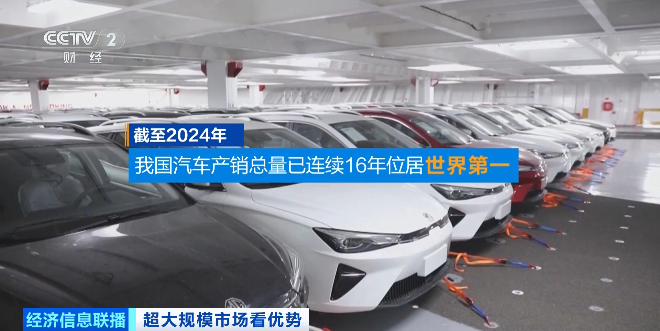
Core Viewpoint - The article emphasizes the significance of China's super-large market as a unique advantage, highlighting the need to leverage this market for economic growth and development strategies [1] Group 1: Consumption Market - China has the world's largest consumer market, supported by 1.4 billion consumers, which is crucial for high-quality economic development [2] - As of 2024, China has maintained its position as the world's largest automobile producer and seller for 16 consecutive years, with leading sales in home appliances and agricultural products [4] - The online retail market in China is the largest globally, with online retail sales reaching 12.79 trillion yuan in the first ten months of this year, a year-on-year increase of 9.6% [8] - The instant retail market in China is projected to reach 780 billion yuan in 2024, with an expected annual growth rate exceeding 25% until 2030 [15] Group 2: Service Consumption - Service consumption is rapidly rising, becoming a new engine for economic growth, with diverse offerings in cultural tourism, healthcare, and entertainment [19] - The night economy is gaining traction, with night-time consumer spending in Shanghai's key districts increasing by 15.3% during the recent holidays [24] Group 3: Innovation and Trends - The article highlights the importance of innovative consumption scenarios and environments to unlock the potential of the domestic market [25] - The rise of personalized and experiential consumption preferences among young consumers is driving new demand, with "IP + consumption" becoming a popular trend [22] - The interaction between new consumption scenarios, business models, and consumer demand is crucial for activating the potential of the super-large market [26]
【经济前瞻】 服务消费有望进入发展快车道
Zheng Quan Shi Bao· 2025-11-17 16:53
张锐 站在"十五五"新的时代起点,我们需要以更宽广的视野审视服务消费的战略意义,并在供求两端协同发 力,创造扩大服务消费的庞大增量势能。 一方面,要采取切实举措提升居民整体收入水平。除了通过促就业达到增收入外,更应突出稳资产与强 社保对改善居民收入的能效。在稳资产方面,既要加大政策托举力度扭转城市房价的下行趋势,更要实 现从"稳定股市"到"推升股市"的管理理念升级;在强社保方面,可推动"国资—财政—社保"联动改革, 增加国资上缴财政并专项用于提高社保体系建设的比重,在此基础上,加大直达消费者的普惠政策力 度,将财政的消费补贴由商品环节扩围至服务领域。 另一方面,要提高政策创新强度以丰富高品质服务供给。统筹利用中央预算内投资、地方政府专项债券 等各类资金渠道,支持符合条件的文化、旅游、养老、托育、体育等服务设施建设;支持服务贸易创新 发展引导基金按市场化原则投资符合条件的服务消费企业,引导社会资本加大对服务消费相关领域投 资,为此需要放宽服务业市场准入,打破地方保护和行政垄断,重点加大电信、教育、养老、医疗、健 康等领域的开放口径。 再者,要系统性加快服务消费标准的研制。一方面,采取行业协会、龙头企业牵头制定团 ...
数览10月消费市场 从钱包多样“打开方式”看消费潜力释放
Ren Min Wang· 2025-11-15 01:59
Group 1 - The core viewpoint of the article highlights the ongoing efforts to boost consumption across various regions and sectors in China, with a focus on initiatives such as trade-in programs for consumer goods and the promotion of digital and service consumption [1][6] - In October, retail sales of sports and entertainment products increased by 10.1% year-on-year, while cosmetics retail sales grew by 9.6%, indicating a shift in consumer spending towards upgraded experiences and products [3][4] - The trade-in policy for consumer goods has shown significant effects, with retail sales of communication equipment rising by 23.2% and cultural office supplies by 13.5% in October, both outpacing the overall retail sales growth [4] Group 2 - Service consumption has also seen positive growth, with retail sales accelerating by 0.1 percentage points compared to the previous months, driven by the National Day and Mid-Autumn Festival holiday effects [5] - Retail sales in the tourism, information services, and cultural and recreational services categories maintained a growth rate of nearly 10% in October, reflecting strong consumer demand in these sectors [5]
国家统计局:我国正处在消费结构升级的关键阶段
Zhong Zheng Wang· 2025-11-14 05:09
Core Insights - The transformation of consumer spending in China is accelerating, with service consumption becoming a significant growth driver [1] - The cultural and tourism services are experiencing robust growth, with active development of new consumption models in various regions [1] - Emerging consumption trends such as digital and green consumption are expanding, contributing positively to overall consumption growth [1] Service Consumption - The growth of service consumption is highlighted as a key area, with notable increases in cultural tourism services, sports events, and performance markets [1] - Information services, including digital audio-visual and online entertainment, are seeing sustained demand and strong sales growth [1] - There has been a significant increase in dining out during holidays, with restaurant revenue showing marked acceleration in October [1] Emerging Consumption Trends - Digital and green consumption are identified as rapidly growing sectors that are effectively promoting overall consumption growth [1] - The current phase of consumption structure upgrading presents vast opportunities in cultural tourism and healthcare [1] - The silver economy and first-time economy are developing quickly, injecting new momentum into consumption expansion [1] Economic Outlook - The economy is maintaining stable operation, with consumer promotion policies beginning to show effects, leading to overall stable market sales [1] - There is a need to enhance residents' consumption capacity and confidence, as well as to strengthen internal consumption dynamics [1] - Future actions will focus on implementing measures to boost consumption, stabilize employment, increase quality supply, and optimize the consumption environment to effectively release consumption potential [1]