
经济软着陆

Search documents
施罗德投资:料今年美国经济增长将保持良好 经济“软着陆”机率上升
Zhi Tong Cai Jing· 2026-01-05 05:54
Group 1 - The core viewpoint is that Schroders believes the recent rise in bond yields has been overdone, and the potential for an economic "soft landing" presents attractive entry points for investors [1] - Schroders has increased the probability of an economic "soft landing" scenario, reflecting signs of stabilization in labor market indicators, such as small business hiring intentions [1] - The firm predicts a moderate economic slowdown by Q4 2025, considering a mild short-term inflation outlook and the potential dovish stance of the new Federal Reserve Chair [1] Group 2 - Schroders sees better bond investment opportunities emerging in regions outside the U.S., while expecting the U.S. interest rate curve to steepen [2] - The underperformance of 10-year and 30-year bonds compared to 2-year and 5-year bonds reflects the weak fiscal condition of the U.S. economy, characterized by a large budget deficit and rising debt-to-GDP ratio [2] - Any threat to the independence of the Federal Reserve could support the strategy of a steepening yield curve, as the market anticipates potential over-relaxation of monetary policy due to temporary labor market weakness [2]
海外利率周报20260104:政策范式不确定性升温,美债交易情绪维持谨慎-20260104
Guolian Minsheng Securities· 2026-01-04 11:42
Report Industry Investment Rating - Not provided in the report Core Viewpoints - Policy paradigm uncertainty is rising, and trading sentiment in the US Treasury market remains cautious. The focus has shifted to the Fed's path and fiscal outlook [2][13] - The US manufacturing sector is in a slow - growth period with both resilience and pressure, and the employment market shows certain resilience under macro - pressure [3][4] - Global major asset classes show different trends, with German bonds weakening slightly, Japanese bonds rising, Asian equity markets performing strongly, Bitcoin and industrial metals strengthening, and global major foreign exchanges generally under pressure [9][22][24][25][26] Summary by Directory 1. US Treasury Yield Review This Week - Yield changes from December 26, 2025, to January 2, 2026: 1 - month (+2bp, 3.72%), 1 - year (-2bp, 3.47%), 2 - year (+1bp, 3.47%), 5 - year (+6bp, 3.74%), 10 - year (+5bp, 4.19%), 30 - year (+5bp, 4.86%). The long - end yields rose slightly overall [2][13] - The Fed's December FOMC meeting minutes made the market's expectation of a rate cut in the April 2026 meeting decline. The prospect of Trump nominating a new Fed chair also disturbs the market's outlook on the future monetary policy path, creating a more cautious trading atmosphere [2][13] 2. US Macroeconomic Indicator Review 2.1 Business Index - The US Markit manufacturing PMI in December was 51.8, in line with expectations but lower than the previous value of 52.2. The manufacturing expansion speed dropped to the lowest in nearly five months, and the growth momentum of the industrial sector slowed down moderately [3][20] - New orders decreased for the first time in a year, and exports declined for seven consecutive months due to tariff frictions. Input cost inflation slowed to an 11 - month low, but prices remained at a historical high, disturbing business confidence [3][20] 2.2 Employment - The number of initial jobless claims in the week of December 27, 2026, decreased by 16,000 to 199,000, lower than the forecast of 219,000 and the previous value of 215,000, enhancing the market's confidence in the economic "soft landing" [4][21] - However, considering the Christmas holiday, the data may be distorted by seasonal factors. Still, it alleviates public concerns about the labor market and provides a reference for the 2026 monetary policy [4][21] 3. Major Asset Review 3.1 Bonds - German bonds weakened slightly. Yield changes: 2 - year (-2bp, 2.12%), 5 - year (-1bp, 2.45%), 7 - year (-1bp, 2.65%), 10 - year (0bp, 2.87%), 15 - year (-1bp, 3.25%), 30 - year (+1bp, 3.50%). Weak economic data and policy uncertainty may lead the market to bet on a more dovish ECB stance [22] - Japanese bonds continued to rise. Yield changes: 1 - year (+2.1bp, 0.93%), 2 - year (+1.2bp, 1.17%), 3 - year (+2.6bp, 1.34%), 5 - year (+2.3bp, 1.55%), 7 - year (+3.5bp, 1.87%), 10 - year (+3.2bp, 2.07%), 15 - year (+1.6bp, 3.05%), 20 - year (+1.8bp, 2.98%). Expectations of the BoJ's policy normalization, inflation pressure, and rising fiscal risk premiums pushed up yields [23] 3.2 Equities - Global equity markets showed significant differentiation. Asian markets performed strongly. The top three gainers were the South Korean Composite Index (+4.36%), the Vietnam VN30 (+3.29%), and the Hang Seng Index (+2.01%). The US Nasdaq fell 1.52%, and the Nikkei 225 fell 0.81% [24] 3.3 Commodities - Bitcoin and industrial metals strengthened. The top three gainers were Bitcoin (+3.00%), London Silver (+2.82%), and LME Copper (+2.60%). Precious metals and agricultural products were under pressure. The top three losers were London Gold (-2.85%), CBOT Corn (-2.78%), and CBOT Soybeans (-2.49%) [25] 3.4 Foreign Exchange - Global major foreign exchanges (against the RMB) were generally under pressure. The top three losers were the Russian Ruble (-1.22%), the Swiss Franc (-0.94%), and the Euro (-0.66%) [26] 4. Market Tracking - The report provides multiple charts, including the weekly changes in government bond yields of major global economies, the weekly changes in major global stock indices, the weekly changes in major commodities, the weekly changes in major global foreign exchanges (against the RMB), and the latest economic data panels of the US, Japan, and the Eurozone [27][31][33][37][39]
中加基金配置周报|人民币汇率升破7.0,美国3季度GDP走强
Xin Lang Cai Jing· 2026-01-04 02:30
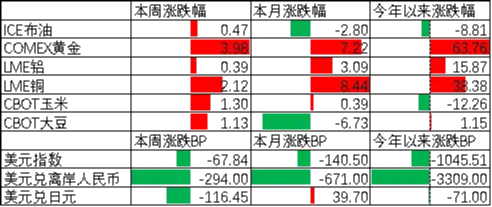
Key Insights - China's December LPR remains unchanged at 3.0% for 1-year and 3.5% for 5-year, maintaining stability for seven consecutive months due to pressure on bank net interest margins and stable policy rates [1][18] - The US Q3 GDP shows a significant annualized growth of 4.3%, surpassing market expectations of 3.3%, marking the fastest growth in two years, driven by strong consumer spending [2][19] - The central bank's monetary policy committee emphasizes the integration of incremental and stock policies to enhance monetary policy regulation, aiming to maintain low comprehensive financing costs [3][19] - The foreign exchange market sees the offshore RMB against the USD surpassing the "7" mark for the first time in 15 months, reaching a high of 6.9985 [4][19] Market Review Futures Market - ICE Brent crude oil increased by 0.47% to $60.33, while COMEX gold rose by 3.98% to $4562 [21][22] - The US dollar index decreased by 67.84 basis points, influenced by calls for the Federal Reserve to lower interest rates [22] Stock Market - The Shanghai Composite Index rose by 1.27% over the past week, while the ChiNext Index increased by 3.00% [23][24] - The Hang Seng Index gained 0.50%, supported by a weaker US dollar [26] Bond Market - Major bonds saw a decline, with 3Y AAA and AA+ bonds down by 7 basis points, while 1Y government bonds also decreased by 7 basis points [29][31] - The fourth-quarter monetary policy meeting highlighted the importance of maintaining capital market stability [29] Asset Allocation Perspective - The unchanged December LPR indicates a preference for stable interest margins rather than aggressive monetary easing, with expectations of a slight economic rebound amid easing trade tensions [33] - The strong Q3 GDP data in the US suggests a robust performance driven by the AI sector, although interest rate cut expectations have cooled slightly [33]

以色列警告可能再次打击伊朗,央行开展1771亿元逆回购
Dong Zheng Qi Huo· 2025-12-26 01:18
1. Report Industry Investment Ratings - **Foreign Exchange Futures (US Dollar Index)**: Short - term shock [12] - **US Stock Index Futures**: Expected to run with a slight upward bias in a volatile manner [13] - **Stock Index Futures**: The Shanghai Composite Index is expected to hit 4000 points in the short term, and it is recommended to evenly allocate long positions in various stock indices [3][15] - **Treasury Bond Futures**: Long - term bonds are expected to turn from shock to rise, and it is recommended that allocation investors buy when interest rates rise, and trading investors buy on dips and exit quickly [17][18] - **Agricultural Products (Soybean Oil/Rapeseed Oil/Palm Oil)**: Palm oil has completed bottom - building, and it is recommended to consider going long after referring to December supply - demand data [19][20] - **Black Metals (Steam Coal)**: Coal prices are expected to continue to decline in the short term [21] - **Black Metals (Iron Ore)**: The short - term fundamentals are under pressure, and it is expected to be in a weak shock [22][23] - **Non - ferrous Metals (Lead)**: It is recommended to wait and see in the short term both for unilateral trading and arbitrage [24] - **Non - ferrous Metals (Zinc)**: In the medium term, it is recommended to pay attention to buying opportunities on pullbacks; for arbitrage, long - short spreads can continue to be held, and an internal - external reverse arbitrage strategy is appropriate [27] - **Non - ferrous Metals (Lithium Carbonate)**: The current fundamentals are weakening, pay attention to short - term correction pressure, and it is recommended to go long on corrections in the medium term [29][30] - **Non - ferrous Metals (Nickel)**: It is expected to return to a shock trend. If the RKAB quota is only 250 million tons, there will be significant upside potential [33] - **Non - ferrous Metals (Tin)**: The short - term supply tension has eased, and there is pressure on the unilateral upward movement of prices. Be wary of price drops when the capital boom fades [38] - **Energy Chemicals (Carbon Emissions)**: High short - term market risk [40] - **Energy Chemicals (Caustic Soda)**: The short - term supply - demand contradiction has eased, but there may be pressure to reduce prices to clear inventory in the future, and the rebound height is limited [44][45] - **Energy Chemicals (PVC)**: The supply - demand contradiction is difficult to be substantially resolved before the Spring Festival, and the short - term rebound pressure is high. In 2026, the supply - demand is expected to improve marginally [48] - **Energy Chemicals (Soda Ash)**: In the medium term, it is recommended to take a bearish view and go short on far - month contracts on rallies [50] - **Energy Chemicals (Float Glass)**: The glass fundamentals are still in surplus, and it is recommended to short on rallies in the medium term [51] 2. Core Views of the Report - Geopolitical risks are rising, with Israel warning of a possible strike on Iran, which may affect the short - term trend of the US dollar index [12] - The US plans to impose 301 tariffs on Chinese semiconductor products in 2027, but the macro environment is still favorable for US stocks in the short term [13] - The A - share market is rising, with the Shanghai Composite Index recording 7 consecutive positive days, and it is expected to hit 4000 points in the short term [3][15] - The central bank has carried out reverse repurchase operations, with loose funds in the short - term and short - term bonds strengthening. Long - term bonds are expected to turn from shock to rise [16][17] - The prices of some commodities are under pressure. For example, steam coal prices are expected to continue to fall, and iron ore prices are in a weak shock [21][22] - The supply - demand situation of some commodities is complex. For example, the supply - demand contradiction of PVC is difficult to be resolved before the Spring Festival, while the supply - demand of palm oil shows signs of improvement [19][48] 3. Summary by Relevant Catalogs 3.1 Financial News and Comments 3.1.1 Macro Strategy (Foreign Exchange Futures (US Dollar Index)) - **News**: Israel warns of a possible strike on Iran, and Ukraine uses British missiles to attack a Russian refinery [10][12] - **Comment**: The possibility of Israel attacking Iran has increased significantly, and geopolitical risks have risen. The US dollar index is expected to be in a short - term shock [12] 3.1.2 Macro Strategy (US Stock Index Futures) - **News**: The US plans to impose 301 tariffs on Chinese semiconductor products in 2027, and China has protested [13] - **Comment**: The market has digested key economic data, and the optimistic expectations for interest rate cuts and economic soft - landing are still strong. The macro environment is favorable for US stocks, which are expected to run with a slight upward bias in a volatile manner [13] 3.1.3 Macro Strategy (Stock Index Futures) - **News**: The new construction and renovation of old urban communities in the first 11 months have completed the annual plan [14] - **Comment**: The A - share market is rising, with the Shanghai Composite Index recording 7 consecutive positive days, and it is expected to hit 4000 points in the short term [3][15] 3.1.4 Macro Strategy (Treasury Bond Futures) - **News**: The central bank has carried out 177.1 billion yuan of 7 - day reverse repurchase operations [16] - **Comment**: The central bank's open - market operations have led to loose funds, short - term bonds have strengthened, and long - term bonds are expected to turn from shock to rise [16][17] 3.2 Commodity News and Comments 3.2.1 Agricultural Products (Soybean Oil/Rapeseed Oil/Palm Oil) - **News**: Malaysia's palm oil exports from December 1 - 25 increased by 1.6% month - on - month [19] - **Comment**: The palm oil market shows signs of supply pressure relief, and it is recommended to consider going long after referring to December supply - demand data [19][20] 3.2.2 Black Metals (Steam Coal) - **News**: The price of steam coal in the northern port market is running weakly [21] - **Comment**: Due to warm winter weather, demand is weak, inventory is high, and coal prices are expected to continue to fall in the short term [21] 3.2.3 Black Metals (Iron Ore) - **News**: The new construction and renovation of 2.58 million old urban communities have been started from January to November [22] - **Comment**: The short - term fundamentals of iron ore are under pressure, with expected decline in molten iron output and a weak shock trend [22][23] 3.2.4 Non - ferrous Metals (Lead) - **News**: The LME 0 - 3 lead is at a discount of $42.3 per ton, and the social inventory of lead ingots has decreased [23] - **Comment**: The supply and demand of lead are both weak, and it is recommended to wait and see in the short term [24] 3.2.5 Non - ferrous Metals (Zinc) - **News**: The LME 0 - 3 zinc is at a discount of $29.14 per ton, and the domestic inventory of zinc ingots has decreased [25] - **Comment**: In the short term, the fundamentals of zinc are less contradictory, and the price is mainly affected by the macro. In the medium term, zinc prices are likely to rise [26][27] 3.2.6 Non - ferrous Metals (Lithium Carbonate) - **News**: Some companies plan to carry out maintenance in January, which will affect the output of cathode materials [28][29] - **Comment**: The current fundamentals of lithium carbonate are weakening, pay attention to short - term correction pressure, and it is recommended to go long on corrections in the medium term [29][30] 3.2.7 Non - ferrous Metals (Nickel) - **News**: Zhefu Holding's nickel sulfate production line has been put into operation, and APNI plans to reduce nickel ore production in 2026 [31][32] - **Comment**: The market is skeptical about APNI's plan. The nickel price is expected to return to a shock trend, and there will be significant upside potential if the quota is only 250 million tons [32][33] 3.2.8 Non - ferrous Metals (Tin) - **News**: The US will not impose additional tariffs on Chinese chips in the next 18 months, and the LME 0 - 3 tin is at a premium [34][35] - **Comment**: The short - term supply tension of tin has eased, and there is pressure on the unilateral upward movement of prices. Be wary of price drops when the capital boom fades [36][38] 3.2.9 Energy Chemicals (Carbon Emissions) - **News**: The closing price of CEA on December 25 was 72.58 yuan per ton, up 5.36% [39] - **Comment**: The short - term market risk of carbon emissions is high [40] 3.2.10 Energy Chemicals (Caustic Soda) - **News**: The price of liquid caustic soda in Shandong is at a low level [41] - **Comment**: The short - term supply - demand contradiction of caustic soda has eased, but there may be pressure to reduce prices to clear inventory in the future, and the rebound height is limited [44][45] 3.2.11 Energy Chemicals (PVC) - **News**: The domestic PVC powder market price is in a range shock [46] - **Comment**: The supply - demand contradiction of PVC is difficult to be substantially resolved before the Spring Festival, and the short - term rebound pressure is high. In 2026, the supply - demand is expected to improve marginally [48] 3.2.12 Energy Chemicals (Soda Ash) - **News**: The inventory of soda ash manufacturers has decreased this week [49] - **Comment**: In the medium term, soda ash is recommended to be taken with a bearish view, and it is advisable to go short on far - month contracts on rallies [50] 3.2.13 Energy Chemicals (Float Glass) - **News**: The inventory of float glass manufacturers has changed little this week [51] - **Comment**: The glass fundamentals are still in surplus, and it is recommended to short on rallies in the medium term [51]
美国股市:标普500指数圣诞前夕收于纪录新高 “圣诞老人行情”拉开帷幕
Xin Lang Cai Jing· 2025-12-24 19:07
圣诞前夕,华尔街交投相对平静,美国市场创下历史新高,更多迹象显示,就业市场并未迅速恶化,从 而支撑市场对经济软着陆的押注。 投资者憧憬"圣诞老人行情" —— 这一行情通常涵盖年内最后五个交易日以及新年前两个交易日 —— 标 普500指数在这一时段之初上涨,成交清淡。 这种平静的市场表现与今年早些时候关税风暴引发的剧烈动荡形成鲜明对比,当时的关税风暴一度让股 指濒临熊市。此后,市场强势反弹,每一次回调中,投资者都以创纪录的速度买入,"错失恐惧 症"(FOMO)主导市场情绪。 年末阶段,市场对人工智能热的质疑一度令这轮强劲涨势受阻,但市场押注美联储2026年仍有进一步降 息空间,这继续提振对美国企业利润前景的乐观预期。 "我们认为投资者应该为市场的进一步上涨做好准备,"瑞银全球财富管理的Ulrike Hoffmann-Burchardi 本周表示,我们维持对美国股票的'有吸引力'评级。我们在科技、医疗保健、公用事业以及金融板块看 到了颇具吸引力的机会,这应该会拓宽未来上涨的基础。" 在消化最新经济数据之际,交易员坚持此前的判断,即美联储明年将降息两次,每次25个基点,这比官 员给出的利率预测中值多一次。 标普50 ...

美股交投清淡 三大指数均持稳
Ge Long Hui A P P· 2025-12-24 15:17
格隆汇12月24日|美股周三早盘交投清淡,标普500指数维持在历史高位附近,市场正分析劳动力市场 数据以寻找关于美联储利率路径的更多线索。纳斯达克100指数和道指数均变动不大。Sevens Report创 始人汤姆·埃塞耶表示,随着年底临近,投资者正坚定地为经济软着陆定价。他认为,在对于未来几个 季度盈利强劲增长的乐观预期中,股市仍有上行空间。 ...
2025期货业盘点|齐盛期货刘旭峰:商品属性接棒驱动,转折点或出现在明年年中
Sou Hu Cai Jing· 2025-12-24 00:12
Core Viewpoint - The chief analyst of Qisheng Futures, Liu Xufeng, believes that the commodity attributes of precious metals are expected to replace their financial and monetary attributes, becoming the main driving force behind price movements, with an expanding supply-demand gap in silver likely supporting prices [1] Group 1: Silver Supply and Demand - The global silver market has experienced a supply shortage for five consecutive years from 2021 to 2025, with deficits of 2,468 tons, 7,762 tons, 6,240 tons, 4,632 tons, and 3,659 tons respectively [2] - Despite a slowdown in global economic growth post-COVID-19 affecting demand expansion, the supply-demand imbalance has not been fully resolved [2] - In 2026, silver demand is expected to see a structural recovery driven by improved investment sentiment and the rapid development of emerging fields such as artificial intelligence and computing devices, which will increase industrial demand for silver and silver alloy coatings [2] Group 2: Economic Indicators and Monetary Policy - As of November 2025, the U.S. CPI has decreased to an annual rate of 2.7%, with core CPI at 2.6%, indicating limited risk of significant inflation rebound [3] - The manufacturing PMI has been in contraction territory, recorded at 48.2 in November, with weak new orders and employment components, while the service sector remains resilient but may weaken in 2026 [3] - A potential turning point may occur in mid-2026, coinciding with the end of Federal Reserve Chairman Powell's term, with expectations that Kevin Hassett, who is perceived as dovish, may accelerate monetary easing if appointed [3] Group 3: Risks and Investment Strategies - The long-term influence of the U.S. dollar credit system is weakening, as evidenced by ongoing gold purchases by global central banks, reflecting a diversification demand away from dollar assets [4] - The People's Bank of China has shown a slowdown in gold purchases in 2025, raising questions about whether it will pause further accumulation in 2026 [4] - While the macro environment may support precious metal prices in the medium to long term, multiple risk factors, including liquidity risks and potential inflation rebounds, should be closely monitored [4] - Investors are advised to focus on upward opportunities while remaining vigilant against short-term extreme volatility, and to reassess the long-term bullish logic for silver if the overseas economy stabilizes during a rate-cutting cycle [4]
2026 年展望—浮沤危悬? 多元布局!
Sou Hu Cai Jing· 2025-12-23 16:39
Core Viewpoint - The article suggests that global risk assets are expected to lead in 2026, with increasing market differentiation and a focus on diversified investment strategies around three key themes while being cautious of four major risks [1][6]. Macroeconomic Overview - The core scenario anticipates a 60% probability of a soft landing for the US economy, with the Federal Reserve expected to cut rates by 75 basis points to 3.0% by the end of 2026. Factors supporting growth include easing trade tensions, increased infrastructure and defense spending in Germany, and targeted stimulus policies in China. There is a 15% risk of a hard landing and a 25% risk of an "unlanding" scenario, with inflation stabilizing but remaining above pre-pandemic levels [1][6][65]. Investment Themes - **Theme 1: Stock Market Growth Driven by AI** The stock market is expected to rise alongside discussions around artificial intelligence, with AI-driven profit growth offsetting some valuation pressures. The recommendation is to overweight US and Asian (excluding Japan) stocks, with a focus on technology, healthcare, and utilities sectors [2][21][23]. - **Theme 2: Emerging Market Debt Outperforming Developed Markets** Emerging market debt, both in USD and local currencies, is seen as attractive due to improved fiscal fundamentals, yield advantages, and expectations of a weaker dollar, which can help mitigate interest rate risks in developed markets [2][28][23]. - **Theme 3: Diversification Tools Highlighted** Gold is expected to continue its upward trend, with target prices of $4,350 per ounce in 3 months and $4,800 per ounce in 12 months. Alternative investment strategies and currencies like the Japanese yen and offshore RMB are also considered important diversification tools [2][30][31]. Asset Class Allocation - In the bond sector, preference is given to emerging market debt and developed market investment-grade government bonds, with opportunities seen in US Treasury Inflation-Protected Securities and short-term high-yield bonds. In the stock sector, there is an underweight position in European (excluding the UK), Japanese, and UK stocks, while overweighting US tech stocks, high-yield stocks of non-financial state-owned enterprises in China, and the Hang Seng Tech Index [2][22][23]. Risk Factors - Key risks include underperformance of AI, potential chain reactions from credit events, shifts in Federal Reserve policy, and unexpected hawkish stances from the Bank of Japan, which could lead to market volatility [3][23][33].

俄罗斯增长放缓但可控
Jing Ji Ri Bao· 2025-12-23 00:03
Economic Overview - In 2025, the Russian economy is expected to experience a controlled cooling period, with GDP growth projected to decline to around 1% after reaching a 12-year high of 4.3% in 2024 [1] - The economic slowdown is attributed to weak production growth, reduced consumer spending, and declining contributions from key sectors [1][2] GDP and Growth Projections - The Russian Academy of Sciences predicts a GDP growth of 0.7% for 2025, while some commercial banks estimate it at 0.9% [2] - Industrial production remains a significant driver of economic growth, with manufacturing, particularly machinery and chemical production, showing stable contributions [2] Inflation and Monetary Policy - Inflation pressure is easing, with the inflation rate dropping to 6.6% in November from a high of 10.34% in March, although it remains above the central bank's target of 4% [3] - The central bank has more room to ease monetary policy due to the declining inflation and cooling domestic demand [3] Currency and Debt Dynamics - The real effective exchange rate of the ruble has appreciated significantly, increasing by 25.2% from January to November [3][4] - Public debt has risen by 10.1% to 32.98 trillion rubles, with domestic debt increasing while external debt has decreased [4] Future Economic Strategy - The Russian government is focusing on structural economic reforms aimed at creating high-tech industries and high-value production jobs, with a plan extending to 2030 [7] - Balancing inflation control, exchange rate stability, and growth is emphasized as crucial for achieving national development goals [7]
国海富兰克林基金狄星华:非农数据罕见连发 就业降温再燃降息前景
Sou Hu Cai Jing· 2025-12-18 06:17
近日,美国劳工统计局一次性补发因政府停摆延误的10月、11月非农报告。国海富兰克林基金经理狄星 华表示,整体来看,这份报告并不算糟糕,从市场较为平淡的反应也可以看出来,数据虽然有变差,但 也没有差到进入"衰退叙事"的地步,经济"软着陆"仍然是基准情形,这为风险资产提供了缓冲空间。 上证报中国证券网讯(记者 王彭)近日,美国劳工统计局一次性补发因政府停摆延误的10月、11月非 农报告。数据显示,美国就业市场呈现"冷热交织"的复杂态势:11月非农就业人口新增6.4万人,略高 于预期的5万人,但失业率意外攀升至4.6%,创下2021年9月以来新高;而10月就业人数大幅减少10.5万 人,远超市场预期的2.5万人降幅,且因数据收集中断未公布当月失业率。对此,国海富兰克林基金经 理狄星华表示,整体来看,这份报告并不算糟糕,从市场较为平淡的反应也可以看出来,数据虽然有变 差,但也没有差到进入"衰退叙事"的地步,经济"软着陆"仍然是基准情形,这为风险资产提供了缓冲空 间。 狄星华表示,在最新非农数据公布后,市场对美联储2026年降息两次的预期有所增强。根据CME"美联 储观察"最新数据显示,明年1月降息25个基点的概率已从 ...