
美债利率

Search documents
关税仍在影响PPI,美联储9月降息预期生变?
Jing Ji Guan Cha Wang· 2025-08-18 12:02
Group 1 - The core CPI in the US for July 2025 ended a five-month streak of underperformance, with a month-on-month increase of 0.2%, aligning with expectations, while core CPI rose by 0.32% [1] - The US economy is facing uncertainties, with signs of weakening consumer market momentum and cautious corporate investment, leading to speculation that the Federal Reserve may consider interest rate cuts despite current inflation data [1] - Market expectations have shifted towards a "rate cut anticipation leading to a reinforced soft landing expectation," resulting in declines in the 2-year Treasury yield and the dollar index, while 10-year TIPS, 10-year Treasury yields, and US stocks have risen [1] Group 2 - The July PPI data indicates that tariff pressures may have been transmitted to US wholesalers, with a month-on-month increase of 0.95%, significantly exceeding the expected 0.2%, and core PPI rising by 0.92%, the highest since 2022 [2] - The impact of tariffs on wholesale, retail, and end-consumer prices remains uncertain, and the market's expectation for a September rate cut is not guaranteed due to the variability in data quality [2] - In optimistic scenarios, the Federal Reserve may cut rates twice this year, while in pessimistic scenarios, only once in October; looking ahead to mid-2026, a new Fed chair may lead to a more accommodative monetary policy with potential rate cuts ranging from 4 to 6 times next year [2] Group 3 - Prior to the September FOMC meeting, the dollar index and 2-year Treasury yield are expected to rise, reflecting a correction of overly optimistic rate cut expectations [3] - Following the September FOMC, market bets on rate cuts in 2026 are anticipated to increase, with concerns about the Fed's independence and debt sustainability likely to widen the yield spread between 2-year and 10-year Treasuries [3] - Recent discussions between Trump and Putin regarding the Russia-Ukraine conflict may enhance short-term market risk appetite, potentially leading to downward pressure on gold prices as safe-haven sentiment diminishes [3]
美国7月CPI前瞻:商品价格抬升或推动CPI环比走高
Soochow Securities· 2025-08-10 12:29
Group 1: CPI Expectations - July CPI is expected to rise, with Bloomberg analysts predicting a month-on-month increase of +0.2% and a year-on-year increase of +2.8%[2] - Core CPI is forecasted to increase by +0.3% month-on-month and +3.0% year-on-year[2] - The Federal Reserve's Inflation Nowcasting predicts a month-on-month increase of +0.16% for CPI and +0.24% for core CPI, with year-on-year increases of +2.72% and +3.04% respectively[2] Group 2: Market Reactions - The expectation of a rate cut has increased due to geopolitical easing, leading to a rise in U.S. stock markets, with the S&P 500 and Nasdaq gaining 2.43% and 3.87% respectively[3] - U.S. Treasury yields rose, with the 10-year yield increasing by 6.7 basis points to 4.283% and the 2-year yield rising by 8.1 basis points to 3.762%[3] - The dollar index decreased by 0.97% to 98.18, while spot gold prices rose by 1.02% to $3,397 per ounce[3] Group 3: Economic Indicators - The ISM Services PMI for July recorded at 50.1, below the expected 51.5, indicating a slowdown in service sector growth[3] - New orders fell to 50.3 and the employment index dropped to 46.4, suggesting weakening demand in the services sector[3] - The New York Fed's consumer survey indicated a one-year inflation expectation of 3.09%, up from 3.02%[3] Group 4: Risks and Future Outlook - The implementation of tariffs may lead to further inflationary pressures, with the potential for CPI to rise in the coming months[4] - There is a risk that the Federal Reserve's rate cuts could lead to an inflation rebound if executed too aggressively[4] - The nomination of Stephen Milan to the Federal Reserve Board may increase internal disagreements regarding future interest rate paths[3]
中金:美元流动性短期收紧或压制美股 但长期风险资产仍具潜力
智通财经网· 2025-08-07 00:14
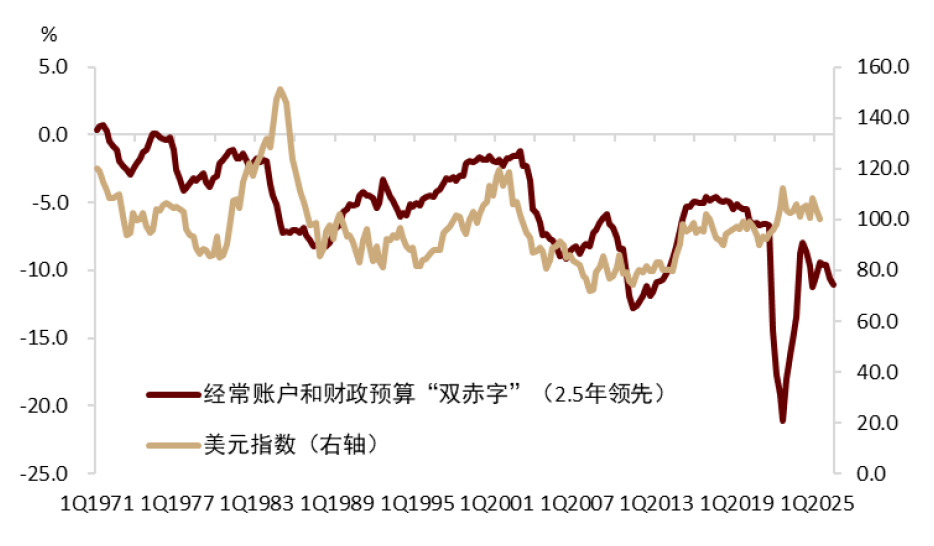
Core Viewpoint - The report from CICC indicates that the U.S. economy showed signs of improvement in July after hitting a low in June, despite a rebound in the dollar index since July. The tightening of dollar liquidity and the impact of tariffs on inflation may negatively affect U.S. stock performance in August and September, while the 10-year Treasury yield is expected to rise to around 4.8% in the near term. However, the long-term outlook remains positive for risk assets due to potential dollar liquidity easing and fiscal support for the economy [1][2][16]. Group 1: Dollar Index and Market Dynamics - The dollar index reflects various factors including cross-border capital flows, fundamentals, and dollar liquidity. Its fluctuations indicate a structural bear market for the dollar amidst ongoing capital rebalancing between the U.S. and other markets [2][4]. - The dollar index has maintained strength despite the widening U.S. fiscal and trade deficits over the past two years, driven by continued capital inflows into U.S. assets underpinned by AI-related market confidence [2][4]. Group 2: Economic Indicators and Labor Market - Following a structural depreciation in April, the dollar index regained positive correlation with the U.S.-Germany yield spread from May, reflecting the recovery of the U.S. economy in July after a downturn from April to June [6][7]. - High-frequency data indicates that unemployment claims rose significantly from April to June, peaking at 1.95 million, corresponding to an unemployment rate of 4.3%. However, new job openings showed a recovery starting in July [9][10]. Group 3: Liquidity and Debt Issuance - The liquidity situation shifted from easing to tightening as the Treasury General Account (TGA) began releasing funds to replenish reserve accounts, with a significant increase in net debt issuance in July amounting to $308.3 billion compared to $104.9 billion from April to June [12][14]. - The Treasury is projected to issue $1 trillion in net debt from July to September, with long-term debt issuance reaching $470 billion, which may lead to financial risks and market volatility [20][21]. Group 4: Inflation and Economic Outlook - The potential for inflation is increasing as the impact of tariffs on import costs becomes more apparent, coupled with strong wage growth and low inflation base effects [16][18]. - The report suggests that if the U.S. economy remains stable with rising inflation and tightening dollar liquidity, Treasury yields are unlikely to stay low, which could adversely affect the real estate and manufacturing sectors [21][22]. Group 5: Future Market Trends - The report anticipates potential adjustments in risk assets over the next couple of months due to tightening liquidity and rising inflation, particularly affecting growth sectors, while financial, real estate, and industrial sectors may remain resilient due to policy support [22]. - The long-term trend suggests that fiscal dominance may lead to renewed liquidity and continued improvement in fundamentals, maintaining an upward trajectory for the market despite short-term adjustments [22].

中金:数据摇摆中,美元仍是决定因素
中金点睛· 2025-08-06 23:45
Core Viewpoint - The article discusses the fluctuations in the US economy and the impact of various factors such as monetary policy, fiscal measures, and international trade on market performance, suggesting that while there may be short-term adjustments, the long-term outlook for risk assets remains positive due to potential liquidity easing and fiscal support [2][18][25]. Group 1: Economic Conditions - The US economy is believed to have bottomed out in June and showed signs of improvement in July, with a debt issuance wave beginning in July to absorb dollar liquidity [2][18]. - The impact of tariffs on inflation is expected to gradually manifest, potentially affecting US stock performance negatively in August and September [2][18]. - The 10-year US Treasury yield is projected to quickly bottom out and rise to around 4.8% [2][18]. Group 2: Dollar Index and Liquidity - The dollar index reflects cross-border capital flows, fundamentals, and dollar liquidity, maintaining strength despite the US's fiscal and trade deficits due to ongoing capital inflows driven by AI investments [3][4]. - Following a structural depreciation in April, the dollar index has shown a recovery since May, correlating with the decline in the US-German yield spread [7][9]. - A significant increase in net debt issuance occurred in July, totaling $308.3 billion, compared to only $104.9 billion from April to June [13][15]. Group 3: Inflation and Fiscal Policy - The risk of inflation is increasing as the impact of tariffs on import costs becomes more apparent, alongside strong wage growth and low inflation base effects [18][20]. - The Treasury is expected to issue $1 trillion in net debt from July to September, with long-term debt issuance reaching $470 billion, which may lead to financial risks and market volatility [22][24]. - The potential for a "new accord" between fiscal and monetary policy could lead to renewed dollar liquidity and improved performance of risk assets in the long term [25].
国泰海通:美联储降息预期或进一步收窄 美股仍有上行空间
Zhi Tong Cai Jing· 2025-07-31 22:47
Group 1 - The core viewpoint is that the US GDP growth in Q2 exceeded expectations, supported by a decline in imports, resilient consumption, and private non-residential investment [1][2] - The annualized quarter-on-quarter GDP growth rate for Q2 2025 reached 3.0%, higher than the market expectation of 2.6% and significantly above the previous value of -0.5% [2] - The main drag on GDP came from changes in private inventories, residential investment, and exports of goods and services [2] Group 2 - The Federal Reserve maintained its interest rates during the July 2025 meeting, but internal divisions have increased, with two members advocating for a 25 basis point cut [3] - The Fed expressed greater uncertainty regarding economic and inflation outlooks, changing its statement from reduced uncertainty to acknowledging that uncertainty remains [3] - Powell reiterated the Fed's independence and provided ambiguous forward guidance, indicating a hawkish stance, which has led to a decrease in market expectations for rate cuts throughout the year [3][4] Group 3 - The expectation for rate cuts throughout the year has narrowed, with the market reflecting only one potential cut in October, aligning with previous forecasts [4] - The anticipated impact of tariffs on inflation is expected to constrain rate cuts, with the 10-year Treasury yield projected to oscillate between 4.5% and 5.0% in the second half of the year [4] - The stock market is expected to experience some volatility in the second half, but the overall upward trend remains intact, particularly in sectors supported by capital expenditures and performance, such as AI and semiconductors [4]

国泰海通|宏观:美联储鹰派继续——2025Q2美国GDP和7月FOMC点评
国泰海通证券研究· 2025-07-31 12:39
Group 1 - The core viewpoint of the article is that the US economy shows resilience, supported by a decline in imports, strong consumer spending, and a return of manufacturing investments, leading to a narrowing of interest rate cut expectations from the Federal Reserve [1][2][3] Group 2 - The US GDP growth rate for Q2 2025 was 3.0%, exceeding market expectations of 2.6% and significantly higher than the previous value of -0.5% [1] - Key supports for the GDP growth included a decrease in imports, resilient consumer spending, and private non-residential investment, while private inventory changes, residential investment, and goods and services exports were the main drags [1] - The Federal Reserve's recent meeting revealed internal divisions, with two members advocating for a 25 basis point rate cut, indicating increasing disagreement within the committee [2] - The Fed expressed greater uncertainty regarding economic and inflation outlooks, with tariffs beginning to impact consumer prices, suggesting that inflation data will be influenced by these tariffs [2] - The Fed's stance remains hawkish, with a commitment to data-driven decisions, leading to a further reduction in market expectations for rate cuts throughout the year [2][3] - The expectation for interest rate cuts has narrowed, with only one potential cut anticipated in October, and the risk of no cuts for the entire year has increased [3] - The 10-year US Treasury yield is projected to oscillate between 4.5% and 5.0% in the second half of the year, reflecting a higher interest rate environment [3] - The US stock market is expected to experience some volatility but maintain an overall upward trend, particularly in sectors supported by capital expenditures and performance, such as AI and semiconductors [3]


-美联储那些事儿:美联储7月议息会议:等待看到更多价格传导
Ping An Securities· 2025-07-31 09:28
Report Industry Investment Rating - Not provided in the given content Core Viewpoints - The Fed decided to keep the policy rate unchanged at 4.25 - 4.5% in the July 2025 meeting, with some members opposing and supporting a 25BP rate cut [8]. - Powell's stance is hawkish, and he has no pre - set expectations for the September policy decision, which dampens market rate - cut expectations [8]. - The certainty of a September rate cut by the Fed is low. If the unemployment rate remains stable or slightly rises in the next two months, the Fed may keep the rate unchanged to wait for tariff transmission results [9]. - If inflation does not rise significantly in the next two months, the bond market opportunities will increase in the fourth quarter; if inflation rises significantly, the US Treasury yields may rise further. It is recommended to maintain a relatively short duration in the short term [9]. - The US dollar index has rebounded to around 100 points. Short - term dollar short - covering may bring some upward space, and the view that the US dollar index will operate in the 95 - 105 range is maintained [6][9]. Summary by Related Catalogs Fed Meeting Decision - In the July 2025 meeting, the Fed kept the policy rate at 4.25 - 4.5% unchanged. Members Bowman and Waller voted against and supported a 25BP rate cut this month [8]. Powell's Stance - Powell adheres to data - dependence and has no policy expectations for September, which hits market rate - cut expectations [8]. - In terms of inflation, Powell aims to prevent one - time price increases from turning into continuous inflation, hopes to maintain a moderately restrictive monetary policy, and believes that tariff transmission to prices may be slower than expected [8][10]. - Regarding employment, Powell thinks the job market is relatively stable despite some downward risks [5][10]. - On economic growth, Powell admits that the overall economic growth has slowed down, and large fluctuations in net exports may affect consumer spending, making some signals difficult to interpret. He also believes that although consumer growth has slowed down, consumers' credit conditions are good [5][10]. Market Reaction - After the Fed's press conference, the market lowered the expectation of a September rate cut. Short - term interest rates rose significantly, the US dollar continued to rise, and the US stock market was under pressure. As of 4:30 Beijing time, the 2Y and 10Y US Treasury yields rose by 6.8BP and 2.8BP respectively compared with before the meeting, the US dollar index rose 0.6% to around 100 points, and the S&P 500 fell 0.4% at the close [9]. Outlook for September Fed Meeting - The certainty of a September rate cut by the Fed is not high. If the unemployment rate remains stable or slightly rises in the next two months, the Fed may keep the rate unchanged to wait for longer - term tariff transmission results [9]. Outlook for US Treasury Yields - If inflation does not rise significantly in the next two months, the bond market opportunities will increase in the fourth quarter; if inflation rises significantly, the US Treasury yields may rise further. It is recommended to maintain a relatively short duration in the short term, and the downward revision of the rate - cut expectation provides some allocation opportunities [9]. Outlook for US Dollar Index - After the US - EU trade agreement, the US dollar index has generally risen and has now rebounded to around 100 points. Short - term dollar short - covering may bring some upward space. Without a substantial weakening signal in the US labor market and continuous rate cuts by the Fed, the view that the US dollar index will operate in the 95 - 105 range is maintained [6][9].
美联储7月议息会议:等待看到更多价格传导
Ping An Securities· 2025-07-31 09:14
Report Industry Investment Rating - No information provided regarding the industry investment rating for this specific topic in the given content. Core Viewpoints - At the July 2025 meeting, the Fed decided to keep the policy rate unchanged at 4.25 - 4.5%, with dissenting votes from Bowman and Waller who supported a 25BP rate cut. Powell's hawkish stance dampened market expectations of a September rate cut [2]. - The market adjusted its September rate - cut expectations after the Fed's press conference, with short - term interest rates rising significantly, the US dollar continuing to strengthen, and the US stock market under pressure. As of 4:30 Beijing time, the 2Y and 10Y US Treasury yields rose 6.8BP and 2.8BP respectively compared to before the meeting, the US dollar index rose 0.6% to around 100 points, and the S&P 500 fell 0.4% at the close [2]. - There is no high certainty of a September rate cut by the Fed. If the unemployment rate remains stable or rises slightly in the next two months, the Fed may keep the interest rate unchanged to wait for the longer - term impact of tariffs. The delay in tariff transfer to consumers may imply consumer weakness [2]. - Regarding US Treasury yields, if inflation does not rise significantly in the next two months, the bond market opportunities will increase in the fourth quarter; if inflation rises significantly, US Treasury yields may rise further. Short - term, it is recommended to maintain a relatively short duration [2]. - For the US dollar index, short - term short - covering may bring some upward space. The view that the US dollar index will operate in the 95 - 105 range is maintained [2]. Summary by Related Content Fed Meeting Decision - In the July 2025 meeting, the Fed kept the policy rate at 4.25 - 4.5%. Bowman and Waller voted against, supporting a 25BP rate cut this month [2]. Powell's Stance - Powell's stance was hawkish, not pre - setting expectations for the September policy decision. He adheres to data - dependence. In terms of inflation, he aims to prevent one - time price increases from turning into persistent inflation and hopes to maintain a moderately restrictive monetary policy. He believes the impact of tariffs on inflation is in the early stage and the transfer to consumers may be slower than expected [2]. - Regarding employment, he thinks the job market is relatively stable despite some downside risks. In terms of economic growth, he admits the overall economic growth has slowed, and the large fluctuations in net exports may affect consumer spending, making it difficult to interpret some signals. He also believes consumers' credit conditions are good despite the slowdown in consumption growth [2]. Market Reaction - After the Fed's press conference, the market lowered its September rate - cut expectations. Short - term interest rates rose significantly, the US dollar continued to strengthen, and the US stock market was under pressure. As of 4:30 Beijing time, the 2Y and 10Y US Treasury yields rose 6.8BP and 2.8BP respectively compared to before the meeting, the US dollar index rose 0.6% to around 100 points, and the S&P 500 fell 0.4% at the close [2]. Outlook for September Fed Meeting - There is no high certainty of a September rate cut. If the unemployment rate remains stable or rises slightly in the next two months, the Fed may keep the interest rate unchanged to wait for the longer - term impact of tariffs. The delay in tariff transfer to consumers may imply consumer weakness [2]. US Treasury Yields Outlook - If inflation does not rise significantly in the next two months, the bond market opportunities will increase in the fourth quarter; if inflation rises significantly, US Treasury yields may rise further. Short - term, it is recommended to maintain a relatively short duration, and the downward revision of rate - cut expectations provides some allocation opportunities [2]. US Dollar Index Outlook - After the US - EU trade agreement, the US dollar index has risen. Short - term short - covering may bring some upward space. The view that the US dollar index will operate in the 95 - 105 range is maintained [2].
鲍威尔偏鹰,降息预期回撤或接近尾声
HUAXI Securities· 2025-07-31 03:02
Group 1: Federal Reserve Stance - Federal Reserve continues to pause interest rate cuts, indicating a shift from "economic activity continues to expand steadily" to "economic activity growth has slowed in the first half of the year" [1] - Powell's hawkish stance suggests that asserting a rate cut in September is premature, with inflation outlook showing mixed signals [1] - Market's expectation for rate cuts has retracted by 10 basis points, with the CME FedWatch indicating a drop from 45 basis points to 35 basis points for the year [1] Group 2: Economic Indicators - Labor market indicators such as turnover rates, job vacancies, and unemployment rates are close to levels from a year ago, indicating no significant weakness [1] - Employment creation and labor supply are slowing, presenting downside risks to the labor market [1] - The market is now leaning towards a single rate cut for the year, with expectations for a potential shift towards rate cut anticipation in August if tariff impacts on inflation remain manageable [2] Group 3: Market Reactions - Following the announcement, the US dollar index rose approximately 0.5%, nearing 100, while the 10-year Treasury yield increased from 4.34% to around 4.38% [1] - The market's confidence in a rate cut in October has decreased to about 80% following the meeting [1] - The overall economic data rebound and retraction of rate cut expectations are expected to support the dollar, although future agreements remain uncertain [2]
2025年7月FOMC会议点评:7月FOMC:给9月降息泼冷水
Soochow Securities· 2025-07-31 02:24
Group 1: FOMC Meeting Insights - The July FOMC meeting maintained interest rates at 4.25-4.5% with a 9-2 vote, signaling a hawkish stance due to inflation concerns[1] - Powell indicated that the distance to achieve inflation targets is greater than that for employment, suggesting a need for restrictive policy rates[1] - The market now expects the likelihood of a rate cut in September to be delayed until Q4 2025, with 2-year and 10-year U.S. Treasury yields projected to rise to 4.05% and 4.5% respectively in August and September[1] Group 2: Economic Indicators and Projections - Economic growth is showing signs of moderation, with consumer spending beginning to slow down, and GDP growth expected to be revised downwards[1] - The labor market remains balanced, but there are signs of downward risks with a slight decline in private sector job opportunities[1] - Inflation remains a concern, with tariffs beginning to impact goods inflation, while service sector inflation shows improvement[1] Group 3: Market Reactions and Future Expectations - Following the FOMC meeting, the probability of a September rate cut has decreased to 47%, with an average expectation of 1.48 rate cuts for the year[1] - The market anticipates a new round of monetary easing after the appointment of a new Fed chair, with expectations for three rate cuts in 2026 potentially increasing to four or more[1] - The overall strategy suggests that the U.S. Treasury yields may initially rise before declining later in the year as the market adjusts to new monetary policies[1]