
金融脱媒

Search documents
150万亿大资管扫描:险资、公募破30万亿,信托业狂飙存隐忧
2 1 Shi Ji Jing Ji Bao Dao· 2025-07-31 13:35
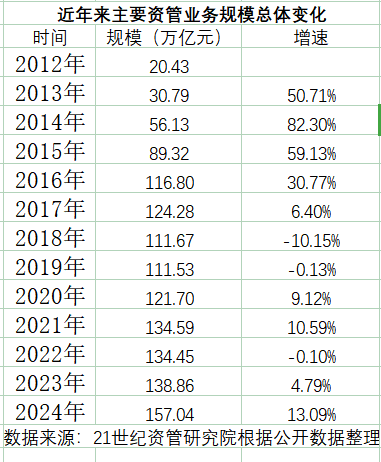
Core Viewpoint - By the end of 2024, China's total asset management scale is expected to reach 150 trillion yuan, with significant growth across various asset management sectors, indicating a clear trend of "financial disintermediation" [1][6]. Group 1: Industry Overview - The asset management industry in China has evolved significantly since the introduction of bank wealth management products in 2004, with various regulatory changes shaping its development [2][4]. - The total asset management scale reached 157.04 trillion yuan by the end of 2024, marking a 13.09% increase from the previous year, the highest growth rate since the implementation of the new asset management regulations [6][8]. - The growth in asset management is driven by a shift in deposits towards wealth management products due to declining bank deposit rates and regulatory changes [15][14]. Group 2: Sector Performance - Trusts experienced the highest growth rate at 23.58%, with their scale approaching that of bank wealth management products, which grew by 11.75% [7][8]. - Public funds and insurance asset management also saw significant growth rates of 20.39% and 15.08%, respectively, indicating a shift in investor preferences [8][19]. - By the end of 2024, the asset management scale for insurance reached 33.26 trillion yuan, accounting for 21.18% of the total market, making it the largest segment [23][24]. Group 3: Regulatory Environment - The China Securities Regulatory Commission (CSRC) has been proactive in promoting high-quality development in the asset management industry, issuing multiple regulatory documents to enhance market stability and investor protection [4][5]. - The implementation of the new asset management regulations has led to a more standardized and transparent industry, with a focus on compliance and risk management [2][3]. Group 4: Financial Performance - The net profit of trust companies increased to 940.36 billion yuan in 2024, reflecting the growth in asset management scale, although the profit margin remains lower than pre-2021 levels [39]. - Public fund management fees decreased by over 8% in 2024 due to a shift towards lower-cost passive investment products, impacting overall revenue [40]. - The income from securities firms' asset management remained stable at 239.47 billion yuan in 2024, despite a significant decline in asset scale over recent years [41].

稳定币对金融体系的潜在影响
2025-06-18 00:54
Summary of Stablecoin Conference Call Industry Overview - The stablecoin market is projected to reach a market capitalization of approximately $230 billion by the end of May 2025, representing a growth of over 40 times in five years, with an annual transaction volume of $28 trillion, surpassing Visa and Mastercard [1][4] Core Insights and Arguments - **Regulatory Framework**: The U.S. and Hong Kong have implemented regulations focusing on reserve asset transparency, liquidity management, algorithmic stability, anti-money laundering, and consumer protection, requiring 100% reserve assets to be backed by fiat or highly liquid assets [1][5] - **International Payments**: Stablecoins offer low-cost and efficient international payment methods, with transaction fees typically below 1% and processing times of a few minutes, contrasting with the global average remittance fee of 6.62% [1][7] - **Impact on Banking**: Stablecoins pose a disintermediation risk for banks, shifting liabilities from savings to interbank liabilities, which may compress interest margins and erode profits [3][13] - **Market Size Comparison**: Despite the rapid growth of stablecoins, their market size remains small compared to traditional financial systems, with domestic dollar deposits around $19 trillion and U.S. Treasury securities at approximately $37 trillion [4] - **Long-term Debt Market**: The ability of stablecoins to absorb long-term U.S. Treasury securities may be overestimated, as they primarily hold short-term securities [15] Additional Important Points - **Types of Stablecoins**: Stablecoins are categorized into three types: fiat-collateralized, crypto-collateralized, and algorithmic stablecoins, with fiat-collateralized stablecoins dominating the market [2] - **Potential for Financial Disruption**: The rapid growth of stablecoins could lead to significant disruptions in the banking sector, particularly if their adoption exceeds current projections [13] - **Government Debt Implications**: The rise of stablecoins may increase demand for U.S. Treasury securities, but their short-term nature limits their impact on long-term debt financing [15] - **Emerging Market Effects**: In emerging economies, the use of stablecoins could lead to currency depreciation and inflationary pressures, prompting regulatory responses to safeguard financial stability [18] - **Future of International Monetary Order**: The development of stablecoins reflects a duality for the U.S. dollar, reinforcing its dominance while also paving the way for a more diversified monetary order amid de-dollarization trends [17] This summary encapsulates the key points discussed in the conference call regarding the stablecoin industry, its regulatory environment, market dynamics, and potential impacts on traditional financial systems.
中金公司 5月金融数据解读
中金· 2025-06-15 16:03
Investment Rating - The report indicates a cautious investment outlook for the financial sector, highlighting a decrease in loan demand and potential liquidity pressures on banks [1][6]. Core Insights - The report emphasizes that the overall loan demand remains insufficient, particularly in medium to long-term corporate and retail loans, which are crucial indicators of real economic demand [1][2][8]. - Social financing growth is primarily driven by government bond issuance rather than credit growth, indicating a shift in leverage dynamics towards government projects that typically have longer return cycles [4][5]. - The phenomenon of financial disintermediation is noted, where funds are moving from traditional banking systems to other channels, increasing liquidity pressure on banks and weakening the transmission effect of monetary policy [7][12]. Summary by Sections Loan Demand and Credit Growth - In May, new loans increased by 620 billion, falling short of market expectations and reflecting a year-on-year decrease in both corporate and retail loans [2][3]. - The decline in short-term loans is attributed to reduced promotional efforts by banks, while medium to long-term loans show slight improvement due to lower mortgage rates [9][8]. Social Financing and Government Bonds - Social financing increased by over 220 billion year-on-year, with government bonds contributing more than 230 billion, indicating a reliance on government debt for financing rather than private sector credit [4][5]. - The structure of social financing is shifting towards government bonds, which typically fund projects that do not yield immediate returns, leading to a lag between financial data and real economic performance [4][5]. Banking Sector and Liquidity - Banks are experiencing significant liability pressure, relying on government-backed projects for stability, while credit demand in sectors like wholesale and manufacturing has not fully recovered [6][1]. - Future liquidity will be influenced by fiscal policies and the progress of large projects, necessitating close monitoring of financial disintermediation trends [6][7]. Financial Disintermediation - Financial disintermediation is occurring gradually, driven by the comparative pricing of financial products rather than strict regulatory constraints, leading to a slow outflow of deposits from banks [12][11]. - The trend is expected to continue, with asset management institutions increasingly focusing on bond allocations as traditional banking faces challenges in retaining deposits [14][15]. Market Indicators: M1 and M2 - M1 growth of 2.3% indicates a recovery, primarily due to increased corporate reserves, while M2 growth remains stable at 7.9% [10][11]. - The changes in M1 and M2 reflect underlying economic conditions, with capital market performance significantly influencing deposit trends in large banks [18][11].

买短债,正当时
Changjiang Securities· 2025-06-07 13:35
Report Industry Investment Rating No relevant content provided. Core View of the Report - The short - end interest rates in the bond market may open a downward space. The yield of 1 - year inter - bank certificates of deposit is expected to decline to around 1.6%, and the yield of 1 - year treasury bonds is expected to decline to 1.3%. The full decline of short - end interest rates will bring a downward space for long - end interest rates. The bond market may first experience a bullish steepening and then a bullish flattening. The strategy is to first use the "bullet" strategy and then the "dumbbell" strategy. If the central bank restarts the operation of buying and selling treasury bonds, it will directly benefit the bond market, especially short - end varieties. Even without considering the central bank's purchase of treasury bonds through primary dealers, large banks also have the motivation to buy short - term bonds. After the peak maturity period of inter - bank certificates of deposit in June, the yield is expected to decline, and the yields of corresponding treasury bonds and credit bonds will also decline [2][7][28]. Summary by Relevant Catalogs 1. Large Banks Buying Short - Term Bonds, Short - End Market Expected to Start - If the central bank restarts the operation of buying and selling treasury bonds, it will directly benefit the bond market, especially short - end varieties. The form may be similar to that in the fourth quarter of 2024, mainly manifested as the purchase of short - duration treasury bonds rather than "buying short and selling long" [5][13]. - Even without considering the central bank's purchase of treasury bonds through primary dealers, large banks have the motivation to buy short - term bonds: 1) Since this year, long - term bond trading has been difficult and the profit - making effect has been weak, so large banks have the motivation to adjust their strategies and buy short - term bonds. 2) Since this year, the average issuance term of government bonds has been higher than in previous years. After taking on more long - duration assets, large banks also have the motivation to buy short - term treasury bonds to balance the duration of the bond investment portfolio. 3) After the reduction of the listed deposit rate in mid - and late May, there is a possibility of "deposit transfer" in banks. This part of the funds mainly flows back to the banking system through non - banks' allocation of inter - bank certificates of deposit and inter - bank current deposits, which may bring pressure on the shortening of the liability duration of banks. Therefore, large banks also have the demand to buy short - duration treasury bonds to balance the asset - liability duration [5][17]. 2. Bank Liability Pressure is Controllable, and the Yield of Certificates of Deposit is Expected to Continue to Decline - The reduction of bank deposit rates theoretically has a negative impact on certificates of deposit and is beneficial to short - duration treasury bonds and credit bonds. Considering the uncertain recovery of real - economy financing and the central bank's recent care attitude, after the peak maturity period of inter - bank certificates of deposit in June, the yield is expected to decline to around 1.6%, and the yields of corresponding treasury bonds and credit bonds will also decline [6][21]. - The reduction of deposit rates and the financial disintermediation after the rectification of "manual interest compensation" have similarities and differences. The reduction of the listed deposit rate is a normal process of interest rate marketization transmission. Due to the stickiness of general deposits, the "deposit transfer" caused by the reduction of the listed deposit rate will be slower than that caused by the rectification of manual interest compensation. The final influencing factors of the price of inter - bank certificates of deposit are the central bank's liquidity injection and the consumption of banks' excess reserves by real - economy financing. Currently, the central bank has shown its care attitude towards liquidity, and the recovery of real - economy financing is still slow. It is currently judged that 1.7% is basically the upper limit of the yield of 1 - year inter - bank certificates of deposit, and it is expected to decline to 1.6% after the maturity pressure in June [6][22]. 3. Short - End Interest Rates Decline First, Then Driving Long - End Interest Rates Down - The short - end interest rates may decline first, and then open a downward space for the long - end. It is expected that the bond market may first experience a bullish steepening and then a bullish flattening. The yield of 1 - year inter - bank certificates of deposit is expected to decline to around 1.6%, and the yield of 1 - year treasury bonds is expected to decline to around 1.3%. If the central bank further reduces the funds price center, the yield of 10 - year treasury bonds is expected to decline to around 1.6%, and the yield of 30 - year treasury bonds is expected to decline to around 1.8%. The strategy is to first use the "bullet" strategy and then the "dumbbell" strategy [7][28].
存款利率下调的影响尚未被充分定价
Xinda Securities· 2025-05-26 07:37
Report Industry Investment Rating - Not mentioned in the provided content Report's Core View - This time the deposit rate cut is the largest since 2022, and its impact on the bond market may not be fully priced. The main impact may be on financial disintermediation, which is beneficial to credit bonds. Although short - term frictions and government bond supply shocks increase the pressure on certificate of deposit (CD) supply, CD yields are expected to gradually decline. The bond market is expected to gradually recover after short - term fluctuations [2][6][56] Summary by Directory I. This time the deposit rate cut is the largest since 2022 - Since 2021, China's deposit rate formation mechanism has been adjusted multiple times. In 2021, the deposit rate ceiling was changed from a multiple to a point - based system; in 2022, banks were required to adjust deposit rates with reference to the 10 - year Treasury yield and 1 - year LPR; in 2023, the central bank tightened its constraints on bank deposit rates [7][8][11] - The decline in deposit rates is often greater than that of policy rates. Due to the narrowing of bank spreads, the central bank cut interest rates in May 2025, pushing the LPR down by 10BP, followed by a new round of deposit rate cuts. This time, the deposit rate ceiling was cut by the largest margin since 2022, reflecting the central bank's goal of protecting bank spreads and promoting a decline in social financing costs [15][23][26] II. The impact of deposit rate adjustment on bank liabilities requires the cooperation of liquidity environment and asset - side shocks - The decline in deposit rates mainly causes structural impacts on bank liabilities, such as funds flowing from some banks to others or being used to buy non - bank products. However, this time, all types of banks cut rates simultaneously, so the impact on each bank is relatively smooth, and the main impact may be increased financial disintermediation [28] - For the impact on the entire banking system to expand, two conditions are generally required: tight liquidity and asset - side shocks. For example, in the second half of 2020, the reduction of structured deposits, combined with tight liquidity and increased supply of credit and government bonds, led to a significant increase in CD rates; in April 2024, after the ban on manual interest subsidies, large - bank deposits decreased, but the stable liquidity environment limited the increase in CD rates [29][30][32] III. The core contradiction of this deposit rate cut may still be financial disintermediation, and its impact has not been fully priced - From the perspective of the money market, although there were fluctuations after the RRR cut and interest rate cut, they can be attributed to exogenous factors such as government bond net financing and tax - period disturbances. The central bank's short - term target DR007 center may have dropped to the 1.5% - 1.6% range, and the spread between the money market rate and the policy rate has been narrowing since March, with the possibility of further narrowing in June [33][36] - From the asset side, the decline in bank credit in April may be due to weakening credit demand after the concentrated lending in the first quarter, rather than the replacement of credit by special refinancing bonds. There is still about 1.3 trillion yuan of special refinancing bonds to be used after May, which may restrict new credit. The supply of government bonds in May increased, which, combined with the frictions caused by the deposit rate cut, may be the reason for the recent fluctuations in CD rates. However, the impact of government bond supply is expected to weaken marginally in the future [45][49][56]
十余家银行接力降息,“存五年不如存一年”或逐渐消失
Di Yi Cai Jing· 2025-05-21 12:45
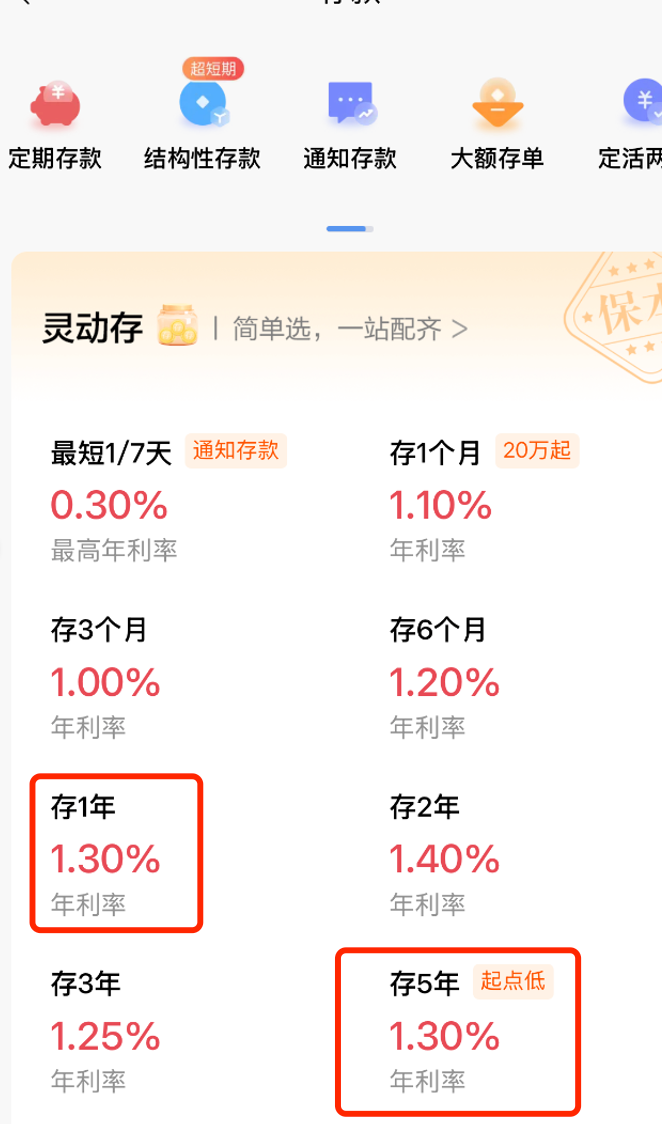
Core Viewpoint - The intention of banks to guide depositors towards "short-term" deposits remains clear, as they respond to the pressure of narrowing net interest margins through refined pricing strategies to reshape the deposit market landscape [1][7][9]. Summary by Sections Deposit Rate Trends - Several banks previously exhibited extreme inversion in deposit rates, where shorter-term deposits offered higher rates than longer-term ones. However, this phenomenon has diminished with the recent wave of deposit rate cuts [2][6]. - As of May 21, 2023, major banks like China Merchants Bank have aligned their one-year and five-year deposit rates at 1.30%, eliminating the extreme inversion [2][9]. - Despite the disappearance of extreme inversions in some banks, certain smaller banks still exhibit varying degrees of rate inversion, particularly in their short- to medium-term deposits [5][6]. Market Response and Future Expectations - Analysts suggest that the trend of "large banks leading, smaller banks following" in deposit rate cuts will continue, potentially leading to a gradual disappearance of existing rate inversions in smaller banks [6][7]. - The recent deposit rate cuts are expected to positively impact banks' net interest margins, as the reduction in deposit costs may exceed the decline in asset yields for the first time historically [11]. Current Deposit Rates - As of May 21, 2023, the deposit rates for major banks are as follows: - Industrial and Commercial Bank of China: 1-year at 0.95%, 5-year at 1.30% - China Merchants Bank: 1-year at 0.95%, 5-year at 1.30% - Other banks like CITIC Bank and Minsheng Bank have similar rates for various terms [8][9]. Implications for Banking Sector - The banking sector is facing significant pressure on net interest margins, with the first quarter of 2023 showing a decline in net interest margin to 1.43%, a historically low level [9]. - The ongoing trend of financial disintermediation is leading to a "liability shortage" for banks, compelling them to attract deposits through higher rates in interbank markets, which could counteract the benefits of lower deposit costs [11].

短端利率偏弱的状态如何破解
Xinda Securities· 2025-05-20 09:19
1. Report Industry Investment Rating - The report does not explicitly mention the industry investment rating. 2. Core Viewpoints of the Report - The attitude towards the bond market remains relatively positive. It is recommended to maintain a medium - to - high duration in the portfolio, appropriately increase leverage to boost short - bond holdings, and seize buying opportunities for long - end bonds during adjustments [3][49]. - Although short - term interest rates are currently weak, as technical factors wane and with the potential for deposit rate cuts and a stable monetary policy, short - and medium - term interest rates are expected to decline, which will support long - term bonds [2][3]. 3. Summary According to the Table of Contents 3.1 Constraints on Short - Term Interest Rates from Some Technical Factors May Weaken in the Future - The weak performance of the 2 - year Treasury bond futures (TS) has restricted short - term interest rates. After the basis repair, the IRR of the CTD bond of the TS2506 contract has dropped, reducing the suppression on futures prices and potentially boosting confidence in short - term bonds [7][12]. - The decline in the central bank's claims on the government in the balance sheet may be due to the maturity of short - term bonds previously purchased or the closing of the previous short - selling long - buying operation. Currently, the impact of this factor is gradually weakening, and large banks have resumed net buying of 1 - 3 - year Treasury bonds [12][15][16]. 3.2 In the Short Term, the Probability of the Funding Rate Remaining Loose but Lower than the Policy Rate is Low, but the Decline in Deposit Rates is Still Expected to Benefit the Short - End - After the RRR cut, the tightening of the funding market was a temporary shock. The average - method assessment of the RRR and the large - scale net payment of government bonds and net withdrawal of reverse repurchase and MLF were the main reasons [17][18][19]. - Although the excess reserve ratio in April was at a low level, the central bank may tolerate a decline in banks' net lending, indicating that it hopes to maintain a loose environment but may not want the funding rate to fall significantly below the policy rate. The decline in deposit rates is conducive to compressing short - and medium - term spreads [25][30]. 3.3 The Weakening of Economic Data in April Indicates Insufficient Demand, and the Fundamental Environment is Still Favorable for the Bond Market - In April, new credit and social financing were both lower than expected. New credit mainly came from government bond issuance, and the decline in new credit may be due to the lack of bank reserve projects after the early - year impulse [34][35][39]. - Despite the slowdown in credit growth, the M2 growth rate increased due to the rise in banks' net lending and bond investment. However, the M1 growth rate declined, indicating limited currency activation [39][42]. - In April, domestic demand declined. Retail sales, investment, and production all showed signs of weakness, indicating that the fundamental environment is favorable for the bond market [44][45][47]. 3.4 The Bond Market is Expected to Continue a Relatively Strong and Volatile Trend - Although the recent Sino - US negotiation has made progress, the impact of short - term export rush is short - term. External demand still faces uncertainties, and domestic demand is insufficient. - The monetary policy is expected to remain in a loose range. If the funding expectation stabilizes, short - and medium - term interest rates are expected to decline, which will support long - term bonds [49].
4月金融数据解读、银行投资框架及观点更新
2025-05-14 15:19
Summary of Key Points from the Conference Call Industry Overview - The conference call primarily discusses the banking sector and its financial performance in April 2025, focusing on social financing, credit data, and macroeconomic indicators [1][2][3]. Core Insights and Arguments - **Social Financing and Government Influence**: In April, the new social financing scale was 1.1 trillion yuan, with government bond issuance contributing significantly, indicating reliance on government leverage for financing [2]. Government financing accounted for over two-thirds of the total new financing, highlighting a dependency on state support [2]. - **Weak Credit Performance**: Credit data fell short of expectations, with both corporate and personal loans showing significant year-on-year declines. Short-term corporate loans and non-bank loans decreased, while medium to long-term corporate loans continued to decline, reflecting weak economic demand [3][5]. - **Consumer Loan Trends**: Residential short-term loans dropped by 400 billion yuan year-on-year, indicating weak consumer spending and cautious home-buying intentions despite historically low mortgage rates [5]. The correlation between residential loans and real estate sales remains strong, with a noted decline in both categories [5]. - **Monetary Policy Adjustments**: The central bank's recent interest rate cut of 10 basis points aims to stabilize long-term residential loans. However, there is a noted outflow of deposits from both residents and enterprises, which may affect future lending dynamics [6][7]. - **M2 Growth and Financial Disintermediation**: M2 growth increased from 7% to 8% in April, driven by non-bank deposits. The financial disintermediation process has slowed, with M1 growth indicating ongoing deflationary pressures [8][9]. - **Loan Rate Dynamics**: The new corporate loan rate decreased to 3.2%, while personal mortgage rates remained stable at 3.1%. There is an oversupply of corporate loans, while personal loan demand is balanced [10][11]. - **Future Trends in Financing and Credit Structure**: A downward trend in social financing and credit growth is expected, with a focus on government financing and efficiency in resource allocation to avoid idle capital [12]. Additional Important Insights - **Investment Logic for Banking Stocks**: The investment rationale for banking stocks is based on asset quality, interest rate risk, and funding support. The banking sector is seen as stable, with dividend yields ranging from 4% to 6%, making it attractive compared to other asset classes [13][14][20]. - **Profit Stability Amid Economic Challenges**: Despite economic downturns and narrowing interest margins, banks can maintain stable profits through diversified operations and effective credit cost management. The expected profit growth for banks is stable or slightly positive, with dividend yields remaining consistent [16][20]. - **Valuation of Chinese Banks**: Current valuations of Chinese banks are not considered high, reflecting expectations of future ROE declines. The A-share and Hong Kong bank valuations indicate a correlation with ROE, suggesting that current prices already account for negative outlooks [27]. - **Impact of Geopolitical Factors**: Tariff issues and geopolitical relations are significant variables affecting the future performance of Chinese banks, influencing interest rates, credit demand, and asset quality [28]. - **Market Sentiment Towards Strong Banks**: Traditional banks with strong operational capabilities, such as China Merchants Bank and Ningbo Bank, are viewed favorably, although external economic factors may negatively impact their stock performance [25]. This summary encapsulates the key points discussed in the conference call, providing insights into the banking sector's current state and future outlook.