社会融资规模

Search documents
宏观金融数据日报-20250915
Guo Mao Qi Huo· 2025-09-15 12:35
Group 1: Market and Liquidity - Interest Rates - DRO01 closed at 1.36 with a -0.60 bp change, DR007 at 1.46 with a -2.38 bp change [4] - GC001 closed at 1.37 with a 28.50 bp change, GC007 at 1.46 with a 4.50 bp change [4] - SHBOR 3M closed at 1.55 with no change, LPR 5 - year at 3.50 with no change [4] - 1 - year treasury closed at 1.40 with a 0.07 bp change, 5 - year at 1.61 with a -1.32 bp change [4] - 10 - year treasury closed at 1.86 with a -1.01 bp change, 10 - year US treasury at 4.06 with a 5.00 bp change [4] - Last week, the central bank conducted 1.2645 trillion yuan in reverse repurchase operations, with 1.0684 trillion yuan maturing, resulting in a net injection of 196.1 billion yuan [4] - This week, 1.2645 trillion yuan of reverse repurchases will mature, and 120 billion yuan of treasury cash fixed - deposits will mature on Monday [5] Group 2: Market and Liquidity - Stock Indexes - CSI 300 closed at 4522 with a -0.57% change, IF current month at 4523 with a -0.9% change [6] - SSE 50 closed at 2969 with a -0.49% change, IH current month at 2969 with a -0.7% change [6] - CSI 500 closed at 7148 with a 0.35% change, IC current month at 7140 with a 0.2% change [6] - CSI 1000 closed at 7423 with a 0.31% change, IM current month at 7393 with a 0.1% change [6] - Last week, CSI 300 rose 1.38% to 4522, SSE 50 rose 0.89% to 2968.5, CSI 500 rose 3.38% to 7147.7, and CSI 1000 rose 2.45% to 7422.9 [6] - Last week, in the Shenwan primary industry index, electronics (6.1%), real estate (6%), agriculture, forestry, animal husbandry and fishery (4.8%), media (4.3%), and non - ferrous metals (3.8%) led the gains, while only comprehensive (-1.4%), banking (-0.7%), pharmaceutical biology (-0.4%), and social services (-0.3%) declined [6] - Last week's A - share daily trading volumes were 2.2215 trillion yuan, 1.9424 trillion yuan, 1.8096 trillion yuan, 2.1904 trillion yuan, and 2.2681 trillion yuan, with the average daily trading volume decreasing by 247.39 billion yuan compared to the previous week [6] Group 3: Market and Liquidity - Futures Volume and Open Interest - IF trading volume was 148,623 with a -12.4% change, and open interest was 278,489 with a -1.3% change [6] - IH trading volume was 65,282 with a -8.0% change, and open interest was 100,041 with a -4.2% change [6] - IC trading volume was 175,859 with a -10.2% change, and open interest was 267,758 with a 0.5% change [6] - IM trading volume was 240,836 with a -24.3% change, and open interest was 372,165 with a -4.2% change [6] Group 4: Market and Liquidity - Futures Basis - IF basis for current month was -1.94%, next month was 1.22%, current quarter was 2.10%, and next quarter was 1.90% [8] - IH basis for current month was -0.15%, next month was -0.17%, current quarter was -0.11%, and next quarter was -0.23% [8] - IC basis for current month was 7.91%, next month was 9.06%, current quarter was 8.45%, and next quarter was 8.40% [8] - IM basis for current month was 29.59%, next month was 14.44%, current quarter was 12.77%, and next quarter was 11.82% [8] Group 5: Economic Data and Market Outlook - In August, the new social financing was 2.57 trillion yuan, a year - on - year decrease of 463 billion yuan, and the stock growth rate of social financing dropped to 8.8% [7] - Government bond net financing decreased by 251.9 billion yuan year - on - year, and corporate short - term loans increased by 260 billion yuan year - on - year [7] - Resident short - term loans only increased by 1.05 billion yuan, and M1 year - on - year growth rate rose slightly to 6% [7] - In the coming week, there will be many domestic and international macro events. The Fed will announce its September interest rate decision, and China - US leaders will have talks [7] - Last week, the stock index rose further, with CSI 500 leading the rise in index futures. Market trading volume decreased last week [7] - The strategy is to control risks in index futures positions and mainly adjust for long positions next week [7]
金融行业周报:央行发布8月社融数据,金融监管总局修订信托管理办法-20250915
Ping An Securities· 2025-09-15 09:02
Investment Rating - The industry investment rating is "Outperform the Market," indicating an expected performance of the industry index to exceed the CSI 300 index by more than 5% within the next six months [37]. Core Insights - The report highlights the release of August social financing data by the central bank, showing a decrease in new RMB loans and a year-on-year growth rate of 6.8%. The total social financing increment for August was 2.57 trillion RMB, which is 463 billion RMB less than the same period last year, with a year-on-year growth rate of 8.8% [4][13]. - The National Financial Regulatory Administration revised the "Trust Company Management Measures," focusing on three main business areas: trust business, inherent asset liability business, and other services, aiming to enhance risk management and compliance [5][15]. - The revised "Consumer Rights Protection Regulatory Evaluation Measures" aims to strengthen consumer rights protection in financial institutions, improve service quality, and promote healthy industry development [6][19]. Summary by Sections Social Financing Data - In August 2025, new RMB loans increased by 590 billion RMB, a year-on-year decrease of 310 billion RMB, with a total social financing increment of 2.57 trillion RMB, down 463 billion RMB from the previous year [4][13]. - The balance of RMB loans to the real economy increased by 623.3 billion RMB, with a year-on-year decrease of 417.8 billion RMB [4][14]. Trust Company Management Measures - The revised measures focus on three main areas: trust business, inherent asset liability business, and other services, with an emphasis on risk management and compliance [5][15]. - The revision aims to align with new regulations and enhance the quality of trust services [5][15]. Consumer Rights Protection Measures - The revised measures include a comprehensive evaluation system for financial institutions, emphasizing consumer rights protection and service transparency [6][19]. - The evaluation will cover various aspects, including marketing behavior, dispute resolution, and consumer education [20]. Industry Data - The banking sector saw a net injection of 196.1 billion RMB in open market operations, with SHIBOR rates rising [27]. - The securities sector reported an average daily trading volume of 3.04 trillion RMB, with a decrease of 4.5% from the previous week [30]. - The insurance sector noted a rise in the yield of ten-year government bonds by 4.10 basis points [33].
国贸期货期权日报-20250915
Guo Mao Qi Huo· 2025-09-15 08:35
1. Report Industry Investment Rating No relevant content provided. 2. Core View of the Report - This week, the commodity index fluctuated and declined slightly. Industrial and agricultural products both weakened. The weak fundamentals dragged down the overall commodity trend in the first half - week, while the market risk appetite improved in the second half - week, driving the commodities to rebound. The demand in the peak season was not strong, and the commodities were likely to fluctuate weakly. There were both bullish and bearish factors at the macro - level, and the demand had not improved significantly at the fundamental level [3]. 3. Summary by Related Catalogs PART ONE: Main Views - **Review**: The commodity index fluctuated and declined slightly this week. Industrial and agricultural products weakened. The weak fundamentals in the first half - week and the improved risk appetite in the second half - week due to Fed rate - cut expectations and A - share rebound affected the commodity trend [3]. - **Overseas**: - In August, US inflation met market expectations. The CPI increased year - on - year and month - on - month, mainly due to rising prices of food, energy, and housing. A 25BP rate cut in September was the benchmark scenario, and the inflation upside risk was controllable. The weak employment market might be the Fed's focus [3]. - In the first week of September, the seasonally - adjusted initial jobless claims in the US reached 263,000, an increase of 27,000 from the previous week, indicating a cooling labor market [3]. - The ECB maintained key interest rates unchanged on September 11, 2025. The policy signal was "hawkish". The market's expectation of another ECB rate cut this year dropped to about 15%. In the short - term, the ECB was likely to stay put, while in the long - term, its policy stance was uncertain [3]. - **Domestic**: - In August, the new social financing scale was 2.57 trillion yuan, less than the same period last year but slightly higher than expected. New loans were 590 billion yuan, less than last year and in line with expectations. The real - economy financing demand was weak, and government net financing might become a drag. The rebound of resident and enterprise credit demand was crucial [3]. - In August, China's imports and exports in US dollars were lower than expected. Export momentum might weaken marginally, but there were still supporting factors such as global economic recovery and strong exports to Africa [3]. - **Commodity View**: With the peak demand season not living up to expectations, commodities were likely to fluctuate weakly. There were both bullish and bearish factors at the macro - level, and the demand had not improved at the fundamental level [3]. PART TWO: Overseas Situation Analysis - **US Inflation and Employment**: In August, US CPI increased year - on - year to 2.9%. The seasonally - adjusted initial jobless claims in the first week of September increased significantly, and the labor market was cooling [3][7][10]. - **ECB Policy**: The ECB maintained key interest rates unchanged on September 11, 2025. The policy signal was "hawkish", and the market's expectation of another rate cut this year dropped to about 15%. The future policy stance was uncertain depending on inflation and economic recovery [3][13]. PART THREE: Domestic Situation Analysis - **Financial Data**: In August, new social financing and loans were lower than the same period last year. The real - economy financing demand was weak, and government net financing might affect future performance. The rebound of credit demand was key [3][17]. - **Foreign Trade Data**: In August, China's imports and exports in US dollars were lower than expected. Export momentum might weaken, but there were supporting factors [3][20]. PART FOUR: High - Frequency Data Tracking - **Industrial Data**: On September 5, the PTA operating rate was 78.28%, and the POY operating rate was 87.36%. In August and September, the operating rates of some industries showed certain changes [27][34]. - **Automobile Data**: In August and September, the sales of automobiles showed growth. For example, in August, the sales were 201.9 (units not specified), a 5.9% increase [34]. - **Agricultural Product Data**: On September 12, the price changes of some agricultural products were 0.75% and 0.14%, etc. [35].
一周流动性观察 | 税期+存单到期规模持续高位 央行或适当加大逆回购投放力度
Zhong Guo Jin Rong Xin Xi Wang· 2025-09-15 07:13
Group 1 - The People's Bank of China (PBOC) conducted a 280 billion yuan 7-day reverse repurchase operation on September 15, maintaining the operation rate at 1.40%, resulting in a net injection of 885 billion yuan after accounting for 191.5 billion yuan of reverse repos maturing on the same day [1] - Last week, the central bank's net reverse repo injection was 196.1 billion yuan, and it announced a 600 billion yuan 6-month buyout reverse repo operation on September 15, with a total net injection of 300 billion yuan for the month, consistent with the previous month [2][3] - The funding environment showed a tightening trend at the beginning of the week due to government debt payments and previous net withdrawals, with overnight rates rising above the central rate, but eased later in the week as the central bank shifted to net injections [1][2] Group 2 - The upcoming week (September 15-19) will see an increase in reverse repo maturities to 1,264.5 billion yuan, with a significant government debt net payment of 402.5 billion yuan, including a single-day net payment of 366 billion yuan on September 15 [2] - Analysts expect that the tax period will be a major influencing factor on the funding environment, but given the central bank's supportive stance, significant fluctuations in funding prices are unlikely, with DR001 expected to remain below 1.4% [2][3] - Financial data from the PBOC indicated that the total social financing stock at the end of August was 433.66 trillion yuan, with a year-on-year growth of 8.8%, and new loans primarily driven by corporate borrowing [3][4]
2025年8月金融数据点评:8月新增信贷恢复较大规模正增长,金融对实体经济支持力度较强
Dong Fang Jin Cheng· 2025-09-15 03:39
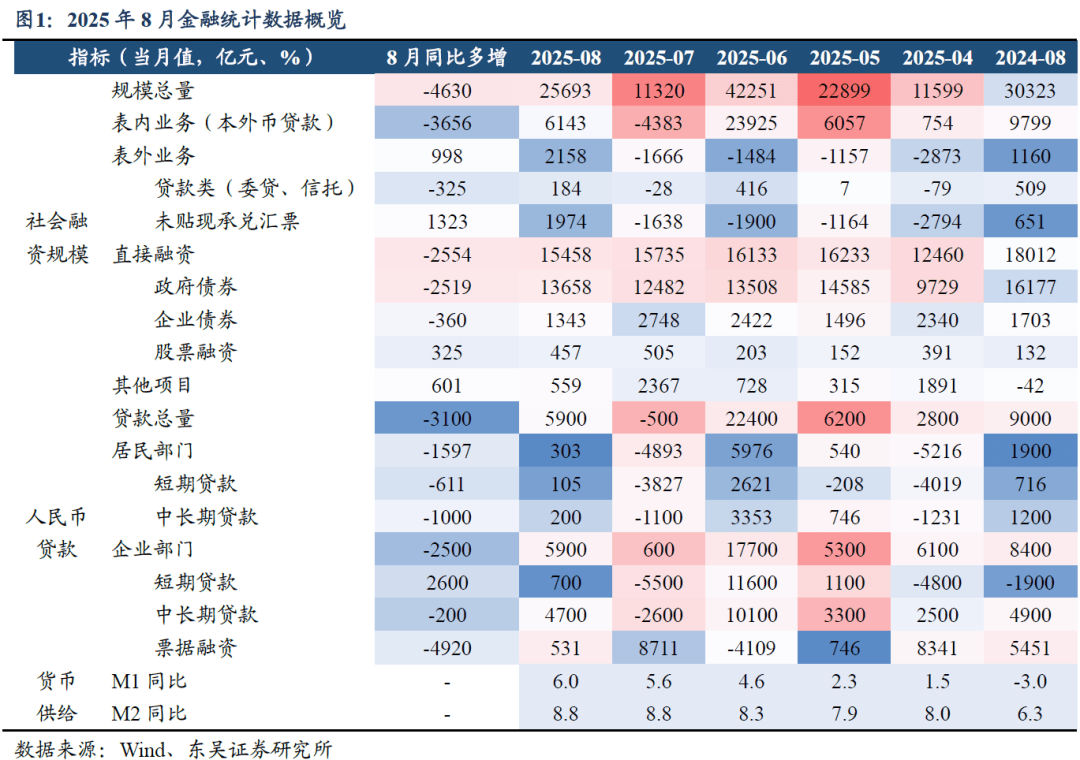
Group 1: Credit Growth and Economic Support - In August 2025, new RMB loans increased to 590 billion, a month-on-month increase of 640 billion, but a year-on-year decrease of 310 billion[1] - The total social financing (TSF) in August was 25,693 billion, a year-on-year decrease of 4,630 billion, marking the first year-on-year decline in 8 months[6] - M2 growth remained stable at 8.8% year-on-year, while M1 growth accelerated to 6.0%, up 0.4 percentage points from the previous month[7] Group 2: Factors Influencing Credit and Financing - The recovery in credit growth was supported by improved macroeconomic conditions, strong export resilience, and seasonal consumption peaks during summer[2] - The decline in year-on-year credit growth was primarily influenced by hidden debt replacement and external market fluctuations, alongside adjustments in the real estate market[2] - The structure of loans improved, with corporate short-term loans increasing by 260 billion, while long-term loans decreased by 200 billion year-on-year, indicating a marginal recovery in corporate credit demand[4] Group 3: Future Outlook and Monetary Policy - The current low inflation levels provide ample room for monetary policy to remain accommodative, with expectations for increased credit growth in the coming months[8] - The central bank is likely to continue implementing measures such as MLF and reverse repos to inject liquidity into the market, with potential interest rate cuts anticipated in the fourth quarter[8] - Overall, the banking system's liquidity is robust, with loan growth rates significantly outpacing nominal GDP growth, indicating strong support for the real economy[5]
8月M2突破331万亿 存款搬家提速
Bei Jing Shang Bao· 2025-09-14 16:44
Group 1 - The core viewpoint of the article highlights the overall stability and growth in China's financial metrics, with significant increases in social financing, broad money supply (M2), and RMB loans, indicating a favorable monetary environment for economic recovery [1][4]. - As of the end of August, the total social financing stock grew by 8.8% year-on-year, while M2 reached 331.98 trillion yuan, also reflecting an 8.8% increase [1][7]. - The increase in RMB loans was 6.8% year-on-year, with a total balance of 269.1 trillion yuan, showing a recovery in corporate and personal loan demand [2][3]. Group 2 - In August, RMB loans increased by 590 billion yuan, with a year-on-year decrease of 310 billion yuan but a month-on-month increase of 640 billion yuan, indicating a rebound in loan issuance [2][3]. - The rise in loan demand is attributed to improved economic conditions, seasonal consumption peaks, and supportive policies aimed at boosting consumer spending [2][3]. - Real estate policies in major cities like Beijing, Shanghai, and Shenzhen have been adjusted to stimulate housing demand, leading to a notable increase in mortgage loan inquiries and agreements [3][4]. Group 3 - The total social financing increment for the first eight months of 2025 was 26.56 trillion yuan, which is 4.66 trillion yuan more than the same period last year [4]. - In August, the new social financing was 2.57 trillion yuan, a year-on-year decrease of 463 billion yuan, primarily due to reduced RMB loans to the real economy and a high comparative base from the previous year [4][6]. - The issuance of special refinancing bonds has accelerated, providing significant funding support for addressing hidden local government debts, which is expected to enhance the efficiency of credit growth in the long term [5][6]. Group 4 - The broad money supply (M2) grew by 8.8% year-on-year, with a balance of 331.98 trillion yuan, while narrow money (M1) increased by 6% [7][8]. - The increase in M1 is influenced by a low comparative base from the previous year and the temporary boost from local government debt replacement [7][8]. - Experts predict that the People's Bank of China may implement further monetary easing measures, including potential interest rate cuts and reserve requirement ratio reductions, to support economic growth [8].
央行8月金融数据:社融增26.56万亿,M1增速回升
Sou Hu Cai Jing· 2025-09-14 14:20
Core Insights - The People's Bank of China released financial statistics for August 2025, indicating a cumulative social financing scale increase of 26.56 trillion yuan in the first eight months, which is 4.66 trillion yuan more than the same period last year [1] - As of the end of August, the M2 balance was 331.98 trillion yuan, showing a year-on-year growth of 8.8%, while the M1 balance was 111.23 trillion yuan, with a year-on-year increase of 6% [1] - The growth rate of RMB loans was 7.1% year-on-year, and deposit balances increased by 8.6% year-on-year [1] Financial Metrics - M1 growth accelerated to 6% from 5.6%, while M2 growth remained stable at 8.8%, indicating increased liquidity in corporate funds [1] - The M2-M1 spread narrowed to 2.8%, reflecting a recovery in corporate demand for current deposits and enhanced fund turnover [1] - The growth rate of social financing stock was slightly lower at 8.8%, with government bonds comprising a higher proportion than corporate bonds, indicating weak medium to long-term financing demand from enterprises [1] Economic Outlook - Financial data showed signs of recovery in August, with M1 rising to 6% and M2 maintaining at 8.8%, suggesting enhanced consumption and investment willingness [1] - Despite weak medium to long-term loans for households, improved real estate policies and fiscal measures are expected to support a weak recovery phase in the economy [1] - Government net financing reached 10.27 trillion yuan, increasing by over 4.63 trillion yuan year-on-year, creating supply pressure in the market [1] Risks and Challenges - Financial data may experience short-term fluctuations and face risks from rapid increases in upstream prices [1]
8月信贷数据环比明显改善 金融对实体经济支持力度较强
Zhong Guo Jing Ying Bao· 2025-09-14 10:09
Core Insights - The growth rates of key indicators such as social financing scale and broad money (M2) reflect the funding supply and demand situation in the real economy [1] - In August, new RMB loans increased by 590 billion yuan, a year-on-year decrease of 310 billion yuan, while social financing increased by 2.57 trillion yuan, a year-on-year decrease of 463 billion yuan [1][2] - The M2 balance at the end of August grew by 8.8% year-on-year, maintaining the same growth rate as the previous month and 2.5 percentage points higher than the same period last year [1] Financing and Lending Trends - The increase in household loans in August was 30.3 billion yuan, with a significant month-on-month increase of 519.6 billion yuan, driven by traditional summer consumption and government subsidies [2] - The demand for consumer loans was boosted by the issuance of subsidies for replacing old consumer goods [2] Future Outlook - The fourth quarter is crucial for achieving the annual and "14th Five-Year" economic goals, with expectations for new policies in infrastructure and real estate to stimulate financial data [2] - The central bank is anticipated to continue implementing medium-term lending facilities (MLF) and reverse repos to inject liquidity into the market, with potential interest rate cuts and reserve requirement ratio reductions expected in the fourth quarter [2][3]
2025年8月份金融数据点评:社融遇拐点,货币见活化
EBSCN· 2025-09-14 08:20
Investment Rating - The report maintains a "Buy" rating for the banking industry, indicating an expected investment return exceeding 15% over the next 6-12 months compared to the market benchmark index [1][48]. Core Insights - The financial data for August 2025 shows a seasonal rebound in loan issuance, but the year-on-year increase is lower, highlighting ongoing demand issues that need to be addressed [5][6]. - The total new social financing in August 2025 was 2.57 trillion yuan, a year-on-year decrease of 463 billion yuan, with a growth rate of 8.8%, down 0.2 percentage points from July [33][36]. - The report emphasizes the need for effective demand stimulation and the potential for policy tools to support credit expansion in the future [6][27]. Summary by Sections Loan Issuance - In August, new RMB loans amounted to 590 billion yuan, a year-on-year decrease of 310 billion yuan, with a growth rate of 6.8%, slightly down from the previous month [5][28]. - Cumulative new RMB loans from January to August totaled 13.5 trillion yuan, a year-on-year decrease of 970 billion yuan [5][6]. Social Financing - The report notes that the August social financing growth rate is expected to decline further in the coming months due to high base effects and a slowdown in government bond issuance [33][36]. - The breakdown of August's social financing shows that new RMB loans contributed 623.3 billion yuan, while government bonds accounted for 13.658 trillion yuan, representing 53% of the total financing increase [36][39]. Monetary Indicators - M2 growth remained stable at 8.8% year-on-year, while M1 growth was recorded at 6%, indicating an improvement in monetary activation [37][38]. - The report highlights a notable shift in deposit patterns, with a decrease in resident deposits and an increase in non-bank deposits, reflecting changing market dynamics [39][40]. Credit Market Dynamics - The weighted average interest rate for new corporate loans was 3.1%, down 10 basis points from July, indicating a stable pricing environment for loans [20][29]. - The report discusses the seasonal rebound in corporate medium to long-term loans, which totaled 4.7 trillion yuan in August, although this was still below the average for the same period in previous years [18][24].
芦哲:M2增速或见顶——2025年8月金融数据点评
Sou Hu Cai Jing· 2025-09-14 08:07
Core Viewpoint - In August 2025, the People's Bank of China reported a new social financing scale of 2.57 trillion yuan, a year-on-year decrease of 463 billion yuan, with the total social financing stock growth rate falling to 8.8% [1][2] Social Financing - The new social financing in August 2025 was 2.57 trillion yuan, which is 463 billion yuan less than the same month last year, marking a decline in growth rate [1] - Government bond financing in August was 1.37 trillion yuan, down 251.9 billion yuan year-on-year, indicating a seasonal decrease in government bond issuance [5] - The total amount of new loans from financial institutions was 590 billion yuan, a decrease of 310 billion yuan year-on-year, reflecting weak effective demand [4][6] Loan Issuance - The new RMB loans in August amounted to 590 billion yuan, which is 310 billion yuan less than the previous year, with a year-on-year growth rate of 6.80% [4][6] - Short-term loans for enterprises increased by 700 billion yuan, showing a recovery in short-term financing demand [6] - The issuance of corporate bonds was 1.34 trillion yuan, down 360 billion yuan year-on-year, while stock financing increased by 457 billion yuan, indicating a rise in market activity [4][5] Monetary Supply - As of the end of August 2025, M2 growth rate remained stable at 8.8%, while M1 grew by 6.0%, reflecting a narrowing gap between M2 and M1 [2][7] - The total new RMB deposits in August were 2.06 trillion yuan, a decrease of 1.6 trillion yuan year-on-year, with significant shifts in deposit structures [2][7] - The government bond financing is a key factor in maintaining the synchronization of M2 and social financing growth rates, but a slowdown in government bond issuance may lead to a peak in M2 growth [7][8] Financial Data Outlook - The next four months may see an improvement in direct financing due to an active stock market, with policies aimed at boosting consumer loans and corporate financing potentially leading to a seasonal increase in loan financing [8]