
通胀

Search documents
春节假期持仓报告
Yin He Qi Huo· 2026-02-12 07:58
1. Report Industry Investment Rating No relevant content provided. 2. Core Views of the Report - The stock index is expected to continue its slow - bull market. Factors such as policy support, stable market funds, and improving economic data create favorable conditions for the market. After the Spring Festival, the market is likely to perform well, especially for small - and medium - cap stocks and the ChiNext and STAR Market indices [11][12]. - The sentiment in the bond market may turn cautious after the Spring Festival. Although the central bank's monetary policy remains moderately loose, factors such as the approaching important meetings and the possible reversal of some investors' behaviors may lead to a more cautious attitude [14]. - In the agricultural and sideline products sector, different products have different trends. For example, soybean meal is expected to gradually reduce inventory, while the price of live pigs is likely to remain low. Corn and starch are expected to fluctuate at high levels, and the price of sugar is expected to be weak [18][22][25]. - In the ferrous metals sector, steel prices may face pressure after the Spring Festival. The supply - demand structure of steel is weakening, and factors such as iron - water production, inventory accumulation, and coal mine resumption need to be monitored. The coking coal and coke market is affected by factors such as coal mine shutdowns and international coal market changes, with prices showing wide - range fluctuations. Iron ore prices are expected to be weak due to the weakening fundamentals [42][44][47]. - In the non - ferrous metals sector, precious metals such as gold and silver are expected to maintain a cautious and optimistic trend. Copper prices are expected to be in a high - level consolidation in the short term but have a long - term upward trend. Aluminum prices are expected to fluctuate in the short term and may rise if the Mozal aluminum plant's production reduction plan is implemented [52][56][58]. - In the shipping innovation sector, the container shipping market has a weakening price increase expectation in March and will enter the off - season after the Spring Festival. Attention should be paid to factors such as shipping capacity deployment, geopolitical situations, and the implementation of price increase announcements [83]. - In the energy and chemical sector, crude oil prices are mainly driven by geopolitical factors in the short term, with a wide - range fluctuation. LPG prices are supported by high international costs in the short term but are restricted by weak domestic supply and demand in the long term. Other chemical products such as asphalt, natural gas, and fuel oil also have their own supply - demand and price characteristics [88][90][96]. 3. Summary by Directory 3.1 Macro Finance 3.1.1 Stock Index - **Analysis**: Policy guidance consolidates the stable and positive trend. Market risk appetite has decreased, and the enthusiasm for A - share investment has cooled, laying the foundation for a slow - bull market. Economic data is improving, which is beneficial to the performance of listed companies. After the Spring Festival, the market is likely to perform well, especially for small - and medium - cap stocks and the ChiNext and STAR Market indices. The futures market has already reduced positions in advance, and if the market improves after the Spring Festival, the basis discount may further narrow [12]. - **Trading Strategy**: Unilateral trading should be to go long on dips; for arbitrage, consider the spot - futures arbitrage of IM/IC long 2609 + short ETF; for options, use the bull spread strategy [13]. 3.1.2 Treasury Bonds - **Analysis**: The central bank's monetary policy remains moderately loose. Although inflation indicators are recovering, the impact on the bond market is limited. The market risk appetite has stabilized, but the bond market sentiment is still affected by the Spring Festival holiday. In the short term, the probability of a policy interest rate cut is low, and the bond market sentiment may turn cautious after the Spring Festival [14]. - **Trading Strategy**: Unilateral trading should be to try to short TS contracts on rallies; for arbitrage, pay attention to the phased long - T - contract inter - delivery spread trading [15]. 3.2 Agricultural and Sideline Products 3.2.1 Soybean Meal - **Analysis**: The international soybean market is strong, but the upside space is limited. The domestic soybean supply is sufficient, and the soybean meal inventory is expected to gradually decrease [18][19]. - **Trading Strategy**: It is recommended to wait and see for unilateral trading and arbitrage; for options, use the short strangle strategy [20]. 3.2.2 Live Pigs - **Analysis**: The supply pressure of live pigs is obvious, and the price is at a low level. The futures price mainly follows the spot price, and the downward space is limited [22]. - **Trading Strategy**: It is recommended to wait and see for unilateral trading and arbitrage; for options, use the short strangle strategy [23]. 3.2.3 Corn - **Analysis**: The US corn production is stable, and the import profit is high. After the Spring Festival, the supply of corn in Northeast China will increase, and the price may decline slightly. The starch price is expected to be relatively strong [25]. - **Trading Strategy**: For unilateral trading, try to buy US corn 03 below 420 cents/bu and short 03 corn on rallies; for arbitrage, widen the spread between 05 corn and starch on dips; for options, use the bear put spread strategy for 03 corn [26]. 3.2.4 Peanuts - **Analysis**: The peanut price is stable before the Spring Festival, and the 05 contract is expected to oscillate at the bottom [27]. - **Trading Strategy**: For unilateral trading, take a short - long position on dips for the 05 contract; for arbitrage, wait and see; for options, try to sell the pk603 - C - 8200 option [28]. 3.2.5 Sugar - **Analysis**: The international sugar price is expected to be weak, and the domestic sugar price is likely to follow the weak trend [29]. - **Trading Strategy**: For unilateral trading, use the high - short and low - cover strategy for the domestic Zhengzhou sugar 5 - month contract; for arbitrage, wait and see; for options, sell call options [30]. 3.2.6 Cotton - **Analysis**: The cotton price is supported, and the Zhengzhou cotton is expected to oscillate slightly stronger in the short term [31]. - **Trading Strategy**: For unilateral trading, the US cotton is expected to oscillate in a range, and the Zhengzhou cotton is expected to be slightly stronger. It is recommended to hold a light position during the Spring Festival; for arbitrage and options, wait and see [32]. 3.2.7 Eggs - **Analysis**: The egg demand is average, and the price is stable with a slight decline. It is recommended to short the 6 - month contract on rallies [33]. - **Trading Strategy**: For unilateral trading, short the 6 - month contract on rallies; for arbitrage and options, wait and see [34]. 3.2.8 Apples - **Analysis**: The apple inventory is low, and the cost of warehouse receipts is high. The price of the 5 - month contract is expected to be strong in the short term [35]. - **Trading Strategy**: For unilateral trading, go long on the 5 - month contract on dips and short the 10 - month contract on rallies; for arbitrage, go long on the 5 - month contract and short the 10 - month contract; for options, wait and see [36]. 3.2.9 Oils and Fats - **Analysis**: The palm oil inventory in Malaysia is at a high level, but the total inventory of Malaysia and Indonesia is not loose. The US biodiesel demand is expected to be good, which is beneficial to soybean oil. The domestic soybean oil inventory is gradually decreasing, and the supply is generally sufficient. The policy of Canadian rapeseed is uncertain, and the domestic rapeseed oil inventory is slightly decreasing [37]. - **Trading Strategy**: For unilateral trading, hold a light position during the holiday; for arbitrage, conduct P59 and Y59 reverse arbitrage; for options, wait and see [38]. 3.3 Ferrous Metals 3.3.1 Steel - **Analysis**: After the Spring Festival, steel mills may resume production, and the steel supply will increase. The demand is in the off - season, and the inventory is accumulating. The supply - demand structure is weakening, and the steel price may face pressure. However, the steel price valuation is low, and the decline is limited [42]. - **Trading Strategy**: For unilateral trading, the price is expected to be weak and oscillating; for arbitrage, short the hot - rolled coil - rebar spread and the rebar - coking coal ratio on rallies; for options, wait and see [43]. 3.3.2 Coking Coal and Coke - **Analysis**: Coal mines are on holiday during the Spring Festival, and the supply is reduced. The impact of the Spring Festival holiday on the Mongolian coal port is limited. The domestic coal market is affected by international and domestic factors, and the price is expected to fluctuate widely. The coking coal valuation is not high, and it is recommended to go long on dips [44][45]. - **Trading Strategy**: For unilateral trading, conduct band trading; for arbitrage, wait and see; for options, sell out - of - the - money put options [46]. 3.3.3 Iron Ore - **Analysis**: The iron ore supply is increasing, and the demand is weak. The fundamentals are weakening, and the price is expected to be weak after the Spring Festival [47]. - **Trading Strategy**: For unilateral trading, hold a small number of short positions; for arbitrage, wait and see; for options, sell out - of - the - money call options [48]. 3.3.4 Ferroalloys - **Analysis**: The supply and demand of ferrosilicon and ferromanganese are relatively stable, and the cost support is strong. It is recommended to take partial profit on long positions before the long holiday [49]. - **Trading Strategy**: For unilateral trading, take partial profit on long positions before the long holiday and go long on dips after the holiday; for arbitrage, wait and see; for options, sell put options [50]. 3.4 Non - Ferrous Metals 3.4.1 Gold and Silver - **Analysis**: The gold and silver market has stabilized and recovered after the adjustment. The trading mainline is expected to return to factors such as great - power games and the US interest - rate cycle. It is recommended to control risks during the holiday [52]. - **Trading Strategy**: For unilateral trading, conservative investors can exit long positions on rallies, and aggressive investors can hold long positions based on the 20 - day moving average with a light position. It is recommended to hold an empty position for silver; for arbitrage, wait and see; for options, switch futures long positions to buy out - of - the - money call options for gold, and use the bull call spread strategy for silver [53]. 3.4.2 Platinum and Palladium - **Analysis**: The non - farm payroll data is contradictory, and the asset volatility is high. Platinum is in a tight - balance pattern, and palladium is in a supply - surplus pattern. Platinum has a stronger upward driving force [54]. - **Trading Strategy**: For unilateral trading, be cautiously bullish and buy on dips; for arbitrage, go long on platinum and short on palladium; for options, wait and see [55]. 3.4.3 Copper - **Analysis**: The copper price has fluctuated sharply recently. After the adjustment, the fundamentals are healthier, and the long - term upward trend remains unchanged. It is recommended to control positions during the Spring Festival [56]. - **Trading Strategy**: For unilateral trading, the price is in a high - level consolidation, and it is recommended to control positions; for arbitrage, wait and see; for options, sell out - of - the - money put options [57]. 3.4.4 Aluminum - **Analysis**: The macro - economic expectations are volatile. If the Mozal aluminum plant reduces production as planned, the aluminum price will be strong; otherwise, the upward momentum will be weakened. The domestic inventory is accumulating, which suppresses the price [58]. - **Trading Strategy**: In the short term, the Shanghai aluminum is expected to oscillate between 22,800 - 24,200 yuan. In the long term, if the production - reduction plan is implemented, be bullish on dips; pay attention to the implementation of the production - reduction plan [59]. 3.4.5 Alumina - **Analysis**: The alumina supply is uncertain during the holiday. If the production reduction continues, the futures price may fluctuate; otherwise, it will be under pressure [60]. - **Trading Strategy**: In the short term, the main contract is expected to oscillate between 2,780 - 2,880 yuan. It is recommended to be cautious. If there are expectations for policies, buy a small number of call options. In the long term, be bearish on rallies in the surplus pattern; if the supply - demand situation improves, the price may rebound [61]. 3.4.6 Zinc - **Analysis**: The zinc concentrate supply shortage is expected to ease. The refined zinc production is expected to decrease. The downstream demand is affected by the Spring Festival holiday. It is recommended to control positions and hedge inventory [62]. - **Trading Strategy**: For unilateral trading, control positions and hold a light position during the holiday; for arbitrage, buy LME and sell SHFE; for options, buy one - times out - of - the - money put options and two - times out - of - the - money call options [63]. 3.4.7 Lead - **Analysis**: The lead concentrate supply is in short supply, and the production of primary lead is profitable, but the production increase is limited. The production of recycled lead is affected by losses and holidays. The downstream demand is weak. It is recommended to wait and see and control positions [66]. - **Trading Strategy**: For unilateral trading, wait and see; for arbitrage, wait and see; for options, sell out - of - the - money put options [66]. 3.4.8 Nickel - **Analysis**: Geopolitical conflicts and inflation expectations drive the inflow of funds into the non - ferrous metal sector. The nickel supply is expected to be in surplus without quota restrictions, but there may be a shortage if the quota is limited. The nickel price is supported by cost and strategic demand. It is recommended to hold a light long position during the holiday [67][68]. - **Trading Strategy**: For unilateral trading, hold a light long position based on the 5 - day moving average; for arbitrage, wait and see; for options, sell the put option of the NI2604 contract with an exercise price of 134,000 [68]. 3.4.9 Stainless Steel - **Analysis**: The stainless - steel cost is rising, and the inventory is increasing. The price is affected by nickel and the macro - economic environment. It is recommended to hold a light long position during the holiday [69]. - **Trading Strategy**: For unilateral trading, hold a light long position based on the 5 - day moving average; for arbitrage, wait and see [70]. 3.4.10 Polysilicon - **Analysis**: The polysilicon spot price is under pressure, and the market is in a state of disorderly fluctuation before the Spring Festival. After the Spring Festival, if the price drops to the previous low, it can be considered to go long or buy call options [71]. - **Trading Strategy**: For unilateral trading, wait and see and look for a good safety margin; for arbitrage, there is no opportunity; for options, buy call options when appropriate [72]. 3.4.11 Industrial Silicon - **Analysis**: The industrial - silicon production is reducing, and the basis is high. The futures price is expected to oscillate between 8,200 - 9,100 yuan. It is recommended to wait for the price to stabilize [73]. - **Trading Strategy**: For unilateral trading, wait for the price to stabilize; for arbitrage, there is no opportunity; for options, there is no opportunity [73]. 3.4.12 Lithium Carbonate - **Analysis**: The lithium - carbonate demand is improving, and the supply will increase in March, resulting in inventory accumulation. However, the market tolerance for inventory is high, and the industry trend is positive. It is recommended to hold a light long position during the holiday [74]. - **Trading Strategy**: For unilateral trading, hold a light long position based on the 5 - day moving average; for arbitrage, wait and see; for options, sell the put option of the lc2605 contract with an exercise price of 140,000 [75]. 3.4.13 Tin - **Analysis**: The tin price is relatively resilient. The tin - ore import is stable, and the production is expected to change slightly. The inventory is decreasing, and the demand is recovering marginally. It is recommended to control positions before the holiday [77][78]. - **Trading Strategy**: For unilateral trading, control positions before the holiday; for arbitrage, wait and see; for options, wait and see [79]. 3.5 Shipping Innovation 3.5.1 Container Shipping - **Analysis**: The price increase expectation in March is weakening, and the market will enter the off - season after the Spring Festival. The freight rate is under pressure, and the supply and demand are affected by factors such as shipping capacity deployment and geopolitical situations [83]. - **Trading Strategy**: For unilateral trading, wait and see before the holiday; for arbitrage, conduct 6 - 10 positive arbitrage rolling operations [84].
美联储施密德:通胀仍高 利率需保持“限制性水平”
Sou Hu Cai Jing· 2026-02-12 06:53
转自:金十数据 堪萨斯联储主席施密德表示,美联储应将利率维持在"一定程度的限制性"水平。他对依然过高的通胀持 续表达担忧。 "在我看来,进一步降息可能会让高通胀持续更久,"施密德周三在新墨西哥州阿尔伯克基一场活动的演 讲中表示。 他补充说,利率仍应对经济构成一定压力,但目前的情况可能并非如此。 "经济增长展现出动能,通胀依然过热,我没有看到太多经济受到抑制的迹象,"施密德说。 继2025年连续三次降息之后,美联储官员上月维持利率不变,施密德表示支持这一决定。目前联邦基金 利率目标区间为3.5%至3.75%,处于或接近多位官员估算的中性水平——即利率既不对经济构成压力也 不刺激经济。 施密德表示,持续的价格压力表明,经济大部分领域的需求超过供给。虽然人工智能等新创新技术最终 可能推动生产率增长,使经济在不推高通胀的情况下扩张,但"我们还没到那一步,"他说。 施密德发表讲话前不久,政府数据显示美国1月非农就业人数创下逾一年最大增幅,失业率意外降至 4.3%。 这位堪萨斯城联储主席承认2025年经济增长强劲,并表示美国经济正以"相当大的动能"进入2026年。 周三晚些时候,克利夫兰联储主席哈玛克表示,劳动力市场似乎 ...
澳洲联储主席警告:通胀高企不可接受 必要时将再次加息
智通财经网· 2026-02-12 06:43
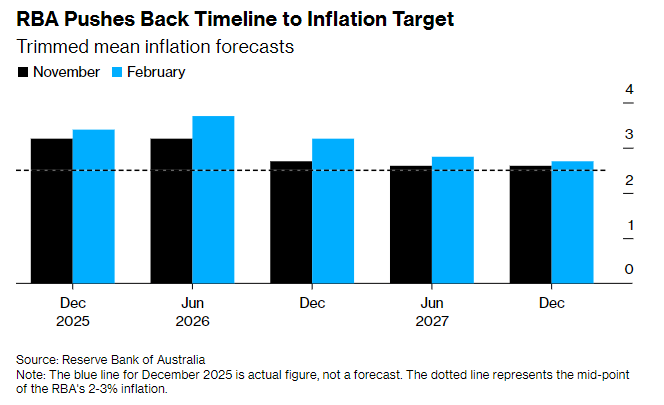
Core Viewpoint - The Reserve Bank of Australia (RBA) is prepared to raise interest rates again if inflation remains stubbornly high, with a cautious approach to further tightening of monetary policy emphasized by Governor Michele Bullock [1][4]. Group 1: Inflation and Monetary Policy - The RBA has become the first major central bank to raise interest rates this year, with expectations of at least one more increase in the coming months as inflation is projected to exceed the target range of 2%-3% [1][4]. - Bullock stated that an inflation rate above 3% is unacceptable, aligning with Deputy Governor Andrew Hagger's warning about the current high inflation levels being a significant challenge for the monetary policy committee [1][4]. - The next RBA meeting is scheduled for mid-March, where decision-makers will review employment and inflation data, along with GDP data for Q4 2025, which is expected to show a resilient Australian economy [4]. Group 2: Economic Challenges - The RBA's recent rate hike marks a sharp policy shift from six months ago when the bank was cutting rates, highlighting structural economic challenges faced by Australia, particularly low productivity growth [4]. - Bullock indicated that without improvements in productivity, maintaining a growth rate above 2% without triggering inflation will be difficult [4]. Group 3: Labor Market and Employment - Despite ongoing inflation control challenges, the unemployment rate remains historically low at 4.1% as of December, with the estimated non-accelerating inflation rate of unemployment (NAIRU) at 4.6% [5]. - Assistant Governor Sarah Hunter emphasized the importance of evaluating economic capacity pressures and labor market conditions to determine whether the recent inflation rise is temporary or a trend [5]. Group 4: Government Spending and Political Sensitivity - Bullock expressed frustration during the hearing regarding media criticism of the RBA's reluctance to attribute government spending to inflationary pressures, highlighting the political sensitivity surrounding fiscal policy [5][6]. - While acknowledging the impact of government spending on the economy, Bullock avoided direct criticism of fiscal policy, stating that public consumption increases total demand but is viewed as a "given condition" by the RBA [5].

美国2026年1月非农数据:教育医疗支撑美国就业市场保持强劲
Donghai Securities· 2026-02-12 05:34
Employment Data - In January 2026, the U.S. added 130,000 non-farm jobs, significantly exceeding the forecast of 70,000 jobs, with the previous month's figure revised down to 48,000 from 50,000[2] - The unemployment rate fell to 4.3%, better than the expected 4.4% and down from the previous 4.4%[2] - Private sector employment increased by 172,000 jobs, with the production sector adding 36,000 jobs and the service sector contributing 136,000 jobs[2] Wage Growth and Inflation Concerns - Average hourly earnings in the private sector rose by 0.4% month-over-month, up from 0.1% in the previous month, raising concerns about inflation driven by wage growth[2] - The significant increase in wages, particularly in cyclical industries like transportation and finance, is attributed to labor shortages caused by adverse weather conditions[2] Sector-Specific Insights - The construction sector saw a rebound with 33,000 new jobs, primarily due to preemptive hiring, although wage growth in this sector slowed from 0.4% to 0.2%[2] - The healthcare and education sectors added 137,000 jobs, largely influenced by the extension of the Affordable Care Act, while financial activities and leisure sectors faced declines[2] Government Employment Trends - Government employment decreased by 42,000 jobs, with federal jobs down by 34,000 and state jobs down by 18,000, likely due to a temporary government shutdown affecting payroll reporting[2] Market Reactions and Economic Outlook - Following the employment data release, markets expect the Federal Reserve to delay interest rate cuts until July, indicating a tightening labor market[2] - The U.S. economy is projected to continue its recovery, but inflation risks remain, particularly due to wage pressures in the labor market[3]
有色板块回暖,中证500领涨
Hua Tai Qi Huo· 2026-02-12 05:02
1. Report Industry Investment Rating - No information provided 2. Core Viewpoints of the Report - The non - ferrous metals sector has recovered. If the non - ferrous metals sector stabilizes and rebounds, it will drive the CSI 500 index to rise further, and its sustainability should be monitored [3]. - Before the holiday, trading tends to be cautious, and the market is expected to maintain a pattern of volume - shrinking repair [3]. 3. Summary by Relevant Catalogs 3.1 Macro Economy - In January, China's CPI rose 0.2% month - on - month and 0.2% year - on - year, with the core CPI up 0.8% year - on - year; PPI rose 0.4% month - on - month, rising for four consecutive months, with the year - on - year decline narrowing by 0.5 percentage points to 1.4% [1]. - In the US in January, the non - farm payrolls increased by 130,000, far exceeding the market expectation of 70,000. The unemployment rate was 4.3%, the lowest since August 2025, and the hourly wage increased by 0.4% month - on - month. However, job growth was concentrated in a few industries, with the healthcare sector adding 124,000 jobs [1]. 3.2 Spot Market - A - share major indices fluctuated. The Shanghai Composite Index rose 0.09% to close at 4131.98 points, and the ChiNext Index fell 1.08%. Sector indices showed mixed performance. Building materials, non - ferrous metals, and petroleum and petrochemical industries led the gains, while communication, media, and social services industries led the losses. The trading volume of the Shanghai and Shenzhen stock markets was less than 2 trillion yuan [2][13]. - Overseas, the three major US stock indices closed slightly lower, with the Nasdaq down 0.16% at 23066.47 points [2]. 3.3 Futures Market - In the futures market, the basis of IC and IM rebounded, with near - month contracts at a premium. In terms of trading volume and open interest, the trading volume and open interest of IH and IM increased simultaneously [2][14]. - The trading volume of IF was 62,400, a decrease of 2,853; the open interest was 281,980, a decrease of 464. The trading volume of IH was 30,833, an increase of 1,354; the open interest was 101,315, an increase of 254. The trading volume of IC was 101,790, an increase of 7,140; the open interest was 294,295, a decrease of 1,888. The trading volume of IM was 133,571, an increase of 401; the open interest was 380,005, an increase of 1,372 [14]. - For the basis of futures contracts: for IF, the basis of the current - month contract was 2.38, a decrease of 1.52; for IH, it was 3.14, a decrease of 2.25; for IC, it was 16.59, an increase of 14.03; for IM, it was 20.69, an increase of 16.39 [41]. - For the inter - delivery spread of futures contracts: for the spread between the next - month and the current - month contracts, the spread of IF was - 1.40, an increase of 2.80; the spread of IH was - 0.20, a decrease of 1.00; the spread of IC was - 6.00, an increase of 12.20; the spread of IM was - 19.20, an increase of 6.40 [45].
1月非农超预期,国债期货大多收涨
Hua Tai Qi Huo· 2026-02-12 05:01
国债期货日报 | 2026-02-12 1月非农超预期,国债期货大多收涨 市场分析 宏观面:(1)宏观政策: 12月8日政治局会议明确实施更加积极的财政政策和适度宽松的货币政策,释放宽货币 信号;中央经济工作会议提出,2026年财政政策方面继续实施更加积极的财政政策,货币方面继续实施适度宽松 的货币政策,灵活高效运用降准、降息及结构性政策工具,为"十五五"良好开局提供稳定的宏观政策环境;2026 年1月19日起,下调再贷款、再贴现等一篮子利率0.25个百分点,同时今年还存在继续降准降息的空间。(2)通胀: 1月CPI同比上升0.2%。 财政:(3)财政:2025年全年财政收支整体未达预期,收入受税收走弱与非税高基数拖累,全年一般公共预算收 入同比下降1.7%;支出节奏前置,年末力度减弱,全年完成度偏低。结构上呈现分化特征,民生支出总体稳定, 基建类支出占比下降,土地财政收入持续疲软。展望2026年,财政政策预计延续积极,强调"总量增加、结构更优", 支出力度有望加强,节奏继续前置,对稳增长形成支撑。(4)金融:2025年前12个月份社会融资规模增量累计为 35.6万亿元,比去年同期3.34万亿:12月末,M2 ...
1月CPI、PPI传递新信号
Jing Ji Guan Cha Wang· 2026-02-12 04:51
2026年1月份,CPI同比增长0.2%,核心CPI保持温和上涨;PPI同比下降1.4%,降幅比上月收窄0.5个百 分点,PPI环比继续上涨。 2月11日,国家统计局公布2026年1月份CPI和PPI数据。1月份,居民消费需求持续恢复,居民消费价格 指数(CPI)环比上涨0.2%,同比上涨0.2%,扣除食品和能源价格的核心CPI同比上涨0.8%。受全国统 一大市场建设持续推进、部分行业需求增加及国际大宗商品价格传导等因素影响,工业生产者出厂价格 指数(PPI)环比上涨0.4%,同比下降1.4%。 核心CPI保持温和上涨 2026年1月,CPI同比增长0.2%,较前月下降0.6个百分点,居民消费价格增速小幅下行。不过,1月份核 心CPI温和上涨的态势没有改变。 国联民生(601456)首席经济学家陶川表示,核心CPI已经萌生出通胀"开门红"迹象。2026年1月核心 CPI环比上涨0.3%,创近6个月新高,其结构性走强印证年初居民消费需求逐步改善,为后续通胀温和 修复提供重要支撑。一方面,开年促消费政策效果持续显现,家用器具、日用杂品等价格延续上行,商 品消费稳步修复;另一方面,节前出行、文娱等服务需求逐步释放, ...
黄金与利率“脱钩”之谜:顽固通胀颠覆市场逻辑?
Jin Shi Shu Ju· 2026-02-12 04:17
Group 1 - The core observation is that the historical negative correlation between gold prices and real interest rates has broken down, indicating increasing investor anxiety about economic prospects [1][2] - Since the Federal Reserve began raising interest rates in 2022, gold prices have surged over 150%, reaching nearly $5,600 per ounce, contrary to traditional expectations [1][2] - Investors are now advised to allocate 15% of their portfolios to gold due to rising geopolitical tensions and high U.S. debt levels [1] Group 2 - The breakdown of the relationship between gold and interest rates suggests that investors are preparing for potential market turmoil and are increasingly concerned about the returns of traditional assets [2] - The persistent high inflation since early 2021 has altered the dynamics, making gold more attractive as a hedge against inflation, despite a recent decline in inflation rates to around 2.7% [3][4] - Geopolitical factors, particularly the Russia-Ukraine conflict, have driven up gold prices as investors seek safe-haven assets and central banks increase gold purchases to reduce reliance on the U.S. dollar [5] Group 3 - The ongoing macroeconomic policy risks are expected to maintain steady demand for gold as a hedge against these uncertainties, with concerns about fiscal sustainability persisting into 2026 [5] - The future trajectory of gold prices remains uncertain, hinging on whether investors perceive high inflation and geopolitical tensions as temporary or as a new normal [6]
财政政策2025年回顾和2026年展望
Bank of China Securities· 2026-02-12 04:16
Index Performance - The Hang Seng Index (HSI) closed at 27,266, up 0.3% for the day and 6.4% year-to-date (YTD) [2] - The Taiwan Stock Exchange (TWSE) showed a significant increase of 1.6% for the day and 16.0% YTD [2] - The Nikkei 225 rose by 2.3% for the day and 14.5% YTD, indicating strong performance in the Japanese market [2] Commodity Price Performance - Brent Crude oil prices increased by 1.3% to US$70 per barrel, with a YTD rise of 15.2% [3] - Gold prices rose by 1.2% to US$5,084 per ounce, reflecting a YTD increase of 17.7% [3] - Copper prices decreased by 0.5% to US$13,108 per ton, with a YTD increase of 5.5% [3] Fiscal Policy Insights - In 2025, China's broad fiscal deficit reached a record high of RMB 12.1 trillion, accounting for 8.6% of GDP, with a public budget deficit ratio of 4% [6] - Fiscal revenue fell by 2.2% in 2025, which was RMB 640 billion below the initial budget target [6] - Broad fiscal expenditure grew by 2.2% to RMB 40.3 trillion, a decrease in growth rate of 0.4 percentage points from 2024 [6] Economic Outlook - For 2026, broad fiscal expenditure growth is expected to accelerate to 3.3%, with a projected fiscal deficit ratio narrowing to 8.2% [7] - CPI in January showed a 0.2% YoY increase, while core CPI growth weakened to 0.8% [9] - PPI decline narrowed from -1.9% in December to -1.4% in January, indicating some recovery in industrial prices [11] Sector Performance - The Chinese pop toy sector is expected to gain traction globally in 2026, driven by increased consumer familiarity and diverse IP offerings [14] - Fertiglobe's core earnings surged 87% YoY to US$325 million in 2025, with a forecasted growth of 42% YoY in 2026 [18] - SMIC reported mixed results for 4Q25, with revenue exceeding expectations but margins under pressure due to increased costs [21]
海外市场点评:1月非农:超预期下的矛盾信号
Guolian Minsheng Securities· 2026-02-12 03:19
Labor Market Insights - January non-farm payrolls increased by 130,000, exceeding expectations, while the unemployment rate fell to 4.3%[4] - The month-on-month wage growth accelerated to 0.4%, indicating a potentially improving labor market[4] Economic Recovery Signals - The manufacturing PMI for January also showed an unexpected rise, suggesting steady economic recovery in the U.S.[4] - However, the non-farm data revisions indicate a downward adjustment of nearly 900,000 jobs for the past year, highlighting potential overestimation risks in the labor market[4] Structural Employment Concerns - Job growth in January was predominantly concentrated in the healthcare and social assistance sectors, with minimal contributions from other industries[4] - Marginal improvements were noted in manufacturing and construction employment, which are positive signs but insufficient for overall productivity enhancement[4] Market Reactions and Future Outlook - Following the positive non-farm data, expectations for interest rate cuts in the first half of the year significantly decreased, leading to a short-term rebound in the dollar and U.S. Treasury yields[4] - Upcoming data releases, particularly January's CPI and quarterly GDP, may further influence market sentiment and interest rate expectations[4] Risks and Considerations - Potential risks include significant changes in U.S. trade policies, unexpected tariff impacts, and geopolitical factors that could increase global asset volatility[5]