
人民币汇率

Search documents
海外宏观及大类资产周度报告-20251228
Guo Tai Jun An Qi Huo· 2025-12-28 14:12
CONTENTS 01 国泰君安期货研究所· 海 外 研 究 联系人 杨藤 F03151619 国泰君安期货·君研海外 海外宏观及大类资产周度报告 戴璐 Z0021475 刘雨萱 Z0020476 日期:2025年12月28日 Guotai Junan Futures all rights reserved, please do not reprint Special report on Guotai Junan Futures 02 03 大类资产周度表现及市场高频数据 周度重点宏观逻辑追踪及资产观点 • 固定收益 – 海外固收周度表现 • 汇率市场 – 主要汇率周度表现 • 汇率市场 – 中国货币政策框架演进 • 汇率市场 – 人民币汇率月频指标 • 汇率市场 – 人民币汇率高频指标 • 大宗商品 – 主要大宗商品周度表现 宏观数据全息图及基本面高频数据 • 海外权益 – 波动率与风险情绪指标 2 • 周度海外宏观要点:宏观清淡平稳搭台,贵金 属、有色爆发 二为交割制度 • FICC-人民币:人民币破七,贸易账为基石,利 差和结汇配合 • FICC-人民币:政策态度较为明确,短期升值空 间或有限 • 周度 ...
中信建投:人民币升值大趋势并未结束
Xin Lang Cai Jing· 2025-12-28 12:37
Core Viewpoint - The rapid appreciation of the RMB is significantly influenced by currency settlement, similar to the situation in July-August this year. The previous three years of bearish sentiment towards the RMB and bullish sentiment towards the USD have led to capital being trapped overseas. This year, as US assets weaken and Chinese assets strengthen, this trapped capital is reversing through currency settlement, driving the RMB's appreciation. The trend of RMB appreciation is expected to continue, with a high probability of breaking the 7 mark, although short-term pressures from currency settlement will ease after the settlement window closes [1][2][3]. Group 1 - The RMB's appreciation this year is a reversal of the depreciation experienced over the past three years, which was largely unexpected by the market. The RMB has approached the 7 mark against the USD [5][30]. - The depreciation of the RMB in previous years was primarily due to the stronger performance of US assets from 2022 to 2024, driven by significant fiscal stimulus and an AI industrial revolution in the US, while other major economies struggled with high inflation [6][31]. - The second reason for the RMB's depreciation was the persistent weakness in China's real estate sector, which suppressed domestic demand and led to a long-term bearish narrative around the economy [7][8][32]. Group 2 - By 2025, the factors that previously led to the RMB's weakness are expected to reverse. The USD is projected to weaken against all major currencies, indicating a decline in global confidence in US assets [10][35]. - The negative impact of the real estate sector on the economy is expected to stabilize by 2025, contributing to a more favorable outlook for the RMB [10][35]. - The strong performance of Chinese exports and the emergence of technological advantages are expected to further enhance the RMB's appreciation momentum [10][35]. Group 3 - The reversal of depreciation expectations is linked to the RMB starting to price in "Chinese advantages," particularly in technology and manufacturing [38][41]. - In 2025, significant changes in asset performance are anticipated, with precious metals and Chinese tech stocks expected to outperform other major assets, reflecting a shift in global economic dynamics [39][40]. - The weakening of the USD is attributed to concerns over US credit and technology, while the RMB's strength is supported by China's robust manufacturing capabilities and the resilience of its supply chains [16][41]. Group 4 - The future outlook for the RMB suggests a systematic re-evaluation of its exchange rate amid the construction of a new global order, driven by China's role in the global manufacturing system and technological leadership [44][46]. - The RMB is expected to undergo a second re-evaluation as it moves away from the negative impacts of the "old economy," with a focus on balancing domestic demand [47]. - In the short term, the RMB should maintain moderate stability, as uncertainties in global conditions and the domestic economy persist [22][27][48].



汇率升值叙事的三重纠偏:美联储降息≠人民币升值≠出口承压
Huachuang Securities· 2025-12-28 10:45
Group 1: Core Narrative and Logic - The popular narrative suggests that the Federal Reserve's interest rate cuts lead to a weaker dollar, which in turn causes the renminbi to appreciate, potentially harming export competitiveness[1] - The logic of this narrative is questioned on two fronts: 1) Federal Reserve rate cuts do not necessarily equate to a weakening dollar; 2) Renminbi appreciation does not necessarily harm export competitiveness[1] - The correlation between the Federal Reserve's policy rate adjustments and the dollar index is weak, with a monthly correlation coefficient of only 0.04 since October 1982[3] Group 2: Renminbi Exchange Rate Analysis - The renminbi's exchange rate is currently considered fairly valued, with deviations from the "value center" ranging from 0% to 2%[7] - The renminbi's appreciation since May has released some corporate foreign exchange positions, widening the potential volatility range of the exchange rate[1] - The exchange rate's future trajectory will depend on several factors, including valuation, policy direction, internal supply and demand, and external responses[11]
【首席观察】2026年,人民币汇率会怎么走?
经济观察报· 2025-12-28 08:45
Core Viewpoint - The article discusses the implications of currency exchange, particularly the timing for exchanging RMB for USD or EUR, emphasizing the importance of managing future payment capabilities and controlling cash flow impacts from exchange rate fluctuations [1][4]. Group 1: Currency Exchange Trends - The offshore RMB to USD exchange rate (CNH) broke 7, reaching around 6.99 on December 25, 2025 [2]. - In 2025, the RMB appreciated approximately 4% against the USD, making the exchange of 10,000 USD cheaper by about 3,000 RMB compared to the beginning of the year [3]. - Conversely, the RMB depreciated by 9%-10% against the EUR in 2025, meaning exchanging 10,000 EUR at year-end would cost an additional 7,000-7,800 RMB compared to the start of the year [3]. Group 2: Market Dynamics and Influences - The RMB's appreciation against the USD is attributed to several factors, including a weaker USD index, increased attractiveness of RMB assets, rising demand for currency exchange from export enterprises, and policy guidance for orderly appreciation [6][8]. - The RMB's strength in late December 2025 is seen as a response to external factors, including a significant decline in the USD index, which fell approximately 9.9% over the year, marking its worst performance since 2003 [8]. Group 3: Future Outlook for RMB - For 2026, the RMB is expected to maintain a strong position against the USD, with 6.8 being a critical level, although caution is advised regarding potential pullbacks [4]. - Five key triggers are identified for the RMB's performance in 2026: continued USD weakness, stable trade surpluses, recovery in real estate expectations, marginal improvements in capital inflows, and effective policy measures to manage exchange rate volatility [11][12][13][14]. - The overall expectation for 2026 is a dual-directional fluctuation of the RMB, with a higher probability of upward trends, emphasizing the importance of confidence in monetary policy and economic structure [15].
人民币要升值到 6.8?富人为什么还想换美元?
Sou Hu Cai Jing· 2025-12-27 12:03
Core Viewpoint - The article discusses the short-term appreciation of the Chinese yuan and its underlying causes, emphasizing that this is a passive response to external factors rather than a reflection of China's economic strength [2] Group 1: Currency Dynamics - The recent appreciation of the yuan is attributed to the expectation of interest rate cuts by the Federal Reserve, which has weakened the US dollar [2] - The yuan's appreciation is not a result of internal economic strength but rather a reaction to external monetary policy changes [2] - In the medium to long term, the trend is expected to be depreciation due to factors such as high M2 money supply and declining corporate profit margins [2] Group 2: Comparative Returns - The interest rate for one-year US dollar deposits is between 2.8% and 3.0%, while the rate for one-year yuan deposits is only 1.45% [2] - The yield on 30-year US Treasury bonds is 4.79%, compared to 2.50% for Chinese government bonds, indicating a significant yield differential [2] - The preference for converting yuan to dollars is driven by the pursuit of higher returns rather than a preference for the dollar itself [2]

信用修复新规即将实施,人民币升破7关口丨一周热点回顾
Di Yi Cai Jing· 2025-12-27 03:27
Group 1: Central Bank Credit Repair Policy - The People's Bank of China announced a one-time credit repair policy effective from January 1, 2026, for overdue amounts not exceeding 10,000 RMB from January 1, 2020, to December 31, 2025 [1] - The policy applies to various loan types, including personal business loans, housing loans, consumer loans, and credit cards, regardless of the lending institution, as long as they are connected to the central bank's credit system [1] - The policy aims to provide individuals with a chance to correct past credit issues, enhance financial institutions' ability to assess credit status, and promote a culture of trust in economic activities [1] Group 2: National Venture Capital Guidance Fund - The National Venture Capital Guidance Fund was launched, establishing three regional funds to attract investments from various sources, aiming for a total fund size of over one trillion RMB [3] - The fund will focus on strategic emerging industries and future industries, with a 20-year lifespan, including a 10-year investment period and a 10-year exit period [3] - The fund has already signed investment intentions with 49 sub-funds and 27 direct investment projects in key sectors such as integrated circuits and biotechnology [3] Group 3: New Foreign Investment Directory - The National Development and Reform Commission and the Ministry of Commerce released the 2025 version of the Encouraged Foreign Investment Industry Directory, effective from February 1, 2026 [4] - The revised directory aims to attract more foreign investment in advanced manufacturing, modern services, high-tech, and energy-saving sectors, particularly in the central and northeastern regions of China [5] - The update responds to the new technological revolution and industrial transformation, optimizing the direction of foreign investment [5] Group 4: Childcare Services Law Draft - The draft law on childcare services emphasizes government leadership in developing public childcare services and aims to reduce family upbringing costs [6] - It includes strict regulations for childcare institutions and personnel qualifications, requiring licenses and adherence to various standards [6] - The law aims to address existing issues in childcare services, such as insufficient supply and safety concerns, contributing to population quality development [7] Group 5: RMB Exchange Rate - The offshore RMB against the US dollar broke the "7" mark for the first time since September 2024, with the onshore RMB also strengthening [8] - The RMB's appreciation is attributed to a weaker dollar and stable economic fundamentals in China, with expectations for future fluctuations around the 7 level [8] - The People's Bank of China aims to maintain the RMB's stability at a reasonable level while enhancing market resilience [8] Group 6: Financial Support for Western Land-Sea New Corridor - Eight departments, including the People's Bank of China, released opinions to enhance financial support for the Western Land-Sea New Corridor, proposing 21 key measures [9] - The corridor connects 12 western provinces and regions, facilitating trade with ASEAN countries and over 583 ports globally [10] - The initiative aims to improve financial services and cooperation across regions, enhancing the corridor's strategic importance in international trade [10] Group 7: Beijing Real Estate Policy Adjustment - Beijing's housing authorities announced adjustments to real estate policies, including relaxed purchase conditions for non-local families and support for multi-child households [11] - The changes aim to stimulate the housing market by addressing the needs of residents and promoting transaction flow [12] - The adjustments reflect a shift in the real estate market dynamics, recognizing the increasing importance of second-hand housing transactions [12] Group 8: Kuaishou Cyber Attack - Kuaishou experienced a large-scale cyber attack on December 22, leading to the temporary shutdown of its live streaming feature and significant stock price decline [13] - The attack highlighted vulnerabilities in Kuaishou's defense mechanisms, prompting concerns about the effectiveness of traditional security measures [13] - The incident serves as a warning for the industry to prioritize security investments and upgrade defense strategies [13]
人民币破7,但“6时代”真的那么容易吗?
Sou Hu Cai Jing· 2025-12-27 01:19
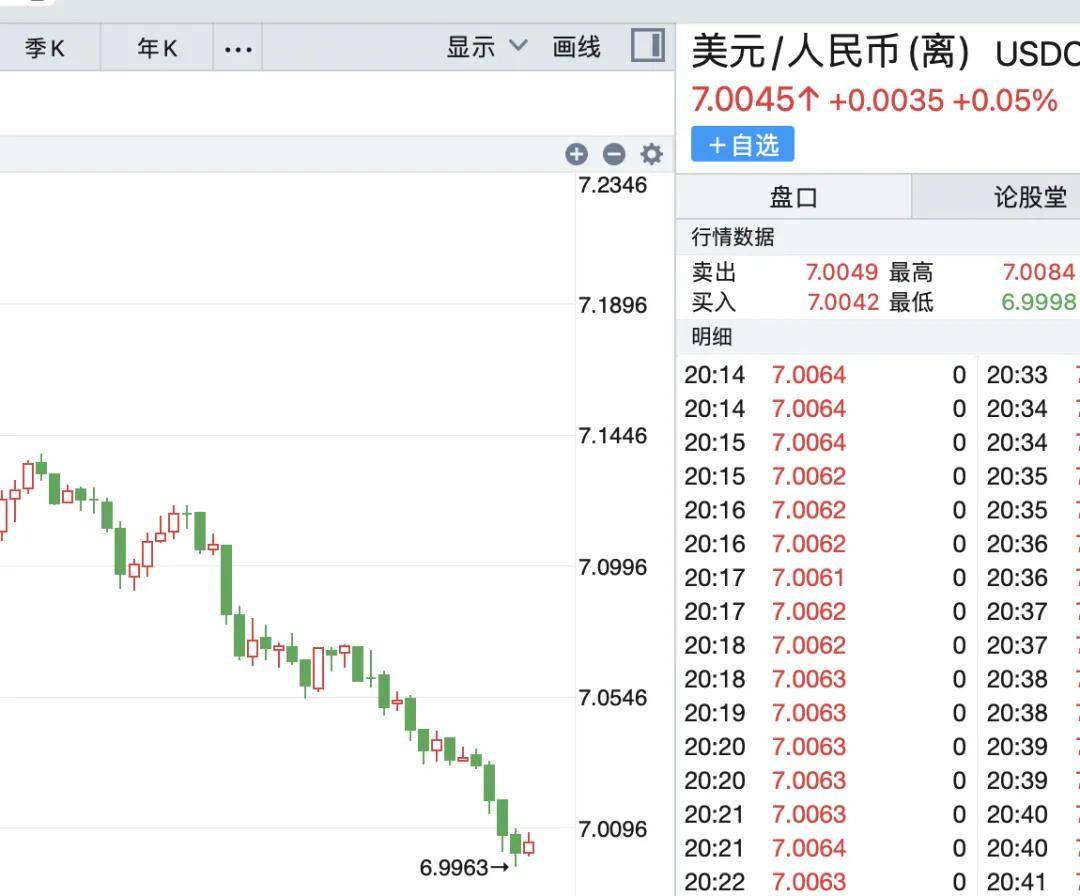
近日,离岸人民币对美元汇率盘中突破7.0整数关口,创下15个月以来的新高,距离市场期待的"6"字头 仅一步之遥。自今年4月以来,人民币兑美元开启持续升值通道,累计升值幅度已达6%,打破了此前两 年多的震荡格局。这波升值行情不仅牵动着金融市场的神经,也与普通民众的留学、旅游消费,以及企 业的进出口经营息息相关。 作为两种核心货币的比价,人民币兑美元的走势从来都是内外因素共同作用的结果。从美元走弱的外部 推力,到中国经济韧性的内部支撑,再到市场季节性行为的叠加,多重力量共同促成了本轮升值行情。 而展望未来,人民币是否会顺利迈入"6"时代,又将受到哪些变量的扰动? 如果说美元走弱是"东风",那么中国经济的稳健表现与人民币资产吸引力的提升,则是人民币能够接住 这波东风的根本底气。 经济基本面的韧性不断超出市场预期。2025年11月,中国国民经济运行数据显示,出口增速由降转升, 达到5.7%,前11个月货物贸易顺差更是首次突破1万亿美元,创下历史同期新高。充足的贸易顺差带来 了稳定的外汇流入,为人民币汇率提供了直接的流动性支撑。同时,国际机构纷纷为中国经济投出"信 任票",国际货币基金组织、世界银行先后上调2025年中 ...
人民币破7,有利于中国成为发达国家?单边升值不一定是好事
Sou Hu Cai Jing· 2025-12-26 23:10
Core Viewpoint - The recent appreciation of the Renminbi (RMB) beyond the 7.0 mark has sparked discussions about its potential impact on China's economy and its role in helping China transition to a developed nation status [1] Microeconomic Impact - The appreciation of the RMB has varying effects on different income groups. For low to middle-income groups, the benefits are limited as domestic goods are primarily produced locally, and the impact of reduced import costs on final prices is minimal. In contrast, high-income groups, who engage more in cross-border consumption, benefit from lower costs for imported goods and enhanced overseas purchasing power [3] Macroeconomic Considerations - Relying solely on RMB appreciation to boost per capita GDP and cross the threshold of developed nations is not sustainable. While RMB appreciation can increase GDP figures in USD terms, the current per capita GDP is projected to exceed 140 trillion RMB, translating to approximately $14,300 at a 7.0 exchange rate, and $16,700 at a 6.0 exchange rate. The threshold for developed nations is currently $20,000 and expected to rise to $30,000 by 2035 [4] Trade and Economic Growth - Foreign trade remains a crucial engine for China's economic growth. Despite external pressures such as U.S. tariffs, China's exports have continued to grow, although some sectors are experiencing profit declines due to a "price for volume" strategy. A rapid appreciation of the RMB, combined with U.S. tariff policies, could severely impact export industries, particularly those with thin profit margins, affecting employment and tax contributions [6] Currency Management - A long-term depreciation of the RMB could deter foreign investment, as currency fluctuations directly affect the returns on RMB-denominated assets. For instance, an appreciation from 7.0 to 6.0 could yield a significant exchange gain of approximately 17% even on low-interest deposits [7] Ideal Currency Fluctuation - The optimal scenario for RMB management is to maintain a stable, two-way fluctuation within a reasonable range, such as between 6.8 to 7.2 or 6.5 to 7.0. This approach would attract foreign investment while minimizing adverse effects on export industries and balancing the interests of different consumer groups [9] Conclusion - A pragmatic and stable approach to RMB exchange rate management, avoiding extreme fluctuations, is deemed the most sensible choice for the current economic landscape [10]
1美元=6.99人民币!人民币一度涨破“7”,对A股意味着什么?
Sou Hu Cai Jing· 2025-12-26 13:17
Group 1 - The offshore RMB against the USD recently broke the 7.0 mark, reaching a 15-month high, indicating a strong upward trend for the RMB in the near future [1] - The rise in the RMB is supported by China's strong manufacturing competitiveness and technological capabilities, highlighted by advancements in AI and robotics [2][3] - The narrowing of the interest rate differential between China and the US, with the Fed expected to cut rates more frequently than the PBOC, is contributing to reduced capital outflow pressure and a stronger RMB outlook [3] Group 2 - The appreciation of the RMB is expected to boost the A-share market, as foreign capital inflows are likely to increase, driving asset appreciation [5] - Historical trends show that the A-share market often rises alongside the RMB, with significant gains observed during previous RMB appreciation periods [5] - Foreign investment firms are optimistic about the A-share market, predicting continued growth in corporate earnings and stock performance in 2026 [5]
人民币汇率重返 6 时代,对投资有什么影响?
雪球· 2025-12-26 13:01
以下文章来源于郭施亮 ,作者郭施亮 郭施亮 . 财经评论员、专栏作家,2013年度搜狐最佳行业自媒体人。香港大公财经特约评论员、每经智库专栏作家,并多次受邀广东省人民政府发展研究中心等权 威机构撰写多篇学术文章。其作品刊登于香港文汇报、新华社《瞭望》、人民日报海外版等数十家权威报刊。 ↑点击上面图片 加雪球核心交流群 ↑ 风险提示:本文所提到的观点仅代表个人的意见,所涉及标的不作推荐,据此买卖,风险自负。 作者: 郭施亮 在美元大幅走弱的影响下 , 促使人民币汇率被动升值 , 同时也促使大部分与美元指数呈现出负相关的资产出现了可观的涨幅 。 在投资市场中 , 常有一句话是这样说的 , " 一鲸落 , 万物生 " , 美元指数涨跌对大部分资产价格带来较大的影响 。 这一轮美元贬值潮 , 不 仅带动了金价的持续上涨 , 而且还带动了股市等资产的持续回暖 。 美元指数持续下跌 , 促使人民币汇率的被动升值 。 不过 , 影响人民币汇率走向的因素 , 远不止美元指数这一项指标 。 例如 , 国内经济基本 面的持续改善 、 市场投资情绪升温以及外资的积极流入等 , 都会对人民币汇率起到积极的提振影响 。 在人民币汇率重 ...
