地缘政治

Search documents
铂钯金期货日报-20260225
Rui Da Qi Huo· 2026-02-25 09:59
1. Report Industry Investment Rating - Not provided in the content 2. Core View of the Report - Today, the platinum and palladium main contracts on the Guangzhou Futures Exchange closed significantly higher. Macroscopically, although the US inflation and GDP data have weakened periodically, Fed officials have successively sent out cautious signals, weakening the market's bets on interest rate cuts this year. Tariffs and the geopolitical situation between the US and Iran have heated up again, leading to high market risk aversion. If the tariff and geopolitical situation between the US and Iran continue to fluctuate, the risk premium may continue to support the prices of platinum and palladium on the beta side of the precious metals market. Fundamentally, platinum prices may continue to show strong resilience driven by rising costs at the South African supply - end, cautious capital expenditure by mining companies, and a tight inventory situation. Recently, due to the ongoing Russia - Ukraine conflict, the market's concern about supply tightening from Russia may support palladium prices to a certain extent. However, the recovery of palladium's recycled supply and the structural substitution in the automotive sector may cause it to move relatively in a volatile manner. In terms of price range, London platinum has a resistance level of 2200 US dollars and a support level of 2000 US dollars; London palladium has a resistance level of 1800 US dollars and a support level of 1600 US dollars. The Guangzhou Futures Exchange's platinum 2606 contract may operate in the range of 460 - 650 yuan/gram, and the palladium 2606 contract may operate in the range of 400 - 500 yuan/gram [2] 3. Summary by Relevant Catalogs 3.1 Market Data - **Futures Market**: The closing price of the platinum main contract is 586.00 yuan/gram, up 38.50 yuan; the closing price of the palladium main contract is 457.95 yuan/gram, up 19.70 yuan. The position of the platinum main contract is 10387.00 lots, down 277.00 lots; the position of the palladium main contract is 3179.00 lots, up 90.00 lots [2] - **Spot Market**: The spot price of platinum (Pt9995) on the Shanghai Gold Exchange is 584.02 yuan/gram, up 38.93 yuan; the average spot price of palladium in the Yangtze River is 431.00 yuan/gram, up 3.00 yuan. The basis of the platinum main contract is - 1.98 yuan/gram, up 0.43 yuan; the basis of the palladium main contract is - 26.95 yuan/gram, down 16.70 yuan [2] - **Supply - Demand Situation**: The non - commercial long positions of platinum in the CFTC are 9966.00 contracts, down 243.00 contracts; the non - commercial long positions of palladium in the CFTC are 3003.00 contracts, down 342.00 contracts. The total supply of platinum in 2025 is expected to be down 0.80 tons; the total supply of palladium in 2025 is expected to be 293.00 tons, down 5.00 tons. The total demand for platinum in 2025 is expected to be up 25.60 tons; the total demand for palladium in 2025 is expected to be 287.00 tons, down 27.00 tons [2] - **Macro Data**: The US dollar index is 97.90, up 0.17; the 10 - year US Treasury real yield is 1.78%, up 0.01%. The VIX volatility index is 19.55, down 1.46 [2] 3.2 Industry News - The US White House stated that President Trump's preferred option on the Iranian issue is always diplomacy, but is willing to use lethal force if necessary. Iranian Foreign Minister Araqchi said that based on the consensus reached in the previous round of negotiations, Iran will resume negotiations with the US in Geneva and is determined to reach a fair and reasonable agreement in the shortest possible time. - Fed Governor Cook said that AI has triggered a generational change in the US labor market, which may lead to an increase in the unemployment rate. The Fed may not be able to respond with interest rate cuts, and monetary policy may be in a dilemma: interest rate cuts cannot effectively address structural unemployment and may push up inflation. - Chicago Fed President Goolsbee said that it is not appropriate to further cut interest rates until there is more evidence that inflation is continuously falling. Goolsbee pointed out that policymakers have been taught a lesson in the past for "misjudging inflation as only temporary" and should not repeat the same mistake. - Sources said that Japanese Prime Minister Hayami Sanae expressed clear concerns about the Bank of Japan's further interest rate hikes during a meeting with Bank of Japan Governor Ueda Kazuo last week, and her stance was significantly tougher than during their last meeting in November last year. - The US has officially started imposing a 10% global tariff, and the White House is preparing a formal order to raise the tariff rate to 15% [2] 3.3 Key Points to Watch - On February 25 at 18:00, the eurozone's January CPI monthly and annual rates. - On February 26 at 21:30, the US unemployment claims data for the week ending February 21. - On February 27 at 21:30, the US January PPI monthly and annual rates [2]
美伊谈判在即,美方强硬声明引发紧张情绪,石油ETF鹏华(159697)收涨0.42%
Xin Lang Cai Jing· 2026-02-25 09:23
Group 1 - The geopolitical situation is escalating, with U.S. President Trump expressing a preference for diplomatic solutions to the Iranian nuclear issue while firmly stating that Iran will not be allowed to possess nuclear weapons. This has heightened market tensions, leading to a rebound in Brent crude oil prices above $71 per barrel and WTI crude oil prices exceeding $66 per barrel [1] - Guosheng Securities indicates that the VLCC non-compliant market is constrained, while the compliant market's supply-demand relationship is improving. The ongoing geopolitical conflicts present uncertainties, such as potential tightening of sanctions leading to a shift of Far East importers to compliant market crude oil, which could negatively impact the operational efficiency and profitability of sanctioned vessels, benefiting the compliant market [1] - As of February 25, 2026, the Guozheng Oil and Gas Index (399439) rose by 0.93%, with significant gains in component stocks such as China Merchants Energy (up 9.99%), Intercontinental Oil and Gas (up 9.94%), and COSCO Shipping Energy (up 8.04%) [1] Group 2 - The Guozheng Oil and Gas Index closely tracks the performance of publicly listed companies in the oil and gas sector on the Shanghai and Shenzhen stock exchanges. As of January 30, 2026, the top ten weighted stocks in the index include China National Petroleum, China National Offshore Oil, and Sinopec, collectively accounting for 66.76% of the index [2] - The Oil ETF Penghua (159697) is designed to closely follow the Guozheng Oil and Gas Index, reflecting the price changes of securities related to the oil and gas industry [3]
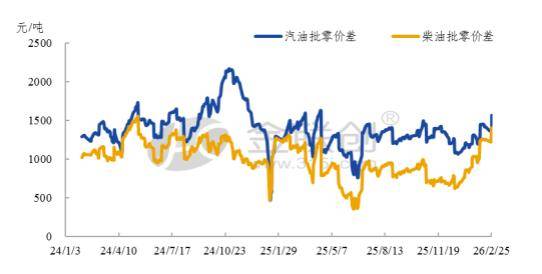
批发行情表现低迷 汽柴批零价差再创新高
Sou Hu Cai Jing· 2026-02-25 09:15
Core Viewpoint - Since 2026, the international oil market has been influenced by three main factors: rising geopolitical risks, tightening supply, and resilient demand growth, leading to an overall upward trend in oil prices with minor corrections [1] Group 1: Oil Price Trends - Brent crude oil has stabilized around $70 per barrel, while WTI has fluctuated near $66 per barrel, with a cumulative increase of nearly 6% during the Spring Festival holiday [1] - Following the price adjustment, domestic refined oil prices saw an increase on the first day after the holiday, but oil prices closed lower for two consecutive days afterward due to insufficient market support [1] Group 2: Price Differentials - The domestic wholesale and retail price differentials have reached new highs, with gasoline price differentials hitting levels not seen since April 2025 and diesel price differentials reaching highs not seen since May 2024 [1] - The recent price adjustments have resulted in a pattern of "three increases and one pause" for refined oil this year, with cumulative increases of 465 yuan/ton for gasoline and 450 yuan/ton for diesel [1] Group 3: Market Dynamics - The market dynamics for gasoline and diesel have shown significant divergence, with gasoline prices experiencing a steady increase while diesel prices have been primarily declining [3] - Gasoline demand has been supported by the Spring Festival holiday, but the ongoing impact of new energy sources continues to suppress gasoline consumption, limiting price increases [3] - Diesel demand has weakened entering the winter season, with traditional low demand periods for outdoor projects and infrastructure, leading to a bearish trend in diesel prices [3] Group 4: Future Outlook - Geopolitical factors are expected to have a more significant impact on oil prices compared to economic and fundamental factors, particularly the outcomes of US-Iran nuclear talks [3] - The likelihood of a new round of price increases remains, with cautious optimism in market sentiment, while gasoline consumption is expected to decline post-holiday, putting downward pressure on gasoline prices [3] - Diesel prices are anticipated to have limited downside potential due to current low price levels and strengthening cost support, with price differentials expected to fluctuate within a narrow range [3]

美国关税不确定性推升避险需求 贵金属走强
Ge Long Hui· 2026-02-25 07:10
Core Viewpoint - The rejection of multiple tariff measures by the U.S. Supreme Court has led to increased uncertainty in policy, prompting investors to flock to safe-haven metals, resulting in a rise in gold prices [1] Group 1: Market Reactions - Analysts indicate that the return of the Chinese market, combined with increased uncertainty in U.S. policy, is maintaining the attractiveness of gold and silver [1] - Spot gold has risen over 1%, while spot silver and platinum have increased by over 4%, and spot palladium has risen by more than 2% [1] Group 2: Federal Reserve and Interest Rates - Two Federal Reserve officials have suggested that there is no intention to change the central bank's interest rate policy in the short term [1] - The market currently anticipates three rate cuts of 25 basis points each this year [1] Group 3: Geopolitical Factors - The Omani Foreign Minister has announced that the U.S. and Iran will hold the third round of nuclear talks in Geneva on Thursday [1] - Ongoing geopolitical factors, such as U.S. fiscal and trade policies, are expected to continue supporting upward momentum in gold prices [1]
美国为何对东地中海地区兴趣增长
Xin Lang Cai Jing· 2026-02-25 06:37
Group 1 - The core viewpoint of the articles highlights the strategic importance of Greece as a key player in the Eastern Mediterranean, particularly in the context of U.S. military and energy interests amid geopolitical tensions [1][2][10] - The U.S. is enhancing its military presence in Greece, deploying the largest aircraft carrier, the "Ford," and establishing a dual-carrier presence in the Middle East to exert pressure on Iran [1][2] - Greece is positioning itself as a southern gateway for U.S. liquefied natural gas (LNG) into Europe, especially as the EU plans to ban Russian gas imports by 2027 [2][10] Group 2 - The U.S. aims to create a stable and reliable strategic hub in the Eastern Mediterranean, leveraging Greece's geographical advantages and upgraded LNG infrastructure [2][3] - Greece's energy minister has been actively promoting closer ties with the U.S. since taking office in 2025, emphasizing energy cooperation as a cornerstone of transatlantic relations [2][5] - The U.S. is exploring a tripartite shipbuilding agreement with Greece and South Korea, focusing on defense industrial collaboration, although Greece's capacity for advanced military shipbuilding is questioned [4][5] Group 3 - Greece's strategic ports, such as Alexandroupolis and Elefsina, are becoming focal points for U.S. investment and military operations, enhancing U.S. influence in the region [3][5] - The U.S. has established access to four major military bases in Greece, reflecting the deepening defense cooperation between the two nations [5][6] - The historical context of U.S.-Greece relations shows a complex interplay of support and skepticism, with some segments of the Greek population maintaining a cautious view of U.S. involvement [6][8] Group 4 - The Eastern Mediterranean is characterized by a strategic triangle involving Greece, Israel, and Cyprus, aimed at counterbalancing Turkey's influence in the region [8][9] - The U.S. has enacted legislation to strengthen its partnerships with Greece, Israel, and Cyprus, promoting military cooperation and regional stability [9][10] - American companies are actively engaging in energy exploration in Greek waters, marking a significant re-entry into offshore oil and gas activities [10][11] Group 5 - The U.S. strategy in the Eastern Mediterranean is driven by a desire to establish a diversified energy supply network for Europe, reducing reliance on Russia and Iran [10][11] - Challenges remain regarding the technical and economic feasibility of large-scale energy projects, including high costs and regional conflicts that could disrupt cooperation [11]
美国公布去年全年的国际资本流动报告,中国连续三年抛售美国股票
Sou Hu Cai Jing· 2026-02-25 05:42
Core Viewpoint - China's continuous selling of U.S. stocks over the past three years is a strategic decision influenced by economic calculations, asset safety considerations, and geopolitical factors [6] Group 1: Risk Management - Chinese regulatory authorities have been advising domestic financial institutions to reduce concentrated holdings in U.S. Treasuries to manage potential volatility risks [1] - The increasing fiscal deficit of the U.S. government poses a risk to long-term Treasury prices, prompting rational investors to diversify their asset allocations [1] Group 2: Geopolitical Factors - The Taiwan issue is highlighted as a critical red line in U.S.-China relations, with China expressing caution in asset allocation amid ongoing U.S. military sales discussions to Taiwan, potentially amounting to $20 billion [3] - China's sale of $34.1 billion in U.S. stocks has a limited short-term impact on the overall U.S. market, which is valued in the trillions, but signals a long-term trend that may influence other sovereign funds and pension plans [3] Group 3: Attitude Towards the Dollar System - The reduction of U.S. asset holdings reflects a shift in attitude towards the dollar system, with global investors, including traditional allies like Canada and India, reassessing their dollar asset exposure [4] - The perception that the dollar and U.S. stocks are becoming a shared problem is emerging among various global investors [4]
光大期货0225黄金点评:聚焦美国情咨文,短线黄金或延续高位震荡
Xin Lang Cai Jing· 2026-02-25 03:56
Core Viewpoint - The article discusses the recent fluctuations in gold prices, influenced by geopolitical events and U.S. tariff policies, suggesting a strategy for investors to adopt a long-term holding approach to gold as part of their asset allocation [2][5]. Market Overview - London spot gold showed weak fluctuations, with COMEX gold futures down 1.25% at $5160.50 per ounce, and SHFE gold down 0.30% [2][5]. - The U.S. dollar index rebounded, nearing a four-week high, while tech stocks strengthened, boosting U.S. equities, leading to declines in gold and oil prices [2][5]. U.S. Tariff Policy - A 10% global tariff policy by the U.S. government took effect, implemented through the 1974 Trade Act, bypassing Congress for a period of 150 days, with uncertainty about a potential increase to 15% [2][5]. - The imposition of tariffs has heightened global economic uncertainty, particularly following a Supreme Court ruling that deemed the previous administration's tariff actions illegal, impacting its credibility ahead of midterm elections [2][5]. Geopolitical Factors - Geopolitical events have become a focal point for market attention, particularly during the holiday period, which previously drove gold prices upward [2][5]. - The article emphasizes the importance of monitoring developments in U.S.-Iran tensions and the anticipation of future interest rate cuts as catalysts for gold price movements [2][5]. Investment Strategy - It is suggested that investors adopt a "phased layout, long-term holding" strategy for gold, positioning it as a significant component of their investment portfolio [2][5].

航运(集运):现货缓跌叠加地缘与关税双重情绪利多驱动 EC各合约增仓上行
Zhong Xin Qi Huo· 2026-02-25 02:54
Industry Investment Rating - The report's outlook is for a volatile market, suggesting to pay attention to going long on Contracts 05 and 06 on dips [5] Core Viewpoints - Against the backdrop of potential deterioration in the Middle East geopolitical situation during the holiday, an adjustment in US tariff policies with a certain reduction in the actual implementation rate, and the EU's decision to extend the Red Sea escort plan, the sentiment side provides some support to the market. The spot price has not shown obvious signs of decline, and the futures market has increased positions to repair the discount [2] - The market is still trading around the near - month contracts, with a significant increase in positions in Contract 04. In the short term, attention should be paid to the risks of MSK's cabin opening, geopolitical sentiment fluctuations, and the rush actions of the photovoltaic industry chain; in the medium term, attention should be paid to the support of spot - end cargo volume and whether shipping companies issue price increase notices [4] Summary by Related Content Market Performance - The SCFIS European line index has had a slow decline for two consecutive periods. The main contract 04 reached a maximum of 1397 points, with a gain of 6.8% and an increase of over 8000 lots in positions. As of the close, the open interest rose to 34,500 lots. Contract 05 closed at 1479 points, up 12.6%, with an increase of 122 lots in positions. Contract 06 closed at 1691.6 points, up 6.1%, with an increase of 1897 lots in positions, and the open interest rose to 15,800 lots [2] Spot Market Freight Rates - As of 16:00, according to Geek Rate online freight rates, MSK's early - March price rose to $1950/FEU after the cabin opening, remaining the same as the previous day. HPL's Shanghai - Rotterdam freight rate in late February was $2035/FEU, and the March price was $3135/FEU. Ocean carriers' 3 - month freight rates varied, with OOCL at $3030 - 3130/FEU, CMA's first - half - month March freight rate in the range of $2293 - 2493/FEU and the second - half - month rate dropping from a high of $3993/FEU to $2793/FEU, EMC at $3030 - 3130/FEU, ONE at $3035/FEU, and MSC's March price at $2340/FEU, a $200 increase compared to February [3] Geopolitical Situation - Trump signaled a缓和 in the US - Iran situation, preferring an agreement over war. Netanyahu of Israel threatened Iran, saying that if Iran attacks Israel due to US military strikes, it will face "unimaginable" retaliation [3] Trade Situation - The US has stopped collecting certain tariffs but imposed a 10% import surcharge under Section 122. China is closely monitoring and will comprehensively evaluate US measures, and will decide on counter - measures against US fentanyl and reciprocal tariffs. China opposes unilateral tariff measures and hopes to conduct candid consultations with the US in the upcoming 6th round of China - US economic and trade consultations [4] Red Sea Navigation Situation - The EU announced on the 23rd that it would extend the Red Sea escort operation for one year until February 28, 2027, to maintain "freedom of navigation in the Red Sea and surrounding waters" [4]
银河期货每日早盘观察-20260225
Yin He Qi Huo· 2026-02-25 02:51
Report Industry Investment Rating No relevant content provided. Core Viewpoints of the Report - After the Spring Festival, the stock market showed a mixed performance with some sectors rising and others falling. The futures market also had different trends in various products, influenced by factors such as supply - demand, geopolitical situations, and policy changes [20][21][25]. - The bond market sentiment was not weak, but the market might become more cautious as the "Two Sessions" approached. The medium - term outlook for the bond market was relatively optimistic [25][26]. - In the agricultural product market, the supply and price trends of different products varied. For example, the supply of protein meal increased, and the price oscillated; the international sugar price bottomed out and oscillated [30][35]. - In the black metal market, steel faced post - holiday pressure, while the performance of coking coal and iron ore was affected by factors such as production resumption and supply - demand changes [62][65][71]. - In the non - ferrous metal market, precious metals like gold and silver were in high - level oscillations due to macro uncertainties, and other non - ferrous metals also had different price trends influenced by factors such as tariffs and supply - demand [76][79][84]. - In the shipping and carbon emission market, the container shipping market was in short - term oscillations, the dry bulk freight market showed a positive trend after the holiday, and the carbon price in the domestic market oscillated while the EU carbon price was affected by policies and public opinions [122][124][126]. - In the energy and chemical market, the prices of various products were affected by factors such as geopolitical situations, supply - demand, and cost. For example, crude oil was in high - level oscillations, and asphalt was supported by cost but with weak demand [132][136]. Summary by Relevant Catalogs Financial Derivatives Stock Index Futures - After the Spring Festival, the stock index rose across the board, but the trading volume was slightly insufficient. The market showed a clear differentiation, with some sectors rising and others falling. The trading strategy was to be bullish on the trend, buy on dips, and consider arbitrage and option strategies [20][21][23]. Treasury Bond Futures - On Tuesday, the bond futures contracts of various tenors generally strengthened. The central bank's large - scale net withdrawal of short - term liquidity after the holiday and the approaching of the "Two Sessions" affected the bond market sentiment. The trading strategy was to be neutral - bullish and wait and see for arbitrage [25][26][28]. Agricultural Products Protein Meal - The supply increased overall, and the price oscillated. The trading strategy was to short at high levels and wait and see for arbitrage [30][31]. Sugar - The increase in Indian sugar production was revised down, and the international sugar price bottomed out and oscillated. The domestic sugar market was in a bottom - oscillation trend. The trading strategy was to wait and see for arbitrage and sell put options in the short term [32][35][36]. Oilseeds and Oils - The domestic oil market made up for losses and maintained oscillations. The trading strategy was to wait and see for arbitrage and consider reverse arbitrage for some contracts [38][39][40]. Corn/Corn Starch - The spot price in the production area was stable, and the futures price was in high - level oscillations. The trading strategy was to buy on dips for the outer - market corn and short lightly on rallies for domestic corn, and consider expanding the spread between corn and starch [41][43]. Live Pigs - The supply increased gradually, and the price continued to decline. The trading strategy was to buy a small amount of the 05 contract and wait and see for arbitrage [44][46]. Peanuts - The spot price was stable, and the futures price oscillated in a narrow range. The trading strategy was to buy lightly on dips and sell put options [47][48]. Eggs - After the holiday, it entered the off - season, and the egg price was stable with a slight decline. The trading strategy was to short the June contract on rallies and wait and see for arbitrage [50][51][52]. Apples - The market performance varied after the year, with the western region performing slightly better than the eastern region. The trading strategy was to go long on the 5 - month contract on dips and consider a long - 5 short - 10 arbitrage [54][55][56]. Cotton - Cotton Yarn - The fundamentals changed little, and the cotton price was supported. The trading strategy was to go long on dips and wait and see for arbitrage [58][59][60]. Black Metals Steel - There was still pressure on steel after the holiday. The trading strategy was to maintain a weak - oscillation trend, hold short positions, and wait and see for arbitrage [62][63]. Coking Coal and Coke - Coal mines were gradually resuming production. The trading strategy was to consider going long on dips and wait and see for arbitrage [64][65][67]. Iron Ore - The fundamentals continued to weaken, and the ore price was in a weak - running state. The trading strategy was to be bearish and wait and see for arbitrage [70][71]. Ferroalloys - The cost support was strong, and it could be used as a long - position configuration on dips. The trading strategy was to go long on dips and wait and see for arbitrage [72][73][74]. Non - Ferrous Metals Gold and Silver - The macro uncertainties continued, and the prices were in high - level oscillations. The trading strategy was to hold long positions cautiously and consider option strategies [76][79][80]. Platinum and Palladium - Supported by macro and geopolitical factors, platinum could be bought on dips, and palladium could be traded in bands. Consider a long - platinum short - palladium arbitrage [80][81][83]. Copper - Affected by continuous tariff disturbances, the copper price was in a strong - oscillation state. The trading strategy was to be bullish in the long - term and consider option strategies [84][85]. Alumina - After the decline in the supply - side operating rate, the spot price was supported. The trading strategy was to be bullish in the short - term [86][87]. Electrolytic Aluminum - Tariff disturbances did not change the supply - demand support pattern. The trading strategy was to wait and see for both arbitrage and options [89][91][92]. Cast Aluminum Alloy - It oscillated with the aluminum price. The trading strategy was to wait and see for both arbitrage and options [93][95]. Zinc - After the correction stabilized, it could be bought on dips. The trading strategy was to wait and see for both arbitrage and options [96][97]. Lead - It oscillated in a range. The trading strategy was to go long lightly on dips and consider option strategies [99][100]. Nickel - The macro factors dominated the price fluctuations. The trading strategy was to hold long positions at low levels and wait and see for arbitrage [101][103][104]. Stainless Steel - Supported by cost, it followed the nickel price. The trading strategy was to hold long positions at low levels and wait and see for arbitrage [106]. Industrial Silicon - Attention should be paid to the resumption rhythm of large factories. The trading strategy was to rebound in the short - term and short on rallies in the medium - term [107][108]. Polysilicon - Driven by merger news, it might rebound in the short - term, and the spot price should be focused on in the medium - term [110][111]. Lithium Carbonate - The demand was good, and the price was at a high level. The trading strategy was to wait and see [113][115]. Tin - Attention should be paid to macro - policy trends. The trading strategy was to hold long positions at low levels and wait and see for arbitrage [118][120]. Shipping and Carbon Emissions Container Shipping - It was mainly in short - term oscillations, and attention should be paid to Maersk's opening - cabin price. The trading strategy was to wait and see for both single - side trading and arbitrage [121][122][124]. Dry Bulk Freight - After the holiday, the demand recovery drove the spot price to improve. Attention should be paid to the impact of the US Maritime Action Plan. The trading strategy was to wait and see [124][125][126]. Carbon Emissions - The domestic carbon price oscillated, and the EU carbon price was affected by policies and public opinions. The trading strategy was to wait and see [126][127][128]. Energy and Chemicals Crude Oil - The API inventory increased more than expected. The trading strategy was to be bullish on the trend, consider the bullish spread, and buy out - of - the - money call options [132][133]. Asphalt - The cost supported the spot price, but the rigid demand had not recovered. The trading strategy was to go long on the BU2606 contract on dips and wait and see for arbitrage [134][136][137]. Fuel Oil - The high - sulfur supply increased, and the low - sulfur price strengthened in the near - term. The trading strategy was to be bullish on the trend, consider expanding the spread between high - and low - sulfur fuel oil, and wait and see for options [139][140][141]. LPG - It was still dominated by geopolitical factors. The trading strategy was to wait and see for both single - side trading and arbitrage [142]. Natural Gas - It was waiting for geopolitical guidance. The trading strategy was to hold short positions on the HH second - quarter contract and wait and see for both arbitrage and options [145][146][147]. PX & PTA - Driven by cost. The trading strategy was to hold long positions, consider positive arbitrage, and wait and see for options [149][150]. BZ & EB - There was a supply vacuum in the overseas market. The trading strategy was to oscillate and consider reverse arbitrage [151][152]. Ethylene Glycol - There was obvious inventory - accumulation pressure. The trading strategy was to oscillate in a range and wait and see for both arbitrage and options [154][157]. Short - Staple Fiber - The polyester raw materials strengthened. The trading strategy was to be bullish on the price, consider narrowing the processing fee on rallies, and wait and see for options [158]. Bottle Chips - The supply was expected to be tight. The trading strategy was to be bullish on the price and wait and see for both arbitrage and options [160][162]. Propylene - The supply - demand support was acceptable. The trading strategy was to hold long positions and wait and see for both arbitrage and options [163]. Plastic PP - The L plastic was bullish on the trend, and the PP was to wait and see. The trading strategy was to go long on the L 2605 contract on dips and wait and see for both arbitrage and options [165][166]. Caustic Soda - The price was weakening. The trading strategy was to wait and see [168][169]. PVC - It was mainly in oscillations. The trading strategy was to go long on dips and wait and see for both arbitrage and options [170][173]. Soda Ash - The price was bullish on the trend. The trading strategy was to be bullish in the short - term, consider a long - soda - ash short - glass arbitrage, and wait and see for options [174][175]. Glass - The price was bearish on the trend. The trading strategy was to be bearish in the short - term, consider a long - soda - ash short - glass arbitrage, and wait and see for options [176][178]. Methanol - It was in a strong - oscillation state. The trading strategy was to go long on dips, consider a 5 - 9 positive arbitrage, and sell put options on corrections [179][180]. Urea - It was rising strongly. The trading strategy was to go long cautiously and wait and see for both arbitrage and options [182][183]. Pulp - The US dollar quotation increased, but the high inventory suppressed the rebound. The trading strategy was to hold long positions and consider option strategies [184][185][187]. Offset Printing Paper - The inventory was high, and the market rebound was limited. The trading strategy was to short on rallies and consider option strategies [188][189]. Logs - The supply and demand were both weak. The trading strategy was to wait and see and consider a 3 - 5 reverse arbitrage [190][192][193]. Natural Rubber and No. 20 Rubber - The gross profit of concentrated latex decreased for consecutive months. The trading strategy was to go long on the RU 05 contract and consider arbitrage strategies [194][196][197]. Butadiene Rubber - The growth rate of butadiene production slowed down. The trading strategy was to short the BR 04 contract lightly and wait and see for both arbitrage and options [198][200][201].
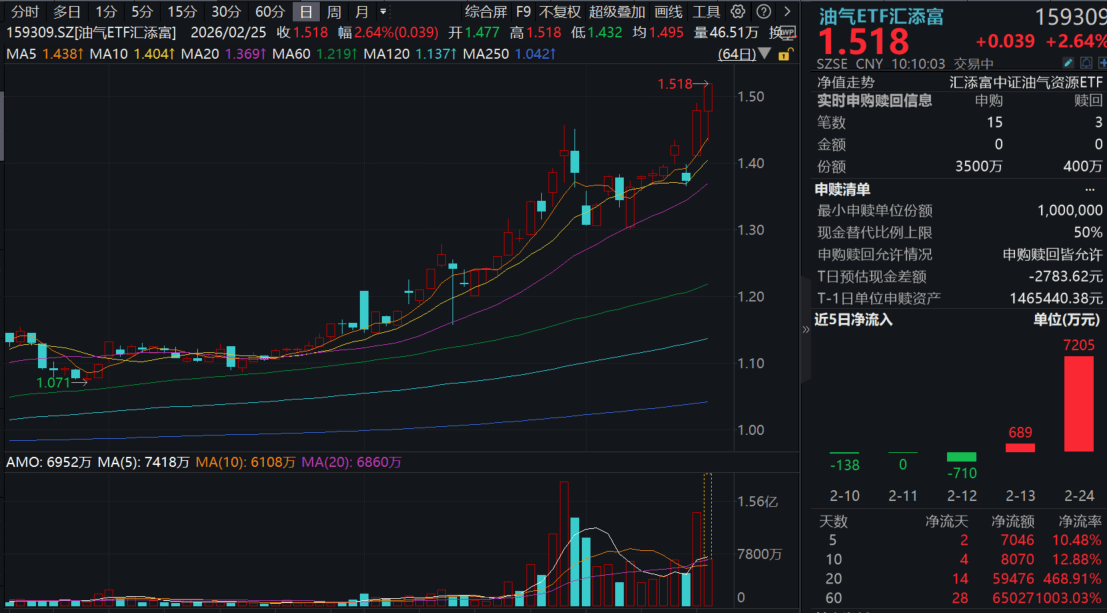
油气继续冲高!招商轮船、招商南油等涨停,油气ETF汇添富(159309)涨超2.5%,盘中强势吸金近5000万元!油价冲高,短中期逻辑全面解析!
Sou Hu Cai Jing· 2026-02-25 02:35
Group 1 - The A-share market is experiencing an upward trend, particularly in the oil and gas sector, with the ETF Huatai-PineBridge (159309) rising over 2.5% and attracting nearly 50 million yuan in investment [1] - Major component stocks of the oil and gas ETF have shown significant gains, with Tongyuan Petroleum up over 14% and potential Hengxin up over 11%, while several other stocks reached their daily limit [2][3] - The oil price trend has been significantly upward since 2026, driven mainly by geopolitical factors, with a focus on the supply-demand balance as a solid support for long-term price increases [6] Group 2 - The short-term oil price is influenced by geopolitical risks, with the Middle East situation being a core variable affecting price volatility, particularly due to U.S. military presence and Iranian military exercises [6] - The ETF Huatai-PineBridge focuses on the oil and gas industry chain, providing a concentrated investment in key sectors such as exploration, equipment, refining, and transportation, emphasizing companies with quality reserves and low-cost advantages [6][7] - The index of the oil and gas ETF has shown strong performance, with its cumulative returns over the last six months, one year, and three years leading among similar indices [8]