
流动性

Search documents
供需叠加股债跷跷板,期债注意节奏
Ning Zheng Qi Huo· 2025-09-15 09:12
Report Industry Investment Rating - The report suggests a strategy of "oscillating with a bearish bias, and paying attention to the stock-bond seesaw" [4] Core Viewpoints - In the third quarter, the bond market issuance has accelerated, increasing supply. The liquidity in the interbank market faces pressure from bond supply, and the tight balance of liquidity due to the demand from the real economy and the warming stock market has increased negative factors for the bond market [2][27] - China's economic prosperity continues to expand overall. The acceleration of the economic recovery rhythm in September is a long - term negative factor for the bond market. However, during the Fed's interest - rate meeting this week, the stock - bond seesaw logic may have a significant impact on the bond market [2][27] - The loose liquidity is the main tone of the second half of the year. The central bank is expected to provide timely liquidity support according to the bond issuance rhythm of the Ministry of Finance [3] Summary by Directory Chapter 1: Market Review - In the third quarter, the fiscal bond - issuing rhythm has accelerated. The supply - demand logic and the stock - bond seesaw logic have increased the difficulty of bond market operations [9] Chapter 2: Overview of Important News - China's economic prosperity continues to expand. In August, the official manufacturing PMI, non - manufacturing PMI, and comprehensive PMI were 49.4%, 50.3%, and 50.5% respectively, with month - on - month increases of 0.1, 0.2, and 0.3 percentage points [13] - At the end of August, M2 increased by 8.8% year - on - year, M1 increased by 6% year - on - year, and the M1 - M2 gap narrowed to - 2.8%, the lowest since June 2021 [13] - Affected by the high base and food prices, in August, China's CPI was flat month - on - month and decreased by 0.4% year - on - year. The core CPI increased by 0.9% year - on - year, with the increase expanding for the fourth consecutive month. The PPI decreased by 2.9% year - on - year, with the decline narrowing by 0.7 percentage points from the previous month [13][14] - In August, China's exports denominated in US dollars decreased by 4.4% year - on - year, lower than the Bloomberg consensus forecast of 5%, and imports decreased by 1.3% year - on - year, lower than the Bloomberg consensus forecast of 3% [14][15] - The market's expectation of restarting the central bank's treasury bond trading operations has been gradually rising [14] Chapter 3: Analysis of Important Influencing Factors 3.1 Economic Fundamentals - China's economic prosperity continues to expand. The overall economic data in August shows that the endogenous economic momentum is strengthening, and the downward pressure on the economy has weakened. Continuous strengthening of counter - cyclical adjustment will be a long - term negative factor for the bond market [15] 3.2 Policy Aspect - At the end of August, the narrowing of the M1 - M2 gap indicates that economic activities have increased. The year - on - year growth rate of social financing stock has slightly increased, and the monthly new social financing has increased compared with last year, mainly driven by government bond issuance [18] 3.3 Capital Aspect - After July 25, DR007 continued to decline, reducing the cost of funds. The central bank will implement a moderately loose monetary policy in the second half of the year, and the Fed's interest rate cut may provide more room for domestic monetary policy easing [18] 3.4 Supply - Demand Aspect - The issuance of special treasury bonds and special bonds has accelerated. The market is waiting for the effects and implementation of relevant policies [22] 3.5 Sentiment Aspect - The stock - bond ratio has broken through the short - term shock range, indicating that the market's attention to the stock market is greater than that to the bond market, and the market risk preference has increased. Short - term bonds are more affected by the capital aspect, while long - term bonds are more affected by the stock - bond seesaw [24] Chapter 4: Market Outlook and Investment Strategy - In the third quarter, the increase in bond market supply and the tight balance of liquidity have increased negative factors for the bond market. However, during the Fed's interest - rate meeting this week, the stock - bond seesaw logic may have a significant impact on the bond market [27]
央行今日开展 6000亿元买断式逆回购操作
Zheng Quan Shi Bao· 2025-09-14 18:02
Group 1 - The People's Bank of China (PBOC) will conduct a 600 billion yuan reverse repurchase operation with a six-month term on September 15 to maintain liquidity in the banking system [1] - Prior to this, the PBOC had already conducted a 1 trillion yuan reverse repurchase operation with a three-month term on September 5, resulting in a net injection of 300 billion yuan for the month [1] - The PBOC has been consistently conducting reverse repurchase operations since June to support market liquidity and stabilize market expectations [1] Group 2 - The bond market sentiment has recently turned pessimistic, leading to increased expectations for the PBOC to resume government bond trading operations [1] - Wang Guogang, a professor at Renmin University, emphasized the importance of government bonds as a tool for coordinating monetary and fiscal policies, advocating for increased issuance of government bonds [2] - The PBOC is expected to enhance its open market operations in government bonds to align with the ongoing proactive fiscal policy [2]
新房在降价促销,可为什么二手房卖不动了,也不降价出售?
Sou Hu Cai Jing· 2025-09-14 16:19
Core Insights - The article highlights the contrasting pricing behaviors between new and second-hand homes in the real estate market, with new homes experiencing significant price reductions while second-hand homes remain relatively stable in price [1][2][3] Market Dynamics - New home prices have decreased by 8% to 15%, while second-hand home prices have only seen a slight decline of 2% to 5% despite a 31% drop in transaction volume for second-hand homes [1][2] - Developers face substantial financial pressure due to high costs associated with land, materials, labor, and interest on loans, leading them to reduce prices to stimulate sales [1][3][6] - In contrast, second-hand homeowners have lower holding costs and are less pressured to sell quickly, allowing them to maintain higher asking prices [2][5] Psychological Factors - The "anchoring effect" influences second-hand homeowners, who are reluctant to sell below their purchase price, often viewing their homes as emotional investments [2][9] - Many second-hand homeowners hold onto the belief that property values will rise again, leading to a reluctance to lower prices [7][12] Information Asymmetry - Developers have access to professional market research, enabling them to adjust strategies quickly, while most second-hand homeowners lack timely market information [3][12] - The speed of information dissemination favors new home price adjustments, while second-hand price changes are often less visible to potential buyers [12][13] Financial Considerations - Developers operate under high leverage and face significant costs if sales are delayed, while second-hand homeowners typically have lower financial burdens, allowing them to wait for better offers [5][6] - The holding costs for developers include various fees and interest, which accumulate rapidly, contrasting with the relatively low costs for second-hand homeowners [9][10] Market Segmentation - The real estate market is characterized by a buyer's market, where buyers have more options, making it crucial for second-hand homeowners to remain competitive in pricing [12] - The disparity in pricing strategies between new and second-hand homes is influenced by differing market conditions across various cities, with first-tier cities showing more resilience in second-hand home prices compared to lower-tier cities [10][12] Long-term Outlook - The sustainability of the current pricing gap between new and second-hand homes is questionable, as market forces will eventually seek equilibrium [12][13] - The article suggests that both developers and second-hand homeowners need to adjust their expectations to align with the evolving real estate landscape [12][13]


美债:10年期收益率降至4.06%,市场降息预期增强
Sou Hu Cai Jing· 2025-09-14 14:25
Group 1 - The core viewpoint of the article indicates that U.S. Treasury yields have declined significantly, driven by cooling employment and falling inflation, with the market fully pricing in a Federal Reserve rate cut in September [1] - As of September 12, the 10-year Treasury yield fell by 16 basis points to 4.06%, while the 2-year yield decreased by 6 basis points and the 30-year yield dropped by 20 basis points over the same two-week period [1] - The U.S. Treasury's fiscal deficit for December was reported at $344.8 billion, with a 12-month cumulative deficit slightly decreasing to $1.89 trillion [1] Group 2 - The net short position in U.S. Treasury futures decreased to 5.915 million contracts, indicating a short-term closure of hedging demand in the interest rate market [1] - The Federal Reserve's policy statement has become more cautious, with market expectations for a 75 basis point rate cut by the end of the year exceeding 90% following weak non-farm payroll data on September 9 [1] - The Treasury General Account (TGA) balance increased by $71.79 billion over two weeks, while the Federal Reserve's reverse repo tool shrank by $10.2 billion, adding uncertainty to liquidity buffers [1]
置换债是否会在Q4提前发行、有何影响?
Xinda Securities· 2025-09-14 12:04
1. Report Industry Investment Rating No information provided in the report regarding the industry investment rating. 2. Core Viewpoints of the Report - The central bank maintains a relatively loose stance within the existing framework, as indicated by the OMO's resumption of large - scale operations after DR001 rose above 1.4%, the increase in banks' rigid net lending to over 4 trillion yuan, and the 300 - billion - yuan over - renewal of the 6 - month outright reverse repurchase [3][19]. - There is no need to over - worry about the so - called "deposit relocation" caused by the rise of the A - share market. The increase in M1 in August was affected by the base effect, and the reason for the increase in non - bank deposits is difficult to determine from the data [21]. - The statement of "advancing the issuance of part of the new local government debt quota for 2026 and using debt - resolution quotas earlier" does not necessarily mean that the 2 - trillion - yuan replacement bonds in 2026 will be issued ahead of schedule in Q4 [3][40]. - Without new quotas, the average monthly net financing scale of government bonds in Q4 is estimated to be about 633.5 billion yuan, lower than the average of the first three quarters. Unless there is a significant decline in fiscal deposits in September, the early issuance of Q4 replacement bonds is not the baseline expectation. Even if they are issued early, the impact on liquidity is controllable [4][44]. 3. Summary by Directory 3.1 Money Market 3.1.1 This Week's Fundamentals Review - The central bank's OMO had a net injection of 196.1 billion yuan this week, and announced a 600 - billion - yuan 6 - month outright reverse repurchase operation next Monday, with a monthly net injection of 300 billion yuan. Affected by government bond payments and the previous OMO net withdrawal, funds tightened in the first half of the week, with DR001 rising to 1.43%. After Wednesday, as the central bank's reverse repurchase shifted to net injection, the funds loosened marginally, and DR001 fell back below 1.4% [3][7]. - The trading volume of pledged repurchase decreased from the high level in the second half of last week, but the average daily trading volume increased by 1.8 trillion yuan to 73.9 trillion yuan. The overall scale of pledged repurchase decreased in the first half of the week and then increased in the second half, still slightly lower than last Friday. In terms of institutions, the net lending of large - scale banks decreased continuously in the first half of the week and recovered after Thursday, the net lending of city - commercial banks fluctuated slightly, and the net lending of joint - stock banks increased. The overall rigid net lending of banks decreased in the first half of the week and then fluctuated and recovered in the second half, rising back above 4 trillion yuan. The non - bank rigid lending increased, mainly due to the large increase in money - market fund lending, while the lending of wealth - management products decreased slightly. The non - bank rigid borrowing decreased, mainly due to the decrease in fund borrowing, while the borrowing of insurance and other products increased. The fund gap index first rose and then fell, rising to - 318 billion on Wednesday and then falling to - 539.9 billion on Friday, still higher than - 621.3 billion last Friday [3][17]. 3.1.2 Next Week's Fund Outlook - The estimated scale of treasury bond payments next week is 392 billion yuan. As of this week, the cumulative issuance of new general bonds in 2025 is 635.5 billion yuan, new special bonds is 3.4138 trillion yuan, ordinary refinancing bonds is 2.0641 trillion yuan, and special refinancing bonds is 1.9629 trillion yuan. The issuance scale of local bonds in 10 regions such as Yunnan, Shandong, and Xinjiang next week is 188.5 billion yuan, including 20.7 billion yuan of new general bonds, 97.8 billion yuan of new special bonds, and 70 billion yuan of refinancing bonds, with an actual payment scale of 190.2 billion yuan. The net payment scale of government bonds will rise from 344.2 billion yuan this week to 402.5 billion yuan [22]. - Next week, funds will face multiple disturbing factors, with greater pressure in the first half of the week. However, the funds injected through outright repurchase will provide some hedging. Considering that the central bank's relatively loose stance within the existing framework remains unchanged, the probability of significant fluctuations in subsequent fund prices is relatively limited, and DR001 may not remain above 1.4% [4]. 3.2 Inter - bank Certificates of Deposit - This week, the 1 - year Shibor rate rose 0.7 BP to 1.67%, and the secondary rate of 1 - year AAA - rated inter - bank certificates of deposit rose 0.5 BP to 1.67%. The issuance scale of inter - bank certificates of deposit increased, but the maturity scale increased more, resulting in a net repayment of 424.1 billion yuan. The net financing scales of state - owned banks, joint - stock banks, city - commercial banks, and rural commercial banks were - 135.6 billion yuan, - 98.3 billion yuan, - 159.8 billion yuan, and - 23.6 billion yuan respectively. The issuance proportion of 1 - year certificates of deposit rose to 15%, and the issuance proportion of 3 - month certificates of deposit was the highest at 34%. Next week, the maturity scale of certificates of deposit is about 894.1 billion yuan, a decrease of 315.7 billion yuan compared with this week [4][45][49]. - The issuance success rates of certificates of deposit of various banks decreased compared with last week. Except for the relatively low issuance success rate of state - owned banks, the others were around the average level in recent years. The issuance spread between 1 - year certificates of deposit of city - commercial banks and joint - stock banks widened [50]. - This week, the relative supply - demand strength index of certificates of deposit fluctuated and increased. The willingness of money - market funds to increase their holdings of certificates of deposit significantly increased after Thursday, the overall demand of wealth - management products for certificates of deposit increased slightly, the demand of non - money funds and other products for certificates of deposit decreased in the middle of the week and then recovered on Friday, and joint - stock banks continuously reduced their holdings after Tuesday. The supply - demand index of certificates of deposit continuously increased after Monday, rising to 36.4% on Friday, a 4.8 - percentage - point increase compared with September 5. In terms of different maturities, the supply - demand indexes of 1 - month and 1 - year certificates of deposit decreased, while those of 3 - month, 6 - month, and 9 - month varieties increased [59]. 3.3 Bill Market This week, bill rates showed a divergent trend. The 3 - month national bill rate decreased by 3 BP to 1.15% month - on - month, while the 6 - month national bill rate increased by 6 BP to 0.79% [64]. 3.4 Bond Trading Sentiment Tracking - This week, the bond market performed weakly, the yield curve steepened and rose, and the spread of Tier 2 and perpetual bonds widened [66]. - Large - scale banks' willingness to increase their bond holdings increased significantly, mainly showing an inclination to increase their holdings of certificates of deposit and long - term treasury bonds, and a significant increase in the willingness to increase their holdings of medium - and short - term treasury bonds and long - term policy - bank bonds, but an inclination to reduce their holdings of ultra - long - term treasury bonds and 5 - 7 - year policy - bank bonds. Trading - oriented institutions shifted to a tendency to reduce their bond holdings. Among them, fund companies tended to reduce their holdings, securities companies' willingness to reduce their holdings increased, other products' willingness to increase their holdings decreased, and other institutions' willingness to increase their holdings increased slightly. All allocation - oriented institutions' willingness to increase their bond holdings increased significantly [66].

中国人民银行将开展6000亿元买断式逆回购操作
Sou Hu Cai Jing· 2025-09-12 13:03
Core Viewpoint - The People's Bank of China (PBOC) announced a 600 billion yuan reverse repurchase operation to maintain liquidity in the banking system, indicating a continued supportive monetary policy stance [1] Group 1: Monetary Policy Actions - On September 15, the PBOC will conduct a fixed amount, interest rate tender, multi-price bidding reverse repurchase operation of 600 billion yuan with a term of 6 months (182 days) [1] - This operation is equivalent to a 300 billion yuan increase in the 6-month reverse repurchase, as 300 billion yuan of the same term is maturing in the month [1] - On September 5, the PBOC conducted an equal renewal of 1 trillion yuan for a 3-month reverse repurchase that was maturing, indicating a total increase of 300 billion yuan for both terms by September 15, marking the fourth consecutive month of increased operations [1] Group 2: Market Implications - According to Wang Qing, Chief Macro Analyst at Dongfang Jincheng, the PBOC's reverse repurchase operations continuously inject liquidity into the market [1] - This action helps stabilize market expectations and supports government bond issuance, while also signaling a sustained commitment to quantitative policy tools [1] - The ongoing supportive monetary policy stance reflects the PBOC's intention to bolster economic conditions [1]
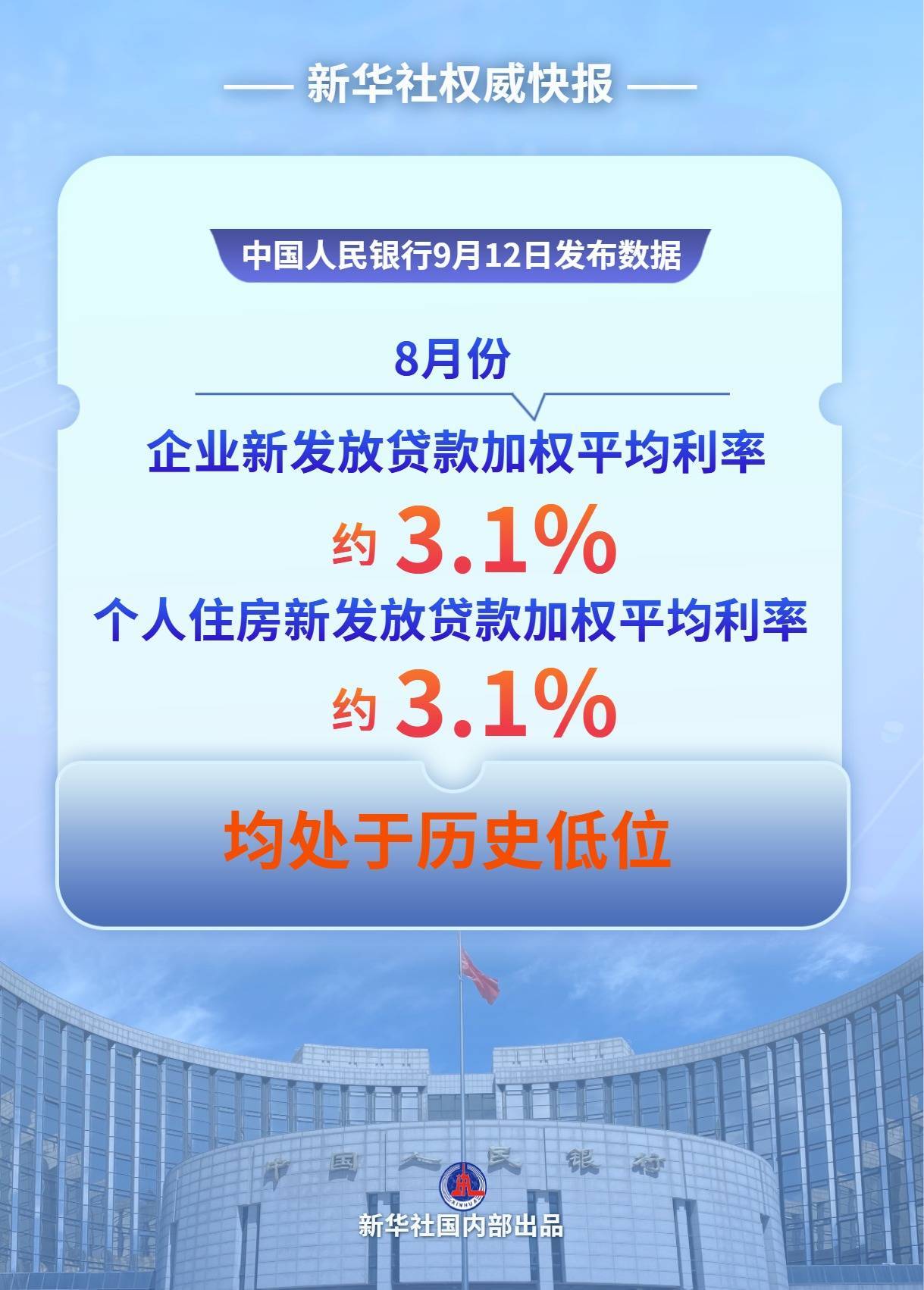
新华社权威快报|8月企业新发放贷款利率保持历史低位
Sou Hu Cai Jing· 2025-09-12 09:11
Core Points - The People's Bank of China reported that the weighted average interest rate for new corporate loans in August was approximately 3.1%, which is a slight decrease from the previous month and about 40 basis points lower than the same period last year [2][1] - The weighted average interest rate for new personal housing loans was also around 3.1%, down approximately 25 basis points year-on-year, indicating historically low levels for both types of loans [2][1] - In the first eight months of the year, the total increase in RMB loans reached 13.46 trillion yuan, demonstrating a solid support for the real economy [2] - As of the end of August, the broad money supply (M2) stood at 331.98 trillion yuan, reflecting a year-on-year growth of 8.8%, indicating ample liquidity in the market [2] - The growth rate of social financing remained at a high level, further supporting economic stability [2]
宏观金融数据日报-20250911
Guo Mao Qi Huo· 2025-09-11 09:48
Report Summary 1. Market Investment Ratings - No information provided regarding the report's industry investment rating. 2. Core Viewpoints - The stock index closed up with reduced volatility and shrinking trading volume. There is still upward potential for the stock index due to abundant domestic liquidity, high expectations of a Fed rate cut in September, and the potential marginal repair of PPI, which could improve A-share profitability. The strategy is to go long opportunistically and take advantage of the premium/discount of stock index futures to place long orders [6]. 3. Summary by Relevant Catalogs Money Market - DRO01 closed at 1.43 with a 1.12bp increase, DR007 at 1.48 with a -0.26bp decrease, GC001 at 1.54 with a -5.50bp decrease, and GC007 at 1.49 with a -3.50bp decrease. SHBOR 3M was at 1.55 with a 0.20bp increase, and LPR 5-year remained unchanged at 3.50 [4]. - The 1-year, 5-year, and 10-year Chinese treasury bonds closed at 1.41, 1.65, and 1.89 respectively, with increases of 1.56bp, 2.06bp, and 2.52bp. The 10-year US treasury bond closed at 4.08 with a 3.00bp increase [4]. - The central bank conducted 3040 billion yuan of 7-day reverse repurchase operations, with 2291 billion yuan of reverse repurchases maturing, resulting in a net injection of 749 billion yuan. This week, 10684 billion yuan of reverse repurchases will mature, and the central bank may restart treasury bond trading operations [4]. Stock Index Market - The CSI 300, SSE 50, CSI 500, and CSI 1000 closed at 4445, 2940, 6932, and 7230 respectively, with increases of 0.21%, 0.37%, 0.05%, and 0.06%. Industry sectors showed mixed performance, with the trading volume of the two markets at 19781 billion yuan, a decrease of 1404 billion yuan [5]. - IF, IH, IC, and IM contracts showed different price changes and volume/position changes. For example, IF volume increased by 7.4% to 130680, and its position increased by 2.7% to 275475 [5]. Futures Premium/Discount - IF, IH, IC, and IM contracts in different delivery months have different premium/discount rates. For example, the IF current-month contract has a premium rate of 11.83% [7].
X @Yuyue
Yuyue· 2025-09-10 14:07
看得出 Solana 是很想在 meme 赌场的定位之外找到新的增长点了,PPI 之后价格表现有点猛。上周四凌晨 Moonshot 上线了一堆 xStocks @xStocksFi 的股票,涵盖 Coinbase、Meta、亚马逊、特斯拉等 60+ 只标的。通过和 Moonshot 合作,xStocks 利用 Solana 目前最大的优势也就是热钱多 + 流动性好,试图引入一部分 ms 的用户来交易 xStocks 发行的代币化股票Solana 的官推此前还发布过针对这一系列代币化股票的案例研究,里面介绍了完整的 60+ 股票列表除了 @Solana_zh 链之外,xStocks 还上线了以太坊,有一系列进展,“链上华尔街”的愿景有了一些实感,这下我们真可以说自己是尊贵的美股交易员了先来看核心数据:- 交易量突破 6 亿美元- 链上持有人 2.5 万- AUM 规模达到 4400 万美元- 在 CEX 端,已上线 Kraken、Bybit 等平台,总成交量突破 36 亿美元xStocks 的流动性正在快速逼近真实股票市场的活跃度,虽然目前来说流动性还是不及纳斯达克,但在圈内用户来说,总体来说代币化股票同时获得 ...
国债期货日报:债基费率调整,国债期货全线收跌-20250910
Hua Tai Qi Huo· 2025-09-10 07:31
Report Industry Investment Rating No relevant content provided. Core Viewpoints - Recent risk preference recovery has suppressed the bond market, and the Fed's interest rate cut expectations and rising global trade uncertainty have increased the uncertainty of foreign capital inflows [3]. - Overall, the bond market fluctuates between stable growth and easing expectations, and short - term attention should be paid to policy signals at the end of the month [3]. Summary by Directory I. Interest Rate Pricing Tracking Indicators - Price indicators: China's CPI (monthly) has a 0.40% month - on - month increase and 0.00% year - on - year change; China's PPI (monthly) has a - 0.20% month - on - month decrease and - 3.60% year - on - year change [9]. - Monthly economic indicators: Social financing scale is 431.26 trillion yuan, with a month - on - month increase of 1.04 trillion yuan (+0.24%); M2 year - on - year is 8.80%, with a month - on - month increase of 0.50% (+6.02%); Manufacturing PMI is 49.40%, with a month - on - month increase of 0.10% (+0.20%) [9]. - Daily economic indicators: The US dollar index is 97.76, with a day - on - day increase of 0.31 (+0.32%); The US dollar against the offshore RMB is 7.1187, with a day - on - day decrease of 0.012 (-0.17%); SHIBOR 7 - day is 1.47, with a day - on - day increase of 0.03 (+2.02%); DR007 is 1.48, with a day - on - day increase of 0.03 (+1.83%); R007 is 1.51, with a day - on - day decrease of 0.05 (-3.26%); The 3 - month inter - bank certificate of deposit (AAA) is 1.57, with a day - on - day increase of 0.01 (+0.51%); The AA - AAA credit spread (1Y) is 0.09, with a day - on - day increase of 0.00 (+0.51%) [10]. II. Overview of the Treasury Bond and Treasury Bond Futures Market - On September 9, 2025, the closing prices of TS, TF, T, and TL were 102.38 yuan, 105.57 yuan, 107.78 yuan, and 115.72 yuan respectively, with price changes of - 0.02%, - 0.01%, - 0.06%, and - 0.22% [3]. - The average net basis spreads of TS, TF, T, and TL were - 0.014 yuan, 0.003 yuan, 0.212 yuan, and - 0.172 yuan respectively [3]. III. Overview of the Money Market Fundamentals - In July 2025, the year - on - year growth rates of M1 and M2 rebounded to 5.6% and 8.8% respectively, and the gap narrowed to 3.2%, indicating abundant liquidity and increased activity of corporate current funds, but weak credit derivative efficiency, continuous contraction of long - term loans of residents and enterprises, and insufficient investment and consumption demand [2]. - On September 9, 2025, the central bank conducted a 247 - billion - yuan 7 - day reverse repurchase operation at a fixed interest rate of 1.4% [2]. - The main term repurchase rates of 1D, 7D, 14D, and 1M were 1.419%, 1.467%, 1.500%, and 1.522% respectively, and the repurchase rates have recently rebounded [2]. IV. Spread Overview - The report provides multiple spread - related figures, including the inter - period spread trends of various treasury bond futures varieties and the term spread between spot bonds and cross - variety spreads of futures [31][35][36]. V. Two - Year Treasury Bond Futures - The report presents figures related to the implied interest rate of the two - year treasury bond futures main contract and the treasury bond maturity yield, the IRR of the TS main contract and the capital interest rate, and the three - year basis spread and net basis spread trends of the TS main contract [38][41][48]. VI. Five - Year Treasury Bond Futures - The report provides figures on the implied interest rate of the five - year treasury bond futures main contract and the treasury bond maturity yield, the IRR of the TF main contract and the capital interest rate, and the three - year basis spread and net basis spread trends of the TF main contract [50][54]. VII. Ten - Year Treasury Bond Futures - The report includes figures on the implied yield of the ten - year treasury bond futures main contract and the treasury bond maturity yield, the IRR of the T main contract and the capital interest rate, and the three - year basis spread and net basis spread trends of the T main contract [57][60][58]. VIII. Thirty - Year Treasury Bond Futures - The report shows figures related to the implied yield of the thirty - year treasury bond futures main contract and the treasury bond maturity yield, the IRR of the TL main contract and the capital interest rate, and the three - year basis spread and net basis spread trends of the TL main contract [64][70]. Strategies - Unilateral: As the repurchase rate rebounds and the treasury bond futures price fluctuates, it is recommended to short at high levels for the 2512 contract [4]. - Arbitrage: Pay attention to the decline of the 2512 basis spread [4]. - Hedging: There is medium - term adjustment pressure, and short - side investors can moderately hedge with far - month contracts [4].