
以旧换新政策

Search documents
销量占比超七成,自主汽车品牌加速“超车”
Bei Jing Shang Bao· 2025-08-11 11:08
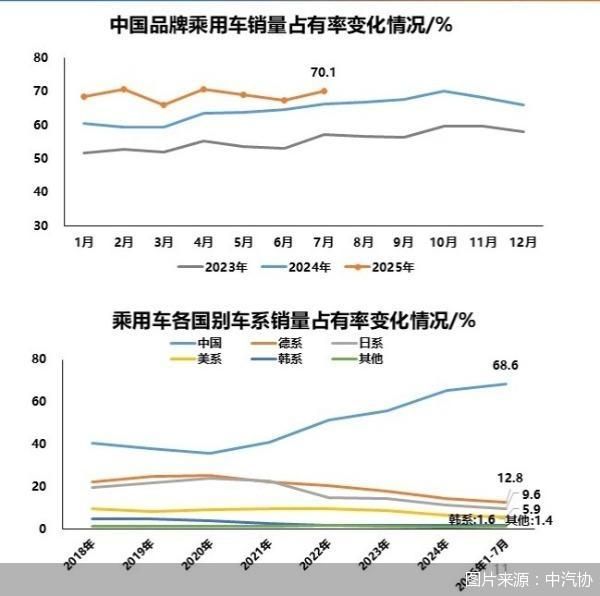
Group 1 - In July 2023, China's automotive production and sales reached 2.591 million and 2.593 million units respectively, showing a month-on-month decline of 7.3% and 10.7%, but a year-on-year increase of 13.3% and 14.7% [2] - The decline in July is attributed to the traditional off-season for the automotive market and some manufacturers conducting annual equipment maintenance, leading to a seasonal slowdown in production and sales [2] - The "trade-in" policy continues to show positive effects, and the comprehensive rectification of the industry is making progress, with new models being continuously launched by companies, contributing to stable market operations [2] Group 2 - In July 2023, the production and sales of passenger vehicles were 2.293 million and 2.287 million units, respectively, with year-on-year growth of 13% and 14.7% [3] - Chinese brands are becoming a significant support for passenger vehicle sales, with sales of Chinese brand passenger vehicles reaching 1.604 million units in July, a year-on-year increase of 21.3%, and a market share of 70.1%, up 3.8 percentage points year-on-year [3] - The market share of Chinese brand sedans, SUVs, and MPVs in July was 64.9%, 73.7%, and 68% respectively, indicating growth in all categories [3] Group 3 - In the first seven months of 2023, the domestic sales of new energy vehicles reached 6.913 million units, a year-on-year increase of 32.3%, with new energy passenger vehicles accounting for 6.499 million units, up 30.9% [4] - The top fifteen groups in new energy vehicle sales accounted for 95.1% of total sales, with BYD and Geely being the top two, together holding over 42% of the market share [4] - The competition among Chinese brands is intensifying, with Leap Motor surpassing Li Auto to become the sales champion in the first half of the year, and new entrants like AITO and Xpeng also showing strong sales performance [5] Group 4 - In July 2023, exports of Chinese vehicles reached 575,000 units, a year-on-year increase of 22.6%, with Chery and BYD leading the export growth [5] - Chery exported 119,000 units, a year-on-year increase of 31.9%, while BYD's exports reached 81,000 units, a significant increase of 160% [5] - Chinese brands are actively expanding into overseas markets, with several companies establishing overseas R&D and production bases [5]


前7个月我国汽车产销量均超1800万辆!新能源汽车渗透率升至45%, 中汽协:以旧换新政策效果持续显现
Mei Ri Jing Ji Xin Wen· 2025-08-11 10:33
每经记者|李星 每经实习编辑|余婷婷 8月11日,中国汽车工业协会(以下简称"中汽协")公布的最新数据显示,1至7月,全国汽车产销累计 完成1823.5万辆和1826.9万辆,同比分别增长12.7%和12%。其中,7月,全国汽车产销分别完成259.1万 辆和259.3万辆,环比分别下降7.3%和10.7%,同比分别增长13.3%和14.7%。 对于7月全国车市产销出现环比双下滑的原因,中国汽车工业协会副秘书长陈士华解释称,7月,车市进 入传统淡季,部分厂家安排年度设备检修,产销节奏有所放缓,环比呈现季节性回落。"从行业市场环 境看,以旧换新政策效果继续显现,行业综合整治'内卷'工作取得积极进展,企业新车型持续投放,助 力车市平稳运行,同比实现增长。"陈士华称。 中国汽车工业协会专务副秘书长许海东表示,今年前7个月,我国汽车市场保持12%的增长,说明整个 汽车行业在拉动内需、促进消费方面发挥了非常重要的作用。 中国品牌乘用车7月市占率达70.1% 1至7月,商用车产销分别完成239.7万辆和242.8万辆,同比分别增长6%和3.9%。其中,天然气商用车销 量为13.4万辆,同比下降9.6%。其中,货车产销分别完 ...
中汽协:7月新能源汽车产销延续快速增长态势
Zhong Guo Xin Wen Wang· 2025-08-11 09:49
Group 1 - In July, China's new energy vehicle (NEV) production and sales grew by 26.3% and 27.4% year-on-year, continuing a rapid growth trend [1][2] - The overall automotive market in China experienced a seasonal decline in production and sales due to the traditional off-peak season, with month-on-month decreases of 7.3% and 10.7% respectively [1] - From January to July, total automotive production and sales reached 18.235 million and 18.269 million units, reflecting year-on-year growth of 12.7% and 12%, with an increase in growth rates compared to the first half of the year [1] Group 2 - In July, NEV production and sales reached 1.243 million and 1.262 million units, accounting for 48.7% of total new vehicle sales [2] - For the first seven months, NEV production and sales totaled 8.232 million and 8.22 million units, with year-on-year growth of 39.2% and 38.5% [2] - In July, China exported 575,000 vehicles, with a year-on-year increase of 22.6%, while NEV exports reached 225,000 units, marking a 10% month-on-month increase and a 120% year-on-year increase [2]
家电行业周报(25年第30周):7月家电零售需求淡季不淡,出口降幅收窄至3%-20250811
Guoxin Securities· 2025-08-11 09:43
Investment Rating - The report maintains an "Outperform" rating for the home appliance industry [6][4]. Core Viewpoints - Retail demand in July for home appliances remains strong despite the seasonal downturn, with air conditioning retail sales growing over 30% [1][18]. - The decline in home appliance exports has narrowed to 3% in July, with expectations for a return to stable growth as tariff policies ease [2][29]. - The U.S. housing market shows resilience, with expectations for recovery following anticipated interest rate cuts by the Federal Reserve in 2024, which could positively impact home appliance demand [3][34]. Summary by Sections 1. Key Recommendations - Recommended companies include Midea Group, Gree Electric Appliances, Haier Smart Home, TCL Smart, and Hisense Home Appliances for white goods; Boss Electric for kitchen appliances; and Bear Electric, Roborock, and Ecovacs for small appliances [4][12][13]. 2. Retail and Export Performance - July retail performance shows strong growth in air conditioners (+39.4% online, +36.5% offline), washing machines (+21.6% online, +15.7% offline), and significant growth in small kitchen appliances like rice cookers (+17.6% online, +12.0% offline) [1][18]. - Home appliance exports in July reached 59.55 billion yuan, a 3% year-on-year decline, with a slight increase in export prices [2][29]. 3. Market Data Tracking - The home appliance sector achieved a relative return of +1.14% this week, outperforming the broader market [42]. - Raw material prices for copper and aluminum increased by 1.1% and 2.5% respectively, while cold-rolled steel prices rose by 0.8% [45][56]. - Shipping indices for routes to the U.S. and Europe showed a decline, indicating potential cost pressures in logistics [57]. 4. Company Earnings Forecasts - Earnings per share (EPS) estimates for key companies include Midea Group at 5.62 yuan for 2025, Gree Electric at 6.34 yuan, and Haier Smart Home at 2.26 yuan [5][67].





7月车市进入传统淡季,无碍新能源汽车销量增27.4%
Zheng Quan Shi Bao Wang· 2025-08-11 09:28
Core Viewpoint - The automotive market in China maintained a stable operation in July, supported by policies such as the trade-in program and the initial progress in addressing "involution" competition [1] Group 1: Market Performance - In July, automotive production and sales reached 2.591 million and 2.593 million units, respectively, with month-on-month declines of 7.3% and 10.7%, but year-on-year increases of 13.3% and 14.7% [1] - From January to July, automotive production and sales totaled 18.235 million and 18.269 million units, reflecting year-on-year growth of 12.7% and 12% [1] - The growth rates for production and sales in the first seven months expanded by 0.2 and 0.6 percentage points compared to the first half of the year [1] Group 2: New Energy Vehicles (NEVs) - In July, NEV production and sales reached 1.243 million and 1.262 million units, with year-on-year growth of 26.3% and 27.4%, accounting for 48.7% of total new car sales [1] - Sales of pure electric vehicles in July were 811,000 units, up 47.1% year-on-year, while plug-in hybrid vehicle sales were 451,000 units, a 2.8% increase [2] - NEV exports were notable, with 225,000 units exported in July, a month-on-month increase of 10% and a year-on-year increase of 120% [2] Group 3: Export Dynamics - NEVs have become the main driver of automotive export growth, with traditional fuel vehicle exports declining [3] - In July, traditional fuel vehicle exports were 350,000 units, down 9.6% month-on-month and 4.3% year-on-year [3] - From January to July, traditional fuel vehicle exports totaled 2.373 million units, a year-on-year decrease of 7% [3] Group 4: Brand Performance - In July, Chinese brand passenger car sales reached 1.604 million units, a year-on-year increase of 21.3%, with a market share of 70.1%, up 3.8 percentage points from the previous year [4] - Chery and BYD were among the top exporters, with Chery exporting 119,000 units (up 31.9%) and BYD exporting 81,000 units (up 160%) in July [4] Group 5: Future Outlook - The automotive industry is expected to maintain a stable operation in the coming months, supported by government policies such as the third batch of long-term special bonds for trade-in programs [5] - The government plans to ensure that funds are used effectively to boost consumer confidence and stimulate automotive consumption through the end of the year [5]
核心CPI持续回升 扩内需促消费政策显效
Jin Rong Shi Bao· 2025-08-11 01:00
Group 1: CPI Analysis - In July, the Consumer Price Index (CPI) increased by 0.4% month-on-month, reversing a previous decline of 0.1% in June, indicating a stable overall price level in the domestic market [1][2] - The core CPI, excluding food and energy, rose by 0.8% year-on-year, marking the highest increase since March 2024, driven by rising prices in gold and platinum jewelry, as well as seasonal service price increases [3][5] - Service prices increased by 0.6% month-on-month, contributing approximately 0.26 percentage points to the CPI increase, with significant rises in travel-related costs due to the summer vacation season [2][3] Group 2: PPI Analysis - The Producer Price Index (PPI) decreased by 0.2% month-on-month, but the decline was less than the previous month by 0.2 percentage points, marking the first narrowing of the month-on-month decline since March [4][5] - The PPI year-on-year fell by 3.6%, consistent with the previous month, reflecting ongoing adjustments in traditional industries and the growth of emerging sectors [5][6] - Improvements in market competition and the implementation of policies to curb disorderly price competition have contributed to a narrowing of price declines in industries such as coal, steel, and solar energy [4][5] Group 3: Consumer Demand and Market Trends - The expansion of domestic demand policies has led to positive changes in consumer prices, with an increase in demand for upgraded consumer goods driving price rises in specific sectors [6] - The prices of certain consumer goods, such as art and ceremonial products, sports balls, and nutritional foods, have seen year-on-year increases of 13.1%, 5.3%, and 1.3%, respectively, indicating a shift towards higher-value consumption [6] - The ongoing construction of large infrastructure projects is expected to support a gradual stabilization of industrial product prices, with the PPI potentially entering a mild recovery phase [6]

宏观经济观察系列(六):从926到730政治局会议,行业景气有何变化?
Western Securities· 2025-08-10 11:11
Group 1: Policy Impact on Consumption - The "old-for-new" policy has seen a subsidy scale double to 300 billion yuan, with 162 billion yuan allocated in the first half of the year[10] - Retail sales in China grew by 5% year-on-year in the first half of the year, but the monthly growth rate fell from 6.4% in May to 4.8% in June, indicating a slowdown[11] - The consumption multiplier effect of the "old-for-new" policy for home appliances and automobiles decreased from 2.29/2.68 times in Q4 2024 to 1.96/2.11 times in the first half of 2025[15] Group 2: Sector Performance - The service consumption sector is expected to take over from goods consumption as the main driver of growth, supported by policy shifts towards service consumption[2] - The automotive sector saw a significant increase in sales, with over 290 million vehicles scrapped and 370 million replaced in 2024, generating over 920 billion yuan in sales[30] - The consumer electronics sector experienced a decline in retail growth, with the retail growth rate for communication equipment dropping from 33% to 13.9% in June 2025[35] Group 3: Economic Indicators - The macroeconomic environment shows a recovery in upstream industrial prices, while downstream demand continues to decline, particularly in logistics[54] - The real estate sector remains under pressure, with a year-on-year decline in new housing sales area narrowing to -6.6% in June 2025, compared to -13.8% in the previous year[42] - The government plans to issue 4.4 trillion yuan in special bonds for infrastructure projects in 2025, an increase of 500 billion yuan from the previous year[36]

分析|扩内需政策效应持续显现,7月核心CPI同比涨幅回升至0.8%
Sou Hu Cai Jing· 2025-08-09 09:57
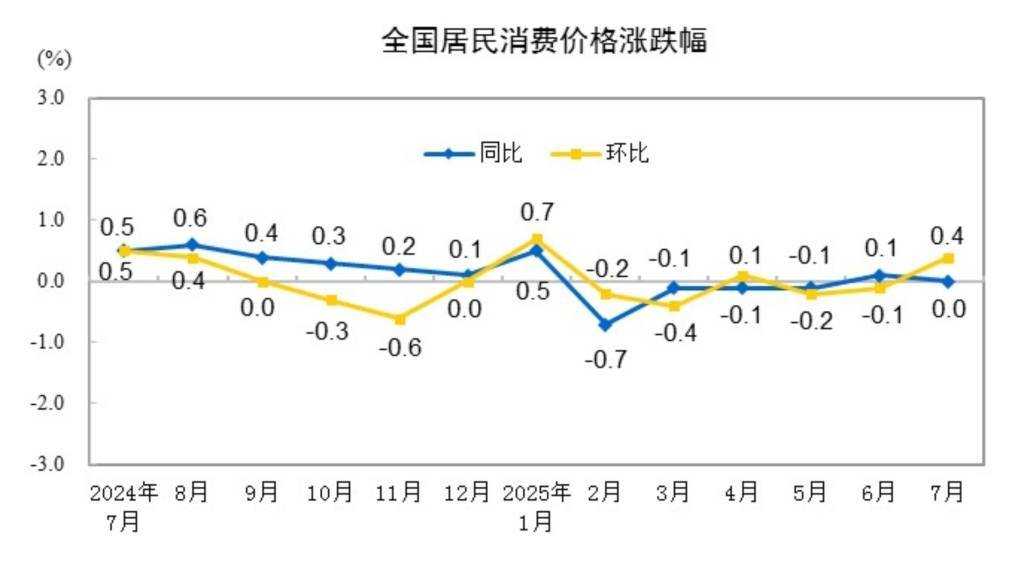
Group 1: Consumer Price Index (CPI) Insights - In July, the national Consumer Price Index (CPI) remained flat year-on-year and increased by 0.4% month-on-month, with an average decline of 0.1% from January to July compared to the previous year [1] - The decline in food prices significantly impacted the CPI, with food prices dropping by 1.6% year-on-year, contributing approximately 0.29 percentage points to the CPI's year-on-year decline [5][6] - The core CPI, excluding food and energy prices, rose by 0.8% year-on-year, marking the highest level since March 2024, indicating a gradual improvement in market supply and demand relationships [6][10] Group 2: Producer Price Index (PPI) Insights - In July, the Producer Price Index (PPI) decreased by 0.2% month-on-month, with the decline narrowing for the first time since March, while the year-on-year decline remained at 3.6% [8][9] - The PPI's year-on-year decline has ended a four-month trend of increasing declines, with some industries showing price recovery due to improved supply-demand relationships [9][12] - The "anti-involution" policy is expected to support a rebound in industrial product prices, particularly in August, although overall PPI month-on-month growth is anticipated to be around 0.0% [12][13] Group 3: Economic Policies and Market Trends - The ongoing effects of demand expansion policies are leading to positive changes in consumer prices, with service prices rising by 0.6% month-on-month, contributing significantly to the CPI increase [6][10] - The "anti-involution" policy is projected to reshape industry supply-demand structures, particularly in overcapacity sectors, potentially leading to a more reasonable price recovery [13] - The overall economic environment remains uncertain, with external trade conditions and domestic demand pressures influencing price trends [11][12]
受食品价格较低影响,7月CPI同比持平
Sou Hu Cai Jing· 2025-08-09 02:10
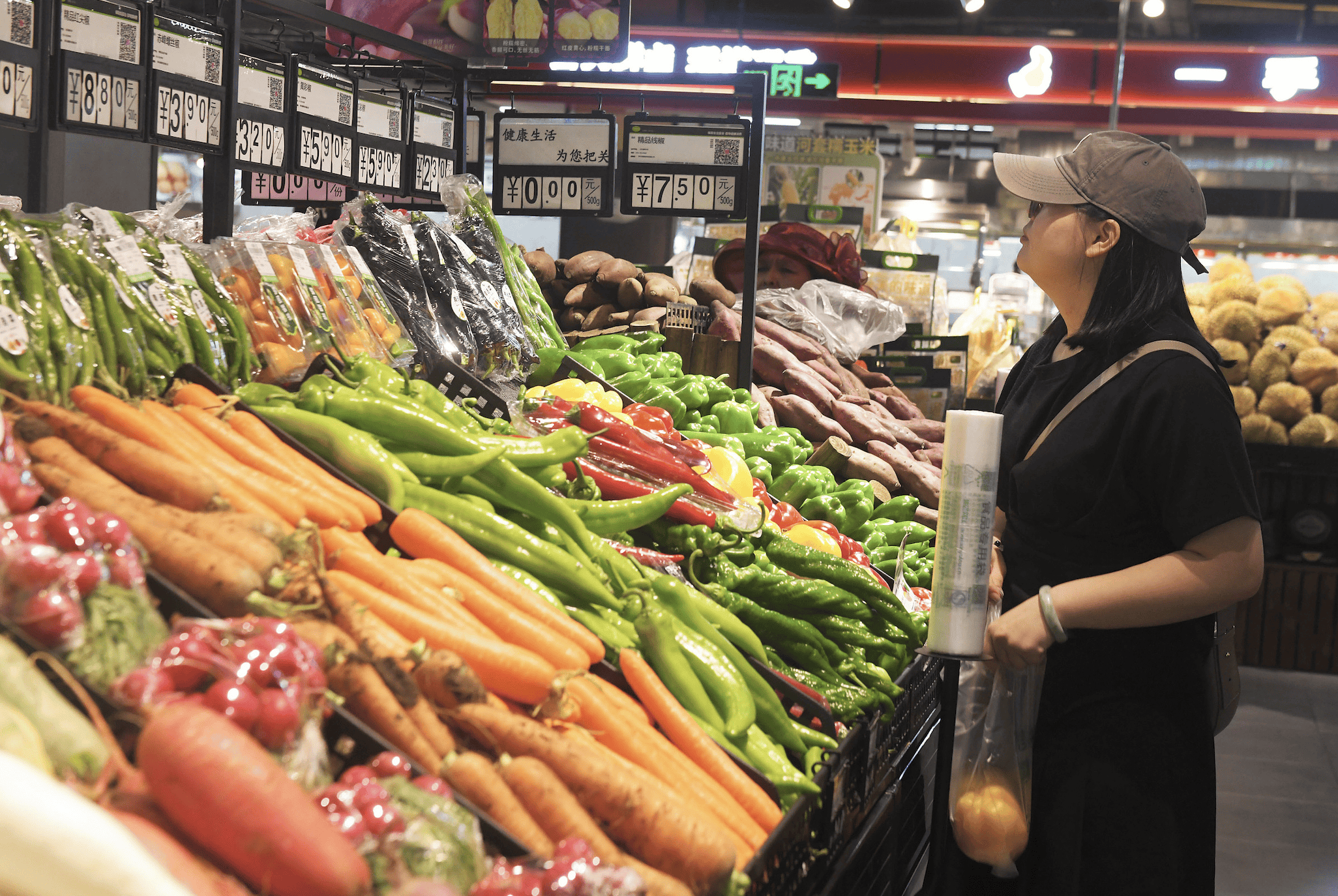
Group 1 - In July, China's Consumer Price Index (CPI) remained flat year-on-year, while the Producer Price Index (PPI) decreased by 3.6%, with the decline rate unchanged from June [1][5] - The decline in food prices, particularly pork and fresh vegetables, significantly impacted the CPI, with pork prices down 8.5% and fresh vegetable prices down 7.6% year-on-year [2][5] - Core CPI increased by 0.8% year-on-year, showing a slight acceleration compared to the previous month [4] Group 2 - The prices of production materials decreased by 4.3% year-on-year, while the decline in living materials prices widened from 1.4% to 1.6% [5] - Some industries are experiencing price increases due to macroeconomic policies and improved supply-demand relationships, with notable increases in prices for alkali (up 3.6%) and aircraft manufacturing (up 3.0%) [6] - The "anti-involution" policy is expected to support domestic prices, particularly in the automotive sector, while overall industrial consumer prices remain subdued due to weak consumer confidence [2][6]
如果美联储降息,将如何影响全球资本市场? | 一财号每周思想荟(第30期)
Sou Hu Cai Jing· 2025-08-08 08:52
Group 1 - The introduction of free preschool education policy is expected to trigger a structural adjustment in the education industry supply [1][2] - Public kindergartens are expanding, with cities like Beijing and Shenzhen initiating reforms to link fees to services, while the government ensures financial support for public kindergarten teachers [1] - Private kindergartens are facing pressure to transform, with high-end institutions needing to de-capitalize and affordable private kindergartens encouraged to specialize and differentiate [1] Group 2 - The free preschool education policy aims to lower family childcare costs and fundamentally reshape the human capital accumulation mechanism [2] Group 3 - The potential impact of the Federal Reserve's interest rate cuts on global capital markets hinges on upcoming U.S. economic data [4] - A scenario where the U.S. labor market deteriorates while inflation remains high could lead to significant market corrections, particularly affecting U.S. assets, while benefiting markets like Hong Kong and A-shares [4] - If the U.S. employment data remains stable, a 25 basis point rate cut in September is likely, which would improve global liquidity and support a mild uptrend in U.S. stocks [4] Group 4 - The U.S. monetary policy decisions will profoundly influence global asset pricing, with potential declines in the U.S. dollar index if interest rates are cut significantly [5] - The persistence of inflation remains a critical variable, as rising energy prices could further elevate inflation levels [5] Group 5 - The end of negative interest rate policies by the European Central Bank may lead to a narrowing interest rate differential between the Eurozone and the U.S., prompting international investors to reduce their holdings in U.S. assets [7] Group 6 - The global trade landscape is shifting from a focus on efficiency and cost to a more complex process of trust reconstruction, indicating a new era of trade dynamics [8] - The current global trade environment emphasizes relationships and political ties over mere pricing, suggesting a need for a balance between trust and efficiency [8]