反内卷政策

Search documents
产需两端均有改善 11月制造业PMI回升
Di Yi Cai Jing· 2025-11-30 13:56
Group 1: Manufacturing Sector Overview - The manufacturing PMI for November is reported at 49.2%, an increase of 0.2 percentage points from October, but it has remained below the critical line for eight consecutive months [1] - The production index and new orders index for November are 50.0% and 49.2%, respectively, indicating improvements in both production and demand [4] - High-tech manufacturing PMI stands at 50.1%, remaining above the critical point for ten months, suggesting continued growth in this sector [4] Group 2: Economic Indicators and Market Sentiment - The production expectations index for November is 53.1%, reflecting increased confidence among manufacturing enterprises regarding market development [5] - The new export orders index has risen to 47.6%, up 1.7 percentage points from October, indicating a stabilization in manufacturing exports [5] - The overall manufacturing market demand is showing signs of recovery, with the new orders index increasing by 0.4 percentage points from October [5] Group 3: Price Trends and Inventory Levels - The purchasing price index for raw materials is at 53.6%, up 1.1 percentage points from October, indicating rising input costs [7] - The finished goods inventory index is at 47.3%, down 0.8 percentage points from October, suggesting smoother sales activities for enterprises [6] Group 4: Service Sector Performance - The non-manufacturing business activity index is reported at 49.5%, a decrease of 0.6 percentage points from October, indicating a slowdown in service sector activities [9] - The financial services sector shows strong performance, with business activity and new orders indices both exceeding 55%, indicating robust growth [13] - The construction industry business activity index has improved to 49.6%, up 0.5 percentage points from October, signaling a recovery in construction activities [14]

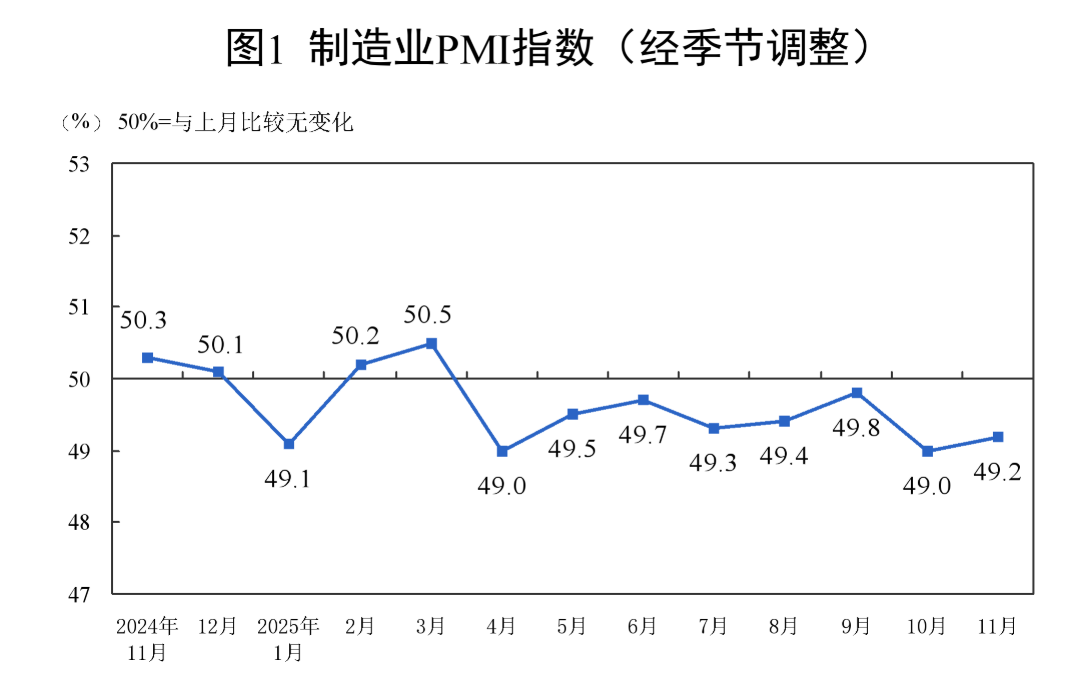
产需两端均有改善,11月制造业PMI回升
Di Yi Cai Jing· 2025-11-30 13:40
Manufacturing Sector - The manufacturing PMI for November is reported at 49.2%, showing a slight increase of 0.2 percentage points from October, but remains below the growth threshold for eight consecutive months [1][4] - The production index and new orders index for November are 50.0% and 49.2%, respectively, indicating improvements in both production and demand, with the production index returning to the critical point [4][5] - High-tech manufacturing PMI stands at 50.1%, remaining above the critical point for ten consecutive months, indicating continued growth in this sector [1][4] Economic Outlook - Analysts suggest that the slight recovery in the manufacturing PMI reflects improved market confidence, driven by the "14th Five-Year Plan" and recent positive outcomes from US-China trade talks [4][5] - Despite the improvements, there are still significant downward pressures on the economy, particularly due to external uncertainties and ongoing adjustments in the real estate market [6][8] - The production activity expectation index for November is 53.1%, indicating increased confidence among manufacturing enterprises regarding market development [5] Export and Demand - The new export orders index for November is 47.6%, up 1.7 percentage points from October, suggesting a stabilization in manufacturing exports [5] - All major manufacturing sectors, including high-tech and consumer goods, have seen increases in new export orders, with high-tech manufacturing new export orders rising over 3 percentage points [5][6] Price Trends - The purchasing price index for raw materials is at 53.6%, up 1.1 percentage points from October, indicating rising costs for manufacturers [7][8] - The factory price index is at 48.2%, showing a slight recovery but still in the contraction zone, suggesting that price increases are primarily affecting upstream sectors [7][8] Service Sector - The non-manufacturing business activity index for November is 49.5%, down 0.6 percentage points from October, reflecting a seasonal decline in consumer-related services [9][12] - The financial services sector shows strong performance, with business activity and new orders indices both exceeding 55%, indicating robust growth in this area [12][13] - The construction sector's business activity index has improved to 49.6%, signaling a recovery in construction activities, supported by recent policy measures [13][14]
全球金融巨头,把脉2026
Zhong Guo Ji Jin Bao· 2025-11-30 06:23
Group 1: Outlook on Chinese Stock Market - Multiple multinational giants express optimism about the Chinese stock market, particularly in the technology sector and AI development, highlighting a potential for significant growth in 2026 [3][4] - UBS forecasts strong profit growth in 2026 will drive Chinese tech stocks higher, viewing them as a high-certainty investment theme globally [3] - Goldman Sachs notes that the valuation levels of the Chinese stock market are attractive compared to other global markets, with potential for capital inflow due to increased retail participation and abundant liquidity [4] Group 2: Investment Themes and Predictions - JPMorgan identifies four key investment themes for 2026: implementation of "anti-involution" policies, growth in domestic and international AI infrastructure, favorable macroeconomic conditions for developed markets, and a K-shaped consumption recovery [4] - JPMorgan sets a target for the CSI 300 index at 5200 points by the end of 2026, corresponding to a price-to-earnings ratio of 15.9 times, based on an expected earnings per share of 328 yuan, reflecting a 15% year-on-year growth [4] Group 3: Outlook on US Stock Market - Financial giants are generally optimistic about the US stock market's performance in 2026, with expectations of continued growth driven by resilient consumer spending and significant investments in AI infrastructure [8][10] - Bank of America highlights six factors supporting the rise of US stocks, including robust consumer spending, substantial capital investments in AI, and anticipated further interest rate cuts by the Federal Reserve [8][9] Group 4: AI Development and Investment Opportunities - The rapid growth of AI investments raises questions about the sustainability of capital expenditures, but also presents new investment opportunities across the AI value chain [12][13] - Fidelity International emphasizes the importance of focusing on core segments of the AI value chain, including large-scale cloud service providers and chip manufacturers, while also identifying undervalued companies poised for growth [13][14] Group 5: Risks and Market Dynamics - Goldman Sachs warns of potential risks related to tariff-related rhetoric and regulatory shocks that could disrupt the current market momentum [6] - The ongoing competition in AI investments among major companies is expected to drive significant global spending, with a focus on maintaining competitive advantages through proprietary technology [15]
有色60ETF(159881)涨超1.4%,工业金属或迎长期定价重塑
Mei Ri Jing Ji Xin Wen· 2025-11-28 11:37
Group 1 - The core viewpoint is that the non-ferrous metals industry is expected to outperform in 2025, driven by weakening US dollar credit and the AI technology revolution [1] - Non-ferrous metals are anticipated to become the "oil" of a new round of industrial chain transformation, widely used in semiconductors, AI computing infrastructure, and new energy systems [1] - Significant price increases for industrial metals like COMEX copper and LME tin are expected in 2025, although the supply-demand gap is not apparent, indicating financial pricing attributes for future supply-demand relationships [1] Group 2 - By 2026, as global narratives may converge, non-ferrous metals will shift from long-term pricing to a combination of short and long-term pricing, with real demand pricing power increasing [1] - Structural support may arise from "anti-involution" policies and export demand driven by industrialization in southern countries [1] - The Non-Ferrous 60 ETF (159881) tracks the CSI Non-Ferrous Index (930708), which selects representative stocks from the non-ferrous metals industry, covering sectors like copper, aluminum, lithium, and rare earths [1]

科技估值低+“反内卷”持续落地,外资行继续看涨中国股市!
Hua Er Jie Jian Wen· 2025-11-28 10:36
Core Viewpoint - Major foreign banks, including UBS, JPMorgan, and Morgan Stanley, express confidence in the Chinese stock market for 2026, driven by various factors such as "anti-involution" policies, AI development, global macroeconomic improvements, and differentiated consumer recovery [1][2]. Group 1: JPMorgan's Outlook - JPMorgan projects a target of 5200 points for the CSI 300 index by the end of 2026, indicating a potential upside of approximately 17% based on a price-to-earnings ratio of 15.9 times [2]. - In bullish scenarios, the index could reach 6010 points, while in bearish scenarios, it may drop to 4000 points [2]. Group 2: UBS's Insights - UBS anticipates that the A-share market will reach new heights in 2026, with overall profit growth expected to rise from 6% in 2025 to 8% [1][3]. - The firm highlights the relative attractiveness of A-shares, noting that the equity risk premium is significantly higher than historical averages, making it appealing compared to other markets [3]. Group 3: Morgan Stanley's Perspective - Morgan Stanley views 2026 as a "stable year" following high returns in 2025, with limited upside for indices and moderate growth in corporate earnings [5]. - The firm expects a return to higher valuation norms as China stabilizes its position in global tech competition and trade tensions ease [5]. Group 4: Key Investment Themes - The report identifies four core investment themes for 2026, including the execution of "anti-involution" policies, which are expected to enhance industry competition and improve profit margins for CSI 300 constituents [4]. - The growth of global AI infrastructure capital expenditures is projected to benefit Chinese suppliers, particularly as domestic AI commercialization progresses [4]. - A favorable global macro environment is anticipated, with looser fiscal and monetary policies in developed markets supporting Chinese companies, especially those with high export ratios [4]. - A K-shaped recovery in consumer spending is expected, benefiting both low-end and luxury sectors, presenting investment opportunities [4]. Group 5: Capital Flow Trends - UBS notes a structural shift in the capital landscape, with residents reallocating savings from real estate and low bank deposit rates towards the A-share market [6]. - Long-term capital inflows are increasing, with insurance funds' equity and fund holdings rising by 1.5 trillion yuan by the end of Q3 2025 [6]. - Initiatives aimed at enhancing the quality and investment value of listed companies, such as increased cash dividends and stock buybacks, are making A-shares more attractive to long-term investors [6].


有色金属行业双周报(2025、11、14-2025、11、27):美联储降息预期反复,金属价格持续震荡-20251128
Dongguan Securities· 2025-11-28 08:21
Investment Rating - The report maintains a "Market Weight" rating for the non-ferrous metals industry, indicating that the industry index is expected to perform within ±10% of the market index over the next six months [63]. Core Insights - The non-ferrous metals industry has experienced a decline of 6.87% over the past two weeks, underperforming the CSI 300 index by 2.90 percentage points, ranking 28th among 31 industries [3][13]. - The report highlights that the Federal Reserve's fluctuating interest rate expectations have led to continued volatility in metal prices, particularly in industrial metals, which are expected to maintain upward momentum due to improving supply-demand dynamics [6][56]. - Precious metals have shown resilience, with gold prices rising significantly, supported by a declining dollar credit, while lithium prices are recovering due to tightening supply conditions and new growth opportunities in energy storage [57][58]. Market Review - As of November 27, 2025, the LME copper price was $10,930/ton, aluminum at $2,831.50/ton, lead at $1,983.50/ton, zinc at $3,022/ton, nickel at $14,840/ton, and tin at $37,925/ton [24]. - The COMEX gold price reached $4,189.60/oz, up $175.9 since early November, while silver was at $53.83/oz, up $5.92 [33][57]. - Lithium carbonate futures were priced at ¥95,800/ton, reflecting a recovery of ¥13,500 since early November, and cobalt prices increased to ¥401,300/ton [37][58]. Industry Analysis by Subsector Industrial Metals - The report notes that the supply-demand balance for copper and aluminum continues to improve, with prices expected to have upward momentum due to macroeconomic easing [6][56]. Precious Metals - The report indicates that despite short-term risks, the long-term outlook for gold remains positive, with prices expected to continue rising due to a weakening dollar [57][58]. Energy Metals - The report emphasizes the upward trend in lithium prices driven by tightening supply and new growth opportunities in energy storage and solid-state batteries [58]. Minor Metals - The rare earth price index was reported at 207.92, with some prices like praseodymium-neodymium oxide increasing, while others like dysprosium and terbium saw declines [41][58]. Company Recommendations - The report suggests focusing on companies such as Western Mining (601168) and Luoyang Molybdenum (603993) in the industrial metals sector, and Ganfeng Lithium (002460) and Tianqi Lithium (002466) in the energy metals sector due to their strong performance and growth potential [6][59].
新能源及有色金属日报:供需双弱,工业硅多晶硅基本面变化不大-20251128
Hua Tai Qi Huo· 2025-11-28 05:28
Report Industry Investment Rating No relevant content provided. Core Viewpoints of the Report - The fundamentals of industrial silicon and polysilicon have not changed significantly, with both supply and demand being weak. For industrial silicon, after production cuts in the southwest, the supply - demand pattern may improve, and the valuation is currently low. If there are relevant policies, the market may rise. For polysilicon, both supply and demand have weakened, with large inventory pressure and average consumer - end performance, and the market is expected to fluctuate mainly [1][3][7]. Summary by Related Catalogs Industrial Silicon Market Analysis - On November 27, 2025, the industrial silicon futures price showed a strong - side fluctuating trend. The main contract 2601 opened at 9000 yuan/ton and closed at 9115 yuan/ton, a change of 120 yuan/ton (1.33%) from the previous day's settlement. The open interest of the 2511 main contract was 237,648 lots, and the total number of warehouse receipts was 39,555 lots, a change of - 870 lots from the previous day [1]. - The spot price of industrial silicon remained stable. The price of East China oxygen - passing 553 silicon was 9500 - 9600 (50) yuan/ton; 421 silicon was 9700 - 9900 (50) yuan/ton. The price of Xinjiang oxygen - passing 553 silicon was 8800 - 9000 (0) yuan/ton, and the price of 99 silicon was 8800 - 9000 (0) yuan/ton. The silicon prices in Kunming, Huangpu Port, the Northwest, Tianjin, Xinjiang, Sichuan, and Shanghai remained flat, and the price of 97 silicon was stable [1]. - As of November 27, the total social inventory of industrial silicon in major regions was 550,000 tons, an increase of 2000 tons from the previous week. Among them, the inventory in ordinary social warehouses was 129,000 tons, unchanged from the previous week, and the inventory in social delivery warehouses was 421,000 tons (including unregistered warehouse receipts and spot inventory), an increase of 2000 tons from the previous week [1]. Consumption End - The quoted price of organic silicon DMC was 13,100 - 13,300 (0) yuan/ton. This week, the domestic organic silicon DMC market price continued to move slightly upward. The current quoted price range was 13,100 - 13,300 yuan/ton, an increase of about 100 yuan/ton from the average price of the previous week. The DMC quoted price of Shandong monomer enterprises was 13,100 yuan/ton, an increase of 100 yuan/ton from the previous week, and the DMC quoted prices of other domestic monomer enterprises were concentrated at 13,200 - 13,300 yuan/ton, with individual enterprises also increasing their quotes by 100 yuan/ton [2]. Strategy - The spot price remains stable. After production cuts in the southwest, the supply - demand pattern may improve. The industrial silicon market is currently affected by overall commodity sentiment and policy - end news. Attention should be paid to whether there are relevant capacity - exit policies. Currently, the valuation of industrial silicon is low, and if there is policy promotion, the market may have room to rise. - Unilateral: Short - term range operation, and long positions can be taken on dips for contracts during the dry season. - Inter - period: None. - Inter - variety: None. - Futures - cash: None. - Options: None [3]. Polysilicon Market Analysis - On November 27, 2025, the main contract 2601 of polysilicon futures fluctuated widely, opening at 56,195 yuan/ton and closing at 55,235 yuan/ton, a change of - 0.91% from the previous trading day. The open interest of the main contract reached 141,586 (143,043 in the previous trading day) lots, and the trading volume on that day was 324,070 lots [4]. - The spot price of polysilicon weakened slightly. The price of N - type material was 49.70 - 54.90 (0.05) yuan/kg, and the price of n - type granular silicon was 50.00 - 51.00 (0.00) yuan/kg. The inventory of polysilicon manufacturers and silicon wafers increased. The latest statistics showed that the polysilicon inventory was 28.10 (a 3.69% change from the previous period), the silicon wafer inventory was 19.50GW (a 4.17% change from the previous period), the weekly polysilicon output was 24,000.00 tons (a - 11.40% change from the previous period), and the silicon wafer output was 12.02GW (a - 5.95% change from the previous period) [4][5]. - In terms of silicon wafers, the price of domestic N - type 18Xmm silicon wafers was 1.18 (- 0.03) yuan/piece, the price of N - type 210mm silicon wafers was 1.53 (- 0.03) yuan/piece, and the price of N - type 210R silicon wafers was 1.23 (- 0.03) yuan/piece. The polysilicon output in October was expected to be about 133,500 tons, an increase from September, exceeding market expectations. In November, there will be significant production cuts in the southwest region, and the output is expected to decline [5]. - In terms of battery cells, the price of high - efficiency PERC182 battery cells was 0.27 (0.00) yuan/W; the price of PERC210 battery cells was about 0.28 (0.00) yuan/W; the price of TopconM10 battery cells was about 0.29 (0.00) yuan/W; the price of Topcon G12 battery cells was 0.29 (0.00) yuan/W; the price of Topcon210RN battery cells was 0.27 (0.00) yuan/W; and the price of HJT210 half - piece battery cells was 0.37 (0.00) yuan/W [5]. - In terms of components, the mainstream transaction price of PERC182mm was 0.67 - 0.74 (0.00) yuan/W, the mainstream transaction price of PERC210mm was 0.69 - 0.73 (0.00) yuan/W, the mainstream transaction price of N - type 182mm was 0.66 - 0.68 (0.00) yuan/W, and the mainstream transaction price of N - type 210mm was 0.68 - 0.69 (0.00) yuan/W [6]. Strategy - Both supply and demand of polysilicon have weakened, with large overall inventory pressure and average consumer - end performance. In November, old warehouse receipts were cancelled, and few new warehouse receipts were registered, resulting in more delivery games for near - month contracts. Currently, the market is affected by anti - involution policies and weak reality, and the policies are still being promoted, with large market fluctuations. Participants need to pay attention to risk management. It is expected that the market will mainly fluctuate. - Unilateral: Short - term range operation, and the main contract is expected to fluctuate in the range of 50,000 - 57,000 yuan/ton. - Inter - period: None. - Inter - variety: None. - Futures - cash: None. - Options: None [7][8].
摩根大通:看好四大投资主题
Zheng Quan Ri Bao Wang· 2025-11-28 04:39
Core Viewpoint - Morgan Stanley maintains a constructive outlook on the CSI 300 Index for 2026, predicting a target level of 5200 points by the end of 2026, representing a potential upside of 17% from the closing price on November 24 [1] Investment Themes - The report highlights four major investment themes for 2026: the implementation of "anti-involution" policies, growth in domestic and international AI infrastructure, favorable macroeconomic conditions in developed markets benefiting overseas sales, and a recovery in the consumer market [1][2] Anti-Involution Policies - The execution of "anti-involution" policies is expected to accelerate, positively impacting the net profit margins and return on equity of CSI 300 constituents, with projected net profit margins and return on equity of 12% and 11% respectively for 2026, ranking in the middle of the Asia-Pacific market [1] AI Infrastructure Growth - Global capital expenditure on AI infrastructure is anticipated to grow in 2026, benefiting Chinese suppliers, with more Chinese stocks and AI monetization targets expected to gain [1] Macroeconomic Environment - The favorable macroeconomic environment, particularly the expected fiscal and monetary policy easing in 2026, will support overseas sales for listed companies [1] Consumer Market Recovery - The recovery of the Chinese consumer market is expected to benefit both low-end and luxury goods consumption [2] Market Style Shift - Morgan Stanley anticipates a shift in market style from value stocks to growth stocks by early 2026, based on metrics such as market capitalization, average daily trading volume, and overseas revenue [2]
1-10月全国规上工业企业利润同比增1.9%,企业利润稳增长
Bei Ke Cai Jing· 2025-11-28 03:27
Core Insights - The total profit of industrial enterprises above designated size in China reached 59,502.9 billion yuan from January to October, marking a year-on-year increase of 1.9%, with growth sustained for three consecutive months since August [1] Group 1: Profit Growth and Industry Performance - The operating income of industrial enterprises above designated size increased by 1.8% year-on-year, creating favorable conditions for profit recovery [2] - Profit growth is notably driven by the equipment manufacturing and high-tech manufacturing sectors, with equipment manufacturing profits rising by 7.8%, contributing 2.8 percentage points to the overall profit growth of industrial enterprises [3] - High-tech manufacturing profits grew by 8%, significantly outpacing the average profit growth of all industrial enterprises by 6.1 percentage points [4] Group 2: Enterprise Type Performance - State-owned enterprises' profits remained flat year-on-year, while joint-stock enterprises saw a profit increase of 1.5%, foreign and Hong Kong-Macau-Taiwan invested enterprises grew by 3.5%, and private enterprises experienced a profit growth of 1.9% [4] Group 3: Economic Indicators and Challenges - Industrial production activities remained active, with an industrial added value growth of 6.1% year-on-year, although the growth rate slightly declined by 0.1 percentage points compared to the previous three quarters [5] - The Producer Price Index (PPI) and the PPI for production materials both showed negative year-on-year growth, indicating ongoing pressure on industrial enterprise profits [5] - The accounts receivable for industrial enterprises stood at 27.69 trillion yuan, reflecting a year-on-year increase of 5.1%, while finished goods inventory rose by 3.7% to 6.82 trillion yuan, indicating challenges in sales collection and inventory reduction [5] Group 4: Future Outlook - The future profit trajectory for enterprises is expected to remain stable and positive, supported by demand and supply-side policies [6][8] - The recovery in industrial enterprise profits is attributed to export boosts and policy enhancements, although challenges remain due to slowing export growth and structural imbalances in supply and demand [7] - Analysts predict that the overall profit growth for industrial enterprises may continue to show positive growth for the year, with potential for the first annual profit increase in four years [9]
刚刚!中国股市突发重大利好!
天天基金网· 2025-11-28 01:06
Core Viewpoint - Morgan Stanley has upgraded the rating of Chinese stocks to "overweight," believing that the potential for significant returns in the Chinese stock market next year outweighs the risks of a sharp decline [2] Group 1: Market Outlook - The firm cites several supporting factors for this outlook, including the application of artificial intelligence technology, consumer stimulus policies, and corporate governance reforms, which are expected to drive the Chinese stock market higher next year [2] - The MSCI Asia (excluding Japan) index is projected to rise to 1025 points by 2026, indicating a potential upside of approximately 15% from the closing price on November 26 [2] - The target point for the CSI 300 index by the end of 2026 is set at 5200 points, representing a potential increase of 17% from the closing price on November 24 [2][4] Group 2: Investment Themes - Four major investment themes are highlighted for 2026: 1. The acceleration of "anti-involution" policies, which will benefit the net profit margin and return on equity of CSI 300 constituent stocks [4] 2. Growth in global AI infrastructure capital expenditure, which will favor Chinese suppliers and local AI-related stocks [5] 3. Recovery in the global macroeconomic environment, particularly due to fiscal and monetary policy easing in major overseas markets, supporting overseas sales for listed companies [5] 4. Recovery of the Chinese consumer market, benefiting both low-end and luxury goods consumption [5] Group 3: Stock Selection and Market Trends - Morgan Stanley has identified IT and healthcare A-share stocks that can capitalize on China's innovation opportunities, suggesting a potential shift in market style from value stocks to growth stocks by early 2026 [5] - The consensus forecast for the CSI 300 index's earnings per share in Q4 2025 may be revised downward, particularly in the technology and healthcare sectors, indicating potential downside risks [5]